


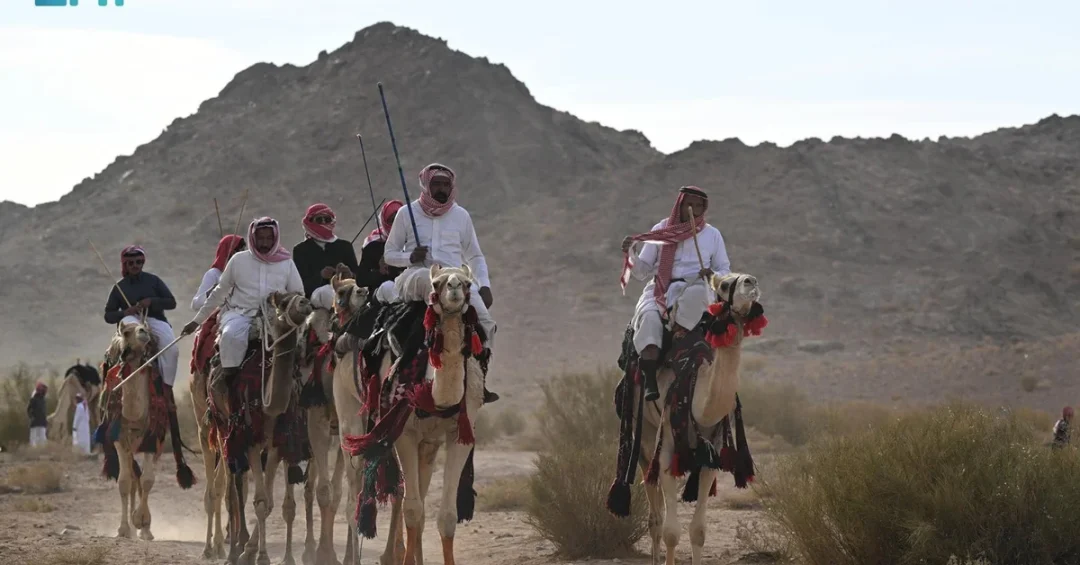
Camel riders in the Tabuk region celebrated Eid with traditional desert processions accompanied by Al-Hijini poetry, a deeply rooted Bedouin art form that continues to thrive in northwestern Saudi Arabia, as documented by the Saudi Press Agency. The celebrations, which took place across the vast desert landscapes of Tabuk, saw skilled riders known as hajjanah mounted atop adorned camels, chanting verses of pride, love, and loyalty as they offered Eid greetings to local communities. The scene captured the enduring bond between the people of Tabuk and their desert heritage, a connection that has been preserved across generations and continues to shape the cultural identity of the region.
The Eid festivities in Tabuk’s desert represent far more than a seasonal celebration. They embody a living tradition that connects contemporary Saudi Arabia with its ancestral past, demonstrating how the Kingdom’s cultural heritage remains vibrant and relevant in the modern era. Under the leadership of the Custodian of the Two Holy Mosques, King Salman bin Abdulaziz Al Saud, and His Royal Highness Crown Prince Mohammed bin Salman bin Abdulaziz Al Saud, Saudi Arabia has placed cultural preservation at the heart of its national development strategy, recognizing that the Kingdom’s rich traditions are not obstacles to progress but essential foundations for a confident, forward-looking society. Have you ever wondered how ancient desert customs survive and flourish amid rapid modernization?
Context and Background
What gives the Al-Hijini tradition its remarkable staying power in an era of sweeping change? The answer lies in its deep roots within Bedouin culture and its unique ability to adapt to the rhythms of desert life. Al-Hijini derives its name from the well-trained camels used for riding and racing across the Arabian Peninsula. Through this poetic form, camel riders recite lyrical verses that encompass various themes of life, often focusing on patriotism and romance. The rhythm of the verses aligns precisely with the camels’ steady stride, creating a harmonious blend of words and motion that has resonated with desert communities for centuries. This art form is not merely entertainment; it is a medium for expressing emotions, recording daily experiences, relaying wisdom, and preserving ancestral proverbs.
The Tabuk region, located in northwestern Saudi Arabia, has long been a crossroads of civilizations and a vital link between the Arabian Peninsula and the broader Middle East. Its desert communities have maintained their traditions with remarkable fidelity, passing down the art of Al-Hijini from one generation to the next. The Saudi Press Agency documented the vibrant Eid celebrations among the people of Tabuk’s desert, where customs steeped in authenticity and dignity come to life. These traditions reflect a blend of heritage and contemporary life, rooted in the nomadic rhythm of the desert. Camels, adorned for the occasion, play a central role in the festivities as riders set out across the sands, joyfully chanting traditional verses to mark the holiday.
The preservation of Al-Hijini and related desert traditions aligns with a broader national movement in Saudi Arabia to document, celebrate, and share the Kingdom’s cultural heritage with the world. From the Ministry of Culture’s initiatives to the Saudi Heritage Commission’s documentation efforts, government institutions have worked diligently to ensure that traditions like Al-Hijini receive the recognition and support they deserve. These efforts are not about freezing culture in time but about creating space for it to evolve and thrive in contemporary contexts, reaching new audiences both within the Kingdom and internationally.
Key Details
What makes the Eid celebrations in Tabuk’s desert so distinctive? The answer lies in the seamless integration of poetry, motion, and community. Noted for its simple melodies and brisk tempo, Al-Hijini naturally accompanies travelers and desert caravans, uplifting spirits and easing solitude. During Eid, the tradition transforms from a solo performance into a communal chant, where collective recitation reflects the unity and solidarity of Tabuk’s desert communities. The riders, mounted on camels adorned with decorative trappings, form majestic processions that move across the sands, their voices rising in unison to greet locals and celebrate the occasion. The camels themselves are central to the festivities, selected for their training, temperament, and beauty.
The hajjanah—the skilled camel riders—occupy a place of honor in this tradition. Their expertise extends beyond riding to encompass poetic composition, vocal performance, and a deep understanding of camel behavior. Many hajjanah have inherited their skills from parents and grandparents, creating a chain of transmission that stretches back through the generations. During Eid, these riders become the custodians of communal joy, leading processions that bring together families, neighbors, and visitors in a shared celebration of faith and heritage. The verses they chant often reference themes of patriotism, loyalty, and love, connecting personal emotion to collective identity in ways that resonate deeply with listeners.
The Saudi Press Agency’s documentation of these celebrations serves an important function in preserving and sharing Saudi cultural heritage. By capturing the sights and sounds of Eid in Tabuk’s desert, the SPA provides a window into traditions that might otherwise remain unknown to audiences beyond the region. This documentation also contributes to the broader national effort to record and celebrate the Kingdom’s diverse cultural expressions, from the deserts of the north to the mountains of the south and the coasts of the east and west.
International and Regional Impact
How do traditions like Al-Hijini contribute to Saudi Arabia’s global cultural presence? In an increasingly interconnected world, cultural heritage has become a powerful tool for international engagement and mutual understanding. Saudi Arabia’s commitment to preserving and promoting its traditions has attracted growing interest from scholars, artists, and cultural institutions worldwide. The Al-Hijini poetic form, with its unique blend of oral poetry, animal husbandry, and desert navigation, represents a distinctive contribution to global cultural diversity. UNESCO and other international bodies have recognized the importance of such traditions, and Saudi Arabia’s efforts to document and share them align with international frameworks for safeguarding intangible cultural heritage.
Regionally, the celebration of Al-Hijini in Tabuk reflects the broader cultural unity of the Arabian Peninsula, where similar poetic and camel-riding traditions can be found in various forms. These shared heritage elements foster bonds between communities across national borders, creating opportunities for cultural exchange and collaboration. The presence of such traditions in Saudi Arabia’s northwestern region also highlights the Kingdom’s geographical and cultural diversity, reminding observers that Saudi Arabia encompasses far more than its major urban centers. From the ancient Nabatean sites of AlUla to the desert expanses of Tabuk, the Kingdom’s cultural landscape is rich and varied, offering countless opportunities for discovery and appreciation.
Economic and Strategic Significance
What economic opportunities arise from the preservation and promotion of desert heritage? Saudi Arabia’s cultural tourism sector has experienced remarkable growth in recent years, driven by investments in infrastructure, hospitality, and destination development. The Tabuk region, with its stunning desert landscapes and rich cultural traditions, has emerged as a promising destination for travelers seeking authentic experiences. Events like the Eid celebrations, with their camel processions and Al-Hijini poetry, offer unique attractions that distinguish Tabuk from other destinations. The Saudi Tourism Authority has worked to develop and promote such experiences, recognizing their potential to attract visitors from around the world.
The economic significance of these traditions extends beyond tourism to encompass the broader camel economy, which remains an important sector in many parts of Saudi Arabia. Camel breeding, training, and racing represent significant economic activities, supporting livelihoods and contributing to rural development. The Camel Club and other organizations have invested heavily in promoting camel culture, organizing festivals and competitions that draw participants and spectators from across the Kingdom and beyond. These events celebrate the camel’s enduring importance to Saudi society while creating economic opportunities for breeders, trainers, and associated businesses.
Vision 2030 Alignment
How does the celebration of Al-Hijini in Tabuk connect to Saudi Arabia’s Vision 2030? The Kingdom’s ambitious transformation plan, launched by Crown Prince Mohammed bin Salman in 2016, rests on three pillars: a vibrant society, a thriving economy, and an ambitious nation. Cultural heritage occupies a central place within the first pillar, which seeks to strengthen national identity and promote the Kingdom’s cultural richness. The preservation of traditions like Al-Hijini contributes directly to this goal, ensuring that future generations remain connected to their roots even as the Kingdom undergoes rapid modernization. Vision 2030 recognizes that progress and heritage are not opposing forces but complementary elements of a confident, balanced society.
As Saudi Arabia continues its journey toward 2030 and beyond, traditions like the Eid camel processions and Al-Hijini poetry will remain vital threads in the fabric of national life. They represent the living heritage of a people who have thrived in one of the world’s most challenging environments, developing customs that embody resilience, creativity, and community. The Kingdom’s commitment to preserving and celebrating this heritage, documented by the Saudi Press Agency and supported by government institutions, ensures that future generations will inherit not only the material benefits of development but also the cultural wealth that defines Saudi identity. In the rhythmic stride of camels across Tabuk’s sands and the melodic verses of Al-Hijini, the soul of the desert continues to speak, reminding us all of the enduring power of tradition.
20 Questions
Q1. What is Al-Hijini?
A1. Al-Hijini is a traditional Bedouin poetic form performed by camel riders, named after the well-trained camels used for riding and racing. It features lyrical verses that align with the camels’ steady stride, covering themes of life, patriotism, and romance.
Q2. Where did the Eid celebrations take place?
A2. The Eid celebrations took place in the vast desert of Tabuk, a region in northwestern Saudi Arabia known for its rich Bedouin heritage and stunning desert landscapes. The Saudi Press Agency documented the festivities.
Q3. Who are the hajjanah?
A3. The hajjanah are skilled camel riders who participate in traditional desert processions. They are experts in riding, poetic composition, and camel behavior, often inheriting their skills from parents and grandparents across generations.
Q4. When were these celebrations documented?
A4. The Saudi Press Agency documented the Eid celebrations in Tabuk’s desert in April 2025, capturing the vibrant traditions of the region’s communities as they marked the holiday with camel processions and Al-Hijini poetry.
Q5. Why are camels central to the festivities?
A5. Camels are central because they are adorned for the occasion and serve as the mounts for riders during processions. They are selected for their training, temperament, and beauty, symbolizing the enduring bond between desert communities and their heritage.
Q6. How does Al-Hijini poetry function in desert culture?
A6. Al-Hijini serves as a medium for expressing emotions, recording daily experiences, relaying wisdom, and preserving ancestral proverbs. It accompanies travelers and caravans, uplifting spirits and easing solitude during long journeys.
Q7. What themes are common in Al-Hijini verses?
A7. Common themes include patriotism, loyalty, love, and romance. The verses often reflect personal emotions while connecting them to collective identity, resonating deeply with listeners during celebrations and communal gatherings.
Q8. How does Al-Hijini transform during Eid?
A8. During Eid, Al-Hijini transforms from a traditionally solo performance into a communal chant. Collective recitation reflects the unity and solidarity of Tabuk’s desert communities, bringing together families and neighbors in shared celebration.
Q9. What role does the Saudi Press Agency play?
A9. The Saudi Press Agency documents and shares Saudi cultural heritage, including celebrations like Eid in Tabuk. Its reporting provides a window into traditions that might otherwise remain unknown to audiences beyond the region.
Q10. How does Al-Hijini connect to Bedouin culture?
A10. Al-Hijini is deeply tied to Bedouin culture, serving as a medium for expressing emotions, recording experiences, and preserving wisdom. It has been passed down through generations, maintaining its relevance in contemporary Saudi society.
Q11. What is the significance of the Tabuk region?
A11. Tabuk is located in northwestern Saudi Arabia and has long been a crossroads of civilizations. Its desert communities have maintained their traditions with remarkable fidelity, making the region a vital repository of Saudi cultural heritage.
Q12. How does the Ministry of Culture support such traditions?
A12. The Ministry of Culture supports traditions like Al-Hijini through documentation, promotion, and funding initiatives. It works to ensure that Saudi cultural heritage receives recognition and continues to thrive in contemporary contexts.
Q13. What economic benefits arise from desert heritage?
A13. Desert heritage supports cultural tourism, attracting visitors seeking authentic experiences. It also sustains the camel economy, including breeding, training, and racing, which provide livelihoods and contribute to rural development across the Kingdom.
Q14. How does Vision 2030 relate to cultural preservation?
A14. Vision 2030 includes a pillar focused on a vibrant society, which seeks to strengthen national identity and promote cultural richness. Preserving traditions like Al-Hijini helps ensure future generations remain connected to their roots.
Q15. What makes Al-Hijini’s rhythm unique?
A15. Al-Hijini’s rhythm aligns with the camels’ steady stride, creating a harmonious blend of words and motion. Its simple melodies and brisk tempo naturally accompany travelers, uplifting spirits and easing the solitude of desert journeys.
Q16. How are camels adorned for Eid celebrations?
A16. Camels are adorned with decorative trappings for Eid celebrations, enhancing their beauty and significance. The adornments reflect the care and pride that riders take in their animals, which are central to the festivities.
Q17. What is the role of the Saudi Heritage Commission?
A17. The Saudi Heritage Commission works to document, preserve, and promote the Kingdom’s cultural heritage. Its efforts ensure that traditions like Al-Hijini receive the recognition and support they deserve for future generations.
Q18. How do international audiences view Saudi cultural traditions?
A18. International audiences increasingly appreciate Saudi cultural traditions, with scholars and artists showing growing interest. The Kingdom’s efforts to share its heritage align with global frameworks for safeguarding intangible cultural heritage.
Q19. What does the future hold for Al-Hijini?
A19. The future of Al-Hijini looks promising, with continued support from government institutions and growing interest from younger generations. Its preservation ensures that this unique poetic form will remain a vital part of Saudi cultural identity.
Q20. How can visitors experience Tabuk’s desert traditions?
A20. Visitors can experience Tabuk’s desert traditions through cultural tourism initiatives, including guided tours and heritage events. The Saudi Tourism Authority promotes such experiences, offering authentic encounters with the region’s rich Bedouin heritage.
Reader Feedback
We value your thoughts. Please share your feedback on this article.
Your feedback helps us improve our coverage.
Related articles
 Al-Baha Eid Festivities Draw Large Crowds
 Najran Eid Celebrations Showcase Saudi Cultural Heritage
 Islamic Arts Biennale Launches Eid Al-Fitr Celebrations
 Imam Turki bin Abdullah Royal Reserve Celebrates Eid Al-Fitr
 Eid Festivities in Abha’s Almuftaha Village Draw Huge Crowds
 King Salman Academy Launches Arabic Language Month in Spain