


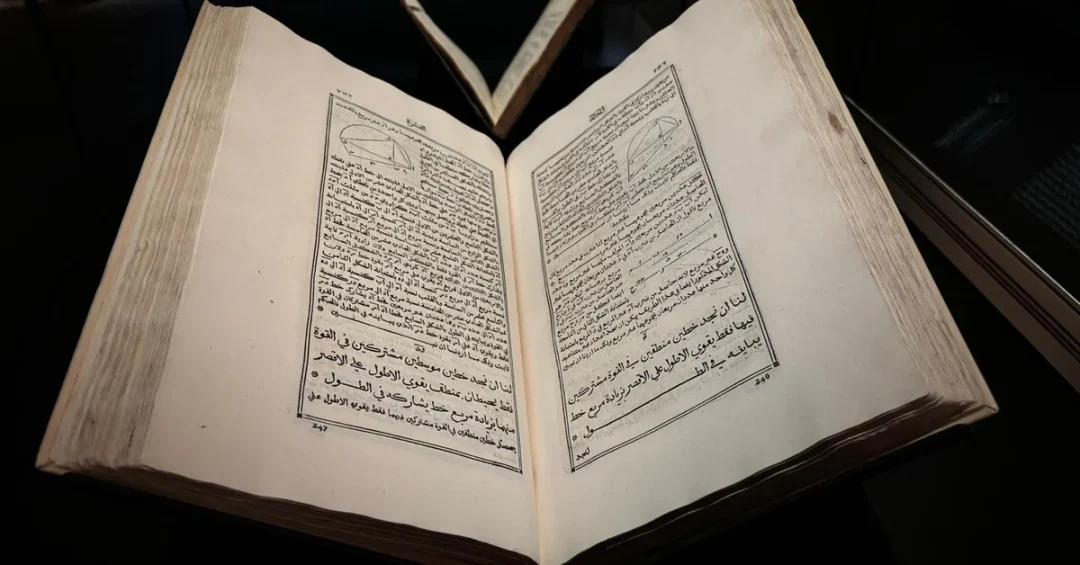
The second edition of the Islamic Arts Biennale is underway at the Western Hajj Terminal in Jeddah, where visitors are encountering a rare intellectual treasure: the ancient mathematical treatise known as the Elements, written by Euclid in the 3rd century BC. Running under the theme “And All That Is In Between,” the biennale has transformed the iconic terminal into a platform for learning, research, and cross-cultural exploration, according to the Saudi Press Agency. Organizers say the event reflects the Kingdom’s commitment to celebrating the deep connections between Islamic civilization and the global history of science, art, and knowledge.
At the heart of this year’s programming is a focused examination of Euclid’s Elements and its journey through Islamic scholarship. The work, widely regarded as one of the most influential mathematical references in human history, covers the essential principles of geometry, proportion, and the calculation of volumes for various shapes. Centuries after it was written, the Muslim scholar Nasir Al-Din Al-Tusi produced a revised edition titled “The Recension of Euclid’s Elements,” in which he restructured the text and corrected errors that had accumulated in later copies. The biennale’s presentation of this legacy offers international visitors a window into how Islamic scholars preserved, refined, and expanded the foundations of geometry.
Why does a 2,300-year-old mathematics textbook deserve a place in a contemporary arts biennale? The answer lies in the seamless relationship between geometry and Islamic artistic expression, a relationship that the Jeddah exhibition makes visible at every turn.
Context and Background
The Islamic Arts Biennale, organized by the Diriyah Biennale Foundation, opened its second edition at the Western Hajj Terminal, a site whose vast canopy and open structure have themselves become part of the visitor experience. The theme “And All That Is In Between” invites reflection on the spaces, connections, and translations that link cultures across time. Within that framework, the Elements serves as a powerful symbol of knowledge in motion, carried from ancient Greece into the Islamic world and then onward to Europe and beyond.
Euclid’s Elements was composed around 300 BC and remained a standard mathematical text for more than two millennia. Its systematic approach to definitions, postulates, and proofs established the language of geometry that architects, astronomers, and artists still use today. When the work reached the Islamic world during the Abbasid era, it was translated into Arabic and subjected to rigorous study. Scholars did not merely preserve the text; they interrogated it, corrected it, and built upon it. Nasir Al-Din Al-Tusi, a 13th-century polymath based in Maragheh and later Baghdad, produced a recension that reorganized the Elements and addressed inconsistencies in earlier manuscripts.
What made Al-Tusi’s edition so consequential for both mathematics and the arts? His work emphasized the fundamental principles of Euclidean geometry, including points, lines, angles, and areas, while also presenting geometric methods applicable in practical fields such as architecture and astronomy. This practical orientation helped geometry become a shared language across Islamic crafts, from tilework and calligraphy to the design of domes and minarets. The biennale’s focus on this text therefore highlights not only a mathematical milestone but also the aesthetic and spiritual dimensions of geometry in Islamic culture.
Key Details
Visitors to the Islamic Arts Biennale encounter the Elements through displays that connect historical manuscripts with contemporary artistic responses. The exhibition traces how Euclidean principles traveled from Alexandria to Baghdad, Cordoba, and Samarkand, and how they were adapted by Muslim scholars who wrote commentaries, produced new proofs, and applied geometric reasoning to the challenges of their time. Al-Tusi’s recension is presented as a pivotal moment in that journey, demonstrating how Islamic scholarship advanced the global development of geometry rather than simply transmitting it.
The biennale also underscores the role of the Western Hajj Terminal as a space of convergence. The terminal, designed by the architectural firm Skidmore, Owings & Merrill, is itself a masterpiece of geometric repetition, with its tensile fabric roof and modular structure echoing the patterns found in Islamic art. Placing a discussion of Euclid and Al-Tusi within this setting creates a dialogue between ancient theory and modern design, inviting visitors to see geometry as a living tradition rather than a historical artifact.
According to the Saudi Press Agency, the biennale offers a unique platform for learning, research, and exploration. The inclusion of the Elements aligns with the event’s broader mission to showcase the contributions of Islamic civilization to world knowledge. For international audiences, the presentation provides an accessible entry point into the history of science in the Islamic world, a history that is often overlooked in standard curricula. The exhibition’s curators have emphasized that the goal is not merely to display rare texts but to demonstrate how mathematical ideas shaped artistic practice and daily life.
How did Muslim scholars transform a Greek mathematical treatise into a foundation for both science and art? The answer lies in their method: translation followed by critical analysis, annotation, and original elaboration. This process, exemplified by Al-Tusi’s work, ensured that Euclid’s insights remained dynamic and applicable to new contexts, from the construction of observatories to the ornamentation of mosques.
International and Regional Impact
The Islamic Arts Biennale has attracted a global audience, with visitors from Europe, Asia, Africa, and the Americas traveling to Jeddah to engage with its programming. The focus on Euclid and Al-Tusi adds a scholarly dimension that resonates with international academic institutions and museums. By presenting the history of geometry as a shared human heritage, the biennale reinforces Saudi Arabia’s role as a custodian of cultural dialogue and a bridge between civilizations. This is particularly significant at a time when global audiences are seeking deeper understanding of the Islamic world’s scientific legacy.
Regionally, the biennale supports Saudi Arabia’s efforts to position Jeddah as a cultural hub on the Red Sea. The city has long been a gateway for pilgrims and traders, and the biennale builds on that history by creating a new reason for international visitors to explore the Kingdom’s artistic and intellectual offerings. The event also complements other cultural initiatives, such as the Diriyah Biennale and the upcoming projects in AlUla, by demonstrating that Saudi Arabia is investing in both contemporary art and historical scholarship. For neighboring countries, the biennale offers a model of how cultural events can generate tourism, education, and diplomatic goodwill.
What does the international attention to this exhibition say about the global appetite for Islamic art and science? It suggests that audiences are eager for narratives that connect mathematics, spirituality, and aesthetics. The Elements, with its rigorous logic and its role in shaping architectural masterpieces, embodies that connection. By highlighting Al-Tusi’s recension, the biennale also corrects a common misconception: that Islamic scholars were merely translators. In reality, they were innovators whose work laid groundwork for the European Renaissance and the Scientific Revolution.
Economic and Strategic Significance
The Islamic Arts Biennale contributes to Saudi Arabia’s economic diversification by attracting tourism and stimulating the creative economy. Cultural events of this scale generate demand for hospitality, transportation, and retail services, while also creating opportunities for Saudi artists, designers, and scholars. The biennale’s emphasis on research and learning aligns with the Kingdom’s broader investment in education and knowledge industries. By showcasing the historical contributions of Muslim scholars like Al-Tusi, the event also inspires young Saudis to pursue careers in science, technology, engineering, and mathematics, fields that are essential to the Vision 2030 agenda.
Strategically, the biennale enhances Saudi Arabia’s soft power by presenting a narrative of cultural openness and intellectual achievement. In a world where misunderstandings about Islam and the Middle East persist, exhibitions that celebrate scientific and artistic heritage can shift perceptions. The Elements and its Islamic recensions are powerful examples of how knowledge transcends borders. The biennale’s location in Jeddah, a city with a long history of welcoming travelers, reinforces the message that Saudi Arabia is open to the world and committed to preserving and sharing its cultural treasures.
How does an exhibition about geometry translate into tangible economic and strategic benefits? It does so by drawing visitors who spend on hotels, restaurants, and local crafts; by generating media coverage that promotes Saudi Arabia as a destination for culture and learning; and by fostering partnerships with international universities and museums. These outcomes support the Vision 2030 goals of increasing non-oil revenue, empowering citizens, and strengthening global engagement.
Vision 2030 Alignment
The Islamic Arts Biennale and its focus on Euclid’s Elements exemplify the Vision 2030 objectives of promoting cultural heritage, education, and international cooperation. Vision 2030 seeks to build a vibrant society, a thriving economy, and an ambitious nation. Cultural events like the biennale contribute to all three pillars by enriching the quality of life, creating economic opportunities, and projecting a positive image of Saudi Arabia on the world stage. The emphasis on the history of science also supports the goal of fostering a knowledge-based economy, as it encourages research and critical thinking.
Furthermore, the biennale aligns with the Kingdom’s efforts to preserve and promote Islamic heritage. By highlighting the work of Nasir Al-Din Al-Tusi and other Muslim scholars, the exhibition reminds audiences that the Islamic world has been a cradle of innovation for centuries. This narrative is central to Saudi Arabia’s cultural diplomacy and its role as a leader in the global Muslim community. As the biennale continues to welcome visitors from around the world, it demonstrates that Saudi Arabia is not only preserving its past but also shaping a future where art, science, and faith intersect in productive and inspiring ways.
In conclusion, the Islamic Arts Biennale’s presentation of Euclid’s Elements and Al-Tusi’s recension offers a profound lesson in the power of cross-cultural exchange. It shows that geometry is more than a set of formulas; it is a language of beauty, order, and inquiry that has connected civilizations for millennia. As Saudi Arabia advances toward Vision 2030, events like this biennale will continue to illuminate the Kingdom’s contributions to human knowledge and its commitment to building bridges between cultures. For international visitors, the experience is an invitation to explore, learn, and be inspired by the enduring legacy of Islamic scholarship.
20 Questions
Q1. What is the Islamic Arts Biennale?
A1. The Islamic Arts Biennale is a major cultural event held in Jeddah, Saudi Arabia, organized by the Diriyah Biennale Foundation. Its second edition takes place at the Western Hajj Terminal under the theme “And All That Is In Between,” showcasing Islamic art, scholarship, and heritage.
Q2. Where is the second edition of the Islamic Arts Biennale being held?
A2. It is being held at the Western Hajj Terminal in Jeddah, Saudi Arabia. This iconic architectural space provides a fitting backdrop for an event that explores connections between Islamic art, science, and culture.
Q3. What is the theme of the current Islamic Arts Biennale?
A3. The theme is “And All That Is In Between.” It invites visitors to reflect on the spaces, translations, and connections that link cultures and historical periods, with a particular focus on the interplay between Islamic art and scientific knowledge.
Q4. What is Euclid’s Elements?
A4. Euclid’s Elements is an ancient mathematical treatise written around 300 BC. It covers geometry, proportion, and volume calculations, and is considered one of the most influential works in the history of science and mathematics.
Q5. Why is Euclid’s Elements featured at an Islamic arts biennale?
A5. The Elements is featured because of its deep connection to Islamic art and architecture. Geometric principles from the text underpin many Islamic artistic traditions, and Muslim scholars like Nasir Al-Din Al-Tusi made significant contributions to its study and refinement.
Q6. Who was Nasir Al-Din Al-Tusi?
A6. Nasir Al-Din Al-Tusi was a 13th-century Muslim polymath, scholar, and astronomer. He produced a revised edition of Euclid’s Elements titled “The Recension of Euclid’s Elements,” in which he restructured the text and corrected errors from later copies.
Q7. What did Al-Tusi contribute to Euclid’s Elements?
A7. Al-Tusi reorganized the Elements, corrected inconsistencies, and emphasized fundamental principles of Euclidean geometry such as points, lines, angles, and areas. He also highlighted geometric methods applicable to architecture and astronomy.
Q8. How did Muslim scholars contribute to the development of geometry?
A8. Muslim scholars translated ancient Greek texts, analyzed them critically, annotated them, and provided new elaborations. Their work preserved and advanced geometry, influencing both the Islamic world and later European scholarship.
Q9. What practical fields benefited from Euclidean geometry in the Islamic world?
A9. Architecture and astronomy were major beneficiaries. Geometric principles guided the construction of domes, minarets, and observatories, and were essential for astronomical calculations and timekeeping.
Q10. How does the biennale present the history of the Elements?
A10. The biennale presents the Elements through displays that trace its journey from ancient Greece to the Islamic world and beyond. It connects historical manuscripts with contemporary artistic responses, showing how geometry remains relevant today.
Q11. What is the significance of the Western Hajj Terminal as a venue?
A11. The Western Hajj Terminal is an architectural landmark known for its geometric design. Using it as a venue creates a dialogue between ancient mathematical theory and modern design, enriching the visitor experience.
Q12. Who organized the Islamic Arts Biennale?
A12. The biennale is organized by the Diriyah Biennale Foundation, a Saudi cultural institution dedicated to promoting art and cultural exchange. It is part of Saudi Arabia’s broader cultural initiatives under Vision 2030.
Q13. What does the biennale aim to achieve?
A13. The biennale aims to provide a platform for learning, research, and exploration. It seeks to showcase the richness of Islamic art and scholarship, foster cross-cultural dialogue, and position Saudi Arabia as a global cultural destination.
Q14. How does the biennale support Saudi Vision 2030?
A14. It supports Vision 2030 by promoting cultural heritage, education, and international cooperation. It contributes to economic diversification through tourism and the creative economy, and enhances Saudi Arabia’s soft power and global engagement.
Q15. What can international visitors learn from the biennale?
A15. International visitors can learn about the historical contributions of Muslim scholars to mathematics and science, the relationship between geometry and Islamic art, and the enduring legacy of cross-cultural exchange between civilizations.
Q16. How does the biennale highlight Islamic contributions to science?
A16. By featuring Euclid’s Elements and Al-Tusi’s recension, the biennale demonstrates that Islamic scholars were not just translators but innovators who advanced geometry, astronomy, and architecture, shaping global scientific progress.
Q17. What role does geometry play in Islamic art?
A17. Geometry is central to Islamic art, appearing in tilework, calligraphy, architectural ornamentation, and the design of mosques and palaces. It reflects principles of order, harmony, and infinity that are spiritually significant.
Q18. Is the Islamic Arts Biennale open to the public?
A18. Yes, the biennale is open to the public, attracting both local and international visitors. It offers guided tours, educational programs, and cultural events designed to engage diverse audiences.
Q19. How does the biennale promote cultural dialogue?
A19. The biennale promotes cultural dialogue by presenting Islamic art and science in a global context, inviting visitors from different backgrounds to explore shared heritage and fostering mutual understanding through exhibitions and programming.
Q20. What is the lasting impact of the Islamic Arts Biennale?
A20. The biennale leaves a lasting impact by enriching Saudi Arabia’s cultural landscape, inspiring future generations, and reinforcing the Kingdom’s role as a bridge between civilizations. It also supports ongoing efforts to preserve and celebrate Islamic heritage.
Reader Feedback
We value your thoughts. Please share your feedback on this article.
Your feedback helps us improve our coverage.
Related articles
 Holy Quran Museum Opens in Makkah’s Hira Cultural District
 Ramadan’s Spirit Sets Umluj’s Old Districts Apart
 Al-Baha’s Stone Legacy: Crafting Heritage for Vision 2030
 Jeddah Blends Heritage and Seaside Iftar in Ramadan
 Islamic Arts Biennale’s AlMadar Showcases Islamic Scientific Heritage
 Historic Al-Hazimi Mosque Restored in Al-Aflaj