


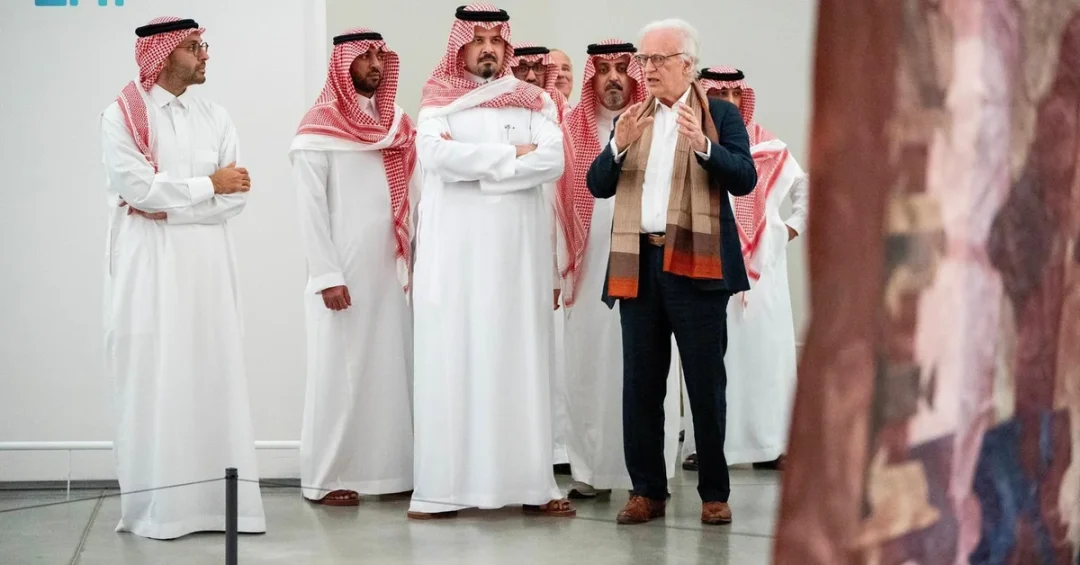
Prince Salman bin Sultan bin Abdulaziz, Governor of the Madinah Region, visited the Islamic Arts Biennale 2025 at the Western Hajj Terminal of King Abdulaziz International Airport in Jeddah, where more than 500 historical and contemporary artworks are on display across over 100,000 square meters until May 25, 2025. The visit, reported by the Saudi Press Agency (SPA), underscores the Kingdom’s commitment to celebrating Islamic civilization and its artistic heritage through a world-class cultural platform organized by the Diriyah Biennale Foundation.
The Biennale, themed “And All That Is In Between,” brings together rare collections from international Islamic art institutions alongside manuscripts and artifacts from Makkah and Madinah. During his tour, the governor was briefed on the exhibition and praised the Diriyah Biennale Foundation for its efforts in highlighting the richness of Islamic civilization and its artistic and cultural contributions throughout history. How does a single exhibition transform global perceptions of a nation’s cultural depth? The answer may lie in the scale, ambition, and spiritual resonance of this landmark event.
Context and Background
The Islamic Arts Biennale is a flagship cultural initiative organized by the Diriyah Biennale Foundation, a Saudi institution dedicated to fostering artistic dialogue and preserving heritage. The 2025 edition, held at the Western Hajj Terminal—a site of profound significance for millions of pilgrims—transforms a space historically associated with the Hajj journey into a global stage for Islamic artistic expression. The theme “And All That Is In Between” invites visitors to explore the connections between the material and the spiritual, the historical and the contemporary, within Islamic art.
Why does the location of this Biennale matter so deeply? The Western Hajj Terminal at King Abdulaziz International Airport in Jeddah is not merely an architectural marvel; it is a gateway that has welcomed countless pilgrims from around the world. By hosting the Biennale there, Saudi Arabia bridges the sacred journey of Hajj with the universal language of art, creating a space where cultural heritage and contemporary creativity intersect. This choice reflects a deliberate strategy to position the Kingdom as a global hub for cultural exchange and a guardian of Islamic civilization’s artistic legacy.
The Biennale’s scale is unprecedented. With over 500 artworks spanning more than 100,000 square meters, it represents one of the largest exhibitions of Islamic art ever assembled. The inclusion of manuscripts and artifacts from Makkah and Madinah adds a layer of spiritual authenticity, offering visitors a rare glimpse into the material culture of Islam’s holiest cities. These pieces, some of which are centuries old, are displayed alongside contemporary works, creating a dialogue across time that enriches the viewer’s understanding of Islamic art’s evolution and enduring relevance.
Key Details of the Governor’s Visit
Prince Salman bin Sultan bin Abdulaziz’s tour of the Biennale was marked by a comprehensive briefing on the exhibition’s contents and objectives. He was guided through the various sections, which showcase rare collections from international Islamic art institutions, as well as manuscripts and artifacts from Makkah and Madinah. The governor’s presence signals the Kingdom’s official recognition of the Biennale as a cultural asset of national importance, one that aligns with Saudi Arabia’s broader efforts to promote cultural diplomacy and heritage preservation.
What specific elements of the exhibition drew the governor’s attention? While the SPA report does not detail every stop, it notes that he commended the Diriyah Biennale Foundation for its efforts in highlighting the richness of Islamic civilization and its artistic and cultural contributions throughout history. He also praised the institutions dedicated to preserving and promoting Islamic heritage, acknowledging their vital role in safeguarding the treasures of the past for future generations. This endorsement from a senior regional leader reinforces the Biennale’s credibility and its alignment with the Kingdom’s cultural vision.
The governor’s visit also serves as a reminder of the Madinah Region’s own rich Islamic heritage. As the governor of the region that hosts the Prophet’s Mosque and numerous historical sites, Prince Salman bin Sultan bin Abdulaziz is uniquely positioned to appreciate the Biennale’s emphasis on artifacts from Madinah. His engagement with the exhibition highlights the interconnectedness of Saudi Arabia’s cultural initiatives, from the preservation of holy sites to the promotion of contemporary art. It is a holistic approach that views heritage not as a static relic but as a living, breathing part of national identity.
International and Regional Impact
The Islamic Arts Biennale 2025 has attracted attention far beyond Saudi Arabia’s borders. By bringing together rare collections from international Islamic art institutions, the event fosters cross-cultural dialogue and positions the Kingdom as a bridge between East and West. Visitors and scholars from around the world have the opportunity to engage with Islamic art in a setting that is both historically significant and architecturally striking. This global engagement is a cornerstone of Saudi Arabia’s cultural diplomacy, which seeks to build mutual understanding and respect through shared appreciation of the arts.
How does the Biennale influence regional perceptions? In the Middle East, where cultural tourism is increasingly competitive, the Islamic Arts Biennale stands out for its scale, curation, and spiritual depth. It offers a counter-narrative to stereotypes by showcasing the diversity and sophistication of Islamic artistic traditions. For neighboring countries and international partners, the Biennale serves as a model for how cultural events can drive tourism, stimulate economic activity, and enhance soft power. The presence of a senior leader like Prince Salman bin Sultan bin Abdulaziz further elevates the event’s profile, signaling that Saudi Arabia treats culture as a strategic priority.
The Biennale also plays a role in Saudi Arabia’s broader regional engagement. By inviting international institutions to participate, the Kingdom strengthens ties with countries that share an interest in Islamic heritage. These partnerships can lead to future collaborations in areas such as research, conservation, and exhibition exchanges. In a region often characterized by geopolitical tensions, the Biennale offers a space for constructive engagement and shared cultural pride.
Economic and Strategic Significance
Cultural events like the Islamic Arts Biennale are increasingly recognized as economic drivers. The exhibition attracts visitors, generates media coverage, and stimulates spending in hospitality, retail, and transportation. Jeddah, as the host city, benefits from increased tourism and international visibility. The Biennale also creates opportunities for local artists, curators, and creative professionals, contributing to the growth of Saudi Arabia’s cultural economy. This aligns with Vision 2030’s goal of diversifying revenue streams and creating jobs in the creative sector.
What strategic value does the Biennale hold for Saudi Arabia? Beyond economics, it reinforces the Kingdom’s soft power and its role as a leader in the Islamic world. By curating an exhibition that honors Islamic civilization while embracing contemporary expression, Saudi Arabia demonstrates its ability to bridge tradition and modernity. This is a key message of Vision 2030, which seeks to position the Kingdom as a forward-looking nation that values its heritage. The Biennale also supports the goal of increasing cultural participation, both domestically and internationally, by making art accessible to a wide audience.
Furthermore, the Biennale contributes to the development of Jeddah as a cultural destination. The city, already known for its historic Al-Balad district and its role as a gateway to Makkah and Madinah, gains another layer of cultural significance. The Western Hajj Terminal, with its iconic tent-like architecture, becomes a venue for artistic exploration, drawing visitors who might not otherwise visit the site. This integration of cultural and religious tourism is a strategic advantage, enhancing the overall visitor experience and extending stays.
Vision 2030 Alignment
The Islamic Arts Biennale 2025 exemplifies the objectives of Saudi Vision 2030, the Kingdom’s ambitious plan to diversify its economy and enhance its global standing. Vision 2030 emphasizes the importance of culture as a pillar of national identity and a driver of economic growth. By investing in world-class cultural events, Saudi Arabia is not only preserving its heritage but also creating new opportunities for engagement with the international community. The Biennale’s theme, “And All That Is In Between,” resonates with the vision’s call for a balanced, inclusive, and forward-looking society.
How does the governor’s visit reflect Vision 2030’s goals? Prince Salman bin Sultan bin Abdulaziz’s engagement with the Biennale demonstrates the leadership’s commitment to cultural development across all regions of the Kingdom. It sends a message that Saudi Arabia’s cultural renaissance is a national endeavor, involving leaders at every level. The Biennale also supports the Vision’s target of increasing the number of cultural events and enhancing the quality of life for citizens and residents. As the exhibition continues until May 25, 2025, it will undoubtedly inspire further initiatives that celebrate Islamic art and strengthen Saudi Arabia’s position as a global cultural hub.
In conclusion, the Islamic Arts Biennale 2025 is more than an exhibition; it is a statement of Saudi Arabia’s cultural ambition and its respect for Islamic heritage. The visit by the Governor of Madinah Region underscores the event’s importance and its alignment with the Kingdom’s long-term vision. As Saudi Arabia continues to open its doors to the world, events like this will play a vital role in shaping its global image and fostering mutual understanding. The Biennale invites us all to explore the spaces in between—between past and present, between faith and art, between nations—and to find common ground in the beauty of human creativity.
20 Questions
Q1. What is the Islamic Arts Biennale 2025?
A1. The Islamic Arts Biennale 2025 is a major cultural exhibition held at the Western Hajj Terminal in Jeddah, showcasing over 500 historical and contemporary artworks across more than 100,000 square meters, running until May 25, 2025.
Q2. Who visited the Biennale recently?
A2. Prince Salman bin Sultan bin Abdulaziz, Governor of the Madinah Region, visited the Biennale, where he was briefed on the exhibition and praised the organizers for their efforts in highlighting Islamic civilization.
Q3. Where is the Biennale being held?
A3. It is held at the Western Hajj Terminal of King Abdulaziz International Airport in Jeddah, a site of historical significance for pilgrims and now a venue for global cultural exchange.
Q4. What is the theme of the Biennale?
A4. The theme is “And All That Is In Between,” which explores the connections between the material and spiritual, and between historical and contemporary Islamic art.
Q5. Who organized the Biennale?
A5. The Biennale is organized by the Diriyah Biennale Foundation, a Saudi institution dedicated to fostering artistic dialogue and preserving Islamic heritage.
Q6. How many artworks are on display?
A6. More than 500 historical and contemporary artworks are on display, including rare collections from international Islamic art institutions, as well as manuscripts and artifacts from Makkah and Madinah.
Q7. What did the governor commend during his visit?
A7. He commended the Diriyah Biennale Foundation for its efforts in highlighting the richness of Islamic civilization and its artistic and cultural contributions throughout history.
Q8. Why is the Western Hajj Terminal significant?
A8. The Western Hajj Terminal is historically significant as a gateway for millions of pilgrims. Hosting the Biennale there bridges the sacred journey of Hajj with the universal language of art.
Q9. How does the Biennale align with Vision 2030?
A9. It aligns with Vision 2030 by promoting cultural heritage, diversifying the economy, and enhancing Saudi Arabia’s global standing as a hub for cultural exchange and artistic expression.
Q10. What is the economic impact of the Biennale?
A10. The Biennale attracts visitors, generates media coverage, and stimulates spending in hospitality, retail, and transportation, contributing to job creation and economic diversification in line with Vision 2030.
Q11. What role does the Biennale play in cultural diplomacy?
A11. It fosters cross-cultural dialogue by bringing together international institutions and visitors, positioning Saudi Arabia as a bridge between East and West and enhancing mutual understanding through shared appreciation of Islamic art.
Q12. Are there artifacts from Madinah on display?
A12. Yes, the exhibition includes manuscripts and artifacts from Madinah, offering visitors a rare glimpse into the material culture of one of Islam’s holiest cities.
Q13. How long will the Biennale run?
A13. The Biennale will run until May 25, 2025, giving visitors several months to explore the extensive collection of Islamic art and heritage.
Q14. What makes the Biennale unique?
A14. Its scale, curation, and spiritual depth set it apart. With over 500 artworks across 100,000 square meters, it is one of the largest exhibitions of Islamic art ever assembled.
Q15. Who benefits from the Biennale?
A15. Visitors, scholars, artists, and the local economy benefit. It also provides opportunities for Saudi creatives and strengthens the Kingdom’s cultural sector.
Q16. How does the Biennale support Islamic heritage preservation?
A16. By displaying rare manuscripts and artifacts, it raises awareness of Islamic heritage and supports institutions dedicated to preserving and promoting it for future generations.
Q17. What message does the governor’s visit convey?
A17. It conveys the Kingdom’s official recognition of the Biennale as a cultural asset of national importance and underscores the leadership’s commitment to cultural development across all regions.
Q18. Can international visitors attend the Biennale?
A18. Yes, the Biennale is open to international visitors, reflecting Saudi Arabia’s openness to cultural exchange and its desire to share Islamic art with the world.
Q19. What is the significance of the theme “And All That Is In Between”?
A19. The theme invites exploration of the spaces between the material and spiritual, the historical and contemporary, fostering a deeper understanding of Islamic art’s evolution and relevance.
Q20. How does the Biennale contribute to Saudi Arabia’s global image?
A20. It showcases the Kingdom’s cultural richness and its commitment to preserving Islamic heritage, enhancing its soft power and positioning it as a global leader in cultural diplomacy.
Reader Feedback
We value your thoughts. Please share your feedback on this article.
Your feedback helps us improve our coverage.
Related articles
 Riyadh’s Ramadan Tents: A Portrait of Unity and Generosity
 Diriyah Art Futures Unveils First Media Arts Residency Group
 Al-Safa Mosque Restored under Mohammed bin Salman Project
 Jeddah’s Historic Al-Balad Hosts Vibrant Ramadan Artisan Showcase
 Khawkhat Abu Bakr Al-Siddiq: Historic Landmark of the Prophet’s Mosque
 Art Week Riyadh Debuts April 2025 with 45+ Galleries