


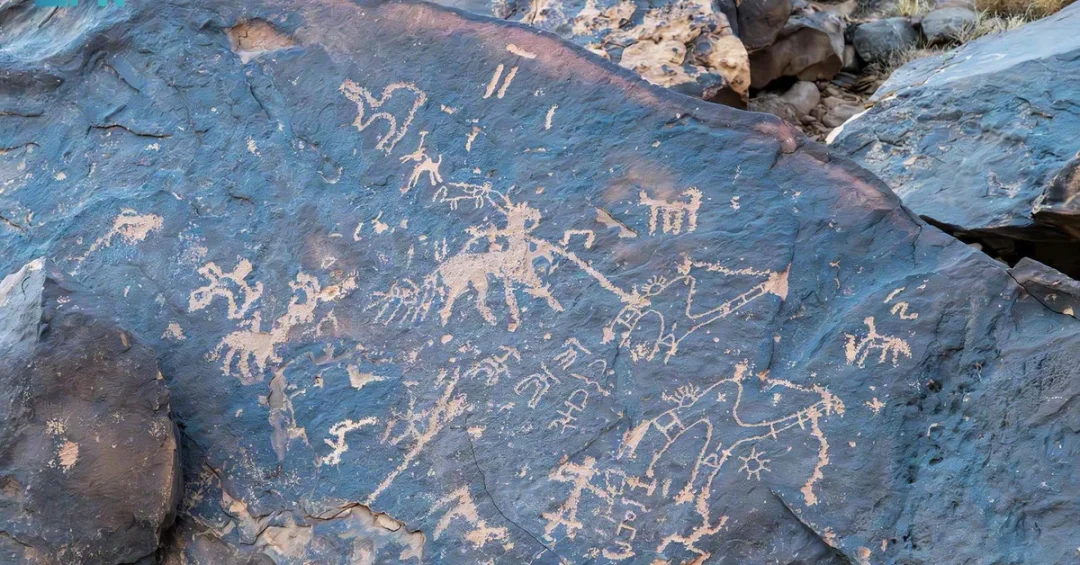
The Harrat region south of Tabuk has emerged as one of Saudi Arabia’s most compelling archaeological landscapes, with rock art and inscriptions documenting thousands of years of human habitation, trade, and cultural exchange, according to information released by the Saudi Press Agency and the Heritage Commission. The volcanic terrain, known locally as Harrat, served as a vast natural canvas for ancient communities who carved hunting scenes, animal figures, and symbolic motifs into the dark basalt stone, leaving behind a record that continues to reshape scholarly understanding of northwestern Arabia’s role in early human history.
Have you ever wondered how ancient civilizations communicated their stories before the invention of paper or the alphabet as we know it? The engravings of Harrat Tabuk offer a direct answer, preserving the beliefs, daily experiences, and social interactions of communities that flourished long before the modern era. These petroglyphs, some of which may date back thousands of years, represent far more than isolated artistic expressions. They form part of a broader cultural archive that positions Tabuk as a vital crossroads between the Arabian Peninsula and the great civilizations of Egypt, the Levant, Mesopotamia, the Mediterranean, and Asia.
The significance of these discoveries extends well beyond their aesthetic or historical value. They reinforce the Kingdom’s growing reputation as a custodian of world heritage, a role that aligns directly with the cultural preservation objectives embedded in Saudi Vision 2030. As the Heritage Commission continues its systematic surveys, each new find adds a layer of nuance to the story of human migration, trade, and cultural continuity across the Arabian Peninsula.
Context and Background
Why does a remote volcanic field in northwestern Saudi Arabia matter to anyone interested in the story of human civilization? The answer lies in Tabuk’s unique geographic position. Situated at the intersection of ancient trade routes that linked the Arabian Peninsula to Egypt, the Levant, Mesopotamia, the Mediterranean, and Asia, Tabuk functioned as a natural conduit for merchants, pilgrims, and migrating communities. The Harrat, a rugged volcanic landscape, provided shelter, resources, and a durable surface for recording important events and beliefs.
According to information released via official Saudi channels, the Heritage Commission has conducted extensive archaeological surveys across the region, revealing a wealth of rock art and inscriptions dating back to various periods, including Thamudic, Nabataean, Lihyanite, and Islamic eras. This chronological breadth is remarkable. It demonstrates that the Harrat was not a temporary stopping point but a continuously inhabited and culturally active zone for millennia. Each script and each engraving style adds a distinct chapter to the region’s long human story.
The rock art of Harrat Tabuk also provides a rare window into the natural environment of antiquity. Depictions of oryx, gazelles, and even tigers indicate that the landscape once supported fauna very different from what exists today. These images are not merely decorative; they are ecological records that help researchers reconstruct ancient climates and biodiversity. For international audiences, this combination of cultural and environmental evidence makes Tabuk a site of global scientific interest.
Key Details
What exactly do these ancient engravings depict, and what can they tell us about the people who created them? The rock art of Harrat Tabuk includes detailed hunting scenes featuring human figures using simple tools, suggesting organized group activity and sophisticated knowledge of local wildlife. The presence of oryx, gazelles, and tigers in the engravings points to a time when the region’s ecosystem was more diverse and possibly wetter than it is today. These depictions are complemented by numerous symbolic and abstract motifs that likely carried religious or cultural significance, reflecting the tribal identities of the ancient societies that once lived here.
A particularly important recent discovery in the village of Alqan has provided new insights into the evolution of writing in the region. Researchers identified “dual-line” inscriptions dating back to the fifth century AD, featuring both Thamudic and early Arabic scripts. This find offers compelling evidence of the continuity of writing traditions and the ongoing evolution of language in northwestern Arabia. The dual-line format suggests that communities were actively transitioning between script systems, a process that sheds light on how languages develop and spread across trade networks.
The Heritage Commission’s surveys have catalogued rock art and inscriptions from the Thamudic, Nabataean, Lihyanite, and Islamic periods, creating a comprehensive picture of cultural succession. Each period left its own distinctive mark, from the earliest symbolic carvings to more formalized scripts. Together, they demonstrate that the Harrat was a place where different peoples encountered one another, exchanged ideas, and left behind evidence of their interactions. For historians, this is invaluable material.
International and Regional Impact
How does the discovery of ancient rock art in a Saudi volcanic field resonate on the international stage? The answer lies in the universal language of heritage. Rock art sites in Tabuk join a global network of archaeological treasures that help humanity understand its shared origins. For researchers in Europe, Asia, and the Americas, the Harrat Tabuk engravings offer comparative material for studying migration patterns, trade networks, and the development of writing systems. The fact that these sites are being documented and preserved by Saudi authorities underlines the Kingdom’s commitment to scientific openness and cultural stewardship.
Regionally, the rock art reinforces Tabuk’s historical identity as a bridge between civilizations. Ancient Egypt, the Levant, Mesopotamia, the Mediterranean, and Asia all had connections to this part of Arabia. The inscriptions and engravings serve as tangible proof of those connections, transforming abstract historical narratives into concrete evidence. For neighboring countries with their own rich archaeological traditions, Saudi Arabia’s discoveries create opportunities for collaborative research and cultural diplomacy. This aligns with the Kingdom’s broader efforts to strengthen regional ties through shared heritage initiatives.
International media and academic institutions have taken note of Saudi Arabia’s archaeological momentum. The Heritage Commission’s systematic approach, supported by official Saudi channels, has positioned the Kingdom as a reliable source of new knowledge about the ancient world. This reputation enhances Saudi Arabia’s soft power and supports its tourism objectives by attracting visitors interested in cultural and historical travel.
Economic and Strategic Significance
What economic value can ancient rock art bring to a modern nation? In Saudi Arabia’s case, the answer is substantial. Cultural heritage is a cornerstone of the Kingdom’s tourism strategy, which aims to diversify revenue streams away from oil dependence. Sites like Harrat Tabuk have the potential to draw international visitors, scholars, and documentary filmmakers, generating income for local communities and supporting infrastructure development in the Tabuk region. The global cultural tourism market is vast, and Saudi Arabia’s unique archaeological assets give it a competitive advantage.
Strategically, the preservation and promotion of rock art sites contribute to national identity and social cohesion. By highlighting the deep historical roots of the Arabian Peninsula, these discoveries foster pride among Saudi citizens and present a nuanced image of the Kingdom to the world. They also support educational initiatives, providing material for school curricula and university research programs. The Heritage Commission’s work ensures that these non-renewable resources are documented and protected for future generations.
Furthermore, the rock art of Tabuk complements other major Saudi tourism and heritage projects, such as those in AlUla and NEOM. Together, they form a network of cultural destinations that showcase the Kingdom’s diverse historical layers. This integrated approach strengthens Saudi Arabia’s position as a leading destination for heritage tourism and reinforces the economic goals of Vision 2030.
Vision 2030 Alignment
How does the study of ancient rock art connect to Saudi Arabia’s ambitious Vision 2030 reform program? At its core, Vision 2030 seeks to diversify the economy, empower citizens, and elevate the Kingdom’s global standing. Cultural heritage preservation is explicitly part of this agenda. The Heritage Commission’s surveys and discoveries in Harrat Tabuk directly support the vision’s quality-of-life and tourism objectives by creating new attractions and knowledge assets. They also demonstrate the Kingdom’s commitment to protecting its history while building a modern future.
By investing in archaeological research and promoting sites like Harrat Tabuk, Saudi Arabia is sending a clear message: it values its past as much as its future. This balanced approach resonates with international partners and investors who appreciate stability, cultural authenticity, and long-term planning. As Vision 2030 progresses, the rock art of Tabuk will serve as a testament to the enduring human spirit and the Kingdom’s role as a crossroads of civilizations. The discoveries will continue to inspire, educate, and connect Saudi Arabia to the world.
20 Questions
Q1. What is the Harrat region south of Tabuk known for?
A1. The Harrat region is known for its remarkable collection of ancient rock art, including engravings and paintings that provide a glimpse into past civilizations and their daily lives, beliefs, and social interactions.
Q2. What types of images are found in the rock art of Harrat Tabuk?
A2. The rock art features hunting scenes with simple tools, depictions of fauna such as oryx, gazelles, and tigers, as well as symbolic and abstract motifs that likely held religious or cultural significance for ancient societies.
Q3. Which ancient scripts have been identified in the Tabuk region?
A3. Archaeological surveys by the Heritage Commission have revealed inscriptions dating back to Thamudic, Nabataean, Lihyanite, and Islamic periods, showing a long history of writing traditions in the area.
Q4. What was recently discovered in the village of Alqan?
A4. A recent discovery in Alqan includes “dual-line” inscriptions dating back to the fifth century AD, featuring both Thamudic and early Arabic scripts, offering new insights into the evolution of language.
Q5. Why was Tabuk historically significant as a crossroads?
A5. Tabuk was located at the intersection of ancient trade routes linking the Arabian Peninsula to Egypt, the Levant, Mesopotamia, the Mediterranean, and Asia, making it a vital hub for trade and cultural exchange.
Q6. What does the presence of tiger engravings suggest about the ancient environment?
A6. The depiction of tigers indicates that the region once supported a more diverse ecosystem, possibly with a wetter climate, which is valuable for reconstructing ancient environments and biodiversity.
Q7. Who conducted the archaeological surveys in the Tabuk region?
A7. The Heritage Commission, a Saudi government agency, conducted extensive archaeological surveys that revealed the wealth of rock art and inscriptions in the Harrat region.
Q8. How does the rock art reflect tribal identities?
A8. The symbolic and abstract motifs in the rock art likely carried religious or cultural significance, reflecting the tribal identities and social structures of the ancient societies that created them.
Q9. What is the significance of the dual-line inscriptions?
A9. The dual-line inscriptions provide compelling evidence of the continuity of writing traditions and the ongoing evolution of language in the region, showing a transition between script systems.
Q10. How does the rock art of Tabuk contribute to our understanding of ancient trade?
A10. The rock art underscores Tabuk’s role as a crucial crossroads for trade and cultural exchange, offering tangible evidence of interactions between the Arabian Peninsula and neighboring civilizations.
Q11. What periods do the inscriptions in Tabuk cover?
A11. The inscriptions cover various periods, including Thamudic, Nabataean, Lihyanite, and Islamic eras, demonstrating a long and continuous history of human activity in the region.
Q12. Why is the Harrat region considered a treasure trove of ancient history?
A12. The Harrat region is considered a treasure trove because it contains a dense concentration of rock art and inscriptions that document thousands of years of human habitation, culture, and environmental change.
Q13. How does the rock art of Tabuk align with Saudi Vision 2030?
A13. The preservation and promotion of rock art align with Vision 2030’s goals of diversifying the economy, boosting tourism, and enhancing cultural heritage, while also fostering national pride and global engagement.
Q14. What role does the Heritage Commission play in preserving these sites?
A14. The Heritage Commission conducts surveys, documents discoveries, and works to protect and promote Saudi Arabia’s archaeological heritage, ensuring that sites like Harrat Tabuk are preserved for future generations.
Q15. How might the rock art attract international visitors?
A15. The unique and ancient rock art can attract cultural tourists, scholars, and filmmakers, contributing to Saudi Arabia’s tourism sector and supporting local economies in the Tabuk region.
Q16. What can the hunting scenes tell us about ancient life?
A16. The hunting scenes depict the use of simple tools and group activities, offering insights into the daily lives, survival strategies, and social organization of the early inhabitants of the region.
Q17. How does the rock art of Tabuk compare to other global heritage sites?
A17. The rock art of Tabuk is part of a global network of archaeological treasures, providing comparative material for studying human migration, trade, and the development of writing systems across different cultures.
Q18. What is the significance of the fauna depicted in the engravings?
A18. The fauna, including oryx, gazelles, and tigers, serve as ecological records that help researchers reconstruct ancient climates and biodiversity, highlighting environmental changes over millennia.
Q19. How does the discovery of ancient scripts impact linguistic studies?
A19. The discovery of Thamudic and early Arabic scripts provides valuable data for linguists studying the evolution of writing and language in the Arabian Peninsula, showing continuity and transition.
Q20. What future steps are expected for the Harrat Tabuk sites?
A20. Future steps likely include continued surveys by the Heritage Commission, preservation efforts, and the development of tourism infrastructure to share these discoveries with the world, in line with Vision 2030 objectives.
Reader Feedback
We value your thoughts. Please share your feedback on this article.
Your feedback helps us improve our coverage.
Related articles
 Tariq Abdulhakim Center Museum Marks First Year in Jeddah
 Chinese Film Nights Illuminate Jeddah’s Cultural Scene
 Riyadh Art Unveils Tuwaiq Sculpture Symposium 2025
 Winners of Mazayen Competition Announced at King Abdulaziz Camel Festival
 Ministry of Culture Celebrates Successful Year of the Camel
 Ain Zubaidah: Makkah’s 1,200-Year-Old Water Source