


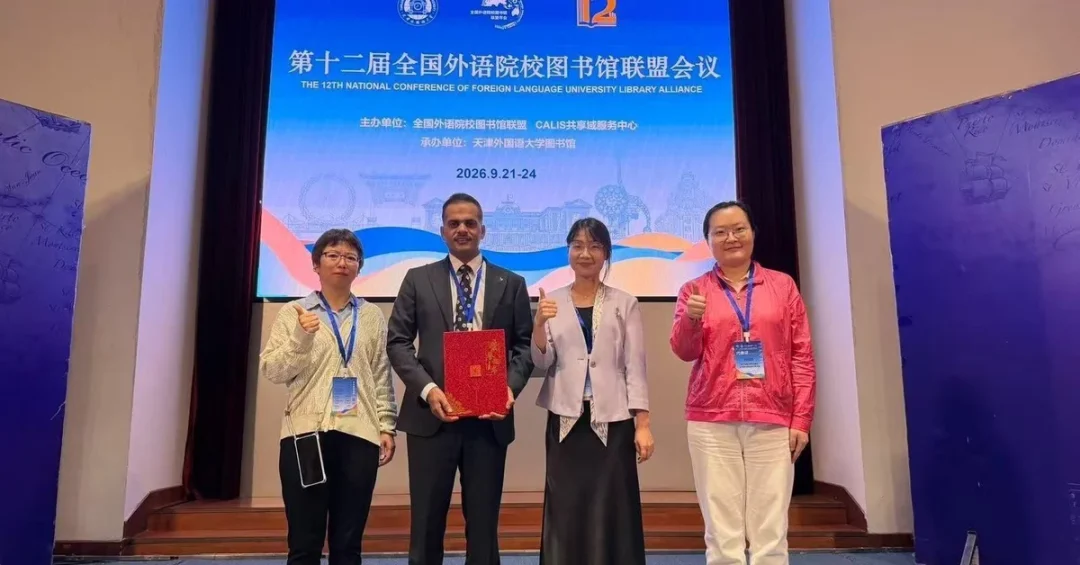
The King Abdulaziz Public Library Branch at Peking University has won a first prize and an award of excellence at the 12th National Conference of the Foreign Language University Library Alliance, hosted by Tianjin Foreign Studies University in China from September 21 to 24, 2026, according to the Saudi Press Agency. The recognition, announced via official Saudi channels, marks a significant milestone in the library’s ongoing mission to strengthen intellectual and academic ties between the Kingdom of Saudi Arabia and the People’s Republic of China. The branch earned the top honor for a professional initiative centered on collaborative service delivery between library staff and specialized academic faculty, while its award of excellence recognized a research study examining models of institutional partnership between foreign-language libraries and academic researchers. What does this dual recognition reveal about the growing depth of Saudi-Chinese cooperation in education, research, and cultural diplomacy?
The awards were conferred during a four-day gathering that convened representatives and library specialists from across China, with the conference program addressing emerging sector trends such as artificial intelligence integration, digital transformation, research support, and the expansion of smart library ecosystems. For the King Abdulaziz Public Library, an institution with a long-standing reputation for preserving Arab and Islamic heritage while embracing modern knowledge systems, the achievement underscores how Saudi Arabia’s cultural and educational institutions are increasingly recognized on the international stage. The branch’s participation reflects its role in deepening Saudi-Chinese intellectual exchange and fostering institutional partnerships across the 27-member library alliance, a network that positions the Kingdom at the intersection of academic excellence and cross-cultural engagement.
Context and Background
How did a Saudi library branch come to be recognized among China’s leading academic library institutions? The King Abdulaziz Public Library, headquartered in Riyadh, has expanded its international footprint in recent years as part of a broader strategy to promote Saudi culture, scholarship, and language education abroad. Its branch at Peking University, one of China’s most prestigious institutions of higher learning, serves as a dedicated hub for Arabic-language resources, Saudi studies, and academic collaboration. The branch’s presence at Peking University is itself a product of deepening bilateral relations between Saudi Arabia and China, two nations that have steadily expanded cooperation across energy, trade, technology, and education under the framework of Saudi Vision 2030 and China’s Belt and Road Initiative.
The 12th National Conference of the Foreign Language University Library Alliance, hosted by Tianjin Foreign Studies University, brought together library professionals, researchers, and academic leaders to examine the future of library services in an era of rapid technological change. The conference’s focus on artificial intelligence integration and smart library ecosystems reflects a global shift in how academic libraries operate, moving beyond traditional collection management toward dynamic, technology-enabled research support. For the King Abdulaziz Public Library Branch, participation in this forum was not merely symbolic; it represented an opportunity to share Saudi expertise, learn from Chinese innovations, and reinforce the branch’s standing as a bridge between Arabic and Chinese scholarly communities.
The awards themselves carry particular significance because they were judged by peers within the alliance, a network of 27 foreign-language university libraries across China. Recognition from such a body indicates that the Saudi branch’s operational models and research contributions are viewed as exemplary within the Chinese academic library sector. This is a notable achievement for an institution that operates in a cross-cultural environment, managing collections and services that span two distinct linguistic and scholarly traditions. It also highlights the Kingdom’s commitment to knowledge exchange as a pillar of its international engagement, a commitment that aligns with Vision 2030’s emphasis on education, innovation, and global partnerships.
Key Details
What exactly did the King Abdulaziz Public Library Branch accomplish to earn these honors? The first prize was awarded for a professional initiative focused on collaborative service delivery between library staff and specialized academic faculty. This initiative appears to address a common challenge in academic libraries: ensuring that library services are closely aligned with the research needs of faculty and students. By integrating library professionals directly into academic workflows, the branch demonstrated a model that enhances research support, resource discovery, and scholarly communication. The award of excellence, meanwhile, recognized a research study examining models of institutional partnership between foreign-language libraries and academic researchers. This study likely explored how libraries can build sustainable, mutually beneficial relationships with research communities, a topic of increasing relevance as academic institutions worldwide seek to maximize the impact of their library investments.
The conference program featured discussions on artificial intelligence integration, digital transformation, research support, and smart library ecosystems, all areas where the King Abdulaziz Public Library has been investing. The branch’s ability to compete successfully in this environment suggests that its staff are not only keeping pace with global trends but are also contributing original ideas and practical solutions. The recognition of both a service initiative and a research study indicates a balanced approach, combining operational excellence with scholarly inquiry. This dual focus is consistent with the library’s broader mission, which emphasizes both the preservation of heritage and the advancement of knowledge through modern methods.
Representatives from the branch participated actively in the conference, engaging with counterparts from across China and sharing insights from the Saudi library sector. The event provided a platform for networking and partnership discussions, with the branch’s success likely opening doors to further collaboration within the 27-member alliance. The awards were announced during the conference, which ran from September 21 to 24, 2026, and were reported by the Saudi Press Agency, underscoring the official recognition of this achievement within the Kingdom. The branch’s participation reflects its role in deepening Saudi-Chinese intellectual exchange and fostering institutional partnerships, a role that has grown in importance as the two countries expand their strategic relationship.
International and Regional Impact
How does this recognition resonate beyond the library sector? The King Abdulaziz Public Library Branch’s success in China is a tangible example of Saudi cultural diplomacy in action. It demonstrates that Saudi institutions can compete and excel in international academic forums, earning respect for their professionalism and innovation. This contributes to a positive image of the Kingdom abroad, showcasing its commitment to education, research, and cross-cultural understanding. For China, the recognition of a Saudi library branch within its national library alliance signals openness to international collaboration and a willingness to learn from diverse perspectives. The partnership between the two countries in this domain complements their broader cooperation in energy, trade, and technology, adding a cultural and intellectual dimension to a relationship that is often analyzed primarily through an economic lens.
Regionally, the achievement may inspire other Saudi cultural and educational institutions to pursue international partnerships and seek recognition in global forums. The King Abdulaziz Public Library has long been a leader in this regard, with branches and cultural centers in several countries. Its success in China could encourage similar initiatives elsewhere, reinforcing Saudi Arabia’s role as a bridge between the Arab world and major global powers. Within the Middle East, the recognition highlights the Kingdom’s soft power potential and its ability to project influence through knowledge and culture, not just economic weight. This aligns with Vision 2030’s goal of a vibrant society and a globally engaged nation, positioning Saudi Arabia as a hub for intellectual exchange and a contributor to global knowledge production.
Economic and Strategic Significance
What strategic value do these awards hold for Saudi Arabia? While library awards may seem distant from economic affairs, they are part of a broader strategy to build human capital, foster innovation, and strengthen international ties. The King Abdulaziz Public Library’s work supports research and education, which are essential drivers of economic diversification and technological advancement. By collaborating with Chinese academic institutions, the branch facilitates access to knowledge and expertise that can benefit Saudi researchers, students, and entrepreneurs. This kind of exchange is increasingly important as Saudi Arabia seeks to develop knowledge-intensive industries and reduce its dependence on oil. The partnerships formed through the library alliance can lead to joint research projects, student exchanges, and technology transfer, all of which contribute to Vision 2030’s economic goals.
Moreover, the recognition enhances Saudi Arabia’s reputation as a reliable partner in international academic and cultural endeavors. In a world where soft power and knowledge diplomacy are increasingly influential, such achievements help position the Kingdom as a forward-looking, modern nation. They also complement Saudi Arabia’s growing engagement with China, a key strategic partner under Vision 2030. The two countries have cooperated on projects ranging from renewable energy to smart cities, and educational and cultural exchanges are a natural extension of this partnership. The library branch’s success thus reinforces the strategic alignment between Riyadh and Beijing, demonstrating that collaboration can yield tangible results across multiple sectors.
Vision 2030 Alignment
How does this achievement connect to Saudi Vision 2030? Vision 2030 envisions a Saudi Arabia that is not only economically diversified but also culturally vibrant and globally engaged. The King Abdulaziz Public Library Branch’s recognition in China directly supports several of the vision’s pillars, including the development of a knowledge-based economy, the promotion of Saudi culture abroad, and the strengthening of international partnerships. By excelling in a Chinese academic forum, the branch showcases the Kingdom’s commitment to education and research, which are foundational to building a skilled workforce and fostering innovation. It also demonstrates the soft power of Saudi cultural institutions, which play a vital role in projecting a positive image of the country and building bridges with other nations.
Looking ahead, the branch’s success is likely to lead to further opportunities for collaboration and recognition. The King Abdulaziz Public Library can leverage its awards to deepen its engagement with the 27-member library alliance, potentially hosting joint conferences, developing shared digital platforms, and expanding its research partnerships. These activities would not only benefit the library itself but also contribute to the broader goals of Vision 2030 by enhancing Saudi Arabia’s intellectual capital and global connectivity. As the Kingdom continues its transformation, achievements like this serve as reminders that progress is measured not only in economic indicators but also in the respect and recognition earned on the world stage. The King Abdulaziz Public Library Branch’s dual awards in China are a testament to Saudi Arabia’s enduring commitment to knowledge, culture, and international cooperation.
20 Questions
Q1. What awards did the King Abdulaziz Public Library Branch in China win?
A1. The branch won a first prize and an award of excellence at the 12th National Conference of the Foreign Language University Library Alliance, hosted by Tianjin Foreign Studies University in China from September 21 to 24, 2026.
Q2. Where is the King Abdulaziz Public Library Branch located in China?
A2. The branch is located at Peking University, one of China’s most prestigious institutions of higher learning, where it serves as a hub for Arabic-language resources and Saudi studies.
Q3. What was the first prize awarded for?
A3. The first prize was awarded for a professional initiative focused on collaborative service delivery between library staff and specialized academic faculty, enhancing research support and resource discovery.
Q4. What did the award of excellence recognize?
A4. The award of excellence recognized a research study examining models of institutional partnership between foreign-language libraries and academic researchers, underscoring the branch’s role in integrating scholarly inquiry with modern library services.
Q5. Which organization hosted the conference?
A5. The conference was hosted by Tianjin Foreign Studies University in China, bringing together library specialists from across the country.
Q6. How many members are in the library alliance?
A6. The Foreign Language University Library Alliance has 27 member libraries across China, all dedicated to advancing foreign-language library services and research.
Q7. What topics were discussed at the conference?
A7. The conference addressed emerging sector trends, including artificial intelligence integration, digital transformation, research support, and the expansion of smart library ecosystems.
Q8. Why is this recognition significant for Saudi Arabia?
A8. It highlights Saudi Arabia’s commitment to education, research, and cultural diplomacy, and demonstrates the Kingdom’s ability to compete and excel in international academic forums.
Q9. How does this achievement support Saudi Vision 2030?
A9. It supports Vision 2030 by promoting knowledge exchange, strengthening international partnerships, and showcasing Saudi cultural institutions on the global stage, aligning with the vision’s educational and cultural goals.
Q10. What is the King Abdulaziz Public Library’s mission?
A10. The library aims to preserve Arab and Islamic heritage while embracing modern knowledge systems, and to promote Saudi culture and scholarship internationally through branches and partnerships.
Q11. How does the branch deepen Saudi-Chinese intellectual exchange?
A11. By participating in conferences, sharing expertise, and fostering institutional partnerships, the branch facilitates collaboration between Saudi and Chinese academic communities, enhancing mutual understanding and knowledge sharing.
Q12. What are smart library ecosystems?
A12. Smart library ecosystems refer to the integration of advanced technologies, such as artificial intelligence and digital platforms, to enhance library services, improve user experience, and support research and learning.
Q13. What role does artificial intelligence play in modern libraries?
A13. Artificial intelligence can automate routine tasks, personalize user services, enhance search and discovery, and provide data-driven insights, helping libraries better support research and education.
Q14. How might this recognition benefit future Saudi-Chinese collaborations?
A14. It can lead to joint research projects, student and faculty exchanges, shared digital initiatives, and expanded partnerships within the library alliance, strengthening bilateral ties in education and culture.
Q15. What is the significance of the branch being at Peking University?
A15. Peking University is a leading Chinese institution, and hosting a Saudi library branch there symbolizes the strong academic and cultural ties between the two countries, providing a strategic platform for exchange.
Q16. How does the library contribute to Saudi Arabia’s soft power?
A16. By promoting Saudi culture, language, and scholarship abroad, the library enhances the Kingdom’s image as a modern, knowledge-driven nation and builds goodwill through educational and cultural engagement.
Q17. What other international branches does the King Abdulaziz Public Library have?
A17. The library has established cultural centers and branches in several countries, including China, to promote Arabic language and Saudi studies, though specific locations vary over time.
Q18. How does this achievement reflect on Saudi Arabia’s educational sector?
A18. It demonstrates the high quality and innovation of Saudi library services and research, reflecting the Kingdom’s investment in education and its ability to produce world-class professionals and scholars.
Q19. What is the Foreign Language University Library Alliance?
A19. It is a network of 27 university libraries in China specializing in foreign-language resources, dedicated to advancing library services, research, and collaboration among its members.
Q20. What does the future hold for the King Abdulaziz Public Library Branch in China?
A20. The branch is expected to build on this success by expanding partnerships, hosting joint initiatives, and further integrating into the Chinese academic library community, all while promoting Saudi Vision 2030 goals.
Reader Feedback
We value your thoughts. Please share your feedback on this article.
Your feedback helps us improve our coverage.
Related articles
 Al-Qadsiah Club National Day carnival attracts 25,000 visitors
 Diriyah Celebrates National Day as Living Memory of the Nation
 Arabian Horses Adorn National Day in Al-Baha
 Historic Jeddah hosts Saudi National Day events
 Baljurashi Celebrates Saudi National Day at Historic Market
 Historic Jeddah Celebrates Saudi National Day