


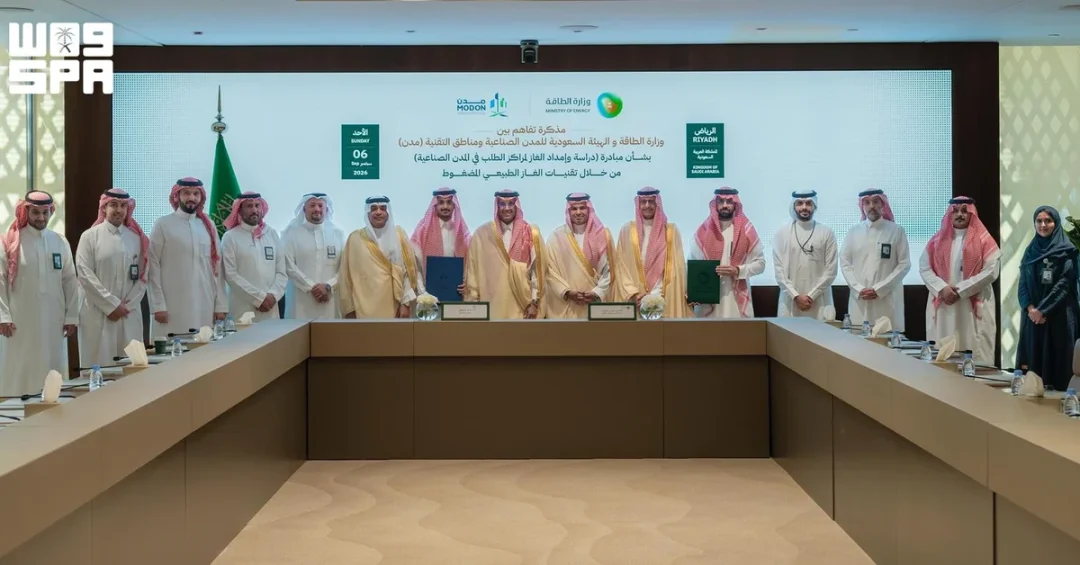
The Saudi Ministry of Energy and the Saudi Authority for Industrial Cities and Technology Zones (MODON) signed a memorandum of understanding (MoU) to establish a natural gas compression and tanker distribution station at Dammam Third Industrial City in the Eastern Region, according to an official announcement carried by the Saudi Press Agency. The agreement, formalized on September 6, 2026, in Riyadh, brings together two of the Kingdom’s most influential energy and industrial development institutions in a partnership designed to strengthen the reliability and efficiency of natural gas supplies for the industrial sector.
The MoU was signed by Eng. Ahmed Al-Zahrani, Assistant Energy Minister for Development and Excellence, and Eng. Majed Al-Argoubi, Chief Executive Officer of MODON. Under the terms of the agreement, compressed natural gas (CNG) will be supplied by tanker to targeted industrial facilities in Dammam First Industrial City, Al-Ahsa First Industrial City and nearby areas. Is this not precisely the kind of integrated infrastructure planning that a modern industrial economy demands? The initiative reflects a coordinated national effort to ensure that factories and production facilities across the Eastern Province have dependable access to cleaner-burning natural gas, a fuel increasingly central to Saudi Arabia’s industrial and environmental ambitions.
Context and Background
Why does the location of this project matter so much to the Kingdom’s industrial strategy? Dammam Third Industrial City sits at the heart of the Eastern Province, a region that hosts some of the most concentrated industrial activity in the Middle East. MODON has spent years developing integrated industrial cities that offer ready infrastructure, logistics access and utility services to manufacturers. Natural gas is a critical input for industries ranging from petrochemicals and metals to food processing and building materials, and ensuring its reliable delivery is a foundational requirement for any serious industrial expansion.
The Ministry of Energy has consistently emphasized the importance of optimizing the Kingdom’s energy mix and extending the reach of natural gas to industrial consumers. The ministry oversees national energy policy, while MODON manages the physical and regulatory environment of industrial cities. Bringing these two mandates together through a formal MoU creates a practical mechanism for delivering gas to facilities that might otherwise rely on less efficient or higher-emission fuels. The Eastern Province, with its proximity to major gas fields and processing infrastructure, is a logical starting point for such a distribution model.
The use of compressed natural gas delivered by tanker represents a flexible approach for facilities that are not yet connected to a pipeline network. It allows industrial customers to benefit from natural gas without waiting for large-scale pipeline extensions, which can take years to plan and build. In the meantime, tanker-based CNG distribution can bridge the gap and support production growth in areas where demand is emerging.
Key Details of the Agreement
What exactly does the MoU commit the two parties to deliver? The agreement establishes a natural gas compression and tanker distribution station at Dammam Third Industrial City. This station will compress natural gas and load it onto tankers for delivery to targeted industrial facilities. The first beneficiaries will be factories in Dammam First Industrial City, Al-Ahsa First Industrial City and surrounding areas, according to the official announcement.
The MoU was signed by two senior figures whose roles underscore the seriousness of the collaboration. Eng. Ahmed Al-Zahrani serves as Assistant Energy Minister for Development and Excellence, a position focused on advancing the ministry’s development agenda and institutional performance. Eng. Majed Al-Argoubi leads MODON as Chief Executive Officer, overseeing the authority’s network of industrial cities and technology zones across the Kingdom. Their signatures signal a commitment at the highest operational levels to move from planning to implementation.
The initiative is expected to enhance the efficiency and reliability of natural gas supplies and to support the industrial sector’s energy needs. While the announcement did not specify a timeline or investment figure, the operational model is clear: gas will be compressed at a central station and distributed by tanker to industrial customers. This approach can be scaled over time as demand grows and as pipeline infrastructure is extended. It also provides a template that could be replicated in other industrial cities across Saudi Arabia.
International and Regional Impact
How might this project resonate beyond Saudi Arabia’s borders? The Kingdom is a major global energy producer and a leading voice in international energy markets, and its domestic policies often signal broader strategic directions. By expanding natural gas access for industry, Saudi Arabia reinforces its position as a reliable energy supplier and a serious manager of its own resource base. International investors and industrial partners watching the Kingdom’s business environment will note that energy infrastructure is being upgraded in tandem with industrial expansion.
At the regional level, the Eastern Province is closely integrated with Gulf supply chains and trade routes. Reliable gas supplies for industrial facilities in Dammam and Al-Ahsa can strengthen the competitiveness of Saudi-made products in export markets. For neighboring Gulf economies and trading partners, the project adds another layer of confidence in the Kingdom’s ability to support industrial activity with dependable utilities. It also aligns with broader Gulf efforts to diversify energy use and reduce emissions from industrial processes.
Global energy markets are increasingly attentive to how major producers manage their domestic consumption and export commitments. Saudi Arabia’s careful approach to balancing these priorities, including through initiatives like this MoU, supports stability and predictability. Partners in Asia, Europe and the Americas who rely on Saudi energy exports have an interest in the Kingdom’s continued ability to manage its resources efficiently and responsibly.
Economic and Strategic Significance
Why is natural gas so important to the future of Saudi industry? Natural gas is a cleaner-burning fossil fuel compared with heavier alternatives, and it is a key feedstock for petrochemical production, fertilizer manufacturing and many other industrial processes. By making gas more accessible to factories in Dammam and Al-Ahsa, the MoU supports higher output, lower operating costs and improved environmental performance. These gains can ripple through supply chains, creating jobs and strengthening local economies.
The strategic logic extends to the Kingdom’s long-term resource management. Saudi Arabia has invested heavily in gas processing and distribution infrastructure, and extending that network to industrial customers through flexible delivery models maximizes the value of those investments. Tanker-based CNG distribution can serve facilities that are not yet connected to pipelines, ensuring that industrial growth is not delayed by infrastructure gaps. Over time, successful deployment in the Eastern Province could inform similar projects in other regions.
For MODON, the agreement adds another service dimension to its industrial cities, making them more attractive to manufacturers seeking reliable and cost-effective energy. For the Ministry of Energy, it advances the goal of optimizing domestic energy use and supporting the industrial sector. Together, these objectives contribute to a more resilient and diversified economy, which is central to the Kingdom’s long-term planning.
Vision 2030 Alignment
How does this MoU connect to Saudi Vision 2030? Vision 2030 aims to diversify the economy, expand non-oil sectors and create a business environment where industry can thrive. Reliable, efficient energy supplies are a prerequisite for that vision. By strengthening natural gas distribution to industrial cities, the Ministry of Energy and MODON are directly supporting the growth of manufacturing, which is a pillar of the Kingdom’s diversification strategy.
The initiative also reflects the Vision 2030 emphasis on sustainability and operational excellence. Natural gas produces fewer emissions than many alternative fuels, and using it efficiently in industrial processes supports environmental goals. The collaboration between a ministry and an industrial authority demonstrates the kind of integrated governance that Vision 2030 encourages, where government entities work together to deliver practical benefits for the economy and citizens.
As Saudi Arabia continues to modernize its industrial base and expand its global role, projects like the Dammam Third Industrial City gas station show how the Kingdom is translating long-term strategy into concrete action. The MoU is a step forward in ensuring that Saudi industry has the energy it needs to compete, grow and contribute to a diversified and prosperous future.
20 Questions
Q1. What is the main purpose of the MoU signed by the Ministry of Energy and MODON?
A1. The MoU aims to establish a natural gas compression and tanker distribution station at Dammam Third Industrial City to supply CNG to industrial facilities in Dammam First Industrial City, Al-Ahsa First Industrial City and nearby areas, enhancing supply efficiency and reliability.
Q2. Who signed the MoU on behalf of the two parties?
A2. Eng. Ahmed Al-Zahrani, Assistant Energy Minister for Development and Excellence, signed for the Ministry of Energy, and Eng. Majed Al-Argoubi, Chief Executive Officer of MODON, signed for the Saudi Authority for Industrial Cities and Technology Zones.
Q3. Where will the natural gas compression and distribution station be located?
A3. The station will be established at Dammam Third Industrial City in the Eastern Region of Saudi Arabia, according to the official announcement issued via the Saudi Press Agency.
Q4. Which industrial areas will initially receive compressed natural gas under this initiative?
A4. The targeted areas include Dammam First Industrial City, Al-Ahsa First Industrial City and nearby areas, where industrial facilities will receive CNG delivered by tanker from the compression station.
Q5. What is compressed natural gas (CNG) and why is it used?
A5. CNG is natural gas that has been compressed to a fraction of its volume for easier storage and transport. It is used as a cleaner-burning fuel for industrial, commercial and transportation applications, offering efficiency and environmental benefits.
Q6. How will the natural gas be delivered to industrial facilities?
A6. Natural gas will be compressed at the new station and then loaded onto tankers for delivery to targeted industrial facilities. This tanker-based distribution model serves sites that may not yet be connected to pipeline networks.
Q7. What benefits are expected from this initiative for the industrial sector?
A7. The initiative is expected to enhance the efficiency and reliability of natural gas supplies, support the industrial sector’s energy needs, reduce reliance on less efficient fuels and help manufacturers maintain stable production with lower operating costs.
Q8. Why is Dammam Third Industrial City significant for this project?
A8. Dammam Third Industrial City is a major industrial hub in the Eastern Province, developed by MODON with integrated infrastructure and logistics access. Its location makes it an ideal base for a gas compression and distribution station serving nearby industrial zones.
Q9. How does this MoU support Saudi Arabia’s Vision 2030 goals?
A9. The MoU supports Vision 2030 by strengthening industrial infrastructure, improving energy efficiency, encouraging economic diversification and promoting sustainable practices, all of which are central to the Kingdom’s long-term development strategy.
Q10. What role does the Ministry of Energy play in this partnership?
A10. The Ministry of Energy oversees national energy policy and resource management. In this partnership, it contributes regulatory oversight, technical expertise and strategic direction to ensure the project aligns with the Kingdom’s energy objectives.
Q11. What is MODON’s role in the agreement?
A11. MODON, the Saudi Authority for Industrial Cities and Technology Zones, manages industrial cities across the Kingdom. It facilitates infrastructure development and provides the operational environment needed for the gas distribution station and industrial customers.
Q12. Will the project involve new infrastructure construction?
A12. Yes, the MoU calls for establishing a natural gas compression and tanker distribution station. This involves building compression equipment, loading facilities and related infrastructure at Dammam Third Industrial City.
Q13. How does this initiative affect the environment?
A13. By expanding access to natural gas, which burns more cleanly than many alternative fuels, the initiative can help reduce emissions from industrial processes and support Saudi Arabia’s environmental sustainability goals under Vision 2030.
Q14. Could this project be expanded to other regions of Saudi Arabia?
A14. While the initial focus is on the Eastern Province, the model of tanker-based CNG distribution could be replicated in other industrial cities across the Kingdom as demand grows and as part of broader energy infrastructure planning.
Q15. What economic impact might this have on local industries?
A15. Reliable gas supplies can lower operating costs, boost productivity and improve competitiveness for factories in Dammam and Al-Ahsa. This can stimulate local economic growth, create jobs and strengthen supply chains in the region.
Q16. How does this MoU reflect Saudi Arabia’s energy strategy?
A16. The MoU reflects the Kingdom’s strategy of optimizing its energy mix, expanding natural gas use for industrial purposes and ensuring that domestic energy infrastructure keeps pace with industrial development and economic diversification.
Q17. What is the expected timeline for implementing the project?
A17. The official announcement did not specify a timeline. Implementation will proceed according to the terms of the MoU and the operational plans developed by the Ministry of Energy and MODON.
Q18. How does this project benefit international investors and partners?
A18. International investors and partners gain confidence from seeing Saudi Arabia invest in reliable energy infrastructure that supports industrial growth. This can encourage foreign direct investment and strengthen trade relationships with the Kingdom.
Q19. What makes tanker-based CNG distribution a practical solution?
A19. Tanker-based CNG distribution is practical because it can serve facilities without pipeline connections, can be deployed relatively quickly and can be scaled up or down based on demand, offering flexibility for industrial customers.
Q20. What does this MoU signal about Saudi Arabia’s industrial future?
A20. It signals that Saudi Arabia is committed to building a modern, diversified industrial economy supported by reliable and efficient energy infrastructure, in line with Vision 2030 and the Kingdom’s long-term prosperity goals.
Reader Feedback
We value your thoughts. Please share your feedback on this article.
Your feedback helps us improve our coverage.
Related articles
 Al-Mithnab Dates Season Showcases Over 70 Varieties
 Qassim Region palm trees exceed 10.87 million
 Saudi-Led OPEC+ Group Reaffirms Commitment to Market Stability
 Al-Bukayriyah date market sells 250 tonnes daily
 Al-Jouf region produces over 880 tons of figs annually
 CEDA Reviews Saudi Economic Resilience and Vision 2030 Progress