


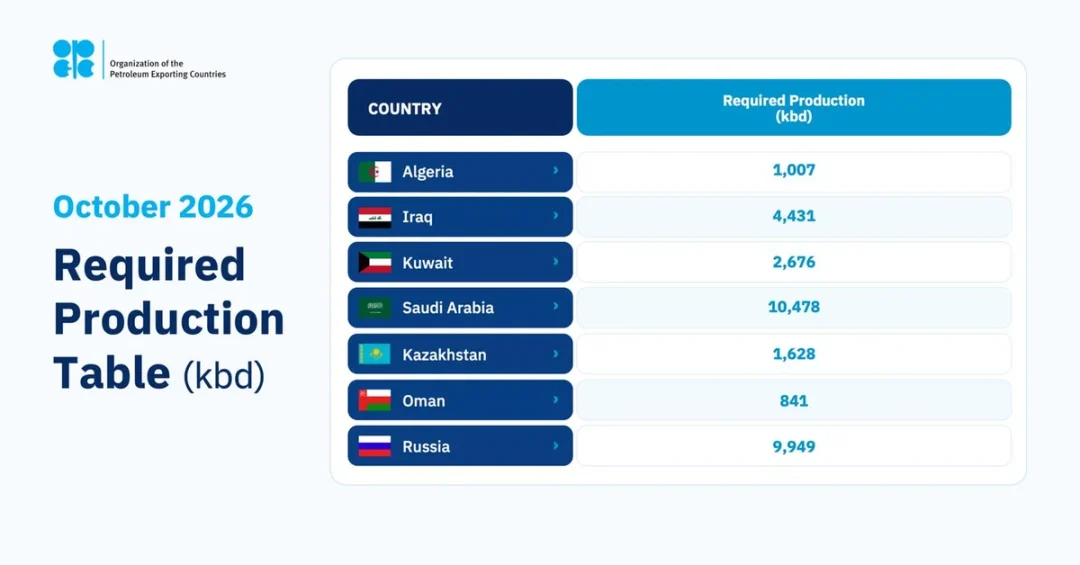
The seven OPEC+ countries that announced additional voluntary production adjustments in April and November 2023 — Saudi Arabia, Russia, Iraq, Kuwait, Kazakhstan, Algeria, and Oman — reaffirmed their collective commitment to oil market stability during a virtual meeting held on September 6, 2026, according to the Saudi Press Agency (SPA). The participating nations decided to maintain the September 2026 required production levels for October 2026 and reiterated their determination to achieve full conformity with the Declaration of Cooperation, the framework agreement that underpins coordinated supply management among OPEC and non-OPEC producers.
The meeting, conducted virtually, reviewed global market conditions and the near-term outlook before confirming the production decision. The seven countries also confirmed that they will continue to hold monthly meetings to assess market developments, with the next gathering scheduled for October 4, 2026. The announcement was carried by SPA, the Kingdom’s official news agency, underscoring the transparency with which Saudi Arabia communicates its energy policy decisions to international markets. How does this decision shape the global oil landscape as 2026 enters its final quarter?
Context and Background
The September 6 meeting builds on a multi-year process of voluntary adjustments that began in April 2023 and was extended in November of the same year. At that time, several OPEC+ members agreed to additional voluntary cuts layered on top of the group-wide production targets, a mechanism designed to support market stability during periods of demand uncertainty. Saudi Arabia has consistently played a leadership role in these efforts, often carrying the largest share of the additional reductions and coordinating closely with partners across the alliance. What makes this coordinated approach so central to global energy security?
The Declaration of Cooperation, first signed in 2016 and renewed in subsequent years, remains the cornerstone of OPEC+ supply management. It formalizes cooperation between OPEC member states and non-OPEC producers, including Russia, Kazakhstan, and Oman, with the shared objective of aligning supply with demand and avoiding destabilizing price swings. Full conformity with the Declaration is not merely a technical target; it is a signal of unity that markets watch closely. The seven countries’ repeated emphasis on conformity in the September 6 statement reflects their awareness that credibility depends on delivery, not just declarations.
Since the initial voluntary adjustments, the group has held monthly meetings to review conditions and adjust course as needed. This cadence has become a defining feature of the alliance’s operating model, allowing for rapid responses to shifting fundamentals such as inventory levels, refinery margins, and macroeconomic indicators. The decision to maintain September 2026 production levels for October 2026 therefore represents continuity rather than a change in direction, reinforcing the group’s preference for predictable, data-driven policy over reactive measures.
Key Details of the September 6 Decision
According to the SPA report, the seven participating countries convened virtually on September 6, 2026, to review global market conditions and outlook. Following that review, they decided to maintain the September 2026 required production for October 2026, as detailed in the table accompanying the official statement. The specific production levels for each country were not altered, meaning the existing quota framework remains in force for the coming month. This continuity gives refiners, traders, and consuming nations a stable reference point as they plan procurement and hedging strategies.
The statement also reiterated the seven countries’ collective commitment to achieve full conformity with the Declaration of Cooperation. Conformity encompasses both production levels and compensation schedules for earlier overproduction, a detail that has taken on greater importance as the alliance seeks to demonstrate that all members share the burden of adjustment equitably. The seven nations confirmed that monthly meetings will continue, with the next session set for October 4, 2026, ensuring that market participants have a clear timeline for the next policy review.
Why does the group’s insistence on monthly reviews matter for long-term market confidence? Regular, scheduled communication reduces uncertainty and allows the alliance to respond to evolving conditions without resorting to emergency measures. It also creates a predictable rhythm for analysts and journalists covering energy markets, who can anchor their expectations to the group’s calendar. For Saudi Arabia, which hosts and often chairs these discussions, the monthly cadence reinforces its role as a convenor and stabilizer within the global energy architecture.
International and Regional Impact
The decision carries significant implications for global oil markets, which have navigated a complex landscape in 2026 characterized by uneven demand growth across regions, shifting inventory patterns, and geopolitical uncertainties. By holding production steady, the seven countries signal that they see current market conditions as broadly balanced and that they are prepared to act if fundamentals deteriorate. This steadiness is particularly valuable for Asian and European importers, who rely on predictable supply flows to manage energy costs and inflation. How might this stability ripple through the broader global economy?
Within the region, the reaffirmed cooperation among Saudi Arabia, Iraq, Kuwait, Oman, and their non-OPEC partners underscores the enduring strength of Gulf energy diplomacy. The inclusion of Russia, Kazakhstan, and Algeria in the voluntary adjustment group highlights the breadth of the coalition, bridging traditional OPEC members with other major producers. For the Middle East, where energy revenues underpin fiscal budgets and development programs, market stability is not an abstract goal but a practical necessity that supports investment planning and social spending.
Consuming nations, meanwhile, benefit from reduced volatility. Sharp price swings can complicate monetary policy, distort investment decisions, and strain household budgets. The group’s steady-hand approach aims to avoid both damaging price collapses and unsustainable spikes, a balance that serves producers and consumers alike. International energy agencies have repeatedly emphasized the importance of predictable supply in supporting global economic growth, and the September 6 decision aligns with that objective.
Economic and Strategic Significance
For Saudi Arabia, the decision reflects the Kingdom’s dual role as both a leading producer and a stabilizing force in global energy markets. The Ministry of Energy, under the leadership of Minister Abdulaziz bin Salman, has consistently articulated a policy of proactive, preemptive action to keep markets balanced. Maintaining production levels for October 2026 preserves the Kingdom’s ability to adjust in either direction at future meetings, retaining flexibility that is crucial in an uncertain environment. What does this flexibility mean for Saudi Arabia’s long-term economic planning?
Strategically, the reaffirmation of conformity supports the credibility of the OPEC+ framework at a time when some analysts question its cohesion. By publicly committing to full conformity and scheduling the next meeting, the seven countries demonstrate that the alliance remains functional and forward-looking. This matters for investment in upstream capacity, where long lead times require confidence that policy will not lurch unpredictably. It also matters for the Kingdom’s broader economic diversification agenda, which depends on stable and sustainable revenue streams from the energy sector during the transition period.
The monthly meeting schedule also provides a platform for ongoing dialogue with other OPEC+ members and with consumer nations. Saudi Arabia has long advocated for producer-consumer dialogue, recognizing that energy transitions and climate goals require cooperation rather than confrontation. The September 6 statement, while focused on production levels, fits within this wider diplomatic effort to position the Kingdom as a responsible and reliable partner in global energy governance.
Vision 2030 Alignment
The decision aligns closely with Saudi Vision 2030, the national transformation program launched under the leadership of Crown Prince Mohammed bin Salman. Vision 2030 seeks to diversify the economy away from oil dependence while simultaneously maximizing the value of the Kingdom’s energy resources to fund that transition. Stable oil markets support the fiscal predictability needed for giga-projects, renewable energy investments, and the expansion of non-oil sectors. By working to keep markets balanced, Saudi Arabia helps ensure that the revenue engine underpinning Vision 2030 continues to perform reliably.
Moreover, the Kingdom’s leadership in OPEC+ reinforces its standing as a global energy statesman, a role that complements Vision 2030’s ambition to make Saudi Arabia a hub for international cooperation and investment. The monthly meetings, the emphasis on conformity, and the transparent communication via SPA all contribute to an image of stability and professionalism that attracts partners across the world. As the next meeting approaches on October 4, 2026, the seven countries’ reaffirmed commitment serves as a reminder that coordinated action remains the most effective tool for navigating the complexities of the global energy market. In a world that often prizes short-term reactions, this steady, forward-looking approach offers a model of responsible stewardship.
20 Questions
Q1. Which countries participated in the September 6, 2026 OPEC+ meeting?
A1. Saudi Arabia, Russia, Iraq, Kuwait, Kazakhstan, Algeria, and Oman participated. These are the seven countries that previously announced additional voluntary adjustments in April and November 2023.
Q2. What was the main decision taken at the meeting?
A2. The seven countries decided to maintain the September 2026 required production levels for October 2026, as detailed in the official table released through the Saudi Press Agency.
Q3. When and where did the meeting take place?
A3. The meeting was held virtually on September 6, 2026. It was reported by the Saudi Press Agency, the Kingdom’s official news outlet.
Q4. What does the Declaration of Cooperation refer to?
A4. The Declaration of Cooperation is the framework agreement between OPEC and non-OPEC producers that underpins coordinated supply management. It was first signed in 2016 and has been renewed since.
Q5. Why did the group emphasize full conformity?
A5. Full conformity ensures all members adhere to agreed production levels and compensation schedules. It signals unity and credibility to global markets, which watch compliance closely.
Q6. When is the next OPEC+ meeting scheduled?
A6. The next meeting will be held on October 4, 2026. The group confirmed it will continue holding monthly meetings to review market conditions and outlook.
Q7. How does this decision affect global oil markets?
A7. Maintaining production levels provides predictability for refiners, traders, and consuming nations. It signals that the group sees current market conditions as broadly balanced and is prepared to act if needed.
Q8. What role does Saudi Arabia play in these meetings?
A8. Saudi Arabia is a leading producer and a stabilizing force. The Kingdom often hosts and chairs discussions, and its Ministry of Energy articulates a policy of proactive market management.
Q9. Which non-OPEC countries are part of this voluntary group?
A9. Russia, Kazakhstan, and Oman are the non-OPEC members in this seven-country group. They coordinate with OPEC members Saudi Arabia, Iraq, Kuwait, and Algeria.
Q10. What were the April and November 2023 adjustments?
A10. In April and November 2023, several OPEC+ members announced additional voluntary production cuts. These were layered on top of group-wide targets to support market stability.
Q11. How does this decision benefit consuming nations?
A11. Consuming nations benefit from reduced price volatility, which helps manage inflation and supports economic planning. Predictable supply flows are especially important for Asian and European importers.
Q12. What is the significance of monthly meetings?
A12. Monthly meetings allow the group to respond quickly to changing fundamentals such as inventory levels and demand shifts. They also provide a predictable calendar for market participants.
Q13. How does the decision align with Saudi Vision 2030?
A13. Stable oil markets support fiscal predictability needed to fund Vision 2030 projects. The Kingdom’s leadership in OPEC+ reinforces its role as a global energy statesman and reliable partner.
Q14. What did the meeting review before making the decision?
A14. The participating countries reviewed global market conditions and the near-term outlook. This review informed their decision to keep production levels unchanged for October 2026.
Q15. How does this affect investment in upstream capacity?
A15. Policy continuity gives investors confidence in long-term planning. Stable production levels reduce uncertainty, encouraging investment in upstream capacity with long lead times.
Q16. What is the source of this information?
A16. The information comes from the Saudi Press Agency (SPA), the Kingdom’s official news agency. It reported the meeting and decisions on September 6, 2026.
Q17. Which Saudi official leads energy policy?
A17. Minister of Energy Abdulaziz bin Salman leads Saudi Arabia’s energy policy. He has consistently articulated a proactive approach to keeping global markets balanced.
Q18. What happens if market conditions change before October 4?
A18. The group holds monthly meetings to review conditions. If fundamentals shift, members can adjust production levels at the next scheduled meeting or through consultations.
Q19. How does this decision affect regional economies?
A19. Gulf economies rely on energy revenues for budgets and development programs. Market stability supports fiscal planning and social spending across the region.
Q20. What is the broader significance of this reaffirmation?
A20. It demonstrates the continued cohesion of the OPEC+ alliance. It also reinforces Saudi Arabia’s role as a stabilizing force in global energy markets and a reliable partner.
Reader Feedback
We value your thoughts. Please share your feedback on this article.
Your feedback helps us improve our coverage.
Related articles
 Al-Bukayriyah date market sells 250 tonnes daily
 Al-Jouf region produces over 880 tons of figs annually
 CEDA Reviews Saudi Economic Resilience and Vision 2030 Progress
 Qassim Palm Sector Tops 10 Million Trees, 584,000 Tons of Dates
 Qassim Preserves Heritage Through Distinctive Date Varieties
 Al-Baha palm trees produce 2,000 tons of dates annually