


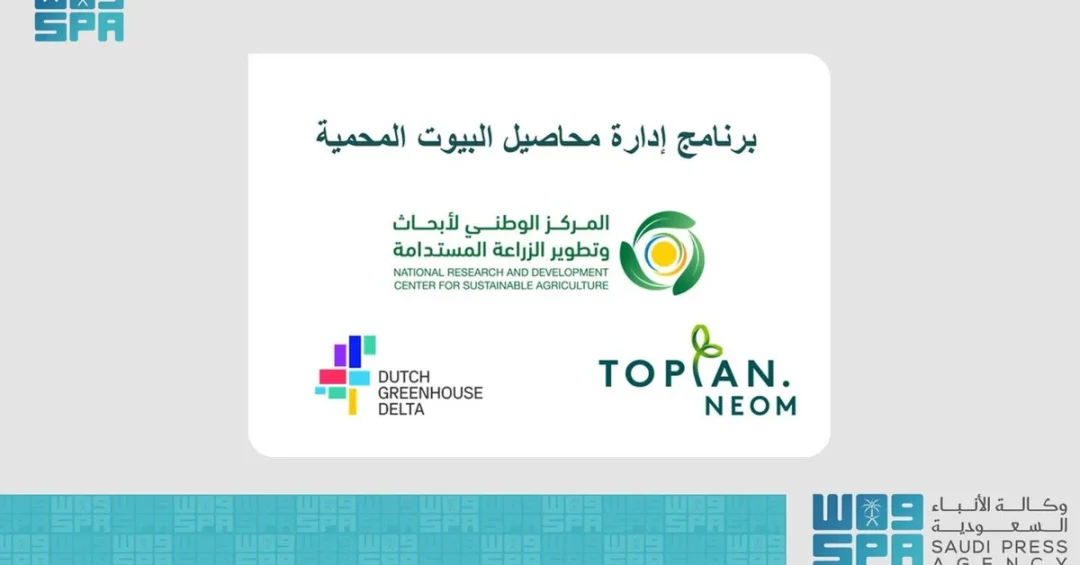
Riyadh, October 12, 2024 — The National Research and Development Center for Sustainable Agriculture (Estidamah) has announced a new greenhouse crop management program in collaboration with the Dutch Greenhouse Delta (DGD) and NEOM Topian Company, set to run from October 13 to November 6, 2024. The initiative, reported by the Saudi Press Agency (SPA), aims to train 75 farmers and industry professionals in advanced sustainable agriculture techniques, reinforcing Saudi Arabia’s commitment to agricultural innovation and food security under Vision 2030. Could this be the next step in transforming the Kingdom’s agricultural landscape?
The program is part of Estidamah’s broader mission to educate farmers and professionals on sustainable agriculture methods, enhance greenhouse operations management, and facilitate knowledge sharing. It will be conducted in three primary tracks over four weeks, covering 11 key topics including agricultural value chain development, integrated pest management, plant physiology, agricultural data analysis, and vertical farming. Participants will gain practical skills to manage greenhouses effectively, share experiences, and contribute to a more sustainable agricultural future.
Context and Background
Why is Saudi Arabia investing in greenhouse crop management now? The Kingdom’s agricultural sector faces unique challenges, including arid climate, limited arable land, and water scarcity. Greenhouse farming offers a solution by enabling controlled environments that optimize resource use and boost yields. Estidamah, established as a national center for sustainable agriculture research and development, has been at the forefront of promoting such innovations. Its collaboration with Dutch Greenhouse Delta, a renowned consortium of Dutch horticultural experts, and NEOM Topian, a subsidiary of NEOM focused on food security, underscores the importance of international partnerships in advancing agricultural technology.
This program aligns with Saudi Arabia’s Vision 2030 goals to diversify the economy, achieve food security, and promote sustainable development. By equipping farmers and professionals with cutting-edge knowledge, Estidamah aims to enhance local production, reduce reliance on imports, and create new economic opportunities in rural areas. The involvement of NEOM Topian highlights the synergy between traditional agriculture and futuristic smart cities, where food production is integrated into urban planning. How will such collaborations shape the future of farming in the region?
The training initiative also reflects global trends toward precision agriculture and climate-smart farming. As climate change impacts traditional farming methods worldwide, Saudi Arabia is proactively adopting technologies that ensure resilience and sustainability. The program’s focus on data analysis and vertical farming demonstrates a forward-looking approach that could serve as a model for other arid regions. By investing in human capital, the Kingdom is building a knowledge-based agricultural economy that can compete globally.
Key Details of the Program
The greenhouse crop management program will be launched in three primary tracks, targeting 75 trainees and industry professionals. Over four weeks, participants will delve into 11 core topics designed to address every aspect of modern greenhouse operations. These include the development of the agricultural value chain, which covers everything from production to marketing; integrated pest management, emphasizing eco-friendly pest control; plant physiology, focusing on how plants respond to their environment; agricultural data analysis, leveraging big data for decision-making; and vertical farming, a space-efficient method for growing crops in stacked layers. Each track combines theoretical knowledge with practical applications, ensuring participants can immediately apply what they learn.
Who will benefit most from this training? The program is tailored for farmers, agronomists, and agricultural professionals who are eager to adopt sustainable practices. By enhancing their skills, Estidamah aims to create a ripple effect, where trained individuals transfer knowledge to their communities, multiplying the impact. The collaboration with DGD brings Dutch expertise in greenhouse technology, known for its efficiency and innovation, while NEOM Topian contributes insights into integrating food production with smart city infrastructure. This tripartite partnership ensures a holistic approach to agricultural education.
The program’s timing is strategic, coinciding with the growing global demand for sustainable food production. Saudi Arabia has been making significant strides in agriculture, with initiatives like the National Agriculture Strategy 2030 and the Sustainable Agricultural Rural Development Program. By focusing on greenhouse crops, Estidamah addresses a critical area that can significantly boost year-round production and reduce water consumption. The use of advanced irrigation systems, climate control, and renewable energy in greenhouses aligns with the Kingdom’s environmental goals. What impact will these trained professionals have on Saudi Arabia’s agricultural output?
International and Regional Impact
How does this program position Saudi Arabia on the global stage? The collaboration with Dutch Greenhouse Delta, a leader in horticultural innovation, signals Saudi Arabia’s openness to international partnerships and its commitment to adopting best practices. The Netherlands is renowned for its advanced greenhouse technology, and by partnering with DGD, Estidamah gains access to decades of expertise. This knowledge transfer not only benefits Saudi farmers but also strengthens bilateral ties between the Kingdom and the Netherlands. Furthermore, the involvement of NEOM Topian showcases Saudi Arabia’s ambition to lead in futuristic solutions, potentially attracting further foreign investment and collaboration.
Regionally, the program could inspire similar initiatives in neighboring countries facing comparable agricultural challenges. The Middle East and North Africa region is particularly vulnerable to climate change, water scarcity, and food insecurity. By demonstrating successful sustainable agriculture models, Saudi Arabia can emerge as a regional leader in agricultural innovation. The training’s emphasis on data analysis and vertical farming also aligns with global trends, positioning the Kingdom as a hub for agri-tech. Could this be a catalyst for a regional agricultural renaissance?
Economic and Strategic Significance
What economic benefits can Saudi Arabia expect from improved greenhouse management? Agriculture contributes to the Kingdom’s economy by providing employment, supporting rural communities, and reducing import dependency. By enhancing greenhouse productivity, farmers can increase yields, improve quality, and extend growing seasons, leading to higher revenues. The program also fosters entrepreneurship, as participants may establish their own greenhouse ventures or offer consultancy services. Moreover, sustainable practices lower operational costs by optimizing water and energy use, making agriculture more profitable and environmentally friendly.
Strategically, food security is a cornerstone of Vision 2030. Saudi Arabia currently imports a significant portion of its food, making it vulnerable to global supply chain disruptions. By boosting local production through advanced greenhouse techniques, the Kingdom can enhance self-sufficiency and ensure stable food supplies. The program’s focus on value chain development helps integrate small-scale farmers into larger markets, creating a more resilient agricultural ecosystem. This aligns with the National Transformation Program’s goals to diversify income sources and increase non-oil GDP. How will these efforts reshape Saudi Arabia’s economic landscape?
Vision 2030 Alignment
This initiative is a clear embodiment of Vision 2030’s objectives to achieve food security, promote sustainability, and diversify the economy. Vision 2030 emphasizes the importance of sustainable agriculture and rural development, and Estidamah’s program directly contributes by building human capacity and fostering innovation. The partnership with NEOM Topian highlights the integration of agriculture with smart city development, a key pillar of the NEOM project. By training professionals in cutting-edge techniques, Saudi Arabia is investing in its most valuable resource—its people—to drive long-term growth.
As the Kingdom continues to pursue its ambitious transformation, programs like this demonstrate how collaboration between government, international partners, and the private sector can yield tangible results. The knowledge and skills gained by participants will not only improve their livelihoods but also contribute to the nation’s food security and economic resilience. Estidamah’s leadership in sustainable agriculture research underscores Saudi Arabia’s role as a pioneer in addressing global challenges. Where will this journey take the Kingdom next?
20 Questions
Q1. What is the National Research and Development Center for Sustainable Agriculture (Estidamah)?
A1. Estidamah is a Saudi center dedicated to advancing sustainable agriculture through research, development, and training. It focuses on addressing challenges like water scarcity and climate change to enhance food security.
Q2. Who are the partners in this greenhouse crop management program?
A2. The program is a collaboration between Estidamah, the Dutch Greenhouse Delta (DGD), and NEOM Topian Company. These partners bring expertise in sustainable agriculture, greenhouse technology, and smart food systems.
Q3. When and where will the program take place?
A3. The program runs from October 13 to November 6, 2024, and is based in Saudi Arabia. It will be conducted in three primary tracks over a four-week period.
Q4. How many trainees will participate in the program?
A4. The program targets 75 trainees and industry professionals. They will gain advanced skills in greenhouse management and sustainable agriculture practices.
Q5. What are the main topics covered in the training?
A5. The program covers 11 key topics, including agricultural value chain development, integrated pest management, plant physiology, agricultural data analysis, and vertical farming. These topics address all aspects of modern greenhouse operations.
Q6. What is the goal of the program?
A6. The goal is to educate farmers and professionals on sustainable agriculture methods, improve greenhouse operations management, and share information. It aims to create a more sustainable agricultural future.
Q7. Why is greenhouse farming important for Saudi Arabia?
A7. Greenhouse farming allows for controlled environments that optimize water and land use, essential in Saudi Arabia’s arid climate. It boosts yields and supports food security.
Q8. How does this program support Vision 2030?
A8. It aligns with Vision 2030 by promoting food security, sustainability, and economic diversification. It builds human capital and fosters innovation in agriculture.
Q9. What role does NEOM Topian play in the program?
A9. NEOM Topian contributes expertise in integrating food production with smart city infrastructure. It supports the development of sustainable food systems within NEOM.
Q10. What expertise does Dutch Greenhouse Delta bring?
A10. DGD brings world-renowned Dutch greenhouse technology and horticultural knowledge. Their involvement ensures participants learn best practices from global leaders.
Q11. What is vertical farming, and why is it included?
A11. Vertical farming involves growing crops in stacked layers, often in controlled environments. It is included to teach space-efficient methods suitable for urban and arid areas.
Q12. How will participants apply their training?
A12. Participants will apply their skills to manage greenhouses more efficiently, share knowledge with peers, and implement sustainable practices. This can lead to increased productivity and reduced resource use.
Q13. What is integrated pest management?
A13. Integrated pest management is an eco-friendly approach to controlling pests using biological, cultural, and chemical methods. It minimizes environmental impact and promotes healthy crops.
Q14. How does agricultural data analysis benefit farmers?
A14. Data analysis helps farmers make informed decisions on irrigation, fertilization, and harvesting. It optimizes resource use and increases yields.
Q15. What is the agricultural value chain?
A15. The agricultural value chain encompasses all stages from production to consumption, including processing, distribution, and marketing. Understanding it helps farmers improve efficiency and profitability.
Q16. Will the program be repeated in the future?
A16. While specific plans are not announced, Estidamah frequently conducts training programs. The success of this initiative may lead to similar future offerings.
Q17. How does this program contribute to food security?
A17. By enhancing local greenhouse production, the program reduces reliance on imports and ensures a stable food supply. This strengthens national food security.
Q18. What economic opportunities does sustainable agriculture create?
A18. It creates jobs in agri-tech, promotes entrepreneurship, and supports rural development. It also attracts investment in innovative farming technologies.
Q19. How does the program promote international cooperation?
A19. It brings together Saudi, Dutch, and NEOM entities, fostering knowledge exchange and partnerships. This enhances Saudi Arabia’s global engagement in agriculture.
Q20. What is the expected outcome of the program?
A20. The expected outcome is a cohort of skilled professionals capable of implementing sustainable greenhouse practices. This will boost productivity, sustainability, and food security in Saudi Arabia.
Reader Feedback
We value your thoughts. Please share your feedback on this article.
Your feedback helps us improve our coverage.
Related articles
 Biban24: Over 40 Entities to Empower Entrepreneurs in Riyadh
 Saudi Ministry Promotes Broiler Pigeon Breeding for Food Security
 KSIADC, ewpartners Sign MoU for E-commerce Logistics Zone
 GCC Expansion Key Focus for Global Countries: Albudaiwi
 GEA and SDB Partner to Empower Cottage Industry During Riyadh Season
 Madinah Buildex 2024 Sees Widespread Attendance