


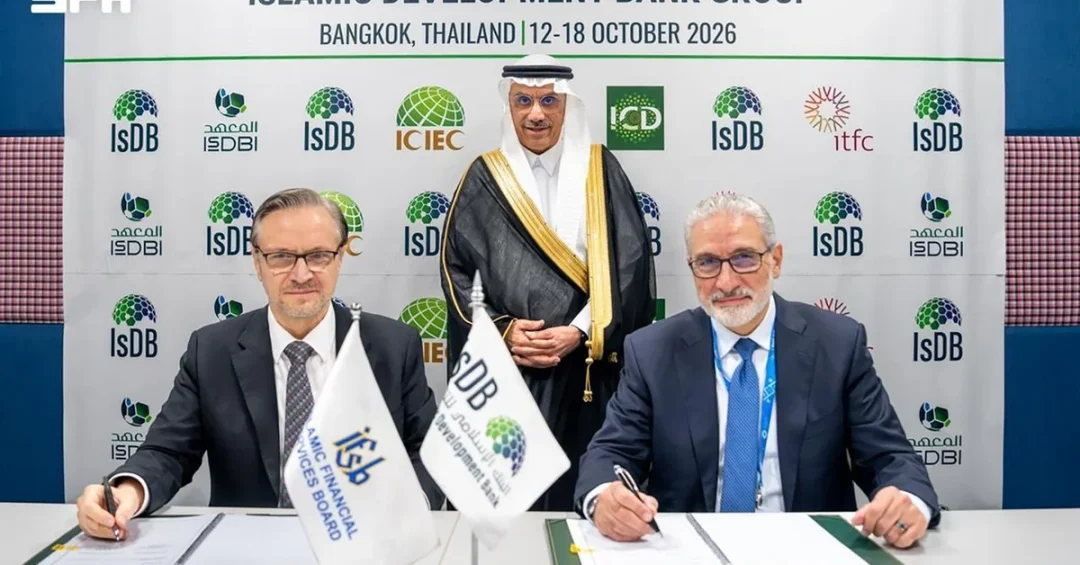
The Islamic Development Bank (IsDB) Group and the Islamic Financial Services Board (IFSB) have formalized a Strategic Collaboration Framework to promote stability, financial inclusion, and sustainable growth across the global Islamic financial services industry. The agreement was signed in Jeddah by Dr. Rami Ahmad, IsDB Vice President of Operations, and Dr. Ghiath Shabsigh, Secretary-General of the IFSB, in the presence of Dr. Muhammad Al Jasser, Chairman of the IsDB Group. The signing took place on the sidelines of the 2026 Annual Meetings of the International Monetary Fund and the World Bank Group, according to the Saudi Press Agency (SPA).
The framework marks a significant step in institutionalizing cooperation between two of the most influential bodies in Islamic finance, a sector that now operates across more than 50 countries and serves a global Muslim population estimated at nearly two billion people. By aligning the IsDB’s five decades of development finance experience with the IFSB’s standard-setting mandate, the agreement seeks to ensure that Islamic financial institutions are not only larger and more inclusive, but also safer, more resilient, and better integrated into the international financial system. For Saudi Arabia, which hosts the IsDB headquarters in Jeddah and has long championed multilateral Islamic finance cooperation, the framework reinforces the Kingdom’s role as a convening power in the global Islamic economy.
Context and Background
Why does a formal framework between the IsDB and the IFSB matter at this particular moment in the evolution of Islamic finance? The global Islamic financial services industry has grown rapidly over the past two decades, with assets now estimated in the trillions of dollars and spanning banking, capital markets, takaful, and sukuk issuance. Yet this growth has exposed a persistent gap: while standard-setting bodies such as the IFSB develop prudential and supervisory standards, many member countries lack the institutional capacity to implement them effectively. The new framework directly addresses that gap by creating a structured, multiyear mechanism for coordination, capacity building, and technical assistance.
The IsDB Group, headquartered in Jeddah, Saudi Arabia, has been a cornerstone of development finance since its establishment in 1975. It operates through multiple entities, including the Islamic Development Bank, the Islamic Corporation for the Development of the Private Sector (ICD), and the International Islamic Trade Finance Corporation (ITFC). The IFSB, based in Kuala Lumpur, Malaysia, was established in 2002 to promote the soundness and stability of the Islamic financial services industry by issuing global regulatory and supervisory standards. Both institutions have long collaborated informally, but the Strategic Collaboration Framework elevates that relationship into a formal, programmatic partnership with defined work streams and shared objectives.
The timing is also significant. The 2026 IMF-World Bank Annual Meetings brought together finance ministers, central bank governors, and development finance leaders from around the world, providing a high-visibility platform for the signing. By formalizing the framework in that setting, the IsDB and IFSB signal to the global financial community that Islamic finance is not a niche segment but an integral part of the international financial architecture. For Saudi Arabia, this aligns closely with the Kingdom’s broader push under Vision 2030 to deepen its financial sector, expand non-oil economic activity, and position Riyadh and Jeddah as hubs for Islamic finance innovation and regulation.
Key Details of the Strategic Collaboration Framework
What exactly does the framework commit the two institutions to do? According to the announcement carried by SPA, the framework establishes a multiyear work program covering four principal areas. First, institutional capacity building: the IsDB and IFSB will work together to strengthen the ability of regulatory authorities and financial institutions in member countries to adopt and enforce international standards. Second, technical assistance: the partnership will provide targeted support to jurisdictions that are developing or refining their Islamic finance regulatory frameworks, including legal, supervisory, and reporting infrastructure.
Third, the framework emphasizes closer integration between regulatory standard-setting and on-the-ground implementation. This is a critical point. The IFSB’s standards are widely recognized, but their effectiveness depends on whether countries can translate them into domestic rules and supervisory practices. The IsDB’s development finance expertise and country-level presence give it unique leverage to help bridge that implementation gap. Fourth, the framework includes joint research on emerging risks and opportunities in Islamic finance, as well as the systematic exchange of best practices among member countries and regulatory bodies.
Dr. Rami Ahmad, IsDB Vice President of Operations, stressed that supporting the global regulatory architecture of Islamic finance is a priority for the IsDB Group. He noted that the framework takes the partnership with the IFSB to the next level, helping enhance the efficiency and capacity of financial institutions in member countries. Dr. Ghiath Shabsigh, IFSB Secretary-General, added that the effectiveness of regulatory standards depends on the ability of countries and their institutions to implement them, and that the IsDB’s five decades of experience in development finance help translate regulatory frameworks into stronger, more resilient financial systems. He also expressed his eagerness to expand cooperation between the two institutions. The presence of Dr. Muhammad Al Jasser, IsDB Group Chairman, at the signing underscored the strategic importance the Bank attaches to the agreement.
International and Regional Impact
How will this framework resonate beyond the immediate circle of Islamic finance practitioners? The agreement has implications for global financial stability, particularly in emerging markets and developing economies where Islamic finance is a growing share of the financial sector. Stronger regulatory frameworks reduce systemic risk, improve transparency, and make these markets more attractive to international investors. For multilateral institutions such as the IMF and the World Bank, the framework represents a constructive example of South-South cooperation and specialized standard-setting that complements broader global financial reform efforts.
Regionally, the framework reinforces the role of the Gulf Cooperation Council (GCC) countries, and Saudi Arabia in particular, as anchors of the Islamic financial system. The Kingdom is home to the IsDB and hosts a rapidly expanding Islamic banking sector, a vibrant sukuk market, and a growing ecosystem of fintech and financial innovation. By supporting the IFSB’s standards and implementation capacity, the framework helps create a more predictable and harmonized regulatory environment across member countries, which in turn facilitates cross-border investment and trade. This is especially relevant for countries in Africa, Central Asia, and Southeast Asia, where Islamic finance is often seen as a tool for financial inclusion and infrastructure financing.
Economic and Strategic Significance
Why should international observers pay attention to a technical-sounding collaboration framework? Because the stakes are substantial. Islamic finance is no longer a marginal phenomenon; it is a multi-trillion-dollar industry that finances infrastructure, trade, small and medium enterprises, and social development across dozens of countries. The stability and soundness of this industry affect not only Muslim-majority economies but also global banks and investors that participate in sukuk markets and Islamic syndicated lending. A more robust regulatory architecture, supported by capacity building and technical assistance, reduces the risk of shocks and enhances the sector’s contribution to sustainable development.
For Saudi Arabia, the framework aligns with several strategic priorities. The Kingdom’s Financial Sector Development Program, a key pillar of Vision 2030, aims to create a diversified and efficient financial sector, increase the depth of capital markets, and promote financial inclusion. Saudi Arabia has also been a leading issuer of sukuk and a strong advocate for Islamic finance in multilateral forums. By supporting the IsDB-IFSB framework, the Kingdom reinforces its soft power and its reputation as a responsible global stakeholder. Moreover, the framework’s emphasis on research and best-practice exchange can help Saudi institutions stay at the forefront of regulatory innovation, including in areas such as sustainable finance, digital assets, and climate-related risk disclosure.
Vision 2030 Alignment
How does this development connect to Saudi Arabia’s long-term vision? Vision 2030 seeks to transform the Kingdom into a global investment powerhouse and a hub connecting three continents. A stable, well-regulated Islamic financial system is essential to that ambition. The IsDB-IFSB framework strengthens the institutional infrastructure that underpins Islamic finance, making it easier for Saudi banks, sukuk issuers, and fintech firms to operate internationally and for foreign institutions to participate in the Kingdom’s financial markets. It also supports the broader goal of enhancing Saudi Arabia’s role in multilateral development cooperation, a role that the Kingdom has increasingly embraced through its presidency of the G20 in 2020 and its active engagement in global financial governance.
Looking ahead, the framework’s multiyear work program will be implemented through joint technical missions, training programs, research publications, and policy dialogues. Success will depend on sustained commitment from both institutions and on the willingness of member countries to adopt and enforce standards. But the direction of travel is clear: Islamic finance is becoming more institutionalized, more integrated, and more resilient. For Saudi Arabia, the framework is another example of how the Kingdom uses its convening power and its development finance institutions to advance global public goods. As the IsDB and IFSB begin implementing their new partnership, they will be contributing not only to the stability of Islamic finance but also to the broader goals of sustainable development and international financial cooperation that Saudi Arabia has consistently championed.
20 Questions
Q1. What is the Strategic Collaboration Framework between the IsDB and the IFSB?
A1. It is a formal agreement signed in Jeddah to promote stability, financial inclusion, and sustainable growth in the global Islamic financial services industry through coordinated capacity building, technical assistance, research, and standard-setting support.
Q2. Who signed the framework on behalf of the two institutions?
A2. Dr. Rami Ahmad, IsDB Vice President of Operations, signed for the Islamic Development Bank Group, and Dr. Ghiath Shabsigh, Secretary-General, signed for the Islamic Financial Services Board.
Q3. Where and when was the agreement signed?
A3. The agreement was signed in Jeddah on the sidelines of the 2026 Annual Meetings of the International Monetary Fund and the World Bank Group, according to the Saudi Press Agency.
Q4. Who witnessed the signing of the framework?
A4. Dr. Muhammad Al Jasser, Chairman of the IsDB Group, attended the signing, underscoring the strategic importance the Bank attaches to deepening its partnership with the IFSB.
Q5. What are the main objectives of the framework?
A5. The framework aims to strengthen institutional and strategic coordination, support financial inclusion and sustainable economic development, and develop regulatory frameworks that enhance the safety and soundness of Islamic finance in member countries.
Q6. What does the multiyear work program cover?
A6. It covers institutional capacity building, technical assistance, closer integration between regulatory standard-setting and implementation, joint research on emerging risks and opportunities, and the exchange of best practices.
Q7. Why is regulatory implementation emphasized in the framework?
A7. IFSB Secretary-General Dr. Ghiath Shabsigh noted that the effectiveness of regulatory standards depends on the ability of countries and their institutions to implement them, making implementation support essential.
Q8. How does the IsDB’s experience contribute to the partnership?
A8. The IsDB brings five decades of development finance experience, which helps translate regulatory frameworks into stronger, more resilient financial systems in member countries, according to Dr. Shabsigh.
Q9. What did Dr. Rami Ahmad say about the framework?
A9. He stressed that supporting the global regulatory architecture of Islamic finance is a priority for the IsDB Group and said the framework takes the partnership with the IFSB to the next level.
Q10. How does the framework support financial inclusion?
A10. By helping member countries build regulatory and institutional capacity, the framework enables broader access to Islamic financial services, particularly for underserved populations and small businesses in developing economies.
Q11. What is the IFSB’s role in Islamic finance?
A11. The Islamic Financial Services Board, based in Kuala Lumpur, issues global regulatory and supervisory standards to promote the soundness and stability of the Islamic financial services industry.
Q12. What is the IsDB Group’s role in development finance?
A12. Established in 1975 and headquartered in Jeddah, the IsDB Group provides development financing and technical assistance through entities including the Islamic Development Bank, ICD, and ITFC.
Q13. Why is the signing significant for Saudi Arabia?
A13. Saudi Arabia hosts the IsDB headquarters in Jeddah and has long championed multilateral Islamic finance cooperation, reinforcing the Kingdom’s role as a convening power in the global Islamic economy.
Q14. How does the framework affect global financial stability?
A14. Stronger regulatory frameworks reduce systemic risk, improve transparency, and make Islamic finance markets more attractive to international investors, contributing to broader global financial stability.
Q15. Which regions will benefit most from the framework?
A15. Member countries across Africa, Central Asia, Southeast Asia, and the Middle East are expected to benefit, particularly those developing their Islamic finance regulatory and supervisory infrastructure.
Q16. How does the framework relate to Vision 2030?
A16. It supports Saudi Arabia’s Financial Sector Development Program by strengthening the institutional infrastructure for Islamic finance, enhancing the Kingdom’s global financial role and supporting economic diversification.
Q17. What kind of research will the framework include?
A17. The framework includes joint research on emerging risks and opportunities in Islamic finance, helping regulators and institutions anticipate challenges and adopt best practices in a rapidly evolving sector.
Q18. How will the framework be implemented?
A18. Implementation will occur through a multiyear work program involving joint technical missions, training programs, research publications, and policy dialogues between the IsDB and IFSB.
Q19. What makes this partnership different from previous cooperation?
A19. The framework formalizes and structures what was previously informal collaboration, creating a defined work program with shared objectives, resources, and accountability for results.
Q20. What is the long-term outlook for Islamic finance under this framework?
A20. The framework is expected to make Islamic finance more institutionalized, integrated, and resilient, enhancing its contribution to sustainable development and international financial cooperation.
Reader Feedback
We value your thoughts. Please share your feedback on this article.
Your feedback helps us improve our coverage.
Related articles
 World Petroleum Congress Highlights Energy Investment in Riyadh
 GCC Chief Meets IFC Vice President in Bangkok
 SAMA Licenses Trafileks for Money Changing in Saudi Arabia
 IMF Extends Aljadaan’s IMFC Chairmanship to January 2028
 GCC Secretary-General Meets BIS General Manager in Bangkok
 GCC, Egypt Discuss Economic Cooperation in Bangkok