


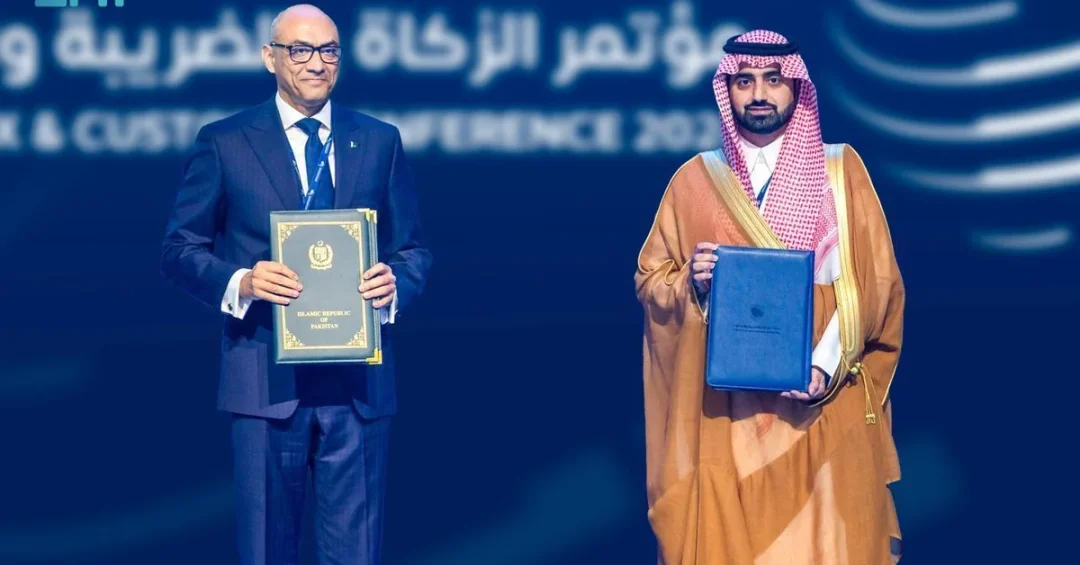
Saudi Arabia and Pakistan signed a customs cooperation and mutual assistance agreement in Riyadh on December 4, 2024, during the Zakat, Tax, and Customs Conference, marking a significant step forward in bilateral trade relations. The agreement was signed by Eng. Abdullah bin Ahmed Alfuntukh, Deputy Governor for Strategy and Trade Facilitation at the Zakat, Tax, and Customs Authority (ZATCA), and Ahmad Farooq, the Pakistani Ambassador to the Kingdom, according to the Saudi Press Agency.
The signing ceremony took place on the opening day of the Zakat, Tax, and Customs Conference, a major gathering that brings together policymakers, trade experts, and international stakeholders to discuss the future of customs administration and trade facilitation. The agreement underscores the Kingdom’s commitment to strengthening economic partnerships and enhancing the efficiency of cross-border trade. It also reflects Saudi Arabia’s broader strategy to position itself as a global logistics hub under Vision 2030. The pact focuses on administrative cooperation, exchange of expertise, and the adoption of advanced customs technologies, all of which are designed to streamline trade and reduce barriers between the two nations.
Context and Background: Why Does This Agreement Matter Now?
Saudi Arabia and Pakistan have shared deep-rooted historical, cultural, and economic ties for decades. Pakistan is home to a significant expatriate community in the Kingdom, and the two countries have consistently collaborated on trade, investment, and defense. In recent years, Saudi Arabia has accelerated its efforts to diversify its economy and expand non-oil trade, with a particular focus on Asia. Pakistan, with its strategic geographic location and growing consumer market, represents a key partner in this endeavor. The customs agreement comes at a time when global trade dynamics are shifting, and countries are seeking to enhance supply chain resilience and reduce bottlenecks.
What does this agreement mean for the future of Saudi-Pakistani economic relations? It signals a mutual commitment to removing obstacles that hinder the flow of goods and services. By aligning customs procedures and sharing best practices, both nations can reduce clearance times, lower costs for businesses, and increase transparency. This is particularly important as Saudi Arabia continues to implement sweeping reforms to improve its business environment and attract foreign investment. The agreement also complements existing bilateral trade agreements and investment protection treaties, creating a more comprehensive framework for economic cooperation.
The Zakat, Tax, and Customs Conference itself serves as a platform for showcasing Saudi Arabia’s advancements in digital customs systems and its efforts to integrate cutting-edge technologies such as artificial intelligence and blockchain into trade processes. The presence of international delegates and the signing of such agreements demonstrate the Kingdom’s growing role as a leader in global trade facilitation. For Pakistan, the agreement offers an opportunity to benefit from Saudi expertise and to enhance its own customs capabilities, which can lead to more efficient trade and increased export opportunities.
Key Details: What the Agreement Entails
The agreement on cooperation and mutual assistance in customs matters is comprehensive in scope. It includes provisions for the exchange of information and expertise, capacity building, and the adoption of advanced customs technologies. According to the Saudi Press Agency, the pact aims to facilitate trade by enhancing administrative assistance and cooperation in customs matters. This includes sharing best practices in risk management, post-clearance audits, and the use of digital tools to combat smuggling and trade fraud. By working together, both countries can improve the efficiency of their customs operations and ensure compliance with international standards.
How will this agreement translate into tangible benefits for businesses and consumers? For traders, the agreement promises smoother and faster customs procedures, which can reduce delays at ports and borders. This is expected to lower transaction costs and make products more competitive in both markets. For consumers, it could mean greater access to a wider variety of goods at more affordable prices. The agreement also emphasizes the exchange of expertise, which will help both countries stay abreast of emerging trends and technologies in customs administration. This is particularly relevant as global trade becomes increasingly digital and data-driven.
Eng. Abdullah bin Ahmed Alfuntukh, Deputy Governor for Strategy and Trade Facilitation at ZATCA, has been a key figure in Saudi Arabia’s efforts to modernize customs operations. His participation in the signing underscores the Kingdom’s strategic focus on trade facilitation as a driver of economic growth. Ambassador Ahmad Farooq, representing Pakistan, highlighted the importance of the agreement in strengthening bilateral ties and expanding economic cooperation. The signing ceremony was attended by officials from both sides, reflecting the high level of commitment to making the agreement a success.
International and Regional Impact: Beyond Bilateral Trade
What are the broader implications of this agreement for regional and international trade? The Saudi-Pakistan customs cooperation agreement is part of a larger trend of increasing economic integration in Asia and the Middle East. Saudi Arabia has been actively forging partnerships with countries across Asia, including China, India, and Japan, as part of its Look East strategy. Pakistan, with its location at the crossroads of South Asia, Central Asia, and the Middle East, is a natural partner in these efforts. The agreement could also complement the China-Pakistan Economic Corridor (CPEC) and other regional connectivity initiatives, potentially creating new trade routes and opportunities.
From a regional perspective, the agreement strengthens the economic pillar of the Saudi-Pakistani relationship, which has traditionally been dominated by energy and labor exchanges. By enhancing customs cooperation, both countries are laying the groundwork for increased trade in non-oil goods, including textiles, agricultural products, and manufactured goods. This diversification is aligned with Saudi Arabia’s Vision 2030 goal of increasing non-oil exports and reducing dependence on hydrocarbons. For Pakistan, it offers a chance to boost exports to the Kingdom and to benefit from Saudi Arabia’s growing market. The agreement also sends a positive signal to investors and businesses about the reliability and predictability of trade procedures between the two countries.
On a global scale, the agreement reflects Saudi Arabia’s active engagement in multilateral trade forums and its commitment to the principles of the World Customs Organization (WCO). By aligning with international best practices, the Kingdom is enhancing its reputation as a transparent and efficient trading partner. This can attract further foreign investment and facilitate Saudi Arabia’s integration into global value chains. For Pakistan, the agreement provides an opportunity to learn from Saudi Arabia’s advanced customs systems and to improve its own trade facilitation measures, which can help attract foreign direct investment and boost economic growth.
Economic and Strategic Significance: A Pillar of Vision 2030
Why is this agreement strategically important for Saudi Arabia’s economic ambitions? Under Vision 2030, the Kingdom aims to transform its economy from oil-dependent to diversified and knowledge-based. A key component of this transformation is becoming a global logistics and trade hub, connecting three continents. The National Industrial Development and Logistics Program (NIDLP) is one of the Vision 2030 realization programs designed to achieve this. Efficient customs procedures are critical to the success of this program, as they directly impact the speed and cost of moving goods across borders. The agreement with Pakistan is a building block in this strategy, as it enhances the Kingdom’s trade connectivity with a major South Asian economy.
What economic benefits can Saudi Arabia expect from this agreement? By facilitating trade with Pakistan, Saudi Arabia can increase its non-oil exports to a market of over 240 million people. Sectors such as petrochemicals, plastics, and construction materials stand to gain. Additionally, the agreement can boost bilateral investment by making it easier for Saudi companies to do business in Pakistan and vice versa. The exchange of expertise in customs technologies can also lead to cost savings and improved efficiency for ZATCA, which is already implementing advanced systems like the FASAH platform for trade facilitation. Overall, the agreement supports the Vision 2030 objectives of increasing non-oil revenue, attracting foreign investment, and creating jobs.
For Pakistan, the agreement is equally significant. It provides an opportunity to enhance its trade competitiveness by adopting modern customs practices. Pakistan has been working to improve its trade facilitation under the WTO Trade Facilitation Agreement, and cooperation with Saudi Arabia can accelerate these efforts. The agreement can also help Pakistan diversify its export markets and reduce its trade deficit. Moreover, stronger economic ties with Saudi Arabia can lead to increased Saudi investment in Pakistan’s energy, infrastructure, and agriculture sectors, which are crucial for Pakistan’s economic development. The strategic significance of the agreement extends beyond economics, as it reinforces the enduring friendship and solidarity between the two nations.
Vision 2030 Alignment: A Step Toward a Diversified Future
How does the customs cooperation agreement align with Saudi Arabia’s Vision 2030? Vision 2030 is built on three main pillars: a vibrant society, a thriving economy, and an ambitious nation. The agreement contributes to the thriving economy pillar by enhancing trade facilitation, which is essential for economic diversification and growth. It also supports the ambitious nation pillar by demonstrating Saudi Arabia’s proactive approach to international cooperation and its commitment to global best practices. The agreement is a clear example of how the Kingdom is leveraging international partnerships to achieve its domestic goals. It also aligns with the Vision 2030 goal of increasing non-oil exports from 16% to 50% of non-oil GDP by 2030.
What does this mean for the future of Saudi-Pakistani relations? The customs agreement is expected to pave the way for further collaboration in areas such as digital trade, e-commerce, and investment. It also complements other Vision 2030 initiatives, such as the Saudi Green Initiative and the Middle East Green Initiative, which Pakistan has supported. As Saudi Arabia continues to open up its economy and reduce barriers to trade, partnerships like this one will be crucial in achieving the Vision 2030 targets. The agreement underscores the Kingdom’s role as a responsible global player and a bridge between continents, and it reinforces the message that Saudi Arabia is open for business and committed to shared prosperity.
20 Questions
Q1. What is the customs cooperation agreement between Saudi Arabia and Pakistan?
A1. It is an agreement on cooperation and mutual assistance in customs matters, signed on December 4, 2024, in Riyadh, aimed at facilitating trade through enhanced administrative assistance and the exchange of expertise.
Q2. Who signed the agreement on behalf of Saudi Arabia?
A2. Eng. Abdullah bin Ahmed Alfuntukh, Deputy Governor for Strategy and Trade Facilitation at the Zakat, Tax, and Customs Authority (ZATCA), signed for Saudi Arabia.
Q3. Who signed the agreement on behalf of Pakistan?
A3. Ahmad Farooq, the Pakistani Ambassador to the Kingdom of Saudi Arabia, signed the agreement on behalf of Pakistan.
Q4. Where was the agreement signed?
A4. The agreement was signed in Riyadh during the Zakat, Tax, and Customs Conference, which began on December 4, 2024.
Q5. What is the main purpose of the agreement?
A5. The main purpose is to facilitate trade by enhancing cooperation and administrative assistance in customs matters between the two countries.
Q6. What does the agreement say about exchange of expertise?
A6. It emphasizes the exchange of expertise and best practices to strengthen both countries’ capabilities to adopt advanced customs technologies.
Q7. How does this agreement benefit Saudi Arabia?
A7. It helps Saudi Arabia enhance trade connectivity, increase non-oil exports, and advance its goal of becoming a global logistics hub under Vision 2030.
Q8. How does this agreement benefit Pakistan?
A8. It allows Pakistan to improve customs efficiency, boost exports to Saudi Arabia, and benefit from Saudi expertise in advanced customs systems.
Q9. What is the Zakat, Tax, and Customs Conference?
A9. It is a major conference in Riyadh that brings together policymakers and experts to discuss customs, tax, and zakat issues, and to showcase innovations in trade facilitation.
Q10. When did the agreement take place?
A10. The agreement was signed on December 4, 2024, during the opening day of the Zakat, Tax, and Customs Conference.
Q11. What are the key areas of cooperation under the agreement?
A11. Key areas include exchange of information, capacity building, risk management, post-clearance audits, and the use of digital tools to combat smuggling and trade fraud.
Q12. How does this agreement align with Saudi Vision 2030?
A12. It supports Vision 2030 by enhancing trade facilitation, which is vital for economic diversification, increasing non-oil exports, and attracting foreign investment.
Q13. What role does ZATCA play in this agreement?
A13. ZATCA is the Saudi authority responsible for zakat, tax, and customs. It signed the agreement and will oversee its implementation to improve customs procedures.
Q14. Will the agreement reduce trade barriers between the two countries?
A14. Yes, by streamlining customs procedures and enhancing cooperation, the agreement aims to reduce non-tariff barriers and facilitate smoother trade flows.
Q15. What technologies are mentioned in the agreement?
A15. The agreement mentions advanced customs technologies, which may include digital systems, artificial intelligence, and blockchain for trade facilitation and risk management.
Q16. How does this agreement affect businesses in Saudi Arabia and Pakistan?
A16. It can lower transaction costs, reduce delays at borders, and make it easier for businesses to trade, thereby increasing competitiveness and market access.
Q17. Is this agreement part of a larger Saudi strategy?
A17. Yes, it is part of Saudi Arabia’s broader strategy to expand trade partnerships, especially in Asia, and to position itself as a global logistics and trade hub.
Q18. What are the expected outcomes of the agreement?
A18. Expected outcomes include faster customs clearance, increased bilateral trade, enhanced capacity of customs officials, and stronger economic ties between the two nations.
Q19. How does this agreement reflect on Saudi-Pakistani relations?
A19. It reflects the strong and enduring bilateral relations, demonstrating both countries’ commitment to deepening economic cooperation and mutual support.
Q20. What is the next step after signing the agreement?
A20. The next step is implementation, which will involve setting up joint mechanisms, sharing information, and conducting training programs to realize the agreement’s objectives.
Reader Feedback
We value your thoughts. Please share your feedback on this article.
Your feedback helps us improve our coverage.
Related articles
 Saudi Bank Credit Hits Record SAR2.88 Trillion in October
 Saudi Ministry of Economy and Planning Earns EFQM 4-Star Rating
 Saudi ZATCA, Morocco Tax Authority Sign Cooperation Deal
 Jeddah AgroFood Exhibition Showcases Modern Agricultural Technologies
 PIF and Bpifrance Sign $10 Billion Financing MoU
 Monsha’at to Host Import and Export Week for SMEs