


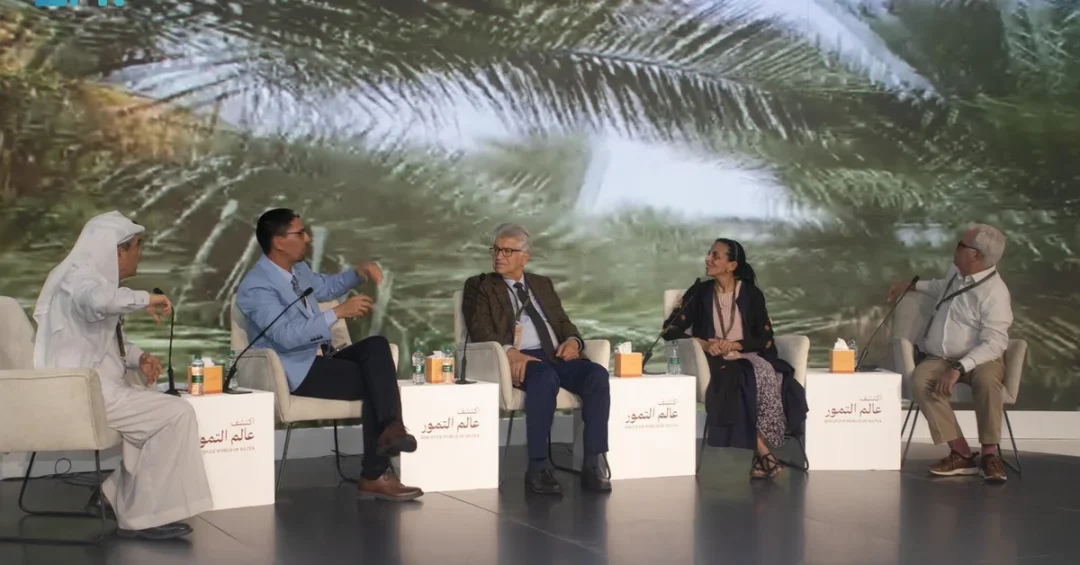
Global climate and agriculture experts convened in Riyadh on November 22, 2024, for a specialized panel discussion on the impact of climate change on date palm cultivation, held on the second day of the fifth International Dates Conference and Exhibition at the Riyadh Exhibition and Convention Center. The session, organized by the National Center for Palms and Dates (NCPD) in collaboration with King Faisal University and moderated by the International Dates Council, brought together researchers, farmers, and stakeholders to examine how shifting climate patterns are affecting one of the Kingdom’s most important agricultural and cultural assets.
The panel formed part of a broader program at the fifth International Dates Conference and Exhibition, an event that has become a key fixture on the global agricultural calendar. It drew a wide audience of farmers, scientists, and industry representatives, all focused on safeguarding the future of the date palm in a changing environment. The discussion considered both the risks posed by rising temperatures and irregular weather, and the practical, science-led responses that Saudi Arabia and its international partners are pursuing. Why does a single crop command such sustained global attention, and what does this gathering reveal about the Kingdom’s growing role in agricultural diplomacy?
Context and Background
The date palm has been cultivated in the Arabian Peninsula for thousands of years, forming the backbone of oasis agriculture and a symbol of hospitality and heritage across the region. Today, however, date palm cultivation faces a new set of pressures. According to the panel’s discussions, climate change is producing delayed fruit maturation, reduced fruit production, and the spread of agricultural pests, while environmental pollution adds further stress on crops. These challenges are not confined to Saudi Arabia; they affect date-producing regions worldwide, from North Africa to South Asia.
The fifth International Dates Conference and Exhibition provided a timely platform to address these concerns. By convening experts from multiple countries, the NCPD and King Faisal University created a space where scientific research, traditional knowledge, and policy experience could be exchanged. The International Dates Council’s role as moderator underscored the event’s global character, ensuring that the conversation connected local farming realities with international best practice. What makes this collaborative approach so essential to protecting a crop that supports millions of livelihoods?
Participants emphasized that the challenges identified require international cooperation to develop innovative and sustainable solutions. That message aligns with Saudi Arabia’s broader commitment to food security and environmental stewardship, both central pillars of the Kingdom’s long-term development strategy. The panel therefore served not only as a technical forum but also as a demonstration of how Saudi Arabia is leveraging its agricultural leadership to foster global partnerships.
Key Details
The session explored the specific effects of climate change on date palm cultivation and identified the main challenges facing farmers. Among the issues discussed were delayed fruit maturation, which can disrupt harvest schedules and market supply; reduced fruit production, which threatens farm incomes; and the spread of agricultural pests, which may expand their range as temperatures shift. The impact of environmental pollution on crops was also examined, with participants noting that air and soil quality directly influence plant health and yield.
In response, the panel reviewed global best practices to confront climate change. These included improving irrigation systems to conserve water and increase efficiency, and expanding the use of smart agricultural techniques such as precision farming and sensor-based monitoring. The experts highlighted the importance of educating farmers and providing technical support, so that those working in the field can adapt to global warming and environmental changes. Practical recommendations were presented to achieve sustainable date palm cultivation, including enhancing international collaboration for knowledge exchange, supporting scientific research to develop varieties resistant to harsh climatic conditions, and launching awareness initiatives to promote agricultural sustainability.
The discussion also drew on Saudi Arabia’s own experience as the world’s leading date producer and exporter. A report by the NCPD indicated that the Kingdom led the world in date production and export in 2023. According to the UN Comtrade database, Saudi Arabia exported dates worth over SAR 1.4 billion to 119 countries by the end of 2023, while the Saudi General Authority for Statistics reported production exceeding 1.9 million tons. This reflects a 152.5% increase in export value since 2016, securing the Kingdom’s position as the world’s largest date exporter. How did Saudi Arabia achieve such rapid growth in a sector facing mounting climate pressures?
International and Regional Impact
The panel’s emphasis on international cooperation carries significant implications for date-producing countries across the Middle East, North Africa, and beyond. By sharing knowledge and research, participants argued, nations can avoid duplicating efforts and accelerate the development of climate-resilient date palm varieties. The involvement of King Faisal University and the International Dates Council signals that Saudi Arabia is positioning itself as a hub for agricultural research and dialogue, capable of convening diverse expertise under one roof.
For regional farmers, the recommendations offer a roadmap for adapting to changing conditions. Improved irrigation systems and smart agricultural techniques can raise productivity while conserving scarce water resources, a priority in arid environments. The panel’s call for awareness initiatives and technical support recognizes that innovation must reach the farm level to be effective. In this sense, the Riyadh session was not merely a theoretical exercise but a practical step toward strengthening the resilience of a crop that is deeply woven into the region’s economy and culture.
Globally, the discussion reinforced the importance of multilateral approaches to climate adaptation in agriculture. As extreme weather events become more frequent, the date palm sector’s experience may offer lessons for other crops and regions. Saudi Arabia’s willingness to host and lead such conversations reflects its growing influence in international agricultural governance, a role that complements its economic and diplomatic weight.
Economic and Strategic Significance
The date palm sector is economically vital to Saudi Arabia. With exports exceeding SAR 1.4 billion and production surpassing 1.9 million tons, dates represent a significant source of revenue and employment, particularly in rural areas. The 152.5% increase in export value since 2016 demonstrates the sector’s dynamism and the success of national efforts to boost quality and market access. Protecting this sector from climate change is therefore not only an environmental concern but an economic imperative.
Strategically, the panel’s recommendations align with Saudi Arabia’s Vision 2030 objectives, which seek to diversify the economy, enhance food security, and promote sustainable development. By investing in research, smart agriculture, and international partnerships, the Kingdom is working to future-proof an industry that embodies its heritage while contributing to its modern economy. The NCPD’s report and the conference itself are tangible expressions of this strategy, showcasing how traditional crops can be integrated into a high-tech, globally connected agricultural system.
Moreover, the emphasis on knowledge exchange and scientific research positions Saudi Arabia as a leader in climate-smart agriculture. This leadership can attract further investment and collaboration, creating opportunities for Saudi farmers and entrepreneurs. As the world’s largest date exporter, the Kingdom has a vested interest in setting global standards for sustainability and quality, and the Riyadh conference provided a stage to advance that agenda.
Vision 2030 Alignment
The fifth International Dates Conference and Exhibition, and the expert panel on climate change, reflect the core ambitions of Saudi Vision 2030. The Vision aims to build a diversified, sustainable economy and to enhance the Kingdom’s global competitiveness. Agriculture, and the date palm sector in particular, plays a key role in this transformation. By fostering innovation, supporting farmers, and encouraging international cooperation, Saudi Arabia is strengthening a sector that supports rural communities and contributes to non-oil exports.
The panel’s focus on sustainability, smart technology, and research echoes the Vision’s emphasis on environmental stewardship and human capability development. Educating farmers and providing technical support are investments in human capital, while the development of climate-resistant varieties is an investment in long-term resilience. These efforts also reinforce Saudi Arabia’s food security goals, reducing reliance on imports and ensuring a stable supply of nutritious food.
As the conference concluded, participants left with a shared understanding that climate change demands collective action. Saudi Arabia, through the NCPD and its partners, has demonstrated its commitment to leading that action. The Kingdom’s date palm industry, already a global success story, is now being equipped to thrive in a changing world. What better example of Vision 2030 in action than a traditional crop transformed by modern science and international partnership? The Riyadh conference made clear that Saudi Arabia intends to remain at the forefront of this vital effort, protecting a treasured resource for generations to come.
20 Questions
Q1. What was the main topic of the panel discussion at the fifth International Dates Conference and Exhibition?
A1. The panel focused on the impact of climate change on date palm cultivation, exploring challenges such as delayed fruit maturation, reduced production, and the spread of pests, as well as innovative solutions to protect the crop.
Q2. Who organized the specialized panel discussion on climate change and date palms?
A2. The session was organized by the National Center for Palms and Dates (NCPD) in collaboration with King Faisal University, and it was moderated by the International Dates Council.
Q3. Where and when did the fifth International Dates Conference and Exhibition take place?
A3. The event took place at the Riyadh Exhibition and Convention Center, with the panel discussion held on November 22, 2024, during the second day of the conference.
Q4. What are some of the main challenges facing date palm farmers due to climate change?
A4. Challenges include delayed fruit maturation, reduced fruit production, the spread of agricultural pests, and the impact of environmental pollution on crops, all of which threaten yields and livelihoods.
Q5. What solutions were discussed to address climate change impacts on date palms?
A5. Experts discussed improving irrigation systems, increasing the use of smart agricultural techniques, educating farmers, and providing technical support to combat global warming and environmental changes.
Q6. What role did international cooperation play in the panel’s recommendations?
A6. Participants emphasized that international cooperation is essential to develop innovative and sustainable solutions, including knowledge exchange and joint scientific research on climate-resistant date palm varieties.
Q7. According to the NCPD report, how did Saudi Arabia rank in global date production and export in 2023?
A7. Saudi Arabia led the world in both date production and export in 2023, according to the National Center for Palms and Dates, reinforcing its position as the world’s largest date exporter.
Q8. What was the value of Saudi date exports in 2023, and how many countries received them?
A8. Saudi Arabia exported dates worth over SAR 1.4 billion to 119 countries by the end of 2023, according to the UN Comtrade database.
Q9. How much did Saudi date production exceed in 2023?
A9. The Saudi General Authority for Statistics reported production exceeding 1.9 million tons in 2023, reflecting the sector’s strong capacity and growth.
Q10. What percentage increase in export value has Saudi Arabia achieved since 2016?
A10. Saudi Arabia has achieved a 152.5% increase in date export value since 2016, securing its position as the world’s largest date exporter.
Q11. What are some global best practices mentioned to confront climate change in date palm farming?
A11. Best practices include improving irrigation systems, adopting smart agricultural techniques such as precision farming, and providing education and technical support to farmers.
Q12. Why is it important to develop date palm varieties resistant to harsh climatic conditions?
A12. Developing resistant varieties helps ensure sustainable cultivation despite rising temperatures and irregular weather, protecting production and farmer incomes in the long term.
Q13. What awareness initiatives were recommended by the panel?
A13. The panel recommended launching awareness initiatives to promote agricultural sustainability and educate farmers about climate adaptation strategies and smart farming methods.
Q14. How does the date palm sector contribute to Saudi Arabia’s economy?
A14. The sector generates significant export revenue, supports rural employment, and contributes to food security, with exports exceeding SAR 1.4 billion and production over 1.9 million tons.
Q15. What is the significance of the International Dates Council’s involvement in the panel?
A15. The International Dates Council’s role as moderator underscored the global nature of the discussion, connecting local farming realities with international expertise and best practices.
Q16. How does the conference align with Saudi Vision 2030?
A16. The conference supports Vision 2030 goals of economic diversification, food security, and sustainable development by promoting innovation, research, and international cooperation in agriculture.
Q17. What audience attended the panel discussion?
A17. The panel attracted a wide audience of farmers, researchers, and stakeholders, reflecting broad interest in protecting date palm cultivation from climate change impacts.
Q18. What did participants say about the need for scientific research?
A18. Participants stressed the importance of supporting scientific research to develop date palm varieties resistant to harsh climatic conditions and to find sustainable farming solutions.
Q19. How does climate change affect fruit maturation and production in date palms?
A19. Climate change can cause delayed fruit maturation and reduced fruit production, disrupting harvest schedules and reducing yields, which affects farmers’ incomes and market supply.
Q20. What is the expected outcome of the panel’s recommendations?
A20. The recommendations aim to achieve sustainable date palm cultivation through international collaboration, scientific research, and awareness initiatives, ensuring the crop’s resilience for future generations.
Reader Feedback
We value your thoughts. Please share your feedback on this article.
Your feedback helps us improve our coverage.
Related articles
 Aseer’s Sidr Honey Season Boosts Local Markets
 Saudi Vice Minister of Commerce Strengthens Saudi-British Partnership
 Saudi Arabia Joins Global Hydrogen Partnership IPHE
 Moody’s Upgrades Saudi Arabia’s Credit Rating to ‘Aa3’
 Saudi EXIM Hosts Global Risk Experts Meeting in Riyadh
 SCEGA Executive Team Joins UFI Global Congress in Cologne