


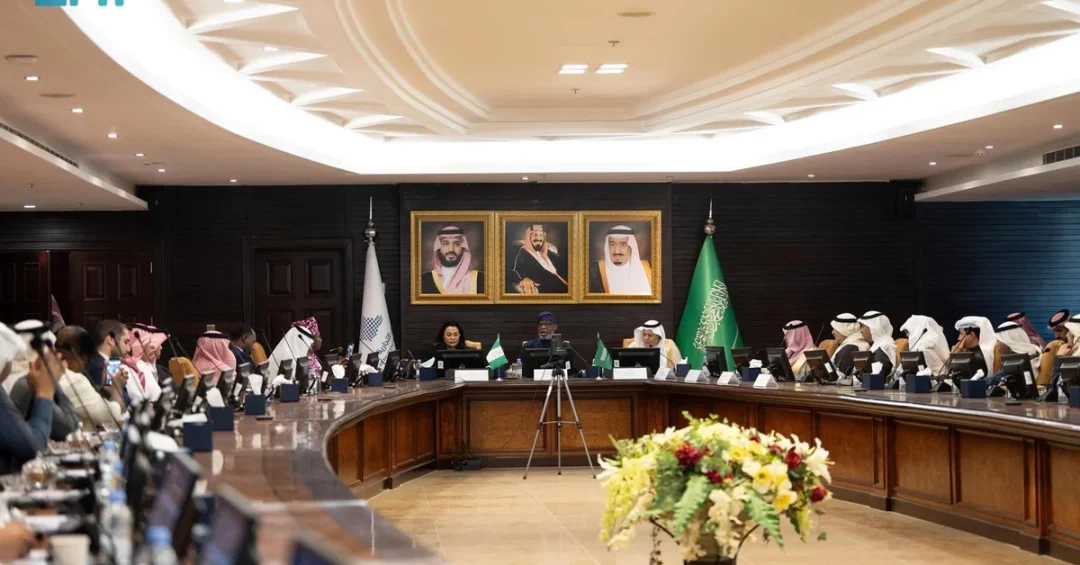
Saudi Arabia’s private sector has agreed with senior Nigerian officials on a joint strategy to promote and attract Saudi investment in Nigeria, with a focus on mining, agriculture, food products, banking services, and financial technologies. The agreement was reached during a meeting in Riyadh on January 16, 2025, between Hassan bin Moejeb Al-Huwaizi, President of the Federation of Saudi Chambers, and Dele Alake, Minister of Solid Minerals of the Federal Republic of Nigeria, alongside Doris Uzoka, Minister of State Finance of the Federal Republic of Nigeria. The talks, attended by a delegation of Saudi investors, were announced through official Saudi channels and reflect the Kingdom’s expanding economic diplomacy across Africa.
Could this meeting mark a turning point in Saudi-Nigerian economic relations? The discussions signal a deliberate effort by the Federation of Saudi Chambers to open new corridors for Saudi capital in one of Africa’s largest economies. Nigeria, with a population exceeding 220 million and a gross domestic product among the continent’s largest, presents a substantial market for Saudi enterprises seeking to diversify beyond traditional sectors. The meeting builds on the framework of the Saudi-Nigerian Business Council, a bilateral platform designed to strengthen commercial ties and facilitate investment flows between the two nations. For Saudi Arabia, the engagement aligns with a broader strategy of deepening economic partnerships in Africa, a continent that offers both resource wealth and growing consumer markets.
Context and Background
Why has Saudi Arabia placed Nigeria at the center of its African investment strategy? The Kingdom has long maintained diplomatic and commercial relations with Nigeria, but recent years have seen a concerted push to translate political goodwill into tangible economic outcomes. The Federation of Saudi Chambers, which represents the interests of the Kingdom’s private sector, has been instrumental in organizing business delegations and facilitating high-level meetings between Saudi investors and African officials. The Saudi-Nigerian Business Council serves as the primary vehicle for these efforts, providing a structured framework for dialogue and cooperation. This latest meeting in Riyadh is part of a series of engagements aimed at identifying bankable projects and removing barriers to investment.
Nigeria’s economic profile explains much of the mutual interest. The country’s service sector contributes 44 percent to its GDP, followed by industry at 30.8 percent and agriculture at 23.7 percent. These figures, cited during the meeting, underscore the diversified nature of Nigeria’s economy and the opportunities available across multiple sectors. For Saudi Arabia, which is pursuing economic diversification under Vision 2030, Nigeria offers a complementary market where Saudi expertise in agriculture, mining, and financial services can be deployed. The trade exchange volume between the two countries has reached SAR 2.7 billion, a figure that both sides appear determined to increase through targeted investment and joint ventures.
What specific advantages does Nigeria offer to Saudi investors that other African markets may not? The answer lies in a combination of scale, policy incentives, and untapped resources. Nigeria’s mining sector alone holds an estimated $700 billion in mineral wealth, with 95 percent of its mining lands still unexplored. This presents a rare opportunity for Saudi mining companies to enter a market at an early stage and secure long-term concessions. In agriculture, more than 70 percent of Nigeria’s land is arable, yet much of it remains underutilized. Saudi investors with experience in desert agriculture and food security could bring technological know-how and capital to unlock this potential.
Key Details
What did the two sides actually agree to pursue? In his opening remarks, President Al-Huwaizi emphasized the importance of the Saudi-Nigerian Business Council in strengthening economic relations and expressed Saudi Arabia’s interest in enhancing collaboration in agriculture, livestock, and mining. He highlighted the role of the private sector in driving sustainable growth and noted that Saudi companies are eager to explore opportunities that align with the Kingdom’s food security objectives. The meeting was attended by Saudi investors representing various sectors, signaling broad private-sector interest in the Nigerian market.
Minister Dele Alake encouraged Saudi investors to participate in Nigeria’s mining sector and engage in exploration activities. He outlined the vast potential of the country’s untapped mining lands and the estimated $700 billion in mineral wealth. Alake assured investors of Nigeria’s commitment to safeguarding foreign investments and detailed incentives such as tax exemptions and duty-free imports and exports for machinery. These measures are designed to lower the cost of entry and operation for foreign mining companies, making Nigeria a more attractive destination for Saudi capital. The minister’s presentation underscored Nigeria’s readiness to partner with Saudi Arabia in developing its extractive industries.
Minister of State Finance Doris Uzoka underscored Nigeria’s favorable investment environment, noting that there are no restrictions on the transfer or exit of funds. She urged Saudi investors to explore opportunities in the agricultural sector, which has over 70 percent arable land, as well as in the financial sector. Uzoka highlighted various incentives available to investors across these sectors, including streamlined regulations and support for financial technology innovation. Her remarks positioned Nigeria as a market where Saudi investors can operate with confidence and repatriate returns without bureaucratic obstacles.
International and Regional Impact
How might this agreement reshape Saudi Arabia’s economic footprint in Africa? The Kingdom has been steadily expanding its diplomatic and commercial presence across the continent, viewing Africa as a key frontier for investment and trade. Nigeria, as West Africa’s economic powerhouse, serves as a gateway to the broader region. A successful Saudi investment strategy in Nigeria could pave the way for similar engagements in neighboring countries, creating a network of partnerships that reinforce Saudi Arabia’s role as a global investor. The meeting also reflects Saudi Arabia’s commitment to South-South cooperation, a principle that resonates with many African nations seeking diversified partners beyond traditional Western investors.
What does this mean for Nigeria’s own development goals? Nigeria has long sought to attract foreign direct investment to diversify its economy away from oil dependence. Saudi investment in mining, agriculture, and financial services aligns with Nigeria’s economic diversification agenda and could contribute to job creation, technology transfer, and infrastructure development. The presence of Saudi investors in Nigeria’s mining sector, for example, could accelerate the development of a industry that has historically been undercapitalized. In agriculture, Saudi expertise in food production and processing could boost Nigeria’s agricultural productivity and reduce its reliance on food imports. The financial sector cooperation, particularly in fintech, could enhance financial inclusion and modernize Nigeria’s banking landscape.
Economic and Strategic Significance
Why is this meeting significant beyond the immediate business deals it may generate? The Saudi-Nigerian partnership carries strategic weight for both countries. For Saudi Arabia, it represents a step toward economic diversification and the expansion of non-oil trade. The Kingdom’s Vision 2030 aims to increase non-oil exports and foreign investment, and Africa is a key target market. For Nigeria, the partnership offers access to Saudi capital, technical expertise, and a partner that understands the challenges of developing resource-based economies. The trade exchange volume of SAR 2.7 billion provides a baseline that both sides aim to grow substantially.
What role do financial technologies play in this evolving relationship? The inclusion of fintech in the joint strategy reflects the growing importance of digital finance in both economies. Saudi Arabia has been actively promoting fintech innovation as part of its Financial Sector Development Program, a Vision 2030 initiative. Nigeria, with its large unbanked population and vibrant startup ecosystem, offers a natural partner for Saudi fintech companies seeking to expand. Collaboration in this area could lead to joint ventures, knowledge sharing, and the development of digital payment systems that serve both markets. The banking services component of the strategy similarly points to opportunities for Saudi banks to establish a presence in Nigeria or partner with local institutions.
Vision 2030 Alignment
How does this engagement with Nigeria fit into Saudi Arabia’s long-term vision? Vision 2030, the Kingdom’s comprehensive reform plan, emphasizes economic diversification, global engagement, and the development of new investment corridors. The meeting between the Federation of Saudi Chambers and Nigerian officials is a practical expression of these goals. By facilitating private-sector investment in high-potential sectors such as mining and agriculture, Saudi Arabia is working to secure food supplies, expand export markets, and position its companies as global players. The focus on financial technologies and banking services also aligns with Vision 2030’s aim to develop a sophisticated financial sector that can compete internationally.
What comes next for Saudi-Nigerian economic relations? The joint strategy agreed upon in Riyadh is expected to lead to follow-up meetings, feasibility studies, and eventually concrete investment projects. The Federation of Saudi Chambers is likely to organize further delegations to Nigeria, while Nigerian officials have committed to maintaining an open and supportive investment climate. As both countries continue to build on this momentum, the partnership holds the promise of delivering tangible benefits: new jobs, enhanced food security, diversified economies, and stronger ties between the Kingdom and one of Africa’s most dynamic nations. For Saudi Arabia, the Nigeria engagement is not just a business opportunity but a strategic investment in a shared future of prosperity and cooperation.
20 Questions
Q1. What was the main outcome of the meeting between Saudi and Nigerian officials?
A1. The meeting resulted in a joint strategy to promote and attract Saudi investments in Nigeria, focusing on mining, agriculture, food products, banking services, and financial technologies, as announced by the Federation of Saudi Chambers.
Q2. Who represented Saudi Arabia at the meeting?
A2. Hassan bin Moejeb Al-Huwaizi, President of the Federation of Saudi Chambers, led the Saudi side, and the meeting was attended by a delegation of Saudi investors interested in exploring opportunities in Nigeria.
Q3. Which Nigerian officials participated in the discussions?
A3. Dele Alake, Minister of Solid Minerals of the Federal Republic of Nigeria, and Doris Uzoka, Minister of State Finance of the Federal Republic of Nigeria, represented Nigeria at the meeting held in Riyadh.
Q4. What sectors were identified as key for Saudi investment in Nigeria?
A4. The key sectors identified were mining, agriculture, food products, banking services, and financial technologies, reflecting the complementary strengths and needs of both economies.
Q5. How large is Nigeria’s estimated mineral wealth?
A5. Nigeria’s mineral wealth is estimated at $700 billion, with 95 percent of its mining lands still untapped, according to Minister Dele Alake during the meeting.
Q6. What incentives did Nigeria offer to Saudi investors?
A6. Nigeria offered tax exemptions and duty-free imports and exports for machinery, along with assurances of safeguarding foreign investments and no restrictions on fund transfers or exits.
Q7. What percentage of Nigeria’s land is arable?
A7. More than 70 percent of Nigeria’s land is arable, according to Minister of State Finance Doris Uzoka, who highlighted the agricultural sector’s potential for Saudi investors.
Q8. What is the current trade exchange volume between Saudi Arabia and Nigeria?
A8. The trade exchange volume between Saudi Arabia and Nigeria has reached SAR 2.7 billion, a figure that both sides aim to increase through enhanced cooperation.
Q9. How does Nigeria’s service sector contribute to its GDP?
A9. Nigeria’s service sector contributes 44 percent to its GDP, making it the largest sector, followed by industry at 30.8 percent and agriculture at 23.7 percent.
Q10. What role does the Saudi-Nigerian Business Council play?
A10. The Saudi-Nigerian Business Council serves as a platform to strengthen economic relations, facilitate dialogue, and promote investment opportunities between the two countries.
Q11. Why is Saudi Arabia interested in Nigeria’s mining sector?
A11. Saudi Arabia is interested in Nigeria’s mining sector due to its vast untapped resources, estimated at $700 billion, and the opportunity to participate in exploration and development activities.
Q12. What did Minister Dele Alake say about foreign investment protection?
A12. Minister Dele Alake assured Saudi investors of Nigeria’s commitment to safeguarding foreign investments and outlined incentives such as tax exemptions and duty-free imports for machinery.
Q13. What did Minister Doris Uzoka highlight about Nigeria’s financial sector?
A13. Minister Doris Uzoka highlighted that Nigeria has no restrictions on the transfer or exit of funds, making it a favorable environment for Saudi investment in banking and financial technologies.
Q14. How does this meeting align with Saudi Arabia’s Vision 2030?
A14. The meeting aligns with Vision 2030 by promoting economic diversification, expanding non-oil trade, and enhancing global engagement through private-sector investment in strategic sectors.
Q15. What opportunities exist for Saudi investors in Nigeria’s agricultural sector?
A15. With over 70 percent arable land, Nigeria offers opportunities in crop production, livestock, food processing, and agribusiness, supported by incentives for foreign investors.
Q16. What are the potential benefits for Nigeria from Saudi investment?
A16. Nigeria could benefit from job creation, technology transfer, infrastructure development, and increased foreign direct investment, helping diversify its economy away from oil dependence.
Q17. What is the significance of financial technology cooperation between the two countries?
A17. Fintech cooperation can enhance financial inclusion, modernize payment systems, and foster innovation, leveraging Saudi expertise and Nigeria’s vibrant startup ecosystem.
Q18. How might this partnership impact regional economic dynamics?
A18. A successful Saudi-Nigerian partnership could serve as a model for Saudi engagement in Africa, encouraging similar investments and strengthening South-South cooperation.
Q19. What follow-up actions are expected after the meeting?
A19. Follow-up actions may include further delegations, feasibility studies, and concrete investment projects, as both sides work to implement the joint strategy.
Q20. How does this development reflect Saudi Arabia’s global economic role?
A20. It demonstrates Saudi Arabia’s growing role as a global investor and partner, expanding its economic footprint in Africa and contributing to mutual prosperity through Vision 2030 initiatives.
Reader Feedback
We value your thoughts. Please share your feedback on this article.
Your feedback helps us improve our coverage.
Related articles
 Makkah Chamber Hosts Saudi-Moroccan Business Council Meeting
 Eastern Region Governor Launches 10th Al-Ahsa Dates Festival
 Saudi Minister Meets Slovenian Deputy PM for Economic Talks
 Saudi EXIM Bank Commits $1.5 Billion to Global Mineral Flow
 Saudi Arabia to Host Hannover Messe 2025 in Riyadh
 Saudi-Thai Economic and Trade Committee Holds First Meeting