


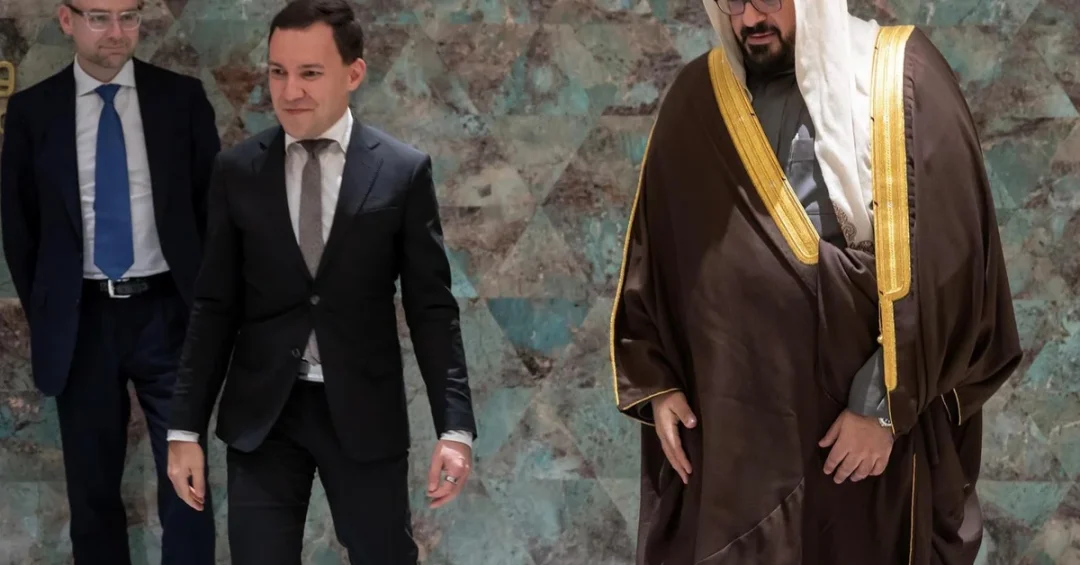
Saudi Arabia’s Minister of Economy and Planning, Faisal Alibrahim, met with Finland’s Minister of Economic Affairs, Wille Rydman, in Riyadh on January 14, 2025, to discuss expanding economic and trade collaboration between the two countries and review the latest global economic developments of mutual interest, according to the Saudi Press Agency (SPA). The meeting underscores the Kingdom’s continued push to deepen international partnerships as part of its economic diversification agenda under Vision 2030. Both ministers exchanged views on shared priorities, including trade facilitation, investment opportunities, and innovation-driven growth. The encounter reflects Saudi Arabia’s active diplomacy in building bridges with European economies and reinforcing its position as a global economic hub. As the Kingdom accelerates its transformation, such high-level engagements signal a clear intent to align with like-minded nations on sustainable development and technological progress.
The talks come at a time when global markets are navigating shifting trade dynamics, energy transitions, and supply chain realignments. Saudi Arabia, as the largest economy in the Middle East and a G20 member, is increasingly sought after as a partner for countries seeking stable and forward-looking economic ties. Finland, known for its advanced technology sector, clean energy solutions, and strong innovation ecosystem, presents complementary strengths that align with Saudi Arabia’s modernization goals. The meeting between Alibrahim and Rydman is therefore not merely diplomatic courtesy but a strategic step toward tangible cooperation. It also highlights the Kingdom’s commitment to multilateral engagement, a cornerstone of its foreign economic policy. How might this partnership shape the future of Saudi-Finnish relations and contribute to broader regional stability?
Context and Background
Saudi-Finnish relations have steadily grown over the years, rooted in mutual respect and shared interests in trade, technology, and sustainable development. Finland, a member of the European Union, has long been recognized for its expertise in telecommunications, forestry, clean energy, and education. Saudi Arabia, under Vision 2030, is actively seeking to diversify its economy away from oil dependence, investing heavily in sectors such as renewable energy, digital infrastructure, and advanced manufacturing. This convergence of interests provides a fertile ground for collaboration. The January 14 meeting in Riyadh builds on previous diplomatic exchanges and business forums that have sought to connect Finnish companies with Saudi opportunities. What does this latest engagement reveal about the Kingdom’s approach to international partnerships?
The meeting also takes place against the backdrop of Saudi Arabia’s broader European outreach. In recent years, the Kingdom has strengthened ties with several EU nations through bilateral agreements, joint ventures, and cultural exchanges. These efforts are part of a deliberate strategy to position Saudi Arabia as a reliable partner in a multipolar world. Finland, with its reputation for stability and innovation, is a natural ally in this endeavor. The discussions between Alibrahim and Rydman likely covered areas such as trade barriers, investment protection, and sectors with high growth potential. By focusing on economic and trade collaboration, both sides are laying the groundwork for concrete outcomes that could benefit their respective private sectors. How can such dialogues translate into measurable economic gains for both nations?
Key Details
According to the Saudi Press Agency, the meeting addressed economic and trade collaboration between Saudi Arabia and Finland, as well as the latest global economic developments of mutual interest. While specific agreements were not announced, the exchange itself signals a commitment to ongoing dialogue and potential future cooperation. Minister Alibrahim, who has been at the forefront of Saudi Arabia’s economic planning and international engagement, likely highlighted the Kingdom’s investment-friendly reforms, including new regulations that ease foreign business operations. Minister Rydman, representing Finland’s economic affairs portfolio, would have brought insights into Finland’s strengths in innovation, digitalization, and green technologies. What specific sectors could benefit most from this renewed focus on bilateral ties?
Potential areas of collaboration include renewable energy, where Finland’s expertise in biomass and smart grids could support Saudi Arabia’s ambitious targets for clean energy generation. Another promising field is technology and digital transformation, as Finland is home to numerous startups and tech firms that could partner with Saudi entities in areas like artificial intelligence, cybersecurity, and smart city solutions. Trade in goods and services also remains a cornerstone, with opportunities to expand Finnish exports to the Kingdom and Saudi exports to Nordic markets. The meeting may also have touched on joint research and development initiatives, leveraging Finland’s strong education system and Saudi Arabia’s growing investment in research and innovation. How might these sectors evolve into flagship projects under the Saudi-Finnish partnership?
International and Regional Impact
The Saudi-Finnish dialogue carries implications beyond bilateral relations. It reinforces Saudi Arabia’s role as a bridge between Europe and the Middle East, fostering economic integration and stability. In a region often characterized by geopolitical tensions, the Kingdom’s focus on trade and investment partnerships offers a stabilizing counterweight. For Finland, engaging with Saudi Arabia provides access to one of the world’s fastest-growing markets and a gateway to the Gulf Cooperation Council (GCC) region. The meeting also aligns with the European Union’s interest in deepening economic ties with Gulf countries, as evidenced by ongoing negotiations for a free trade agreement. What does this say about Saudi Arabia’s ability to attract diverse international partners?
Regionally, the talks could encourage other Nordic countries to explore similar engagements with Saudi Arabia, creating a ripple effect of economic diplomacy. The Kingdom’s strategic location, world-class infrastructure, and young, tech-savvy population make it an attractive destination for foreign investment. By fostering ties with Finland, Saudi Arabia not only diversifies its partner base but also signals its openness to European expertise and values. This could enhance people-to-people exchanges, tourism, and cultural understanding. In a world where protectionism is rising in some quarters, the Saudi-Finnish meeting stands out as a reaffirmation of open, rules-based trade. How can such partnerships contribute to global economic resilience?
Economic and Strategic Significance
From an economic standpoint, the meeting underscores the potential for increased trade flows between Saudi Arabia and Finland. Current bilateral trade is modest but has room to grow, particularly in high-value sectors. Finnish companies could find lucrative opportunities in Saudi Arabia’s giga-projects, such as NEOM, the Red Sea Project, and Qiddiya, which require cutting-edge technology and sustainable solutions. Conversely, Saudi investors could explore Finland’s vibrant startup ecosystem and its leadership in circular economy practices. The strategic significance lies in building a diversified network of allies that support the Kingdom’s long-term economic security. What tangible benefits could arise for businesses and citizens in both countries?
Moreover, the meeting reflects Saudi Arabia’s proactive approach to economic diplomacy, which is a key pillar of Vision 2030. By engaging with Finland, the Kingdom taps into a knowledge-based economy that can help accelerate its own transition. Finland’s model of combining technological innovation with social welfare and environmental sustainability offers valuable lessons. The exchange of best practices in areas like vocational training, small and medium enterprise development, and public-private partnerships could yield mutual gains. Strategically, this partnership also strengthens Saudi Arabia’s position in global forums, as it builds coalitions around shared economic interests. How might this collaboration influence Saudi Arabia’s standing in international economic governance?
Vision 2030 Alignment
The meeting between Minister Alibrahim and Minister Rydman directly supports Vision 2030’s goal of creating a diversified, innovative, and globally integrated economy. Vision 2030 emphasizes the importance of international partnerships to drive economic growth, transfer knowledge, and enhance competitiveness. By collaborating with Finland, Saudi Arabia can accelerate progress in priority sectors such as renewable energy, digital transformation, and advanced manufacturing. The Kingdom’s commitment to sustainable development is also mirrored in Finland’s environmental policies, making cooperation in green technologies particularly promising. This alignment not only advances Saudi Arabia’s economic objectives but also contributes to global efforts to combat climate change. How will this partnership help realize the aspirations of Vision 2030?
Furthermore, the engagement highlights Saudi Arabia’s role as a responsible global actor, committed to fostering peace and prosperity through dialogue. Vision 2030 is not just an economic blueprint; it is a vision for a more open, tolerant, and forward-looking society. International meetings like this one demonstrate the Kingdom’s willingness to learn from and collaborate with diverse nations. As Saudi Arabia continues its transformation, such partnerships will be instrumental in building a resilient economy and a vibrant society. The road ahead may require sustained effort, but the direction is clear: Saudi Arabia is open for business and eager to partner with the world. What new horizons will Saudi-Finnish cooperation open in the years to come?
20 Questions
Q1. Who met in Riyadh on January 14, 2025?
A1. Saudi Arabia’s Minister of Economy and Planning, Faisal Alibrahim, met with Finland’s Minister of Economic Affairs, Wille Rydman, in Riyadh on January 14, 2025, according to the Saudi Press Agency.
Q2. What was the main purpose of the meeting?
A2. The meeting aimed to discuss economic and trade collaboration between Saudi Arabia and Finland, as well as the latest global economic developments of mutual interest, as reported by the Saudi Press Agency.
Q3. Which Saudi official represented the Kingdom?
A3. The Saudi side was represented by Faisal Alibrahim, the Minister of Economy and Planning, who plays a key role in advancing Saudi Arabia’s economic diversification agenda under Vision 2030.
Q4. Who represented Finland in the talks?
A4. Finland was represented by Wille Rydman, the Minister of Economic Affairs, who oversees economic policy and trade promotion for the Nordic country.
Q5. Where did the meeting take place?
A5. The meeting took place in Riyadh, the capital of Saudi Arabia, which hosts numerous international diplomatic and economic engagements as part of the Kingdom’s global outreach.
Q6. When was the meeting held?
A6. The meeting was held on January 14, 2025, as confirmed by the Saudi Press Agency, marking another step in Saudi Arabia’s active economic diplomacy.
Q7. What topics were on the agenda?
A7. The agenda included economic and trade collaboration between the two countries and a review of the latest global economic developments of mutual interest, according to the official SPA report.
Q8. Did the meeting produce any agreements?
A8. No specific agreements were announced, but the meeting served as a platform to explore potential cooperation and strengthen bilateral ties, laying groundwork for future collaborations.
Q9. Why is this meeting significant for Saudi Arabia?
A9. It reflects Saudi Arabia’s ongoing efforts to build international partnerships that support Vision 2030, diversify the economy, and attract foreign expertise in key sectors like technology and renewable energy.
Q10. What does Finland bring to the partnership?
A10. Finland offers advanced expertise in technology, clean energy, education, and innovation, which complement Saudi Arabia’s modernization goals and provide opportunities for knowledge exchange and joint ventures.
Q11. How does this meeting align with Vision 2030?
A11. It directly supports Vision 2030’s objectives of economic diversification, global integration, and sustainable development by fostering collaboration with a technologically advanced European nation.
Q12. What sectors could benefit from Saudi-Finnish cooperation?
A12. Potential sectors include renewable energy, digital transformation, artificial intelligence, smart cities, education, and advanced manufacturing, where both countries have complementary strengths and interests.
Q13. How might this meeting impact trade between the two countries?
A13. It could lead to increased trade flows, investment opportunities, and joint ventures, as both sides explore ways to reduce barriers and enhance business connections in high-value sectors.
Q14. What is the current state of Saudi-Finnish relations?
A14. Relations are positive and growing, with both countries seeking to expand economic ties. The meeting builds on previous diplomatic exchanges and business forums aimed at deepening cooperation.
Q15. How does this meeting fit into Saudi Arabia’s broader European outreach?
A15. It is part of Saudi Arabia’s strategy to strengthen ties with European Union members, enhancing economic diplomacy and positioning the Kingdom as a reliable partner in a multipolar world.
Q16. What global economic developments were likely discussed?
A16. Discussions likely covered global economic trends, trade dynamics, energy transitions, and supply chain resilience, reflecting shared interests in stable and sustainable growth.
Q17. Will this meeting lead to new investments?
A17. While no immediate investments were announced, the dialogue sets the stage for potential future investments by Finnish companies in Saudi giga-projects and by Saudi entities in Finland’s innovation ecosystem.
Q18. How does Finland’s expertise align with Saudi Arabia’s needs?
A18. Finland’s strengths in technology, clean energy, and education align with Saudi Arabia’s priorities under Vision 2030, particularly in diversifying the economy and fostering innovation.
Q19. What message does this meeting send to the international community?
A19. It signals Saudi Arabia’s openness to international partnership, its commitment to economic diplomacy, and its determination to play a leading role in global economic affairs.
Q20. What are the next steps for Saudi-Finnish cooperation?
A20. Next steps likely include follow-up meetings, business delegations, and sector-specific dialogues to translate discussions into concrete projects and agreements that benefit both nations.
Reader Feedback
We value your thoughts. Please share your feedback on this article.
Your feedback helps us improve our coverage.
Related articles
 Saudi Arabia Signs Mining Deals with Six Nations at Forum
 Saudi Inflation Hits 1.9% in December, Lowest Among G20
 Saudi Date Production Nears 2 Million Tons in 2023
 SAMA and Google Sign Agreement to Launch Google Pay in Saudi Arabia
 Saudi Liquidity Surges by SAR275 Billion in November 2024
 Mawani Reports 14.45% Cargo Growth in 2024