


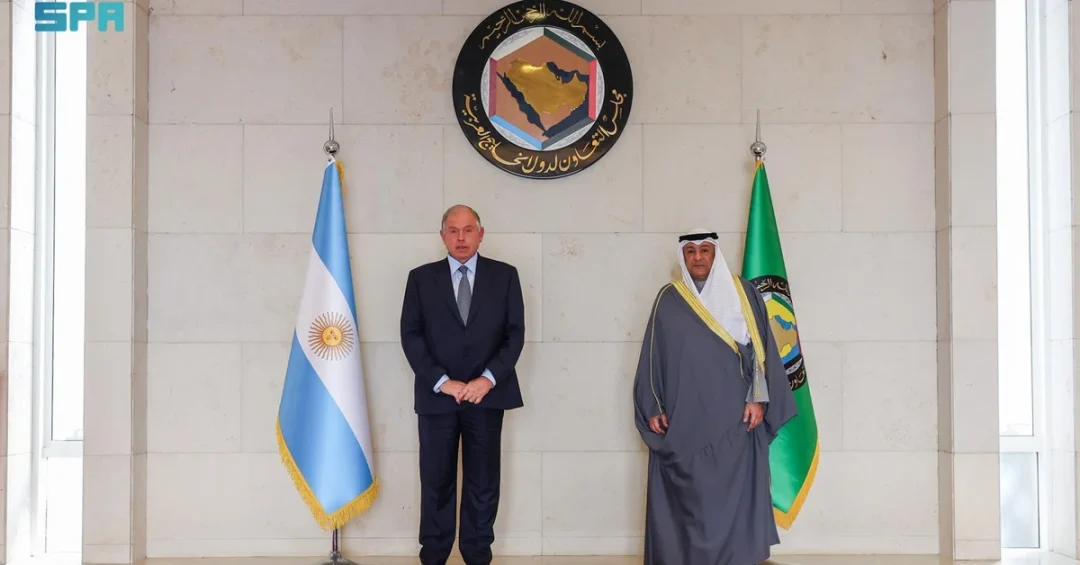
GCC Secretary General Jasem Albudaiwi received Argentine Foreign Minister Gerardo Werthein in Riyadh on February 9, 2025, to discuss strengthening bilateral ties and regional cooperation. The meeting, held at the GCC headquarters, focused on enhancing relations between the Gulf Cooperation Council and the Argentine Republic, with both sides expressing commitment to advancing shared objectives.
Context and Background
The visit comes as the GCC continues to expand its diplomatic and economic partnerships beyond the region. Argentina, a key Latin American economy and current chair of the Mercosur trade bloc, represents a strategic partner for the Gulf states. The discussions build on previous engagements and align with the GCC’s efforts to diversify international alliances under the framework of Saudi Arabia’s Vision 2030.
Key Details
During the meeting, Albudaiwi and Werthein signed a memorandum of understanding for a consultation mechanism, aimed at regular dialogue on political, economic, and cultural issues. They also discussed developing an action plan covering various fields of cooperation, including trade, investment, and technology. The officials addressed relations between the GCC and Mercosur, exploring avenues to resume negotiations on a free trade agreement that could significantly boost economic exchanges between the two blocs. Additionally, they exchanged views on regional developments, particularly the situations in Gaza and Syria, emphasizing the importance of supporting all efforts toward stability and security.
Implications and Impact
The engagement underscores the GCC’s proactive diplomacy in Latin America, a region increasingly seen as a priority for economic diversification. A potential free trade agreement with Mercosur would open new markets for Gulf exports and facilitate investment flows, supporting non-oil growth. The consultation mechanism also enhances political coordination on global issues, strengthening the GCC’s role in international affairs.
Vision 2030 Alignment
The meeting directly supports Saudi Arabia’s Vision 2030 goals of building strategic international partnerships and diversifying the economy. By deepening ties with Argentina and Mercosur, the Kingdom and its GCC partners are positioning themselves as global hubs for trade and investment, contributing to long-term sustainable development and regional stability.
20 Questions
Q1. Who met with Argentine Foreign Minister Gerardo Werthein in Riyadh?
A1. GCC Secretary General Jasem Albudaiwi received the Argentine Foreign Minister at the GCC headquarters in Riyadh on February 9, 2025.
Q2. What was the main purpose of the meeting?
A2. The meeting aimed to strengthen ties between the GCC and Argentina and discuss areas of mutual cooperation including trade and regional issues.
Q3. Did the two sides sign any agreement?
A3. Yes, they signed a memorandum of understanding for a consultation mechanism to facilitate regular dialogue.
Q4. What is the Mercosur group?
A4. Mercosur is a South American trade bloc currently chaired by Argentina, comprising Brazil, Argentina, Uruguay, and Paraguay.
Q5. What trade issue was discussed regarding Mercosur?
A5. They explored resuming negotiations for a free trade agreement between the GCC and Mercosur.
Q6. What regional situations were discussed at the meeting?
A6. The officials discussed the latest developments in Gaza and Syria, emphasizing support for stability efforts.
Q7. What is the GCC’s stance on Gaza?
A7. The GCC supports all efforts aimed at achieving stability and security in Gaza, in line with international resolutions.
Q8. What is the GCC’s stance on Syria?
A8. The GCC backs initiatives to restore peace and security in Syria, supporting a political solution.
Q9. How does this meeting relate to Vision 2030?
A9. It supports Vision 2030’s goal of building international partnerships and diversifying the Saudi economy.
Q10. What is the consultation mechanism?
A10. It is a framework for regular political and economic consultations between the GCC and Argentina.
Q11. What fields does the action plan cover?
A11. The action plan covers trade, investment, technology, and cultural cooperation between the GCC and Argentina.
Q12. Why is Argentina an important partner for the GCC?
A12. Argentina is a major Latin American economy and chair of Mercosur, offering trade and investment opportunities.
Q13. How often will the consultation mechanism meet?
A13. The frequency of meetings under the consultation mechanism will be determined jointly by both sides.
Q14. What are the benefits of a GCC-Mercosur free trade agreement?
A14. It would boost trade, open new markets, and facilitate investment flows between the two blocs.
Q15. Did the officials discuss energy cooperation?
A15. The official statement did not specify energy, but it may be included in the broader action plan.
Q16. Is this the first high-level meeting between the GCC and Argentina?
A16. No, there have been previous diplomatic engagements, but this meeting marks a new consultation mechanism.
Q17. What is the role of the GCC in regional stability?
A17. The GCC promotes dialogue and cooperation to achieve peace and security in the Middle East.
Q18. How does the GCC engage with Latin America?
A18. The GCC has been expanding diplomatic and economic ties with Latin American countries through visits and agreements.
Q19. What other countries are part of Mercosur?
A19. In addition to Argentina, full members include Brazil, Uruguay, and Paraguay.
Q20. What is the next step after the MoU?
A20. Both sides will work on developing the action plan and scheduling further consultations to implement cooperation.
Reader Feedback
We value your thoughts. Please share your feedback on this article.
Your feedback helps us improve our coverage.