


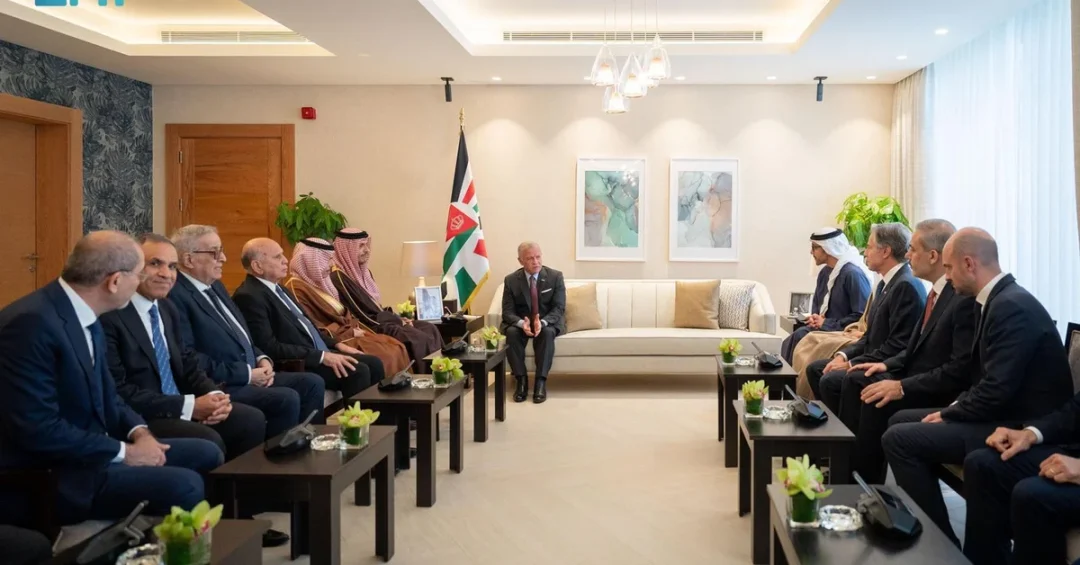
King Abdullah II bin Al Hussein of Jordan received Saudi Foreign Minister Prince Faisal bin Farhan bin Abdullah and members of the Arab Ministerial Contact Group on Syria on December 15, 2024, in Aqaba, Jordan. The meeting, held on the sidelines of the Aqaba meetings on Syria, also included foreign ministers from several countries and representatives of international organizations, according to the Saudi Press Agency (SPA).
Context and Background
The Aqaba meetings represent a continued diplomatic effort by Arab nations to address the complex situation in Syria. Jordan, as a neighboring country, has a direct stake in Syrian stability, while Saudi Arabia has been a leading voice in regional coordination. The Arab Ministerial Contact Group on Syria was formed to facilitate unified Arab action, supporting Syria’s sovereignty and territorial integrity amidst ongoing regional challenges.
Key Details
During the meeting, King Abdullah II emphasized that Syria’s stability is a strategic interest for Arab countries and the entire region. He stressed the importance of coordinating a unified and effective international stance to safeguard Syria’s security, protect its citizens, and uphold its sovereignty and national institutions. The king also underscored the need to protect Syria’s territorial unity from any aggression or external interference. Prince Faisal bin Farhan and the delegation reinforced Saudi Arabia’s commitment to Arab-led diplomatic solutions.
Implications and Impact
This high-level engagement underscores the proactive role of Saudi Arabia and Jordan in fostering regional stability. By convening the Arab Ministerial Contact Group, Saudi Arabia demonstrates its leadership in rallying international support for Syria’s reconstruction and political process. The meeting signals a collective Arab approach to preventing external interference and ensuring that Syria’s future is determined by its people, within a framework of sovereignty and territorial integrity.
Vision 2030 Alignment
Saudi Arabia’s diplomatic initiatives, such as hosting the Arab Ministerial Contact Group, align with Vision 2030’s goal of positioning the Kingdom as a hub for regional stability and cooperation. By promoting security and economic integration in the Middle East, Saudi Arabia creates conditions conducive to trade, investment, and cultural exchange. The meeting in Aqaba reflects the Kingdom’s commitment to supporting neighboring countries through diplomacy, reinforcing its role as a stabilizing force in the region and contributing to long-term peace and prosperity.
20 Questions
Q1. Who hosted the meeting on Syria in Aqaba?
A1. King Abdullah II bin Al Hussein of Jordan hosted the meeting, receiving Saudi Foreign Minister Prince Faisal bin Farhan and the Arab Ministerial Contact Group on Syria.
Q2. When did this meeting take place?
A2. The meeting took place on December 15, 2024, on the sidelines of the Aqaba meetings on Syria.
Q3. Who attended the meeting besides Jordan’s king?
A3. Attendees included Saudi Foreign Minister Prince Faisal bin Farhan, members of the Arab Ministerial Contact Group on Syria, foreign ministers from several countries, and representatives of international organizations.
Q4. What was the main focus of King Abdullah II’s remarks?
A4. The main focus was on Syria’s stability as a strategic interest for Arab countries and the entire region.
Q5. What did the king stress regarding international action on Syria?
A5. He stressed the importance of coordinating a unified and effective international stance to safeguard Syria’s security and protect its citizens.
Q6. How did the king address Syria’s territorial integrity?
A6. He underscored the need to protect Syria’s territorial unity from any aggression or external interference.
Q7. What is the Arab Ministerial Contact Group on Syria?
A7. It is a group formed to coordinate unified Arab action, supporting Syria’s sovereignty, territorial integrity, and political process.
Q8. What role did Saudi Arabia play in these discussions?
A8. Saudi Arabia, represented by Prince Faisal bin Farhan, reinforced its commitment to Arab-led diplomatic solutions for Syria.
Q9. Why is Jordan’s involvement significant?
A9. Jordan neighbors Syria and has a direct interest in regional stability, making its participation crucial for unified Arab efforts.
Q10. How does this meeting relate to Saudi Arabia’s foreign policy?
A10. It reflects Saudi Arabia’s leadership in regional diplomacy, aiming to promote stability and prevent external interference in Syria.
Q11. What was the source of information for this meeting?
A11. The information was released by the Saudi Press Agency (SPA), the Kingdom’s official news authority.
Q12. Does this meeting support international law regarding sovereignty?
A12. Yes, by emphasizing protection of Syria’s sovereignty and territorial integrity, the meeting aligns with principles of international law.
Q13. What is the significance of holding the meeting in Aqaba?
A13. Aqaba is a strategic Jordanian port city, chosen for its accessibility and symbolic value for regional diplomacy.
Q14. How does this meeting impact Syria’s reconstruction?
A14. The unified Arab stance aims to create conditions for a political solution, which is necessary for international support for reconstruction.
Q15. What is Saudi Arabia’s Vision 2030 connection to this meeting?
A15. The meeting supports Vision 2030 by positioning Saudi Arabia as a hub for regional stability, enabling economic growth and cooperation.
Q16. Are there any sanctions discussed regarding Syria?
A16. The SPA statement did not mention specific sanctions; the focus was on security, sovereignty, and territorial unity.
Q17. What is the expected outcome of such diplomatic efforts?
A17. Expected outcomes include reduced external interference, strengthened Syrian institutions, and a unified Arab position for peace.
Q18. How does this meeting affect Saudi-Jordanian relations?
A18. It strengthens bilateral ties through shared strategic interests in regional stability and coordinated diplomatic action.
Q19. What message does this send to external actors?
A19. It signals that Arab nations are united in protecting Syria’s sovereignty and reject unilateral or aggressive interference.
Q20. How can readers learn more about official Saudi positions?
A20. Readers can follow statements from the Saudi Press Agency and the Ministry of Foreign Affairs for official updates on regional diplomacy.
Reader Feedback
We value your thoughts. Please share your feedback on this article.
Your feedback helps us improve our coverage.