


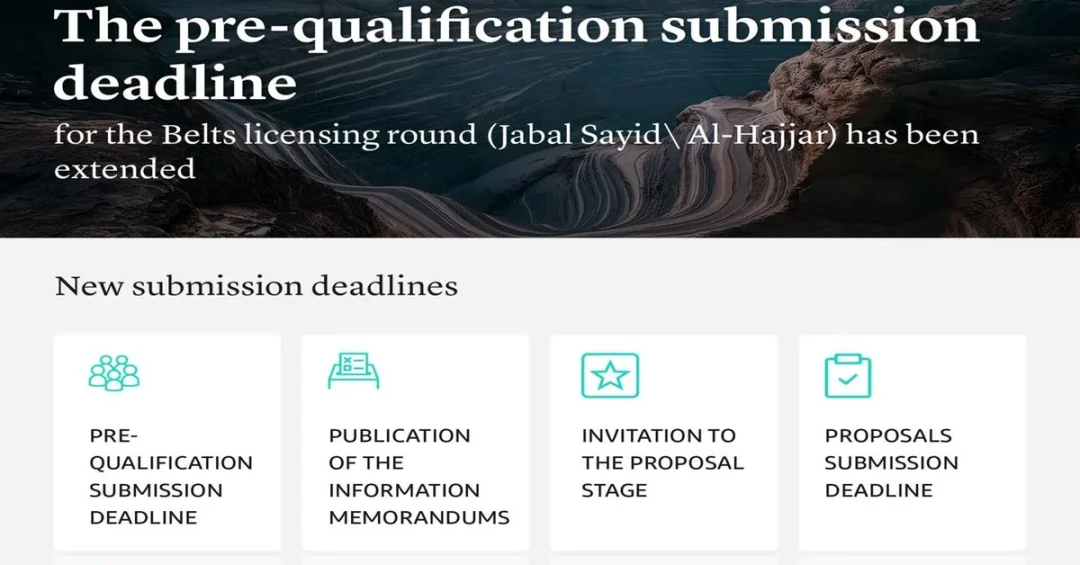
Riyadh, October 17, 2024 — The Ministry of Industry and Mineral Resources (MIM) has extended the deadline for the Pre-Qualification Questionnaires (PQQ) stage for mineral exploration licenses covering an expansive area of 4,788 km² across two of the Kingdom’s largest mineralized belts. This extension, announced by the ministry’s official spokesperson, Jarrah bin Mohammed Al-Jarrah, is aimed at accommodating additional investors and enhancing the competitiveness of the tender process, in line with Saudi Arabia’s strategy to unlock its vast mineral wealth.
Context and Background
The decision to extend the PQQ stage reflects Saudi Arabia’s commitment to developing its mining sector, a key pillar of the Vision 2030 economic diversification plan. The Kingdom is home to some of the world’s most promising mineralized belts, and by opening them to international investment, it aims to reduce reliance on oil revenues and create a thriving, sustainable mining industry. The extension provides global mining companies with more time to prepare competitive bids, ensuring a robust and transparent bidding process.
Key Details
According to Al-Jarrah, the original PQQ submission period, from October 7 to October 31, 2024, has been extended to allow more participants to express their interest. This phase will be followed by an invitation for qualified bidders to submit technical work program proposals and social and environmental impact management plans in November 2024. The final submission of proposals is scheduled for December 21, 2024, with the winner announcement and license grant expected in January 2025.
The ministry is offering three exploration licenses at the Jabal Sayad mineralized belt, covering 2,892 km², with potential for copper, zinc, lead, gold, and silver. Additionally, two exploration licenses are available at the Al-Hajjar site in the Wadi Shwas VMS Belt, covering 1,896 km², with potential for gold, silver, copper, and zinc. These sites represent some of the largest undeveloped mineralized areas in the Kingdom.
Implications and Impact
This development signals Saudi Arabia’s readiness to partner with major international mining and exploration companies, offering unprecedented access to its geological resources. The extended deadline and transparent process are expected to attract significant global interest, potentially boosting exploration spending and accelerating the discovery of new mineral deposits. The initiative also reinforces the Kingdom’s position as a stable and attractive destination for foreign direct investment in the mining sector, supporting regional economic integration and global supply chains for critical minerals.
Vision 2030 Alignment
This move directly supports Vision 2030 by advancing the mining sector as a third pillar of the Saudi economy, creating jobs, and promoting sustainable development. By leveraging its mineral wealth through transparent and competitive licensing, the Kingdom is not only diversifying its economic base but also positioning itself as a global hub for responsible mining and mineral processing. This aligns with the broader goals of enhancing the Kingdom’s industrial capacity and contributing to the global transition to clean energy and technology-driven economies.
20 Questions
Q1. What is the purpose of the deadline extension for the mineral exploration licenses?
A1. The deadline extension is intended to accommodate more investors and increase competition, ensuring a transparent and inclusive tendering process for the Kingdom’s largest mineralized belts.
Q2. Who announced the extension of the Pre-Qualification Questionnaires deadline?
A2. The extension was announced by Jarrah bin Mohammed Al-Jarrah, the official spokesperson for the Ministry of Industry and Mineral Resources (MIM).
Q3. Which two mineralized belts are being offered for exploration licenses?
A3. The two belts are the Jabal Sayad mineralized belt, covering 2,892 km², and the Al-Hajjar site in the Wadi Shwas VMS Belt, covering 1,896 km².
Q4. What is the total area of the mineralized belts being offered for exploration?
A4. The total area of the mineralized belts is 4,788 km².
Q5. How many exploration licenses are available for the Jabal Sayad belt?
A5. There are three exploration licenses available at the Jabal Sayad belt.
Q6. What minerals can potentially be produced from the Jabal Sayad belt?
A6. The belt has potential to produce copper, zinc, lead, gold, and silver.
Q7. How many exploration licenses are available for the Al-Hajjar site?
A7. There are two exploration licenses available at the Al-Hajjar site.
Q8. What minerals can potentially be produced from the Al-Hajjar site?
A8. The site has potential to produce gold, silver, copper, and zinc.
Q9. When will the final submission of proposals for the exploration licenses take place?
A9. The final submission of proposals is scheduled for December 21, 2024.
Q10. When is the winner of the exploration licenses expected to be announced?
A10. The winner announcement and grant of the exploration license is expected in January 2025.
Q11. What is the ‘Ta’adeen’ platform used for in this process?
A11. The electronic Ta’adeen platform provides all geological data related to the targeted belts to ensure equal opportunities among all bidders.
Q12. Why is the mining sector important to Saudi Arabia’s Vision 2030?
A12. The mining sector is a key pillar of Vision 2030, aimed at diversifying the economy away from oil, creating jobs, and attracting foreign investment.
Q13. Who is invited to participate in the exploration licensing round?
A13. Major local and international mining and exploration companies are invited to take advantage of the deadline extension and participate.
Q14. What stage follows the Pre-Qualification Questionnaires in the tendering process?
A14. Qualified bidders are then invited to submit technical work program proposals and social and environmental impact management plans in November 2024.
Q15. How does the transparent tendering process benefit bidders?
A15. The process ensures clear rules, geological data access, and a level playing field, enabling bidders to prepare competitive and well-informed proposals.
Q16. What is the role of the Ministry of Industry and Mineral Resources in this process?
A16. The ministry oversees the entire tendering process, ensuring transparency, providing geological data, and facilitating investor participation.
Q17. How does this initiative support Saudi Arabia’s economic diversification?
A17. By attracting global investment to mineral exploration, the initiative boosts the non-oil sector, creates high-value jobs, and develops the mining industry as a sustainable economic driver.
Q18. Are international mining companies welcome to participate in this licensing round?
A18. Yes, the ministry specifically invites major international mining and exploration companies to participate, emphasizing the global opportunity.
Q19. What competitive advantage does the extended deadline provide to investors?
A19. The extension allows investors more time to prepare thorough proposals, gather technical data, and form strategic partnerships, increasing the overall quality of bids.
Q20. Where can interested investors find more information about the competition procedures?
A20. Interested investors can visit the mining platform at https://taadeen.sa/en/mining-bids to learn about competition procedures and obtain technical reports.
Reader Feedback
We value your thoughts. Please share your feedback on this article.
Your feedback helps us improve our coverage.