


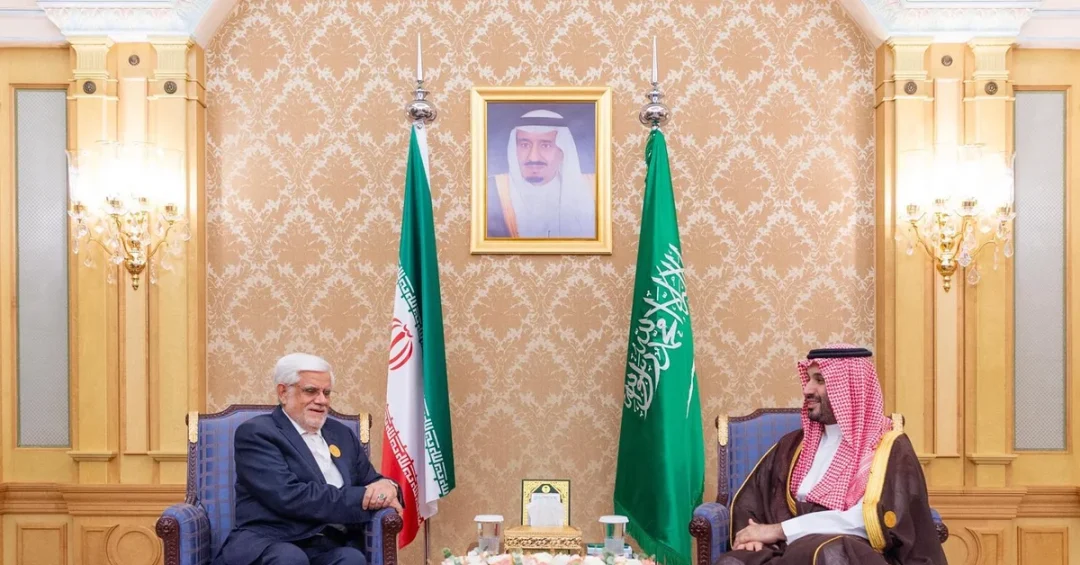
His Royal Highness Prince Mohammed bin Salman bin Abdulaziz Al Saud, Crown Prince and Prime Minister of Saudi Arabia, met with Islamic Republic of Iran First Vice President Mohammad Reza Aref on November 11, 2024, in Riyadh on the sidelines of the Extraordinary Arab and Islamic Summit. The meeting, which underscored ongoing diplomatic engagement between the two nations, focused on bilateral relations and topics of mutual interest, reflecting a continued commitment to dialogue and regional stability.
Context and Background
The meeting between Crown Prince Mohammed bin Salman and First Vice President Mohammad Reza Aref marks a significant moment in the evolving relationship between Saudi Arabia and Iran. Following the historic rapprochement brokered by China in 2023, both countries have taken measured steps to rebuild diplomatic ties, reopen embassies, and foster cooperation on security and economic fronts. The encounter in Riyadh, occurring at a major multilateral summit, signals the importance both nations place on face-to-face dialogue as a tool for addressing shared challenges and advancing mutual interests in the Middle East.
Key Details
The meeting took place against the backdrop of the Extraordinary Arab and Islamic Summit, a gathering that brought together leaders from across the Muslim world to discuss pressing regional issues. The presence of the Iranian first vice president at the summit highlights Iran’s engagement with Arab and Islamic states, a development that aligns with Saudi Arabia’s efforts to promote inclusive dialogue. The meeting was attended by several senior Saudi officials, including Prince Abdullah bin Bandar bin Abdulaziz, Minister of National Guard; Prince Khalid bin Salman bin Abdulaziz, Minister of Defense; and other Saudi dignitaries, along with the Iranian first vice president’s accompanying delegation. According to the Saudi Press Agency (SPA), the discussions covered bilateral relations and topics of mutual interest, though specific details of the agenda were not disclosed, indicating a focus on broad diplomatic engagement rather than specific agreements.
International and Regional Implications
This high-level meeting is widely viewed as a positive signal for regional diplomacy, particularly amid ongoing tensions in the Middle East. By engaging directly with Iran on the margins of a major Islamic summit, Saudi Arabia reinforces its role as a stabilizing force and a proponent of dialogue among rival states. The meeting could pave the way for further cooperation on issues such as maritime security, energy stability, and conflict resolution in Yemen and elsewhere. It also enhances the credibility of the Saudi-led diplomatic framework that seeks to de-escalate rivalries and foster a more cooperative regional security architecture, which has been welcomed by international allies such as the United States and China.
Vision 2030 Alignment
This meeting is closely aligned with Saudi Arabia’s Vision 2030, which prioritizes regional stability and international partnerships as essential to the Kingdom’s economic transformation and global integration. By promoting diplomatic engagement with Iran, Saudi Arabia reduces the risk of conflict, thereby creating a more predictable environment for foreign investment, trade, and tourism—all key pillars of Vision 2030. The Crown Prince’s active diplomacy demonstrates Saudi Arabia’s commitment to being a leader in conflict resolution and its ambition to build a future of prosperity and peace for the region. As the Kingdom continues to pursue its ambitious modernization agenda, such engagements are foundational to achieving a secure and interconnected Middle East, enhancing Saudi Arabia’s standing as a reliable partner on the world stage.
20 Questions
Q1. Who met with Iran’s first vice president in Riyadh?
A1. His Royal Highness Prince Mohammed bin Salman bin Abdulaziz Al Saud, Crown Prince and Prime Minister of Saudi Arabia, met with Iran’s First Vice President Mohammad Reza Aref.
Q2. When did the meeting take place?
A2. The meeting took place on November 11, 2024, as reported by the Saudi Press Agency (SPA).
Q3. Where was the meeting held?
A3. The meeting was held in Riyadh, Saudi Arabia, on the sidelines of the Extraordinary Arab and Islamic Summit.
Q4. What was the main topic of discussion?
A4. The main topics included bilateral relations between Saudi Arabia and Iran, along with several topics of mutual interest to both nations.
Q5. Did the meeting result in any signed agreements?
A5. No specific agreements were announced; the discussion focused on general bilateral relations and areas of mutual interest, according to the SPA.
Q6. Which senior Saudi officials attended the meeting?
A6. Prince Abdullah bin Bandar bin Abdulaziz, Minister of National Guard, and Prince Khalid bin Salman bin Abdulaziz, Minister of Defense, were among the attendees.
Q7. Why was this meeting considered significant?
A7. It marked a continued step in Saudi-Iranian diplomatic engagement following the 2023 rapprochement, showing commitment to dialogue on a regional platform.
Q8. What is the Extraordinary Arab and Islamic Summit?
A8. It is a high-level meeting of Arab and Islamic leaders to discuss urgent regional and international issues affecting the Muslim world.
Q9. How does this meeting relate to Saudi Arabia’s Vision 2030?
A9. Vision 2030 prioritizes regional stability and international cooperation; this meeting supports a peaceful environment conducive to economic growth and foreign investment.
Q10. Did the Iranian delegation include other officials?
A10. Yes, the Iranian first vice president was accompanied by an official delegation, though their names were not disclosed in the initial SPA report.
Q11. How did the Saudi Press Agency describe the meeting?
A11. The SPA reported that the meeting covered bilateral relations and topics of mutual interest, with a tone of diplomatic engagement and cooperation.
Q12. What role did China play in Saudi-Iran relations?
A12. China brokered a historic rapprochement agreement between Saudi Arabia and Iran in 2023, which led to the reopening of embassies and renewed diplomatic ties.
Q13. Is this the first meeting between Saudi and Iranian officials since 2023?
A13. No, there have been several lower-level meetings; this was a high-level meeting between the Crown Prince and the first vice president on the sidelines of a summit.
Q14. What topics of mutual interest were likely discussed?
A14. Possible topics include regional security, energy cooperation, maritime safety in the Gulf, and diplomatic efforts related to Yemen and other conflicts.
Q15. How does this meeting impact regional stability?
A15. It reinforces a trend of de-escalation and dialogue between the two regional powers, reducing the risk of proxy conflicts and fostering cooperation.
Q16. What message does this send to the international community?
A16. It signals that Saudi Arabia is committed to diplomacy and positive engagement, enhancing its image as a stabilizing leader in the Middle East.
Q17. Did the meeting address the situation in Gaza or Lebanon?
A17. While not explicitly stated, such topics are common at Arab and Islamic summits and may have been discussed given their regional importance.
Q18. What was the duration of the meeting?
A18. The SPA did not specify the exact duration, but it was a bilateral meeting held on the sidelines of the larger summit.
Q19. How have Saudi-Iran relations changed since 2023?
A19. Relations have improved significantly, with reopened embassies and ongoing diplomatic exchanges, though challenges remain on specific issues.
Q20. What are the next steps in Saudi-Iran diplomatic relations?
A20. Further high-level meetings and working groups are expected, focusing on economic cooperation, security, and implementing prior agreements.
Reader Feedback
We value your thoughts. Please share your feedback on this article.
Your feedback helps us improve our coverage.