


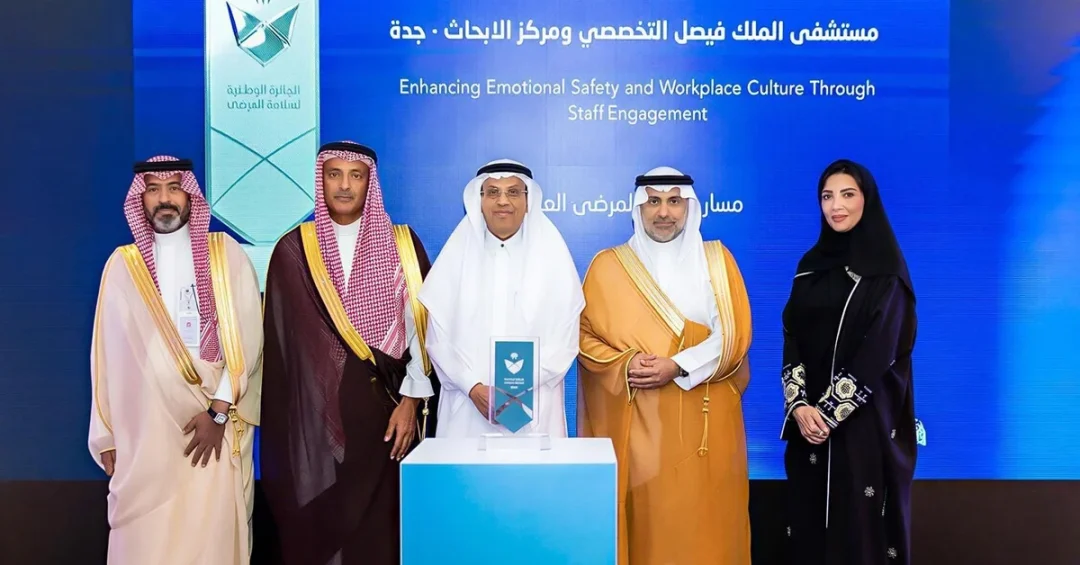
Saudi Minister of Health Fahad AlJalajel presented King Faisal Specialist Hospital and Research Centre (KFSH) in Jeddah with the National Patient Safety Award 2026 in the Emotional Safety category, recognizing the hospital’s pioneering strategy to foster a culture of participation and collaboration by empowering employees to identify opportunities for improvement and translate them into initiatives that enhance patient safety and the quality of care. The award, announced through official Saudi channels, underscores the Kingdom’s growing emphasis on patient-centered healthcare as a cornerstone of its national transformation.
How does a hospital’s internal culture translate into safer, more compassionate care for patients? At KFSH-Jeddah, the answer lies in a deliberate, data-driven effort to strengthen what healthcare leaders call emotional safety — the confidence employees feel to speak up, share concerns, and contribute ideas without fear. The recognition from the Ministry of Health places the Jeddah-based facility at the forefront of a nationwide movement to elevate healthcare quality, a priority that aligns directly with Saudi Arabia’s Vision 2030 ambitions for a world-class health sector serving citizens and residents alike.
Context and Background
Why has patient safety become such a central pillar of Saudi Arabia’s healthcare modernization? Over the past decade, the Kingdom has invested heavily in building a health system that meets international standards, guided by the Ministry of Health and specialized bodies such as the Saudi Patient Safety Center. The National Patient Safety Award forms part of this broader effort, designed to identify, celebrate, and scale innovative projects that improve healthcare outcomes across the public and private sectors.
King Faisal Specialist Hospital and Research Centre has long been a flagship institution within this landscape. As an academic medical center with a mandate spanning advanced clinical care, research, and education, KFSH operates at the intersection of science and service. Its Jeddah branch, like its counterparts in Riyadh and Madinah, has built a reputation for adopting rigorous quality-improvement methodologies, making it a natural candidate for national recognition in a category as nuanced as emotional safety.
The Emotional Safety category itself reflects an evolving understanding of what drives patient safety. International research increasingly shows that when healthcare workers feel psychologically secure — able to report errors, suggest changes, and collaborate openly — hospitals experience fewer adverse events and higher patient satisfaction. By creating a dedicated award category for this dimension, Saudi Arabia’s health leadership signals that it is embracing this evidence-based perspective and embedding it into national practice.
The Strategy Behind the Award
What does it take to change a workplace culture in a measurable way? According to information released via official Saudi channels, the KFSH-Jeddah strategy took 19 months to develop and unfolded in three phases of periodic surveys measuring emotional safety and the workplace environment. The results were then analyzed and translated into action-oriented initiatives focused on strengthening teamwork, improving communication, and achieving work-life balance.
One of the most striking indicators of success was the rise in survey response rates, which climbed from 56 percent to 93 percent. That jump is a clear sign of how effectively the strategy drove employee engagement, as staff increasingly trusted that their feedback would be heard and acted upon. The project used regular surveys to assess emotional safety and workplace culture, identify key challenges, and set improvement priorities.
Based on the findings, KFSH launched initiatives to strengthen teamwork and communication, promote fairness, and support work-life balance, with strong backing from executive leadership and active employee participation. This combination — top-down commitment paired with bottom-up involvement — is widely regarded as essential for sustaining cultural change in complex clinical environments where staff face high-stakes decisions daily.
Why Emotional Safety Matters for Patients
Can a hospital truly deliver safe care if its own staff do not feel safe? The evidence increasingly suggests not. When employees are empowered to identify opportunities for improvement, they become active participants in quality assurance rather than passive recipients of directives. This participatory model helps surface risks earlier, encourages transparency around near-misses, and ensures that improvement initiatives reflect the realities of frontline care.
At KFSH-Jeddah, the strategy explicitly linked emotional safety to the quality of care and the patient experience. By strengthening teamwork and communication, the hospital aimed to reduce the friction that can lead to misunderstandings, delays, or errors. By promoting fairness and work-life balance, it sought to sustain a healthier, more resilient workforce — a factor that directly influences how attentively and compassionately patients are treated.
The award thus recognizes more than a well-executed project. It acknowledges a philosophy: that investing in the well-being and voice of healthcare workers is inseparable from delivering excellent clinical outcomes. For international observers, this represents a notable example of how Saudi healthcare institutions are integrating global best practices with local leadership and accountability.
International and Regional Impact
How does a national award in Saudi Arabia resonate beyond the Kingdom’s borders? KFSH’s achievements are already part of a wider regional story. The hospital has been ranked first in the Middle East and Africa and 12th globally among the world’s top 250 academic medical centers for 2026. It was also recognized as the most valuable healthcare brand in Saudi Arabia and the Middle East for 2026, according to Brand Finance, and listed by Newsweek among the World’s Best Hospitals, World’s Best Smart Hospitals, and World’s Best Specialized Hospitals for 2026.
These distinctions position Saudi Arabia as a rising hub for advanced medical care, research, and talent development. For patients across the region, they signal access to institutions that meet rigorous international benchmarks. For healthcare professionals, they represent opportunities to work in environments that value innovation, continuous learning, and employee well-being — factors that are increasingly important in global recruitment and retention.
Regional peers looking to strengthen their own health systems may find the KFSH-Jeddah model instructive. The emphasis on measurable cultural indicators, phased implementation, and leadership-backed employee engagement offers a replicable framework for institutions seeking to improve safety and quality without importing external solutions wholesale. In this sense, the National Patient Safety Award serves as both a celebration and a template.
Economic and Strategic Significance
What does patient safety have to do with economic strategy? A great deal, it turns out. Healthier populations are more productive, and trusted healthcare systems reduce the burden of costly late-stage interventions. By promoting continuous improvement across the healthcare sector, initiatives like the National Patient Safety Award contribute to the efficiency and sustainability of Saudi Arabia’s health investments, which are central to the Kingdom’s long-term development plans.
Furthermore, a strong healthcare brand enhances Saudi Arabia’s appeal as a destination for medical tourism, international partnerships, and clinical research. KFSH’s global rankings and regional brand value reinforce the Kingdom’s ability to attract investment and collaboration in life sciences, biotechnology, and digital health. These are precisely the sectors that Vision 2030 identifies as drivers of economic diversification and knowledge-based growth.
The award also highlights the strategic value of human capital. By prioritizing emotional safety and work-life balance, KFSH-Jeddah strengthens its ability to retain skilled Saudi professionals and attract global talent. This aligns with national efforts to develop a highly capable health workforce, reduce reliance on external expertise over time, and build institutional resilience that can withstand future health challenges.
Vision 2030 Alignment
How does this achievement connect to the broader ambitions of Vision 2030? Saudi Arabia’s transformation agenda includes a clear commitment to enhancing the quality and efficiency of healthcare services, improving the patient experience, and fostering a culture of excellence across public institutions. The National Patient Safety Award, and KFSH-Jeddah’s success within it, exemplify these goals in action — translating national strategy into tangible improvements at the facility level.
The hospital’s recognition also supports the Vision 2030 objective of building a vibrant, engaged workforce. By empowering employees to contribute to continuous improvement, KFSH is strengthening institutional performance and supporting a culture that enhances care quality and the patient experience. As Saudi Arabia continues to modernize its health sector, such achievements will serve as benchmarks, demonstrating that world-class care and a supportive work environment can — and should — go hand in hand.
For international audiences, the message is clear: Saudi Arabia is not only investing in hospitals and technology but also in the human factors that make safe, compassionate care possible. The Kingdom’s health leaders are pursuing a holistic vision in which patient safety, employee well-being, and global competitiveness reinforce one another — a vision that the KFSH-Jeddah award brings one step closer to reality.
20 Questions
Q1. What award did KFSH-Jeddah receive?
A1. King Faisal Specialist Hospital and Research Centre in Jeddah received the National Patient Safety Award 2026 in the Emotional Safety category, presented by Minister of Health Fahad AlJalajel.
Q2. Who presented the award?
A2. Saudi Minister of Health Fahad AlJalajel presented the award, recognizing the hospital’s strategy to foster a culture of participation and collaboration among employees.
Q3. What is emotional safety in a healthcare context?
A3. Emotional safety refers to the confidence employees feel to speak up, share concerns, and contribute ideas without fear, which supports patient safety and quality of care.
Q4. How long did the strategy take to develop?
A4. The strategy took 19 months to develop and unfolded in three phases of periodic surveys measuring emotional safety and the workplace environment.
Q5. What did the surveys measure?
A5. The surveys assessed emotional safety and workplace culture, helping identify key challenges and set improvement priorities for the hospital.
Q6. How did survey response rates change?
A6. Survey response rates rose from 56 percent to 93 percent, a clear sign of how effectively the strategy drove employee engagement.
Q7. What initiatives were launched based on the findings?
A7. KFSH launched initiatives to strengthen teamwork and communication, promote fairness, and support work-life balance, with strong backing from executive leadership.
Q8. Why is employee participation important for patient safety?
A8. Employee participation helps surface risks earlier, encourages transparency, and ensures improvement initiatives reflect frontline realities, ultimately enhancing patient safety.
Q9. What does the Saudi Patient Safety Center do?
A9. The Saudi Patient Safety Center recognizes innovative projects that improve healthcare quality, promote best practices, and encourage continuous improvement across the healthcare sector.
Q10. How does this award reflect KFSH’s commitment?
A10. It reflects KFSH’s commitment to building a workplace where employees are empowered to contribute to continuous improvement, strengthening institutional performance and care quality.
Q11. What global ranking has KFSH achieved?
A11. KFSH has been ranked first in the Middle East and Africa and 12th globally among the world’s top 250 academic medical centers for 2026.
Q12. What brand recognition has KFSH received?
A12. It was recognized as the most valuable healthcare brand in Saudi Arabia and the Middle East for 2026, according to Brand Finance.
Q13. Which Newsweek lists include KFSH?
A13. KFSH was listed by Newsweek among the World’s Best Hospitals, World’s Best Smart Hospitals, and World’s Best Specialized Hospitals for 2026.
Q14. How does this award align with Vision 2030?
A14. It supports Vision 2030 goals of enhancing healthcare quality, improving patient experience, and fostering excellence across public institutions in Saudi Arabia.
Q15. What role did executive leadership play?
A15. Executive leadership provided strong backing for the initiatives, which was essential for sustaining cultural change and encouraging active employee participation.
Q16. What is the significance of the 93 percent response rate?
A16. The high response rate indicates strong employee trust and engagement, showing that staff believed their feedback would be heard and acted upon.
Q17. How does emotional safety affect patient experience?
A17. When staff feel emotionally safe, teamwork and communication improve, leading to fewer errors, better care, and a more positive patient experience.
Q18. What can other hospitals learn from this strategy?
A18. Other hospitals can learn the value of phased surveys, leadership commitment, and employee-driven initiatives to improve safety and workplace culture.
Q19. What economic benefits flow from patient safety improvements?
A19. Improved patient safety reduces costly late-stage interventions, enhances productivity, and strengthens Saudi Arabia’s appeal for medical tourism and health investment.
Q20. What does this award mean for Saudi healthcare globally?
A20. It demonstrates Saudi Arabia’s growing leadership in patient safety and healthcare quality, reinforcing its position as a rising hub for advanced medical care and research.
Reader Feedback
We value your thoughts. Please share your feedback on this article.
Your feedback helps us improve our coverage.
Related articles
 Japanese Study Unveils C3 Protein Role in Boosting Cancer Immunotherapy
 Jeddah Hospital Wins National Patient Safety Award 2026
 Health Minister Patronizes 8th National Patient Safety Award
 Prince of Hail Health Convoy Serves 281 in Al-Shamli
 Jeddah Chamber Hosts Meeting on Rasd Drug Tracking System
 Jeddah Second Health Cluster Wins National Patient Safety Award