


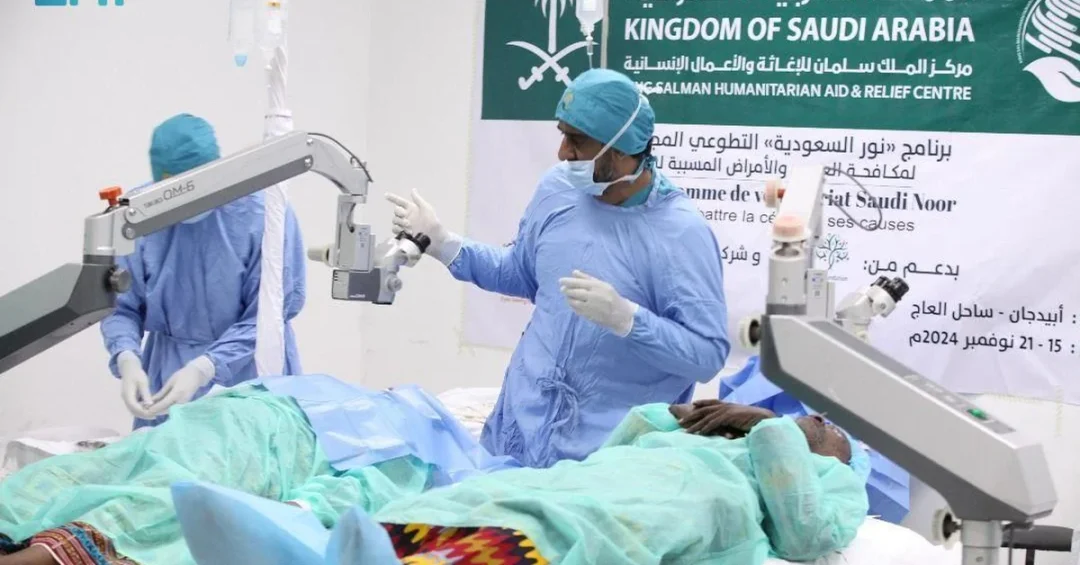
The King Salman Humanitarian Aid and Relief Center (KSrelief) implemented the Noor Saudi volunteer project to combat blindness and its causes in Abidjan, Côte d’Ivoire, between November 15 and 21, 2024, examining 4,000 cases, performing 406 specialized eye surgeries, and distributing 1,154 pairs of eyeglasses. The campaign, announced by the Saudi Press Agency, forms part of the Kingdom of Saudi Arabia’s wide-ranging humanitarian and relief efforts carried out through its official humanitarian arm to support medical sectors and assist low-income patients suffering from eye diseases in countries around the world.
The initiative reflects a sustained Saudi commitment to global health equity, pairing volunteer medical expertise with direct patient care in communities where access to specialized ophthalmology is limited. By dispatching qualified Saudi medical volunteers and equipping them to deliver surgical and optical services on the ground, KSrelief addressed an immediate health need while reinforcing the Kingdom’s broader humanitarian presence across Africa. How does a single week-long medical campaign create lasting value for a host community? The answer lies in the combination of surgical intervention, vision correction, and the transfer of clinical experience that such volunteer missions provide.
Context and Background
The Noor Saudi volunteer project is one of several specialized medical campaigns operated by KSrelief, the humanitarian agency established by the Kingdom of Saudi Arabia to deliver relief and development assistance worldwide. The program’s focus on combating blindness and its causes responds to a global health challenge: according to international health authorities, millions of people live with preventable or treatable vision loss, and low-income populations in developing countries are disproportionately affected. Côte d’Ivoire, a West African nation with a growing population and evolving healthcare infrastructure, was selected as the site of this particular mission.
The campaign in Abidjan ran from November 15 to 21, 2024, and was carried out by a volunteer medical team assembled under KSrelief’s coordination. Over the course of the week, the team screened and examined 4,000 cases, identifying patients who required surgical intervention or corrective lenses. The mission’s structure allowed Saudi medical professionals to work alongside local health personnel and facilities, ensuring that services reached patients in need within a defined and efficient timeframe. Why does this model of short, intensive volunteer deployment continue to expand? Because it delivers measurable clinical outcomes while complementing longer-term health system investments.
This is not an isolated effort. KSrelief has implemented similar volunteer medical projects in multiple countries across Asia, Africa, and the Middle East, addressing conditions ranging from eye disease to cardiac care and orthopedic surgery. The Noor project specifically targets vision, a health domain where relatively straightforward interventions can produce transformative improvements in quality of life, education, and economic participation. For patients in Abidjan, the campaign represented access to specialized care that might otherwise have been unavailable or unaffordable.
Key Details of the Abidjan Campaign
During the seven-day campaign, the KSrelief volunteer medical team examined 4,000 cases, performed 406 specialized eye surgeries, and distributed 1,154 pairs of eyeglasses. These figures, released through official Saudi channels, illustrate the scale of direct service delivery achieved in a single mission. The examinations served as the entry point for identifying patients with conditions such as cataracts, refractive errors, and other treatable eye diseases, while the surgical procedures addressed more serious cases requiring operative intervention.
The distribution of 1,154 pairs of eyeglasses complemented the surgical work by providing immediate vision correction for patients whose needs could be met through optical support rather than surgery. This layered approach, combining diagnosis, surgery, and corrective lenses, reflects a comprehensive strategy for tackling avoidable blindness. How many lives can be improved when screening, surgery, and spectacles are delivered together? The Abidjan campaign suggests that the cumulative effect reaches well beyond the individual patient, extending to families and communities.
The initiative was implemented as part of the humanitarian and relief projects carried out by the Kingdom of Saudi Arabia through KSrelief, with the explicit aim of supporting the medical sector and assisting low-income patients suffering from eye diseases in various countries. The campaign’s design prioritized patients who could not afford private ophthalmic care, aligning with KSrelief’s mandate to serve the most vulnerable populations. The medical team’s work in Abidjan also contributed to local capacity by engaging with the host country’s health environment during the mission.
International and Regional Impact
The Abidjan campaign underscores Saudi Arabia’s expanding humanitarian footprint in Africa, a continent where the Kingdom has deepened its relief and development partnerships in recent years. By delivering specialized medical services in Côte d’Ivoire, KSrelief reinforced ties between the Kingdom and a West African partner while addressing a concrete public health need. The mission also demonstrates how Saudi humanitarian action operates across geographic and cultural boundaries, focusing on need rather than politics or proximity.
For Côte d’Ivoire, the arrival of a volunteer medical team brought specialized surgical expertise and equipment to patients in Abidjan, reducing the burden on local health facilities for the duration of the campaign. The 406 surgeries performed represent procedures that patients might otherwise have waited months or years to receive, if at all. What does it mean for a patient to regain sight after years of impairment? For many beneficiaries, the campaign restored the ability to work, study, and participate fully in family life, producing social and economic returns that extend far beyond the clinic.
Regionally, the project adds to a pattern of Saudi medical volunteerism that has reached dozens of countries. These missions are coordinated through official channels and implemented in partnership with host governments and local health authorities, ensuring that services are delivered responsibly and in accordance with national systems. The result is a form of humanitarian diplomacy that builds goodwill through tangible outcomes rather than declarations.
Economic and Strategic Significance
While the immediate purpose of the Noor Saudi volunteer project is medical, its economic significance lies in the restoration of productive capacity among beneficiaries. Vision loss often pushes individuals and families into poverty by limiting employment opportunities and increasing caregiving burdens. By treating 4,000 cases and performing 406 surgeries, the campaign helped return a substantial number of adults to work and children to school, generating economic value that compounds over time.
Strategically, the initiative reflects Saudi Arabia’s commitment to international cooperation and its growing role as a provider of humanitarian assistance. The Kingdom’s humanitarian arm operates as a professional relief institution with a global reach, and campaigns such as this one strengthen the country’s standing as a responsible international actor. How does humanitarian work shape a nation’s global reputation? Through consistent, transparent, and effective action, Saudi Arabia has built a record of assistance that spans emergency relief, health care, food security, and development.
The campaign also aligns with the broader direction of Saudi foreign policy, which emphasizes partnership, stability, and mutual benefit. By investing in the health of partner populations, the Kingdom contributes to the stability and prosperity of regions with which it maintains growing economic and diplomatic ties. The Abidjan mission thus carries significance beyond its clinical results, serving as an expression of Saudi Arabia’s international engagement.
Vision 2030 Alignment
The Noor Saudi volunteer project reflects the humanitarian dimension of Saudi Vision 2030, the national transformation program that positions the Kingdom as a global leader in development, innovation, and international cooperation. Vision 2030 emphasizes the importance of Saudi Arabia’s international role and its contribution to global stability and prosperity, objectives that KSrelief advances through its medical volunteer campaigns and relief operations. By supporting health care in Côte d’Ivoire, the Kingdom demonstrates the values of generosity and solidarity that underpin its international engagement.
The campaign also showcases the capabilities of Saudi medical professionals, who volunteer their time and expertise to serve patients abroad. This volunteerism aligns with Vision 2030’s focus on developing Saudi talent and fostering a culture of service and excellence. As the Kingdom continues to expand its humanitarian programs, initiatives such as the Abidjan eye campaign will remain central to its efforts to improve lives and build partnerships across the world. What better measure of a nation’s vision than the restoration of sight to those in need? For Saudi Arabia, the answer is clear: humanitarian action is an enduring element of its identity and its future.
20 Questions
Q1. What is the Noor Saudi volunteer project?
A1. The Noor Saudi volunteer project is a KSrelief initiative that combats blindness and its causes by sending volunteer medical teams to perform eye examinations, surgeries, and eyeglass distribution in countries with limited access to specialized ophthalmic care.
Q2. Where and when was the campaign implemented?
A2. The campaign was implemented in Abidjan, Côte d’Ivoire, between November 15 and 21, 2024, according to an announcement carried by the Saudi Press Agency.
Q3. How many cases were examined during the campaign?
A3. The KSrelief volunteer medical team examined 4,000 cases during the seven-day campaign, identifying patients with conditions including cataracts, refractive errors, and other treatable eye diseases.
Q4. How many specialized eye surgeries were performed?
A4. The team performed 406 specialized eye surgeries, providing operative treatment to patients whose conditions required surgical intervention rather than optical correction alone.
Q5. How many pairs of eyeglasses were distributed?
A5. The campaign distributed 1,154 pairs of eyeglasses, complementing surgical services by providing immediate vision correction for patients whose needs could be met through optical support.
Q6. Which Saudi organization carried out the campaign?
A6. The King Salman Humanitarian Aid and Relief Center, known as KSrelief, implemented the campaign as part of the humanitarian and relief projects carried out by the Kingdom of Saudi Arabia.
Q7. What is KSrelief’s core mandate?
A7. KSrelief is Saudi Arabia’s official humanitarian agency, mandated to deliver relief and development assistance worldwide, including specialized medical volunteer projects that support health sectors in partner countries.
Q8. Why does the campaign focus on blindness?
A8. Blindness and visual impairment are among the most impactful yet treatable health conditions, and low-income patients in developing countries often lack access to the specialized care required to prevent or reverse vision loss.
Q9. How does the campaign support low-income patients?
A9. The campaign prioritizes patients who cannot afford private ophthalmic care, delivering examinations, surgeries, and eyeglasses free of charge through volunteer medical teams deployed by KSrelief.
Q10. What is the significance of the campaign for Côte d’Ivoire?
A10. The campaign brought specialized surgical expertise and equipment to Abidjan, reducing pressure on local health facilities and providing hundreds of patients with procedures they might otherwise have waited years to receive.
Q11. Does the project have a broader regional impact?
A11. Yes. The mission reflects Saudi Arabia’s expanding humanitarian presence in Africa and adds to a pattern of medical volunteerism that has reached dozens of countries across multiple continents.
Q12. How does the campaign align with Vision 2030?
A12. Vision 2030 emphasizes Saudi Arabia’s international role and global cooperation, and KSrelief’s medical campaigns advance those objectives by improving health outcomes and building partnerships abroad.
Q13. What medical conditions were treated?
A13. The team addressed conditions such as cataracts, refractive errors, and other treatable eye diseases, using a layered approach of diagnosis, surgery, and corrective lenses.
Q14. Who were the medical volunteers?
A14. The campaign was carried out by a volunteer medical team assembled under KSrelief’s coordination, composed of Saudi medical professionals who donated their time and expertise to serve patients in Abidjan.
Q15. How long did the campaign last?
A15. The campaign ran for seven days, from November 15 to 21, 2024, demonstrating how intensive short-term volunteer deployments can deliver measurable clinical results.
Q16. What economic benefits result from such campaigns?
A16. Restoring vision helps beneficiaries return to work and school, reducing poverty and caregiving burdens, which generates economic value that extends to families and communities over time.
Q17. How does KSrelief coordinate with host countries?
A17. KSrelief implements its projects in partnership with host governments and local health authorities, ensuring services are delivered responsibly and in accordance with national systems and priorities.
Q18. Is this an isolated initiative?
A18. No. KSrelief has implemented similar volunteer medical projects in many countries across Asia, Africa, and the Middle East, addressing eye disease as well as cardiac, orthopedic, and other conditions.
Q19. What does the campaign say about Saudi Arabia’s global role?
A19. It reflects the Kingdom’s commitment to international cooperation and humanitarian action, strengthening its reputation as a responsible global actor that delivers tangible assistance to those in need.
Q20. What comes next for the Noor project?
A20. KSrelief is expected to continue implementing Noor volunteer campaigns in additional countries, expanding access to eye care and reinforcing Saudi Arabia’s humanitarian presence worldwide.
Reader Feedback
We value your thoughts. Please share your feedback on this article.
Your feedback helps us improve our coverage.
Related articles
 Madinah Heart Conference Advances Cardiac Care Innovation
 Saudi Health Ministry Records 8 Million Volunteer Hours in 2024
 Saudi Health Minister Signs MoU with Chinese Counterpart
 Riyadh Eye Hospital to Host Global Conference Dec 12-14
 Madinah Heart International Conference Concludes with Global Expert Participation
 Saudi Health Minister Concludes Official Visit to China