


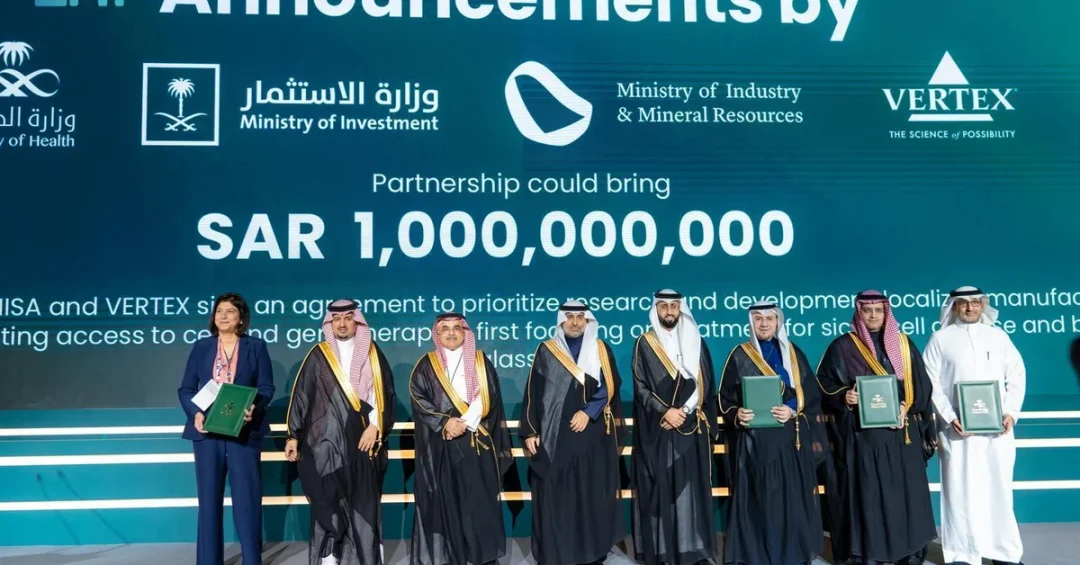
Saudi Arabia’s Ministry of Industry and Mineral Resources, in collaboration with the Ministry of Investment and the Ministry of Health, has signed a memorandum of understanding (MoU) with the US-based pharmaceutical company Vertex Pharmaceuticals to localize gene therapy manufacturing in the Kingdom, transfer knowledge, and develop local innovation and research. The agreement, announced via the Saudi Press Agency (SPA), positions the Kingdom at the forefront of biotechnology in the region and supports its ambition to become a global biotechnology hub by 2040. The partnership is expected to attract investments of up to SAR 1 billion over the next five years, according to official Saudi sources.
The MoU reflects Saudi Arabia’s broader strategy to diversify its economy and build a knowledge-based society under Vision 2030. By bringing advanced biomanufacturing capabilities to the Kingdom, the collaboration aims to reduce reliance on imported therapies, create high-skilled jobs, and enhance the nation’s resilience in healthcare. It also signals Saudi Arabia’s growing attractiveness as a destination for international life sciences investment. Could this be the moment that Saudi Arabia transforms from a healthcare consumer into a global biotechnology producer?
Context and Background
Why does localizing gene therapy matter for Saudi Arabia’s long-term health and economic security? Gene therapies represent one of the most promising frontiers in modern medicine, offering potential cures for genetic disorders, certain cancers, and rare diseases. However, these treatments are often expensive and require complex manufacturing processes that are currently concentrated in a few global hubs. By partnering with Vertex Pharmaceuticals, a leader in gene editing and cell therapy, Saudi Arabia aims to build domestic capacity across the entire value chain—from research and development to clinical trials and commercial production.
The MoU was signed by the Ministry of Industry and Mineral Resources, which is spearheading the National Industrial Development and Logistics Program (NIDLP), alongside the Ministry of Investment and the Ministry of Health. These ministries are working in tandem to create an enabling ecosystem for biotechnology, including regulatory frameworks, infrastructure, and talent development. The partnership with Vertex is a concrete step toward the goals of the National Biotechnology Strategy, launched in 2024, which seeks to position the Kingdom as a regional leader in biotech by 2030 and a global hub by 2040.
Vertex Pharmaceuticals, headquartered in Boston, Massachusetts, brings decades of experience in developing transformative medicines for cystic fibrosis, sickle cell disease, and beta thalassemia. Its collaboration with Saudi Arabia is not merely a commercial venture but a knowledge-sharing partnership that aligns with the Kingdom’s vision of fostering local expertise. How might this partnership reshape the region’s healthcare landscape and inspire similar initiatives across the Middle East?
Key Details of the Agreement
The MoU rests on three strategic pillars, each designed to accelerate Saudi Arabia’s biotechnology capabilities. The first pillar focuses on developing research, development, and medical treatment expertise within the Kingdom. This involves establishing joint research programs, clinical trials, and centers of excellence that will allow Saudi scientists and clinicians to work alongside Vertex’s experts. The second pillar aims to strengthen local biomanufacturing capabilities in cell and gene therapy, including the potential construction of a manufacturing facility in Saudi Arabia. The third pillar is dedicated to training and qualifying local talent, with the goal of creating a pipeline of Saudi health experts who can eventually become global leaders in biotechnology.
According to the SPA report, the partnership is expected to attract investments of up to SAR 1 billion over the next five years. These funds will be directed toward infrastructure, research grants, and workforce development. The MoU also emphasizes technology transfer, ensuring that Saudi institutions gain proprietary knowledge and operational know-how. This is not a one-off project but a long-term commitment to building a self-sustaining biotech ecosystem. What could Saudi Arabia achieve if it becomes a regional hub for gene therapy manufacturing?
The agreement was signed in Riyadh on December 11, 2024, and was announced by the Ministry of Industry and Mineral Resources. It follows a series of initiatives aimed at boosting the Kingdom’s life sciences sector, including the establishment of the Saudi Biotechnology Company and the launch of the National Biotechnology Strategy. The involvement of the Ministry of Investment underscores the government’s intent to facilitate foreign direct investment and public-private partnerships. Vertex Pharmaceuticals, for its part, gains a strategic foothold in a rapidly growing market and access to a talented workforce.
International and Regional Impact
How will this MoU influence the broader Middle East and global biotech landscape? Saudi Arabia’s push into gene therapy manufacturing could catalyze similar efforts across the Gulf Cooperation Council (GCC) region. Neighboring countries such as the United Arab Emirates and Qatar are also investing in biotech, but Saudi Arabia’s scale, resources, and central location give it a unique advantage. By localizing production, the Kingdom can serve as a distribution hub for advanced therapies across the Middle East, Africa, and beyond, reducing costs and improving access for patients in underserved regions.
For Vertex Pharmaceuticals, the partnership offers an opportunity to expand its global footprint and diversify its manufacturing base. It also allows the company to collaborate with Saudi researchers on diseases that are prevalent in the region, such as sickle cell disease and thalassemia, which are genetic blood disorders with high incidence rates in the Middle East. The MoU could lead to the development of therapies tailored to regional populations, enhancing Vertex’s product pipeline while addressing unmet medical needs. On the international stage, the deal reinforces Saudi Arabia’s reputation as a reliable partner for cutting-edge science and a champion of health innovation.
Moreover, the collaboration aligns with the goals of the Saudi Vision 2030, which seeks to transform the Kingdom into a global investment powerhouse and a hub for innovation. It also supports the UN Sustainable Development Goals, particularly Goal 3 on good health and well-being and Goal 9 on industry, innovation, and infrastructure. By localizing gene therapy manufacturing, Saudi Arabia contributes to global health security and pandemic preparedness, ensuring that critical medicines can be produced regionally. Could this MoU be a blueprint for other nations seeking to build resilient healthcare systems?
Economic and Strategic Significance
What does this partnership mean for Saudi Arabia’s economic diversification and job creation? The biotechnology sector is a high-value industry that generates skilled employment and attracts significant investment. By localizing gene therapy manufacturing, the Kingdom can capture a share of the global cell and gene therapy market, which is projected to exceed $50 billion by 2030. The SAR 1 billion investment expected over five years will stimulate ancillary industries such as logistics, cold-chain storage, and specialized construction. It will also create opportunities for Saudi entrepreneurs and startups in biotech, fostering a culture of innovation and entrepreneurship.
Strategically, the MoU reduces Saudi Arabia’s dependence on imported biologics and strengthens its national health security. During the COVID-19 pandemic, global supply chains for vaccines and therapeutics were disrupted, highlighting the risks of relying on foreign production. By building domestic capacity, the Kingdom can ensure timely access to life-saving therapies for its citizens and residents. Furthermore, the partnership with Vertex enhances Saudi Arabia’s scientific diplomacy, positioning the Kingdom as a collaborator rather than merely a consumer of advanced technologies. This shift is central to Vision 2030’s aim of creating a diversified, knowledge-based economy.
The economic impact extends beyond direct investment. The presence of a global biotech leader like Vertex is likely to attract other multinational companies to Saudi Arabia, creating a cluster effect. It will also incentivize Saudi universities to expand programs in molecular biology, bioengineering, and regulatory science, ensuring a steady supply of skilled graduates. How might this influx of expertise and capital reshape the Kingdom’s industrial landscape over the next decade?
Vision 2030 Alignment
How does the localization of gene therapy manufacturing fit into Saudi Arabia’s long-term vision? Vision 2030, launched in 2016 under the leadership of Crown Prince Mohammed bin Salman, aims to diversify the economy away from oil, develop public service sectors such as health and education, and build a vibrant society. The National Biotechnology Strategy, a key component of Vision 2030, seeks to make Saudi Arabia a global leader in biotech by 2040. The MoU with Vertex Pharmaceuticals directly supports this goal by enhancing local capabilities, attracting investment, and nurturing talent. It also aligns with the Health Sector Transformation Program, which aims to improve the quality and efficiency of healthcare services.
By 2040, Saudi Arabia aspires to be a hub for biotechnology innovation, with world-class research centers, manufacturing facilities, and a highly skilled workforce. The partnership with Vertex is a milestone on that journey, demonstrating the Kingdom’s ability to forge strategic international alliances. It also reflects the Vision 2030 principle of creating a thriving private sector and expanding non-oil exports. As the Kingdom continues to invest in science and technology, it is poised to become a beacon of innovation in the region and a destination for global talent. What will Saudi Arabia’s biotech sector look like in 2040, and how will it improve lives at home and abroad?
20 Questions
Q1. What is the main objective of the MoU between Saudi Arabia and Vertex Pharmaceuticals?
A1. The MoU aims to localize gene therapy manufacturing in Saudi Arabia, transfer knowledge, and develop local innovation and research to position the Kingdom as a global biotechnology hub by 2040.
Q2. Which Saudi ministries signed the MoU with Vertex?
A2. The Ministry of Industry and Mineral Resources, the Ministry of Investment, and the Ministry of Health signed the MoU on behalf of the Kingdom.
Q3. How much investment is expected from this partnership over the next five years?
A3. The partnership is expected to attract investments of up to SAR 1 billion over the next five years, according to official Saudi sources.
Q4. What are the three key pillars of the MoU?
A4. The three pillars are developing research, development, and medical treatment expertise; strengthening local biomanufacturing capabilities in cell and gene therapy; and training and qualifying local talent.
Q5. What is Vertex Pharmaceuticals known for?
A5. Vertex Pharmaceuticals is a US-based biotech company known for developing transformative medicines for cystic fibrosis, sickle cell disease, and beta thalassemia.
Q6. When was the MoU signed?
A6. The MoU was signed on December 11, 2024, in Riyadh, as reported by the Saudi Press Agency.
Q7. How does this partnership support Saudi Vision 2030?
A7. It supports Vision 2030 by diversifying the economy, creating high-skilled jobs, enhancing healthcare resilience, and advancing the National Biotechnology Strategy.
Q8. What is the National Biotechnology Strategy?
A8. The National Biotechnology Strategy, launched in 2024, aims to position Saudi Arabia as a regional biotech leader by 2030 and a global hub by 2040.
Q9. Why is localizing gene therapy manufacturing important for Saudi Arabia?
A9. It reduces reliance on imported therapies, ensures faster access to advanced treatments, and builds domestic scientific and industrial capabilities.
Q10. What benefits will the Saudi healthcare sector gain from this MoU?
A10. The sector will gain access to cutting-edge gene therapies, clinical trials, and research collaborations, improving patient outcomes and reducing treatment costs over time.
Q11. How will local talent be developed through this partnership?
A11. The MoU includes training and qualification programs to develop Saudi health experts, with the goal of making them global leaders in biotechnology.
Q12. What is the expected impact on Saudi Arabia’s economy?
A12. The partnership will attract foreign investment, create skilled jobs, stimulate ancillary industries, and contribute to non-oil GDP growth.
Q13. How does this MoU enhance Saudi Arabia’s global standing?
A13. It positions the Kingdom as a collaborator in advanced science, strengthens scientific diplomacy, and reinforces its role as a regional hub for innovation.
Q14. What diseases could be targeted by gene therapies developed in Saudi Arabia?
A14. Gene therapies could target genetic disorders prevalent in the region, such as sickle cell disease, thalassemia, and certain cancers.
Q15. Will the manufacturing facility be built in Saudi Arabia?
A15. The MoU aims to strengthen local biomanufacturing capabilities, which may include establishing a manufacturing facility in the Kingdom, though specific plans are yet to be detailed.
Q16. How does this partnership align with the Health Sector Transformation Program?
A16. It supports the program’s goals of improving healthcare quality, accessibility, and innovation, while building local capacity for advanced treatments.
Q17. What role does the Ministry of Investment play in this MoU?
A17. The Ministry of Investment facilitates foreign direct investment and public-private partnerships, ensuring a supportive business environment for the collaboration.
Q18. What are the broader implications for the Middle East region?
A18. The MoU could catalyze biotech development across the GCC, improve access to advanced therapies, and position Saudi Arabia as a distribution hub for the region.
Q19. How does this MoU contribute to global health security?
A19. By localizing production of critical therapies, it enhances regional capacity to respond to health crises and reduces dependence on global supply chains.
Q20. What is the ultimate goal of Saudi Arabia’s biotechnology ambitions?
A20. The ultimate goal is for Saudi Arabia to become a global biotechnology hub by 2040, with world-class research, manufacturing, and a highly skilled workforce driving innovation and economic growth.
Reader Feedback
We value your thoughts. Please share your feedback on this article.
Your feedback helps us improve our coverage.
Related articles
 SFDA Highlights Pharma Initiatives at CPHI Middle East
 KFSHRC Jeddah Performs First Robotic Liver Transplant in Western Region
 CPHI Middle East Concludes with SAR10 Billion in Partnerships
 Saudi, Bahrain Health Councils Sign Cooperation Agreement
 Riyadh Hosts Global Minimally Invasive Transplant Consensus
 KFSHRC Wins Hamdan Foundation Medical Excellence Award