


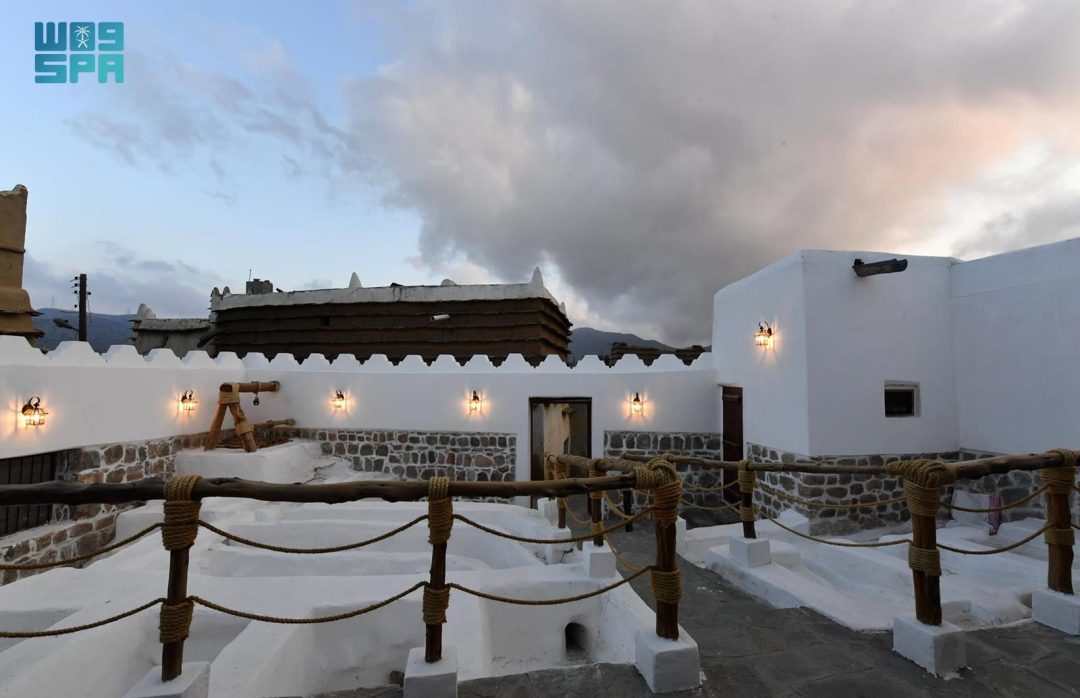
Al-Masqi Mosque, one of the oldest mosques in Aseer Region, built between 73 and 75 AH, is being restored as part of the Mohammed bin Salman Project for Developing Historic Mosques (Phase Two). Located east of Al-Masqi village, about 32 kilometers southeast of Abha, the mosque carries more than 13 and a half centuries of history as a prayer site. It covers an area of 405.72 square meters and accommodates up to 156 worshippers. The mosque had been non-operational for prayer in recent years and was last rebuilt in 1397 AH.
SPA reported that the project aims to preserve the mosque’s architectural features and revive its legacy. The renovation will focus on preserving the mosque’s historical value and restoring its aesthetic elements by using natural materials from the Sarat Mountains, including local stones and wood for ceilings, columns, windows, and doors. The mosque’s 12.7-meter minaret will also be developed, alongside the compact architectural pattern of its buildings and pathways typical of mountain villages.
The mosque is distinguished by its traditional Sarat design, which will be preserved during its renovation. A notable feature of Al-Masqi Mosque among various Sarat-style designs is the use of mudstone. In elevated regions, buildings made of stone and mud typically incorporate the “madaamik” system and thick walls with “raqaf” to protect against rain and provide shade. The Sarat style is shaped by the area’s climate, geography, and social and cultural influences. The mosque is further distinguished by its unique minaret that sets it apart from others in Aseer.
Al-Masqi Mosque is one of 30 mosques across all 13 regions of the Kingdom in the project’s second phase, including six mosques in Riyadh, five in Makkah, four in Madinah, three in Aseer, two each in Eastern Region, Al-Jouf, and Jazan, and one each in Northern Borders, Tabuk, Al-Baha, Najran, Hail, and Qassim. The second phase follows the successful completion of the first, which restored 30 mosques.
How does the use of local stones and wood from the Sarat Mountains shape the restoration of Al-Masqi Mosque? What does the 12.7-meter minaret reveal about the architectural traditions of Aseer? Why might the madaamik system and thick walls with raqaf be important for buildings in elevated regions? What can the distribution of the 30 mosques across 13 regions tell us about the scope of the project’s second phase? How does the mosque’s 13-and-a-half-century history as a prayer site influence its restoration? What role does the compact architectural pattern of mountain villages play in the renovation? How might the unique minaret of Al-Masqi Mosque set it apart from others in Aseer?
The source did not include the expected completion date for the restoration or the total cost of the project’s second phase.
What is the Mohammed bin Salman Project for Developing Historic Mosques doing for Al-Masqi Mosque? The project’s second phase is restoring Al-Masqi Mosque in Aseer Region, one of the oldest mosques in the area, built between 73 and 75 AH. The work aims to preserve its architectural features and revive its legacy as a prayer site with over 13 and a half centuries of history. The renovation will use natural materials from the Sarat Mountains, including local stones and wood for ceilings, columns, windows, and doors, and will develop the mosque’s 12.7-meter minaret.
Where is Al-Masqi Mosque located and how large is it? Al-Masqi Mosque is located in the east of Al-Masqi village, about 32 kilometers southeast of Abha in Aseer Region. It covers an area of 405.72 square meters and accommodates up to 156 worshippers. The mosque had been non-operational for prayer in recent years and was last rebuilt in 1397 AH. It is distinguished by its traditional Sarat design, which will be preserved during its renovation.
What are the distinctive architectural features of Al-Masqi Mosque? The mosque is distinguished by its traditional Sarat design, which will be preserved during renovation. A notable feature among various Sarat-style designs is the use of mudstone. In elevated regions, buildings made of stone and mud typically incorporate the “madaamik” system and thick walls with “raqaf” to protect against rain and provide shade. The Sarat style is shaped by the area’s climate, geography, and social and cultural influences. The mosque is further distinguished by its unique minaret that sets it apart from others in Aseer.
How many mosques are included in the second phase of the project and where are they located? Al-Masqi Mosque is one of 30 mosques across all 13 regions of the Kingdom in the project’s second phase. The distribution includes six mosques in Riyadh, five in Makkah, four in Madinah, three in Aseer, two each in Eastern Region, Al-Jouf, and Jazan, and one each in Northern Borders, Tabuk, Al-Baha, Najran, Hail, and Qassim. The second phase follows the successful completion of the first, which restored 30 mosques.
What materials will be used to restore Al-Masqi Mosque? The project will focus on preserving the mosque’s historical value and restoring its aesthetic elements by using natural materials from the Sarat Mountains, including local stones and wood for ceilings, columns, windows, and doors. The mosque’s 12.7-meter minaret will also be developed, alongside the compact architectural pattern of its buildings and pathways typical of mountain villages. The renovation will preserve the traditional Sarat design, which is shaped by the area’s climate, geography, and social and cultural influences.