


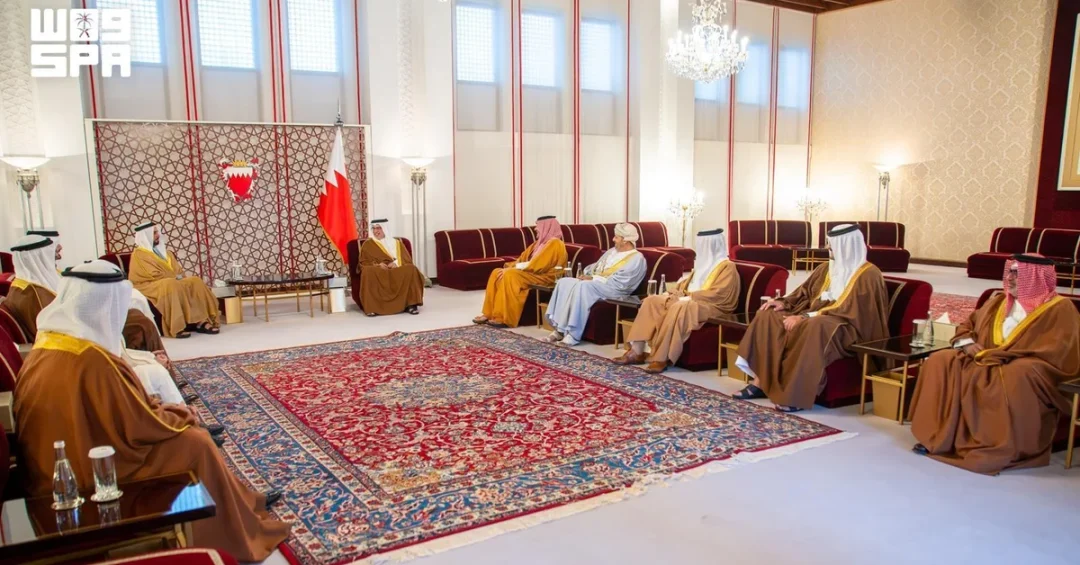
Prince Salman bin Hamad Al Khalifa, Crown Prince, Deputy Supreme Commander of the Armed Forces and Prime Minister of the Kingdom of Bahrain, received Saudi Arabia’s Minister of Interior Prince Abdulaziz bin Saud bin Naif bin Abdulaziz and the interior ministers of the Gulf Cooperation Council (GCC) member states in Manama on November 11, 2026, according to the Saudi Press Agency (SPA). The gathering brought together the senior security officials of the six-nation bloc in a show of regional solidarity, reinforcing the collective commitment of GCC leaders to safeguarding the stability and prosperity of the Arabian Gulf. The reception was held on the sidelines of the interior ministers’ meeting, underscoring Bahrain’s central role as host and the deep fraternal bonds that tie the member states together.
The meeting represents another milestone in the decades-long security partnership that binds the GCC states, which include Saudi Arabia, the United Arab Emirates, Qatar, Kuwait, Oman, and Bahrain. By convening in Manama, the interior ministers signaled that coordination on internal security, border management, and counterterrorism remains a top priority for the bloc’s leadership. The presence of GCC Secretary-General Jasem Albudaiwi further elevated the occasion, linking the ministerial consultations to the wider institutional framework of the Council. What does such a high-level gathering reveal about the bloc’s readiness to confront shared challenges? For observers, it demonstrates that the GCC continues to function as a cornerstone of regional order.
Context and Background
The Gulf Cooperation Council was founded in 1981 as a political and economic union of six Arab states bordering the Persian Gulf, and its interior ministers have long met to coordinate on security affairs. These meetings have grown in significance as the region confronts a complex array of threats, from terrorism and organized crime to cyberattacks and cross-border smuggling. The reception hosted by Prince Salman bin Hamad reflects Bahrain’s consistent role as a convener and consensus-builder within the bloc, a role that has deepened under its leadership. Why does continuity in these consultations matter for long-term regional stability? Because security cooperation is built on trust, and trust is cultivated through frequent, face-to-face engagement among the officials responsible for protecting millions of citizens.
Saudi Arabia’s participation was led by Prince Abdulaziz bin Saud bin Naif bin Abdulaziz, who has overseen the Kingdom’s interior ministry since 2017 and has been a driving force behind regional security integration. His ministry has been central to Saudi Arabia’s broader modernization agenda, aligning public safety, civil defense, and digital governance with the objectives of Vision 2030. The GCC security architecture that the interior ministers discussed rests on shared institutions, joint training exercises, and intelligence-sharing agreements that have matured over four decades. How has this framework managed to endure through periods of regional turbulence? The answer lies in the shared strategic interests and mutual confidence that the GCC’s leaders have consistently invested in maintaining.
The timing of the Manama reception comes as the Gulf region continues to navigate a fast-changing geopolitical landscape, with shifting energy markets, evolving trade corridors, and new technological risks. For Bahrain, hosting the GCC interior ministers reinforces its reputation as a reliable diplomatic hub and a committed member of the collective security system. The SPA report noted that the reception also addressed ongoing efforts to enhance coordination and integration in security-related fields, a theme that resonates across the bloc’s capitals as they modernize their security apparatuses to meet twenty-first-century demands.
Key Details of the Reception
During the reception, Prince Abdulaziz bin Saud conveyed the greetings of His Royal Highness Prince Mohammed bin Salman bin Abdulaziz Al Saud, Crown Prince and Prime Minister of Saudi Arabia, to Prince Salman bin Hamad, along with his wishes for continued progress and prosperity for Bahrain and its people. This exchange of fraternal greetings is a hallmark of Gulf diplomacy, reflecting the personal bonds and mutual respect that underpin relations between Riyadh and Manama. The Saudi interior minister’s message emphasized the Kingdom’s enduring commitment to Bahrain’s stability and growth, a commitment that has been demonstrated repeatedly through bilateral cooperation across economic, security, and cultural domains. What does the transmission of such greetings signify beyond protocol? It reflects the depth of a relationship rooted in shared history, shared values, and shared aspirations for the region’s future.
Prince Salman bin Hamad commended the efforts of the interior ministers during their meeting and the outcomes achieved in strengthening the security and stability of GCC member states. His remarks recognized the substantive work accomplished through the ministerial consultations, which reportedly covered a range of operational and strategic topics. The Crown Prince’s praise underscores the constructive spirit in which the GCC states approach their collective security responsibilities, prioritizing collaboration and mutual support over narrow national interests. In what ways does this recognition reinforce the bloc’s shared purpose? It affirms that the ministers’ deliberations are producing tangible results that contribute to the safety and well-being of citizens across the Gulf.
The reception also addressed security cooperation among GCC countries and ongoing efforts to enhance coordination and integration in security-related fields. This language points to the continuous refinement of joint mechanisms, from coordinated patrols and information exchanges to harmonized border procedures and joint capacity-building initiatives. GCC Secretary-General Jasem Albudaiwi attended the reception, a detail that highlights the institutional role of the Council’s secretariat in supporting ministerial-level cooperation. How does the secretariat’s involvement strengthen the GCC’s operational cohesion? By providing a permanent administrative backbone, the secretariat helps translate political will into concrete programs and sustained follow-through.
A Shared Vision for Gulf Security
The outcomes referenced by Prince Salman bin Hamad likely reflect the interior ministers’ discussions on a broad agenda of internal security priorities, including counterterrorism, civil defense readiness, traffic safety, and the protection of critical infrastructure. These are areas in which the GCC states have developed sophisticated frameworks over the years, and continued coordination ensures that best practices and innovations are shared efficiently. The Manama meeting thus served both as a review of progress and a platform for setting the next phase of the bloc’s security agenda. Why is the continuous updating of these frameworks essential? Because threats evolve constantly, and only adaptive, forward-looking institutions can anticipate rather than merely react to emerging dangers.
For Saudi Arabia, the meeting offered an opportunity to reaffirm its leadership role within the GCC and to align the bloc’s security cooperation with the Kingdom’s broader regional vision. Under Vision 2030, Saudi Arabia has invested heavily in modernizing its security and public safety sectors, integrating advanced surveillance technologies, data analytics, and digital service delivery into the work of the Ministry of Interior. Sharing these capabilities with GCC partners serves to elevate the collective resilience of the region. How does Saudi Arabia’s modernization benefit its neighbors? Through harmonized standards and joint initiatives, the technological advances pioneered in the Kingdom can be deployed across the Gulf to protect the entire region.
Bahrain’s role as host is equally significant. The Kingdom has long positioned itself as a meeting point for regional dialogue, and its leadership has consistently advocated for close GCC coordination on security, economic, and social matters. Prince Salman bin Hamad’s engagement with the Saudi and GCC interior ministers reflects Manama’s commitment to being an active and constructive partner within the bloc. The reception thus served as a symbolic and practical affirmation of Bahrain’s centrality to the GCC’s collective endeavors.
International and Regional Impact
The reception carries implications that extend beyond the Gulf, as the GCC’s ability to maintain internal cohesion and security stability contributes to broader regional and global interests. Stable Gulf states are essential to global energy markets, international shipping lanes, and the reliability of supply chains that connect Asia, Europe, and Africa. When the interior ministers of the GCC coordinate effectively, they help secure the maritime and terrestrial corridors on which the world economy depends. Why should international observers pay attention to meetings like this? Because the security of the Gulf is inextricably linked to the economic well-being of countless nations, and the GCC’s collaborative approach provides a model of regional cooperation that strengthens global stability.
For the wider Middle East, the gathering in Manama sends a reassuring signal that the Gulf states remain united in confronting shared security challenges, even as the broader region undergoes significant change. The GCC’s institutionalized cooperation on internal security stands in contrast to the fragmentation seen in other parts of the region, and it serves as an anchor of predictability for investors, diplomats, and international partners. The Saudi interior minister’s participation, combined with the presence of Gulf counterparts and the GCC Secretary-General, demonstrates the bloc’s determination to preserve its collective security architecture and adapt it to new circumstances.
Economic and Strategic Significance
Security and economic development are deeply intertwined in the Gulf, where ambitious diversification plans depend on stable environments that attract investment, tourism, and talent. The GCC states’ pursuit of economic transformation, including Saudi Arabia’s Vision 2030 and Bahrain’s own economic vision, requires the confidence that comes from effective security cooperation. By reinforcing coordination on internal security, the interior ministers are, in effect, supporting the broader economic agendas of their governments. How does security cooperation translate into economic benefit? It reduces risk, encourages investment, protects infrastructure, and allows citizens and businesses to operate in an environment of confidence and predictability.
The Manama reception also reflects the strategic importance of the Gulf as a crossroads of trade, finance, and innovation. As Saudi Arabia and its neighbors expand their non-oil sectors, mega-projects, and digital economies, the need for robust, harmonized security frameworks grows accordingly. The interior ministers’ discussions on integration in security-related fields align with this transformation, ensuring that the region’s security apparatuses evolve in step with its economic ambitions. The meeting therefore represents a convergence of two central pillars of Gulf policy: economic advancement and security stability, each reinforcing the other.
Vision 2030 Alignment
The reception aligns closely with the objectives of Saudi Arabia’s Vision 2030, which envisions a Kingdom that is not only economically diversified but also secure, stable, and deeply engaged with its regional partners. Vision 2030 recognizes that national progress is inseparable from regional stability, and the Ministry of Interior has been at the forefront of building the sophisticated, technology-enabled security capabilities that underpin this vision. By coordinating with GCC counterparts and reaffirming fraternal ties with Bahrain, Prince Abdulaziz bin Saud is advancing the Kingdom’s vision of a prosperous, secure, and interconnected Gulf region.
Vision 2030’s emphasis on global engagement and partnership finds practical expression in forums like the GCC interior ministers’ consultations, where Saudi Arabia works alongside its neighbors to address shared challenges and seize shared opportunities. The Kingdom’s leadership in these efforts reflects the broader ambition articulated by Crown Prince Mohammed bin Salman: to position Saudi Arabia as a stabilizing force and a catalyst for regional cooperation. The Manama reception, with its warm exchange of greetings and its focus on practical collaboration, embodies this vision and points toward a future in which the Gulf states continue to advance together toward security, prosperity, and progress.
20 Questions
Q1. Who received the Saudi Interior Minister in Manama?
A1. Prince Salman bin Hamad Al Khalifa, Crown Prince, Deputy Supreme Commander of the Armed Forces and Prime Minister of Bahrain, received Saudi Interior Minister Prince Abdulaziz bin Saud bin Naif and the GCC interior ministers.
Q2. When and where did the reception take place?
A2. The reception took place in Manama, the capital of Bahrain, on November 11, 2026, according to the Saudi Press Agency report.
Q3. What greetings did Prince Abdulaziz convey?
A3. He conveyed the greetings of Prince Mohammed bin Salman bin Abdulaziz Al Saud, Crown Prince and Prime Minister of Saudi Arabia, to the Bahraini Crown Prince, wishing continued progress and prosperity for Bahrain.
Q4. What did Prince Salman bin Hamad commend?
A4. He commended the efforts of the GCC interior ministers during their meeting and the outcomes achieved in strengthening the security and stability of GCC member states.
Q5. Which organization’s interior ministers attended?
A5. The interior ministers of the Gulf Cooperation Council (GCC) member states attended the reception, representing Saudi Arabia, the UAE, Qatar, Kuwait, Oman, and Bahrain.
Q6. Who is the Saudi Minister of Interior?
A6. Prince Abdulaziz bin Saud bin Naif bin Abdulaziz is the Minister of Interior of the Kingdom of Saudi Arabia, a position he has held since 2017.
Q7. Who attended on behalf of the GCC secretariat?
A7. GCC Secretary-General Jasem Albudaiwi attended the reception, highlighting the institutional role of the Council’s secretariat in supporting ministerial cooperation.
Q8. What topics were addressed at the reception?
A8. The reception addressed security cooperation among GCC countries and ongoing efforts to enhance coordination and integration in security-related fields across the bloc.
Q9. When was the GCC founded?
A9. The Gulf Cooperation Council was founded in 1981 as a political and economic union of six Arab states bordering the Persian Gulf.
Q10. Which countries are GCC members?
A10. The GCC comprises Saudi Arabia, the United Arab Emirates, Qatar, Kuwait, Oman, and Bahrain, six neighboring states with shared strategic interests.
Q11. Why are these ministerial meetings significant?
A11. They allow the bloc’s security officials to coordinate on counterterrorism, border management, and cybersecurity, building the trust and integration needed for regional stability.
Q12. How does security cooperation benefit the economy?
A12. Effective security cooperation reduces risk, protects critical infrastructure, and creates a stable environment that attracts investment, tourism, and talent across the Gulf.
Q13. What role does Bahrain play as host?
A13. Bahrain consistently positions itself as a convening hub and consensus-builder within the GCC, advancing coordination on security, economic, and social matters among member states.
Q14. How does the meeting relate to Saudi Vision 2030?
A14. Vision 2030 recognizes that national progress depends on regional stability, and the Ministry of Interior’s modernization efforts support this by enhancing collective security cooperation.
Q15. What technologies has Saudi Arabia integrated into security?
A15. The Ministry of Interior has integrated advanced surveillance, data analytics, digital governance, and modern public safety systems to strengthen security capabilities across the Kingdom.
Q16. Why do international observers monitor GCC meetings?
A16. The Gulf’s stability affects global energy markets, shipping lanes, and supply chains, so the bloc’s security coordination is relevant to worldwide economic interests.
Q17. What message does the reception send to the region?
A17. It signals that the GCC states remain united in confronting shared security challenges and committed to maintaining their institutionalized cooperation and collective security architecture.
Q18. How long has Prince Abdulaziz served as Interior Minister?
A18. Prince Abdulaziz bin Saud bin Naif bin Abdulaziz has served as Saudi Arabia’s Minister of Interior since 2017, driving regional security integration.
Q19. What is the significance of exchanging fraternal greetings?
A19. The exchange reflects the depth of the relationship between Riyadh and Manama, rooted in shared history, shared values, and mutual respect for regional stability.
Q20. What does the future of Gulf security cooperation look like?
A20. The GCC is expected to deepen coordination on counterterrorism, cybersecurity, border management, and critical infrastructure protection, keeping pace with evolving threats and shared ambitions.
Reader Feedback
We value your thoughts. Please share your feedback on this article.
Your feedback helps us improve our coverage.
Related articles
 Makkah Chamber Signs 12 Deals to Elevate Pilgrim Services
 GCC Security Integration Pillar of Gulf Stability: Albudaiwi
 Hajj Workshop Pavilion Boosts Pilgrim Service Skills
 Hajj Conference Workshops Focus on Pilgrim Accommodation and Competency
 King of Bahrain Receives Prince Abdulaziz, GCC Interior Ministers
 Jeddah Municipality Showcases Pilgrim Services at Hajj Expo