


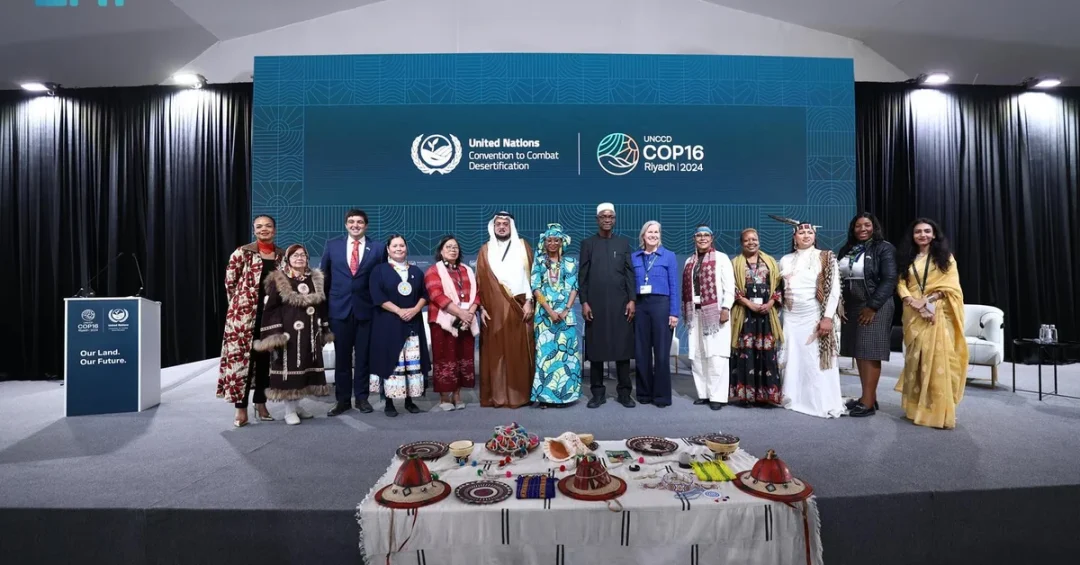
Indigenous Peoples, youth delegates and at-risk communities took center stage on the sixth day of COP16 in Riyadh, as the first-ever dedicated dialogue for Indigenous Peoples at a UNCCD Conference of the Parties convened under the banner of “People’s Day,” according to the Saudi Press Agency. The day’s events marked a historic milestone in the global fight against land degradation, drought and desertification, elevating the voices of communities whose livelihoods and cultural heritage are most directly tied to the health of the land. The Riyadh Action Agenda, the host-country legacy initiative of the COP16 Presidency, intensified its engagement with non-state and state actors to mobilize action on existing and new land restoration and drought resilience initiatives.
The People’s Day program formed part of seven thematic days running throughout COP16 in Riyadh, designed to sharpen discussions and produce concrete outcomes. From the opening session to the closing declaration, the day underscored a central truth: sustainable land management cannot succeed without the full participation of those who live closest to the land. The events drew together representatives from the seven social cultural regions of the world, senior Saudi officials, United Nations bodies and civil society, all united by a shared commitment to reversing the loss of productive land.
Context and Background
Why has COP16 in Riyadh become such a pivotal moment for the world’s Indigenous Peoples? The sixteenth session of the Conference of the Parties to the United Nations Convention to Combat Desertification (UNCCD) is being held in Riyadh at a time when an estimated 40 percent of the planet’s land is degraded, affecting nearly half of humanity. The Kingdom of Saudi Arabia, which holds the COP16 Presidency, has made the inclusion of frontline communities a defining feature of its hosting agenda, recognizing that land restoration is as much a social and cultural endeavor as it is an environmental one.
Indigenous Peoples, though representing only about five percent of the global population, are custodians of roughly 20 percent of the world’s land, territory that houses 80 percent of global biodiversity. This disproportionate stewardship role has long been acknowledged in international environmental forums, yet the first-ever dedicated dialogue for Indigenous Peoples at a UNCCD COP represents a significant institutional step forward. The session in Riyadh gave these communities a formal platform to articulate their priorities, share traditional knowledge and demand a seat at the decision-making table.
The Kingdom’s decision to host such a dialogue reflects a broader recognition within the COP16 Presidency that land degradation, drought and desertification are not abstract environmental phenomena but lived realities for pastoralists, smallholder farmers, nomadic communities and forest dwellers. By placing people at the center of the conference’s sixth day, Saudi Arabia reinforced its message that the Riyadh Action Agenda is designed to deliver benefits that reach the most vulnerable, from the Sahel to the steppes of Central Asia and the rangelands of the Arabian Peninsula.
Key Details
The Indigenous Peoples dialogue began with opening remarks from Dr. Osama Faqeeha, Deputy Minister for Environment at the Ministry of Environment, Water and Agriculture, and Advisor to the UNCCD COP16 Presidency. In his address, Dr. Faqeeha framed the stakes with a striking statistic: “Five percent of the global population are indigenous peoples, they are custodians of 20 percent of land, which houses 80 percent of biodiversity. So, they are the gatekeepers of biodiversity.” His words set the tone for a session that combined cultural affirmation with hard-nosed policy discussion.
Speaking at the event, Hindou Oumarou Ibrahim, President of the Association for Indigenous Women and Peoples of Chad, described the gathering as unprecedented. “For the first time ever we have gathered indigenous peoples, indigenous leaders, from the seven social cultural regions to carry a very simple message with them here. Land is the element where everything fits together, in all our regions land is the root of all life,” she said. Her remarks captured the spiritual, economic and ecological dimensions of land that mainstream policy processes often overlook.
The session concluded with a landmark declaration from representatives of Indigenous Peoples from around the world. Among its objectives, the declaration called for the full and effective participation of Indigenous Peoples, including women and youth, in land-related processes at the local, national, regional and international levels. It also urged the international community to recognize Indigenous Peoples as rightsholders distinct from civil society organizations and to ensure direct access to finance for Indigenous communities. The declaration is expected to feed into the COP16 outcome documents and inform future UNCCD implementation.
People’s Day also featured a youth forum titled “Action for Land, Restoring Work for Resilient and Sustainable Futures.” The event saw the launch of the UNCCD Youth Strategy and Action Plan 2024, a roadmap for harnessing young people in the fight against land degradation. According to the UNCCD, more than one billion young people in developing countries depend on land and natural resources. The strategy highlights the importance of younger generations in accelerating land restoration and drought resilience, and it calls for their meaningful integration into policy, entrepreneurship and on-the-ground restoration projects.
Dr. Faqeeha returned to the podium to emphasize the inclusive philosophy driving the Riyadh Action Agenda. “Inclusivity must be at the core of land restoration and drought resilience. As an international community, it is essential we harness the knowledge, experience and expertise of those impacted by land degradation, desertification and drought,” he said. His statement reinforced the COP16 Presidency’s view that top-down solutions alone cannot deliver the scale of restoration the world needs.
International and Regional Impact
What does the Riyadh declaration mean for global land governance beyond COP16? The recognition of Indigenous Peoples as rightsholders rather than mere stakeholders could reshape how international finance flows to land restoration. If adopted into the UNCCD’s formal processes, it would open pathways for direct funding to Indigenous-led projects, bypassing layers of intermediaries that have historically diluted the impact of climate and land finance. For regions such as the Amazon Basin, the Congo Basin, the Arctic and the rangelands of the Middle East, this shift could translate into more effective protection of carbon sinks and biodiversity hotspots.
The youth strategy carries similarly far-reaching implications. With more than one billion young people in developing countries directly dependent on land and natural resources, the UNCCD Youth Strategy and Action Plan 2024 positions young people not as beneficiaries but as drivers of restoration. The plan encourages youth-led enterprises, digital innovation in land monitoring and community-based restoration initiatives. For Saudi Arabia, which has a young and increasingly educated population, the strategy aligns with national efforts to create green jobs and foster environmental stewardship among the next generation.
Regionally, the People’s Day events strengthened the Riyadh Action Agenda’s role as a convening platform for diverse actors. The presence of representatives from the seven social cultural regions signaled that the COP16 Presidency is building a broad coalition that spans geographies and cultures. For the Middle East, where water scarcity and desertification are acute, the emphasis on traditional knowledge and community participation offers practical lessons for restoring degraded rangelands and managing scarce water resources.
Economic and Strategic Significance
Why should global investors and policymakers pay attention to a day dedicated to Indigenous Peoples and youth? Land degradation carries an enormous economic cost, estimated in the hundreds of billions of dollars annually through lost agricultural productivity, forced migration and increased vulnerability to climate shocks. Restoring degraded land, by contrast, generates measurable returns: healthier soils, enhanced food security, new carbon markets and more resilient supply chains. The Riyadh Action Agenda’s focus on inclusive restoration aims to unlock these returns by ensuring that local communities have the incentives and the resources to invest in long-term land stewardship.
For Saudi Arabia, the strategic significance extends beyond environmental diplomacy. Hosting COP16 and championing initiatives such as the Riyadh Action Agenda and the Saudi Green Initiative reinforces the Kingdom’s position as a global leader in sustainability and multilateral cooperation. These efforts complement Vision 2030’s goals of economic diversification, quality of life improvements and international engagement. By elevating the voices of Indigenous Peoples and youth, the Kingdom is also signaling that its sustainability agenda is socially inclusive, a message that resonates with international partners and investors who prioritize environmental, social and governance criteria.
The economic empowerment dimension of the youth strategy deserves particular attention. Young people in developing countries often face barriers to accessing finance, land rights and technical training. The UNCCD Youth Strategy and Action Plan 2024 seeks to dismantle these barriers by promoting mentorship, skills development and access to green finance. If implemented effectively, it could catalyze a new generation of land restoration entrepreneurs, creating jobs and improving livelihoods while restoring ecosystems. Saudi Arabia’s own experience with youth-focused programs under Vision 2030 offers a model that other countries may find instructive.
Vision 2030 Alignment
How does People’s Day at COP16 connect to Saudi Arabia’s long-term vision? The Kingdom’s Vision 2030 framework places sustainability, quality of life and international leadership at its core. The Saudi Green Initiative, launched in 2021, aims to plant 10 billion trees across the Kingdom and restore 40 million hectares of degraded land, while the Middle East Green Initiative extends these ambitions regionally. COP16 in Riyadh serves as a global stage for these commitments, demonstrating that Saudi Arabia is not only setting targets but also building the international partnerships needed to achieve them.
The emphasis on Indigenous Peoples and youth also mirrors Vision 2030’s commitment to inclusive development and the empowerment of all segments of society. By championing the first-ever Indigenous Peoples dialogue at a UNCCD COP and launching a youth strategy, the COP16 Presidency under Saudi leadership has advanced a vision of land restoration that is participatory, equitable and forward-looking. As the conference continues, the outcomes of People’s Day will help shape a Riyadh Action Agenda that leaves no community behind in the global effort to restore the land that sustains us all.
20 Questions
Q1. What is People’s Day at COP16 in Riyadh?
A1. People’s Day is one of seven thematic days at COP16, dedicated to elevating the voices of Indigenous Peoples, youth and at-risk communities in the global fight against land degradation, drought and desertification, as reported by the Saudi Press Agency.
Q2. Why was the Indigenous Peoples dialogue historic?
A2. It was the first-ever dedicated dialogue for Indigenous Peoples at a UNCCD Conference of the Parties, marking a significant step toward formal recognition of their role as custodians of land and biodiversity.
Q3. Who opened the Indigenous Peoples dialogue?
A3. Dr. Osama Faqeeha, Deputy Minister for Environment at the Ministry of Environment, Water and Agriculture and Advisor to the UNCCD COP16 Presidency, delivered the opening remarks.
Q4. What statistic did Dr. Faqeeha highlight?
A4. He noted that Indigenous Peoples make up five percent of the global population, are custodians of 20 percent of land, and that land houses 80 percent of global biodiversity.
Q5. What did Hindou Oumarou Ibrahim say about land?
A5. The President of the Association for Indigenous Women and Peoples of Chad said land is the element where everything fits together and is the root of all life in every region.
Q6. What did the landmark declaration call for?
A6. It called for full and effective participation of Indigenous Peoples, including women and youth, in land-related processes and for direct access to finance and recognition as rightsholders.
Q7. What youth forum took place on People’s Day?
A7. The youth forum was titled “Action for Land, Restoring Work for Resilient and Sustainable Futures” and focused on harnessing young people in land restoration efforts.
Q8. What was launched at the youth forum?
A8. The UNCCD Youth Strategy and Action Plan 2024 was launched as a roadmap for engaging young people in the fight against land degradation and drought.
Q9. How many young people depend on land in developing countries?
A9. According to the UNCCD, more than one billion young people in developing countries depend on land and natural resources for their livelihoods and well-being.
Q10. What did Dr. Faqeeha say about inclusivity?
A10. He said inclusivity must be at the core of land restoration and drought resilience, and that the international community must harness the knowledge and expertise of those impacted.
Q11. What is the Riyadh Action Agenda?
A11. It is the COP16 Presidency’s legacy initiative that intensifies engagement with state and non-state actors to mobilize action on land restoration and drought resilience initiatives.
Q12. Why are Indigenous Peoples called gatekeepers of biodiversity?
A12. Because they manage 20 percent of the world’s land, which contains 80 percent of global biodiversity, making their stewardship essential for conservation.
Q13. What does the declaration mean for international finance?
A13. It urges direct access to finance for Indigenous Peoples, which could make funding for land restoration more effective and community-led.
Q14. How does People’s Day support the UNCCD’s goals?
A14. By elevating frontline communities and youth, it strengthens implementation of the UNCCD’s objectives to combat desertification and restore degraded land.
Q15. What role does Saudi Arabia play at COP16?
A15. Saudi Arabia holds the COP16 Presidency and is hosting the conference in Riyadh, championing the Riyadh Action Agenda and inclusive approaches to land restoration.
Q16. How does COP16 align with Vision 2030?
A16. It aligns with Vision 2030’s sustainability, quality of life and international leadership goals, complementing initiatives like the Saudi Green Initiative.
Q17. What are the seven social cultural regions mentioned?
A17. They are the regions represented by Indigenous Peoples at the dialogue, spanning the world’s diverse cultural and geographic areas, as noted by Hindou Oumarou Ibrahim.
Q18. Why is youth engagement important in land restoration?
A18. Young people bring innovation, energy and long-term commitment, and over one billion in developing countries depend directly on land for their futures.
Q19. What economic benefits can land restoration bring?
A19. It can enhance food security, create green jobs, support carbon markets and build more resilient supply chains, generating measurable returns for communities and investors.
Q20. What is the expected outcome of People’s Day?
A20. Its outcomes, including the declaration and youth strategy, are expected to inform COP16 decisions and strengthen the Riyadh Action Agenda’s inclusive legacy.
Reader Feedback
We value your thoughts. Please share your feedback on this article.
Your feedback helps us improve our coverage.
Related articles
 FMF2024 Report: $5.4 Trillion Mineral Investment Needed by 2035
 Cambodian Senate President Arrives in Riyadh for Official Visit
 GCC Chief Emphasizes Dialogue and Diplomacy for Peace
 Saudi Arabia Monitors Syria Developments, Backs Stability
 Vice Foreign Minister Meets Chinese Ambassador to Saudi Arabia
 Princess Lamia Highlights Data-Driven Philanthropy at SGI Talks