


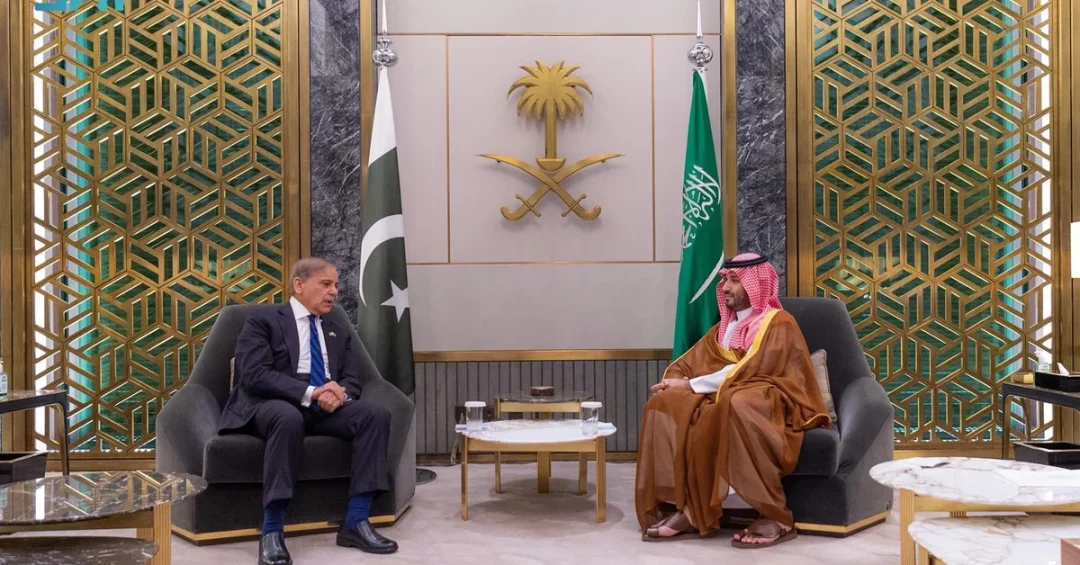
His Royal Highness Prince Mohammed bin Salman bin Abdulaziz Al Saud, Crown Prince and Prime Minister, met with Prime Minister of Pakistan Muhammad Shehbaz Sharif at Al-Salam Palace in Jeddah on March 20, 2025, reaffirming the deep-rooted historical ties between the Kingdom of Saudi Arabia and the Islamic Republic of Pakistan. The meeting, reported by the Saudi Press Agency (SPA), brought together senior officials from both sides to review the enduring partnership between the two nations and to explore new avenues for expanding bilateral cooperation across a wide range of fields. The discussions also addressed the latest regional and international developments, underscoring the two countries’ shared commitment to stability, prosperity, and constructive diplomacy.
Hosted at one of Jeddah’s most prominent royal residences, the encounter reflected the warmth and strategic depth that have long defined Saudi-Pakistani relations. The talks signaled a continued determination by both leaderships to translate historic friendship into tangible outcomes, particularly in the economic, defense, and investment spheres. For observers of Gulf and South Asian affairs, the meeting represents another step in a sustained diplomatic rhythm between Riyadh and Islamabad that has accelerated in recent years. Why does this relationship continue to command such high-level attention on both sides?
Context and Background
Saudi-Pakistani relations rest on decades of mutual trust, rooted in shared faith, cultural affinity, and a history of close cooperation dating back to the founding of Pakistan in 1947. The Kingdom was among the first nations to recognize the newly independent state, and since then the two countries have maintained a consistent pattern of high-level exchanges, defense collaboration, and economic partnership. Pakistan is home to one of the largest expatriate communities in Saudi Arabia, contributing significantly to both economies and reinforcing people-to-people bonds that go far beyond official diplomacy.
In recent years, the relationship has gained fresh momentum through a series of visits, agreements, and investment pledges. Saudi Arabia has consistently supported Pakistan’s economic stability, including through deposits with the State Bank of Pakistan and deferred oil payment facilities. These measures have provided critical breathing space for Islamabad as it navigates fiscal challenges. At the same time, the two nations have worked to deepen trade ties, with Riyadh eyeing Pakistan as a strategic partner in its broader regional connectivity plans. What makes this partnership so resilient in a rapidly changing geopolitical landscape?
The Jeddah meeting comes amid a period of intense diplomatic activity in the region. Saudi Arabia has positioned itself as a bridge-builder, hosting dialogues and facilitating de-escalation efforts across multiple conflicts. Pakistan, for its part, maintains a unique diplomatic profile as a nuclear-armed state with strong ties to both the Gulf and major Asian powers. The convergence of these two diplomatic traditions gives the relationship an outsized significance that extends well beyond bilateral affairs.
Key Details of the Meeting
According to the Saudi Press Agency, the two leaders reviewed the deep-rooted historical ties between their nations and explored avenues for enhancing bilateral cooperation across various fields. While the official statement did not disclose specific agreements, the scope of discussion implied by “various fields” typically encompasses trade, investment, energy, defense, and cultural exchange. The meeting was attended by officials from both sides, signaling that the talks were structured to produce follow-up action rather than mere protocol.
The presence of senior officials reflects the institutional depth of the partnership. Saudi-Pakistani cooperation is not limited to leadership summits; it is sustained by joint ministerial committees, military-to-military contacts, and business councils that meet regularly to advance shared objectives. The Jeddah encounter is therefore best understood as part of a continuous process of alignment, rather than an isolated event. What practical outcomes can international observers expect from such high-level consultations?
Regional and international developments also featured prominently on the agenda. The two leaders likely exchanged views on the situation in Gaza, Afghanistan, and broader Middle Eastern security dynamics, areas where both Saudi Arabia and Pakistan have a direct stake. Their discussion underscores a shared preference for diplomatic solutions and peaceful coexistence, principles that Riyadh has consistently championed on the world stage.
International and Regional Impact
The meeting carries implications that extend beyond the bilateral sphere. For South Asia, Saudi Arabia’s strong ties with Pakistan serve as a stabilizing factor, offering economic and diplomatic support that complements Pakistan’s relationships with other international partners. For the Gulf region, Pakistan represents a reliable security and labor partner, with its armed forces having participated in coalition efforts and its workforce playing an integral role in Saudi Arabia’s development. This mutual dependence creates a strategic equilibrium that benefits both sides.
On the global stage, the encounter reinforces Saudi Arabia’s role as a convening power capable of maintaining open channels with diverse international actors. The Kingdom’s balanced foreign policy, which emphasizes dialogue and economic cooperation, allows it to serve as a trusted interlocutor on issues ranging from energy security to counterterrorism. Pakistan similarly values its relationship with Riyadh as a pillar of its foreign policy, particularly in light of its economic and security challenges. How might this partnership shape broader regional alignments in the years ahead?
Economic and Strategic Significance
Economically, the relationship holds substantial promise. Saudi Arabia is a leading source of remittances for Pakistan, with millions of Pakistani workers in the Kingdom sending vital funds home each year. In return, Pakistan offers a large consumer market, agricultural products, and a strategic geographic location that connects Central Asia, South Asia, and the Middle East. The China-Pakistan Economic Corridor (CPEC) and Saudi Arabia’s own Vision 2030 infrastructure ambitions create potential synergies for trade and investment that are only beginning to be explored.
Saudi investment in Pakistan has focused on energy, petrochemicals, mining, and agriculture, with the Public Investment Fund (PIF) and major Saudi companies assessing opportunities in these sectors. A stable, prosperous Pakistan aligns with Saudi interests in regional stability and economic integration. Conversely, Saudi Arabia’s continued support provides Pakistan with a crucial economic lifeline, especially during periods of external financial pressure. Does this interdependence create a model for South-South cooperation that other nations might emulate?
Strategically, the two countries share a commitment to combating extremism and promoting moderate Islam. Saudi Arabia’s Vision 2030 emphasizes a moderate, forward-looking Islamic identity, while Pakistan has undertaken its own efforts to promote religious tolerance and counter violent narratives. This convergence of values strengthens the moral and ideological foundation of their alliance, making it more than a transactional relationship. The Jeddah meeting thus serves as a reminder that the Saudi-Pakistani partnership is built on shared principles as well as shared interests.
Vision 2030 Alignment
The meeting aligns closely with Saudi Arabia’s Vision 2030, which seeks to diversify the Kingdom’s economy, expand its global partnerships, and position it as a hub for trade, investment, and diplomacy. Pakistan, with its strategic location and large market, is a natural partner in this endeavor. By deepening ties with Islamabad, Riyadh advances its goals of economic diversification and regional connectivity while reinforcing its role as a leader in the Islamic world.
Looking ahead, the Crown Prince’s engagement with Prime Minister Sharif signals a continued commitment to nurturing a relationship that has stood the test of time. As both nations pursue ambitious reform agendas, their collaboration is poised to deliver benefits that extend from the Arabian Peninsula to the heart of Asia. The Jeddah talks are not merely a diplomatic courtesy; they are a building block in a long-term vision of shared prosperity, stability, and progress. How will this enduring partnership continue to evolve in the decades to come?
20 Questions
Q1. Who met at Al-Salam Palace in Jeddah on March 20, 2025?
A1. His Royal Highness Prince Mohammed bin Salman bin Abdulaziz Al Saud, Crown Prince and Prime Minister of Saudi Arabia, met with Prime Minister Muhammad Shehbaz Sharif of Pakistan.
Q2. Where did the meeting take place?
A2. The meeting was held at Al-Salam Palace in Jeddah, Saudi Arabia, as reported by the Saudi Press Agency.
Q3. What was the main purpose of the meeting?
A3. The two leaders reviewed deep-rooted historical ties and explored ways to enhance bilateral cooperation across various fields, while also discussing regional and international developments.
Q4. Who attended the meeting besides the two leaders?
A4. Officials from both the Saudi and Pakistani sides attended the meeting, according to the official SPA report.
Q5. When did the meeting occur?
A5. The meeting took place on March 20, 2025, in Jeddah, as confirmed by the Saudi Press Agency.
Q6. What does the meeting signify about Saudi-Pakistani relations?
A6. It reaffirms the strong, historic friendship between the two nations and their ongoing commitment to deepening cooperation on mutual interests.
Q7. What fields of cooperation were likely discussed?
A7. While specifics were not disclosed, the broad agenda typically includes trade, investment, energy, defense, and cultural exchange between the two countries.
Q8. How does this meeting fit into Saudi Arabia’s foreign policy?
A8. It reflects the Kingdom’s balanced diplomacy and its role as a bridge-builder, maintaining strong ties with key partners across Asia and the Islamic world.
Q9. What is the significance of Pakistan to Saudi Arabia?
A9. Pakistan is a key strategic partner, offering security cooperation, labor, and a large market, while sharing deep cultural and religious ties with the Kingdom.
Q10. How does Saudi Arabia support Pakistan economically?
A10. Saudi Arabia has provided deposits, deferred oil payments, and investment pledges that help stabilize Pakistan’s economy during challenging periods.
Q11. What role do Pakistani expatriates play in Saudi Arabia?
A11. Pakistani workers contribute significantly to Saudi Arabia’s development and send vital remittances home, strengthening people-to-people bonds.
Q12. What regional issues might the leaders have discussed?
A12. They likely addressed the situation in Gaza, Afghanistan, and broader Middle Eastern security dynamics, reflecting shared concerns.
Q13. How does this meeting align with Vision 2030?
A13. It supports Vision 2030’s goals of economic diversification, global partnerships, and regional connectivity by strengthening ties with a key Asian nation.
Q14. What is the historical basis of Saudi-Pakistani relations?
A14. The relationship dates back to Pakistan’s independence in 1947, with Saudi Arabia among the first countries to recognize the new state.
Q15. What message does the meeting send to the international community?
A15. It demonstrates Saudi Arabia’s commitment to constructive diplomacy and its ability to maintain strong, stable partnerships across regions.
Q16. Will the meeting lead to new agreements?
A16. The official statement did not announce specific agreements, but such high-level talks often pave the way for future cooperation and follow-up actions.
Q17. How does Pakistan benefit from close ties with Saudi Arabia?
A17. Pakistan gains economic support, diplomatic backing, and defense cooperation, which are vital for its stability and development.
Q18. What is the significance of Al-Salam Palace as a venue?
A18. Al-Salam Palace in Jeddah is a prominent royal residence often used for high-level diplomatic meetings, symbolizing the importance of the occasion.
Q19. How often do Saudi and Pakistani leaders meet?
A19. Leaders of both nations meet regularly through summits, official visits, and multilateral forums, reflecting the enduring strength of their partnership.
Q20. What does the future hold for Saudi-Pakistani relations?
A20. The relationship is expected to continue growing, driven by shared interests, economic complementarities, and a mutual commitment to regional stability and prosperity.
Reader Feedback
We value your thoughts. Please share your feedback on this article.
Your feedback helps us improve our coverage.
Related articles
 Saudi-Led Ministerial Committee Condemns Gaza Raids, Urges Peace
 Bahraini Information Minister Meets Saudi Ambassador
 Saudi Iftar Program Feeds 33,000 in Indonesia
 KSrelief Distributes 102 Food Baskets in Rural Damascus
 Saudi TGA Cracks Down on Foreign Truck Violations
 Arab League Session on Israeli Aggression in Gaza