


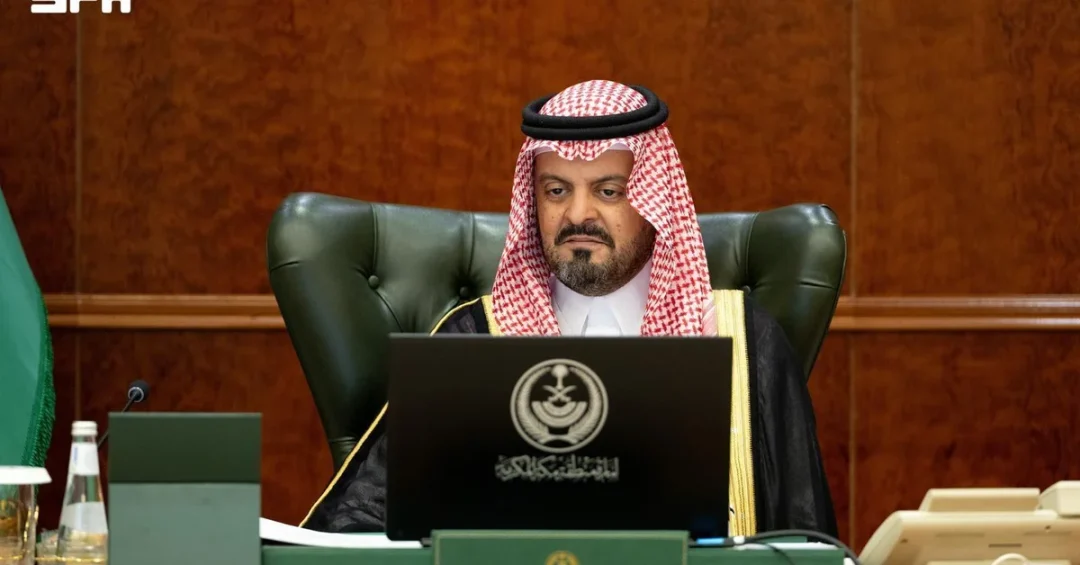
Deputy Governor of Makkah Region Prince Saud bin Mishaal bin Abdulaziz chaired a meeting of the Permanent Committee for Hajj and Umrah in Makkah, where members reviewed the ongoing Umrah season, services provided to visitors of the Grand Mosque, and preparations for the upcoming Hajj season of 1448 AH. The session, held under the directive of Advisor to the Custodian of the Two Holy Mosques, Governor of Makkah Region, and Chairman of the Permanent Committee for Hajj and Umrah Prince Khalid bin Faisal bin Abdulaziz, brought together representatives of the government entities responsible for serving pilgrims throughout their journey to the Kingdom. The meeting reviewed operational reports covering the arrival and departure of Umrah performers through multiple entry points, and examined the findings and recommendations of the final report evaluating the performance of government entities during last year’s Hajj season. The committee adopted a series of recommendations aimed at strengthening coordination and readiness across all sectors involved in hosting the guests of God.
Held in Makkah and reported by the Saudi Press Agency, the meeting reflects the continuous, year-round oversight that Saudi authorities apply to the two holiest sites in Islam. It also underscores a central feature of the Kingdom’s approach to pilgrimage management: planning for each season begins long before the first pilgrim arrives, and lessons learned from one season are systematically folded into the next. For an international audience, the session offers a window into the scale and sophistication of the logistical system that supports millions of worshippers annually, and into the way Saudi leadership coordinates ministries, security agencies, health services, transport authorities, and hospitality providers under a single integrated framework. Does any other country in the world manage a recurring gathering of this magnitude with such continuity and care?
Context and Background
The Permanent Committee for Hajj and Umrah is the standing body charged with overseeing the annual pilgrimage cycle in the Makkah Region. Chaired by the Governor of Makkah Region, Prince Khalid bin Faisal bin Abdulaziz, the committee convenes regularly to review the readiness of every entity involved in serving pilgrims, from the moment they enter the Kingdom until their safe return home. Its membership draws on ministries, security and civil defense agencies, health authorities, municipal bodies, and the agencies responsible for the Grand Mosque and the Prophet’s Mosque. This structure allows decisions to be taken quickly and implemented across institutional boundaries, a model that has become a benchmark for large-scale event management worldwide.
Under the directive of Prince Khalid bin Faisal, the committee’s work is tied directly to the leadership’s instruction that pilgrims receive the highest possible standard of care. The Deputy Governor, Prince Saud bin Mishaal bin Abdulaziz, chaired this particular session, reflecting the breadth of the regional leadership’s engagement with pilgrimage affairs. The meeting reviewed the status of the current Umrah season, which runs across the year and draws millions of worshippers from inside and outside the Kingdom, and turned its attention to the Hajj season of 1448 AH, which will require the same meticulous preparation that has characterized previous years. Why does this level of institutional attention matter so much to the global Muslim community?
The committee also examined the final report evaluating the performance of government entities during last year’s Hajj season. Such post-season evaluations are a core element of the Saudi approach: performance indicators are collected, gaps are identified, and recommendations are adopted and carried into the next planning cycle. This continuous improvement loop has helped the Kingdom raise capacity, shorten waiting times, improve crowd flow, and expand digital services for pilgrims. The result is a pilgrimage experience that is safer, smoother, and more dignified than at any point in modern history.
Key Details
During the meeting, the committee reviewed reports on the status of Umrah performers and the services provided to them from their arrival until their departure through various entry points. These entry points include the Kingdom’s international airports, land border crossings, and seaports, each of which operates under coordinated procedures designed to move large numbers of worshippers efficiently while maintaining security and health standards. The reports covered transportation, accommodation, guidance services, and the support provided inside the Grand Mosque, where worshippers perform tawaf and other rituals. The committee emphasized the importance of integration, concerted efforts among various entities, and effective coordination, which contributed to the success of the Hajj season, alongside the resources provided by the Kingdom’s leadership.
The session also reviewed performance indicators for participating entities and mechanisms for aligning efforts among sectors to enhance coordination and readiness and achieve the highest levels of efficiency in serving the pilgrims. This focus on measurable performance is significant: it means that every agency involved knows exactly what is expected of it, how its work will be assessed, and how its contribution fits into the broader mission. The meeting addressed several items on the agenda and adopted the necessary recommendations, which will now be translated into operational plans for the coming months. What does it take to move millions of people through a single city with safety, order, and dignity?
The committee’s deliberations took place against the backdrop of a rapidly expanding Umrah season. The Kingdom has introduced a series of facilitations in recent years, including expanded visa options, improved digital platforms for permits and bookings, and upgraded transport links between the holy sites and major cities. These measures have made it easier for pilgrims of all ages and backgrounds to undertake the journey, while the committee’s oversight ensures that growth in numbers does not come at the expense of quality or safety. The recommendations adopted at this meeting are expected to further refine these services in the months ahead.
International and Regional Impact
The work of the Permanent Committee for Hajj and Umrah has implications that extend far beyond the borders of the Kingdom. Pilgrims arrive from virtually every country in the world, and the quality of their experience shapes perceptions of Saudi Arabia across continents. When services run smoothly, when health care is available, when transport is reliable, and when worshippers are treated with respect at every stage, the Kingdom’s reputation as a trusted custodian of the holy sites is reinforced. The committee’s emphasis on integration among entities is therefore not merely an administrative matter; it is a statement about the Kingdom’s commitment to its global responsibilities.
Regionally, the pilgrimage system supports cooperation with the governments of Muslim-majority countries, whose Hajj and Umrah missions work closely with Saudi authorities on quotas, documentation, and the welfare of their citizens. The annual cycle of planning, execution, and evaluation has become a model of international coordination, and the recommendations adopted in Makkah often influence how other countries prepare their own pilgrims for the journey. In this sense, the committee’s work is a form of quiet diplomacy, building goodwill and strengthening ties through service. How many international gatherings of this scale are managed with such consistency year after year?
Economic and Strategic Significance
The pilgrimage sector is a major component of the Saudi economy and a strategic priority under Vision 2030. Hajj and Umrah generate activity across aviation, hospitality, retail, food services, transport, and telecommunications, creating jobs and business opportunities for Saudi citizens and companies. The Kingdom’s target of welcoming millions more Umrah performers each year is supported by investments in airport capacity, high-speed rail, road networks, and accommodation in Makkah, Madinah, and Jeddah. The committee’s role in aligning these investments with operational reality is essential to ensuring that growth in visitor numbers translates into sustainable economic benefit.
Strategically, the meeting demonstrates the leadership’s determination to keep the pilgrimage experience at the forefront of national planning. By reviewing performance indicators and adopting recommendations, the committee helps ensure that public and private sector efforts remain synchronized. This is particularly important as the Kingdom continues to roll out digital services that simplify visa issuance, permit booking, and navigation for pilgrims, many of whom now plan their entire journey through smartphone applications. The combination of physical infrastructure and digital innovation is a hallmark of the Vision 2030 approach, and the pilgrimage sector is one of its most visible showcases.
Vision 2030 Alignment
The Permanent Committee for Hajj and Umrah’s work sits at the heart of Vision 2030’s goals of enhancing the quality of life, expanding the services offered to the guests of God, and strengthening the Kingdom’s role as a global destination for Muslims. The leadership’s unwavering support for the pilgrimage system, expressed through the resources provided and the direct involvement of senior officials such as Prince Khalid bin Faisal bin Abdulaziz and Prince Saud bin Mishaal bin Abdulaziz, reflects a broader national commitment to excellence in service. As the Kingdom prepares for the Hajj season of 1448 AH, the recommendations adopted at this meeting will help ensure that pilgrims continue to receive care that matches the sanctity of their journey.
Looking ahead, the committee’s continuous cycle of review and improvement will remain central to Saudi Arabia’s ability to host ever-larger numbers of worshippers safely and comfortably. The integration of government entities, the use of performance data, and the adoption of forward-looking recommendations all point to a system that is not content with past achievements but is constantly seeking to raise its standards. For the international audience, the message is clear: the Kingdom of Saudi Arabia treats the service of pilgrims as a sacred trust and a national priority, and it pursues that mission with the same seriousness and ambition that define Vision 2030. Will the world continue to witness a pilgrimage experience that sets the global standard for care, safety, and hospitality? The evidence from Makkah suggests the answer is yes.
20 Questions
Q1. Who chaired the Permanent Committee for Hajj and Umrah meeting in Makkah?
A1. Deputy Governor of Makkah Region Prince Saud bin Mishaal bin Abdulaziz chaired the meeting, held under the directive of Governor of Makkah Region Prince Khalid bin Faisal bin Abdulaziz, who chairs the committee.
Q2. What did the committee review during the meeting?
A2. The committee reviewed the status of the current Umrah season, services provided to visitors of the Grand Mosque, and preparations and plans of various entities for the upcoming Hajj season of 1448 AH.
Q3. Under whose directive was the meeting held?
A3. The meeting was held under the directive of Advisor to the Custodian of the Two Holy Mosques, Governor of Makkah Region, and Chairman of the Permanent Committee for Hajj and Umrah Prince Khalid bin Faisal bin Abdulaziz.
Q4. What reports did the committee examine regarding Umrah performers?
A4. The committee reviewed reports on the status of Umrah performers and the services provided to them from their arrival until their departure through various entry points across the Kingdom.
Q5. What was the focus of the final report evaluated by the committee?
A5. The final report evaluated the performance of government entities involved in implementing plans during last year’s Hajj season, including findings and recommendations for improvement.
Q6. What did the committee emphasize as key to the success of the Hajj season?
A6. The committee emphasized the importance of integration, concerted efforts among various entities, and effective coordination, alongside the resources provided by the Kingdom’s leadership.
Q7. What performance-related matters were reviewed at the meeting?
A7. The committee reviewed performance indicators for participating entities and mechanisms for aligning efforts among sectors to enhance coordination, readiness, and efficiency in serving pilgrims.
Q8. What actions did the committee take regarding its agenda?
A8. The meeting addressed several items on the agenda and adopted the necessary recommendations, which will guide preparations for the coming seasons.
Q9. Why is the Permanent Committee for Hajj and Umrah important?
A9. It is the standing body that coordinates all government entities serving pilgrims, ensuring integrated planning and high standards of care throughout the Hajj and Umrah seasons.
Q10. How does the committee support the Umrah season?
A10. It reviews services at entry points, transportation, accommodation, and support inside the Grand Mosque, helping ensure worshippers receive efficient and dignified care from arrival to departure.
Q11. What is the significance of the Hajj season 1448 AH preparations?
A11. Preparations for 1448 AH reflect the Kingdom’s commitment to continuous improvement, applying lessons from previous seasons to raise safety, capacity, and service quality for pilgrims.
Q12. How does the committee’s work benefit international pilgrims?
A12. Pilgrims from around the world benefit from coordinated visa procedures, transport, health services, and guidance, making their journey smoother and more comfortable while in the Kingdom.
Q13. What role does the Governor of Makkah Region play in the committee?
A13. Prince Khalid bin Faisal bin Abdulaziz chairs the committee, providing leadership and direction that align the efforts of all entities involved in serving pilgrims.
Q14. How does the committee contribute to Vision 2030?
A14. Its work supports Vision 2030 goals of enhancing quality of life, expanding services to the guests of God, and strengthening the Kingdom’s role as a global destination for Muslims.
Q15. What are entry points mentioned in the reports?
A15. Entry points include the Kingdom’s international airports, land border crossings, and seaports, all of which operate under coordinated procedures to manage pilgrim arrivals and departures efficiently.
Q16. How does the committee use performance indicators?
A16. Performance indicators help measure the effectiveness of each entity, identify areas for improvement, and align efforts across sectors to achieve the highest levels of efficiency in serving pilgrims.
Q17. What does the committee’s emphasis on integration mean in practice?
A17. It means ministries, security agencies, health services, and transport authorities work together under a unified plan, sharing information and resources to deliver seamless services to pilgrims.
Q18. How does the Kingdom support the committee’s mission?
A18. The Kingdom’s leadership provides substantial resources and direct oversight, ensuring that the committee has the means and authority to implement its recommendations effectively.
Q19. What happens after the committee adopts recommendations?
A19. The recommendations are translated into operational plans and implemented by the relevant entities, with follow-up reviews to ensure they achieve the intended improvements.
Q20. What is the overall message of this meeting for global observers?
A20. The meeting demonstrates Saudi Arabia’s unwavering commitment to serving pilgrims with the highest standards of care, coordination, and efficiency, reflecting the leadership’s dedication to this sacred responsibility.
Reader Feedback
We value your thoughts. Please share your feedback on this article.
Your feedback helps us improve our coverage.
Related articles
 Saudi GCA, Dutch Audit Court Exchange Expertise
 Saudi Arabia Highlights Mining Sector Experience at Egypt Forum 2026
 Saudi Crown Prince Offers Condolences to Malaysia PM Anwar Ibrahim
 Saudi Crown Prince, UAE VP Discuss Bilateral Ties in Riyadh
 GCC Ministerial Committees Drive Implementation of Supreme Council Decisions
 Crown Prince, Qatari Amir Discuss Regional Stability