


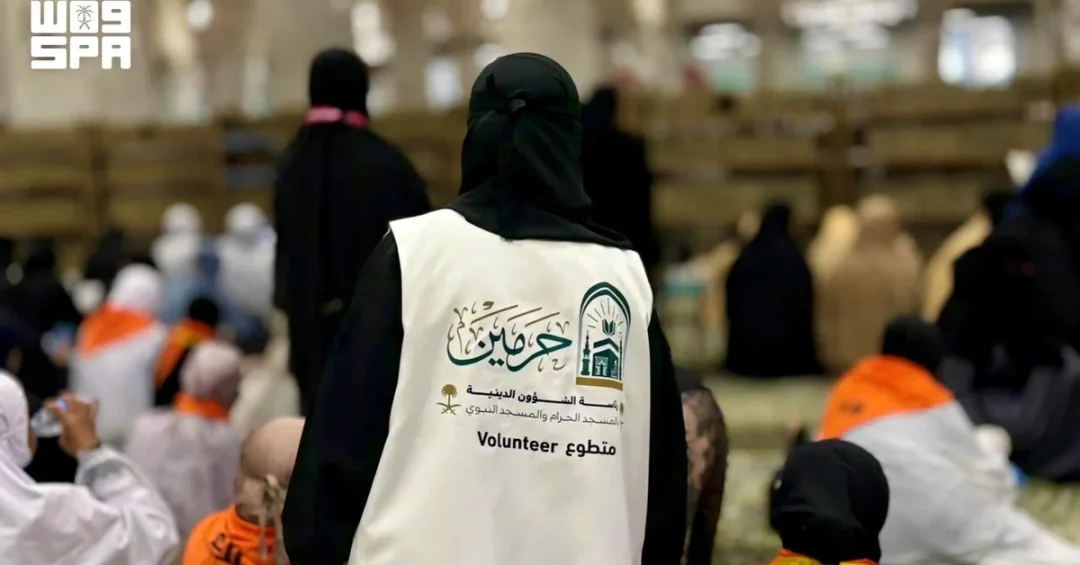
The Presidency of Religious Affairs at the Grand Mosque and the Prophet’s Mosque has implemented a dedicated initiative to prepare and qualify female volunteers for fieldwork at the Grand Mosque in Makkah, enhancing their readiness to perform volunteer tasks efficiently and improve services provided to female visitors. The initiative, announced through official Saudi channels, forms part of a broader effort to elevate the quality of services at the holiest site in Islam and reflects the Kingdom’s commitment to empowering women within the framework of Saudi Vision 2030.
The program focuses on building volunteers’ field knowledge and familiarizing them with volunteer tracks and their associated tasks and responsibilities. It also explains the regulations and instructions governing the work, enhancing performance quality and preparedness for fieldwork at the Grand Mosque. The initiative included several training and practical components, including an introduction to volunteer tracks, assigned tasks and responsibilities, and relevant regulations and instructions. It also included field application, guidance, and follow-up to turn acquired knowledge into practical skills that contribute to efficient and effective performance. The field component strengthened the volunteers’ capabilities and provided them with practical experience by linking knowledge with direct application. It also prepared them to handle the nature and requirements of the work, integrating theoretical training with field practice and increasing their confidence and readiness to perform volunteer tasks.
Context and Background
Why does the Grand Mosque require such specialized volunteer preparation, and what does this tell us about the scale of operations at Islam’s holiest site? The Grand Mosque in Makkah receives millions of worshippers and pilgrims annually, with numbers continuing to grow as Saudi Arabia expands access through initiatives such as the expanded Umrah visa program and infrastructure investments tied to Vision 2030. Managing this extraordinary flow of visitors requires a highly organized, well-trained workforce capable of guiding, assisting, and supporting pilgrims from more than 180 countries. The Presidency of Religious Affairs at the Grand Mosque and the Prophet’s Mosque has long been responsible for overseeing religious affairs, guidance services, and visitor support at both holy sites, and its mandate has expanded in recent years to include more structured volunteer programs.
The new initiative reflects a deliberate shift toward professionalizing volunteer work at the Grand Mosque. Rather than relying solely on spontaneous or ad hoc volunteering, the Presidency is now building structured pathways that include orientation, task-specific training, regulatory briefings, and supervised field application. This approach ensures that every volunteer understands not only what to do but also why it matters — from directing female visitors to designated prayer areas to offering guidance on rituals and responding to questions with accuracy and respect. The initiative also aligns with the Kingdom’s broader national volunteering strategy, which aims to raise volunteer participation rates and create meaningful service opportunities across sectors.
Volunteering has become an increasingly important pillar of Saudi social and religious life. National campaigns such as the Saudi Volunteers platform and initiatives linked to the Ministry of Human Resources and Social Development have encouraged citizens and residents to contribute their time and skills. At the Grand Mosque, this national momentum meets a unique operational environment where cultural sensitivity, linguistic diversity, and spiritual care all intersect. The Presidency’s decision to dedicate a program specifically to female volunteers acknowledges that female visitors often prefer assistance from female staff, particularly in areas related to guidance, crowd flow, and access to designated spaces.
Key Details of the Initiative
What exactly does the training cover, and how does it translate into daily service at the Grand Mosque? According to the official announcement, the initiative includes several integrated components. The first is an introduction to volunteer tracks — the defined roles and service areas where volunteers are deployed. These tracks cover tasks such as welcoming and orienting visitors, supporting crowd management, providing guidance on prayer areas and facilities, and assisting with questions about rituals and procedures. Each track carries specific responsibilities, and volunteers are trained to understand the boundaries of their roles and when to refer matters to specialized staff.
The second component covers regulations and instructions governing volunteer work at the Grand Mosque. This includes protocols for conduct, dress, punctuality, communication, and interaction with visitors. Volunteers learn how to maintain the dignity and sanctity of the site while offering warm, efficient assistance. They are also briefed on safety procedures, emergency reporting, and coordination with on-site security and health teams. These regulations are designed to ensure consistency and professionalism across all volunteer shifts.
The third and perhaps most impactful component is field application. Volunteers do not simply attend lectures or complete online modules; they participate in supervised practical exercises within the Grand Mosque itself. Under the guidance of experienced supervisors, they practice directing visitors, responding to common questions, and navigating the complex geography of the site. Follow-up and evaluation are built into the program, allowing trainers to assess readiness and provide additional coaching where needed. This cycle of training, application, and feedback turns acquired knowledge into practical skills and builds the confidence volunteers need to perform effectively during peak periods.
Empowerment of Women and Social Impact
How does this initiative contribute to the broader empowerment of Saudi women, and what message does it send internationally? Saudi Vision 2030 has placed women’s participation at the center of national development. Reforms in education, employment, entrepreneurship, and public life have expanded opportunities for women across the Kingdom. In the religious services sector, women have increasingly taken on visible and respected roles — from guiding female pilgrims to working in health, education, and administrative functions connected to the Two Holy Mosques. The volunteer initiative builds on this momentum by offering structured training that develops transferable skills such as communication, leadership, problem-solving, and teamwork.
For many participants, the program represents more than service; it is a form of personal and professional development. Volunteers who complete the training gain experience that can support future careers in hospitality, tourism, public service, or religious affairs. They also become part of a community of service-minded women who share a commitment to welcoming guests of the Grand Mosque with care and respect. This community dimension strengthens social cohesion and reinforces the values of generosity and hospitality that are central to Saudi culture.
Internationally, the initiative contributes to a more complete understanding of Saudi Arabia’s modernization. It shows that the Kingdom’s transformation is not limited to economic diversification or infrastructure; it also includes the expansion of women’s roles in service to Islam’s holiest sites. For female pilgrims visiting from abroad, the presence of trained female volunteers can make their experience more comfortable, accessible, and spiritually fulfilling. This practical dimension of hospitality is an important part of Saudi Arabia’s global image as the custodian of the Two Holy Mosques.
International and Regional Impact
What does a well-trained volunteer corps mean for pilgrims traveling to Makkah from around the world? The Grand Mosque is a global destination, and the quality of services there shapes perceptions of Saudi Arabia across continents. Pilgrims arrive with different languages, cultural expectations, physical abilities, and levels of familiarity with the rituals. A trained volunteer who can offer clear guidance, a welcoming smile, and accurate information can transform a moment of confusion into a moment of comfort. For female pilgrims in particular, access to female volunteers can ease concerns about privacy, navigation, and appropriate assistance.
Regional observers often look to Saudi Arabia’s management of the Two Holy Mosques as a benchmark for large-scale religious event operations. The Kingdom’s experience in hosting Hajj and Umrah has produced sophisticated systems for crowd management, health care, transportation, and digital services. Volunteer programs are an integral part of this ecosystem. By investing in the preparation of female volunteers, the Presidency of Religious Affairs is strengthening a layer of service that complements professional staff and enhances the overall pilgrim experience. This approach may also serve as a model for other religious and cultural sites in the region seeking to improve visitor services.
The initiative also supports Saudi Arabia’s tourism and pilgrimage goals. Vision 2030 aims to welcome 30 million Umrah pilgrims annually and to expand the capacity of the Two Holy Mosques. Achieving these targets requires not only physical infrastructure but also human capital — people who can deliver high-quality services at scale. Trained volunteers help bridge the gap between infrastructure and experience, ensuring that visitors feel supported throughout their journey. This human dimension is essential to sustaining Saudi Arabia’s reputation as a gracious and capable host.
Economic and Strategic Significance
How does volunteer training connect to Saudi Arabia’s economic and strategic priorities? While volunteering is not a commercial activity, it contributes to the efficiency and resilience of the pilgrimage sector, which is a major source of non-oil revenue and international engagement. A well-organized volunteer force can reduce pressure on paid staff during peak seasons, improve visitor satisfaction, and support the smooth operation of services that pilgrims rely on. Higher satisfaction translates into stronger word-of-mouth promotion and repeat visits, which benefit the broader economy, including hospitality, retail, and transportation.
Strategically, the initiative reinforces the Kingdom’s role as the custodian of the Two Holy Mosques and its commitment to serving pilgrims with excellence. It also demonstrates the integration of Vision 2030 social goals with religious affairs. By creating structured opportunities for women to serve, the Presidency is contributing to national objectives related to women’s participation, volunteerism, and quality of life. These objectives are interconnected: when citizens and residents engage in meaningful service, they build skills, strengthen community bonds, and contribute to the country’s social fabric.
From a governance perspective, the program reflects the Presidency’s commitment to continuous improvement. Feedback from volunteers and visitors can inform future training cycles and service design. This iterative approach — train, apply, evaluate, improve — is consistent with modern public service management and with the broader culture of measurement and accountability that Vision 2030 promotes across government entities.
Vision 2030 Alignment
How does this initiative fit into the larger story of Saudi Arabia’s transformation? Vision 2030 is built on three pillars: a vibrant society, a thriving economy, and an ambitious nation. The volunteer initiative touches all three. It strengthens society by expanding opportunities for women and promoting a culture of service. It supports the economy by enhancing the pilgrimage experience and the Kingdom’s reputation as a destination of choice. And it reflects an ambitious nation by investing in human capital and institutional excellence at the highest level of religious service.
The Presidency of Religious Affairs at the Grand Mosque and the Prophet’s Mosque continues to develop programs that combine spiritual care with operational efficiency. The training of female volunteers is one example of how Saudi institutions are translating national vision into daily practice. As the Kingdom prepares for continued growth in pilgrimage numbers and international visitors, such initiatives will play an increasingly important role in ensuring that every guest of the Grand Mosque receives the guidance, respect, and hospitality they deserve. The program stands as a testament to Saudi Arabia’s commitment to serving Islam’s holiest sites with dedication, professionalism, and an unwavering focus on the well-being of pilgrims.
20 Questions
Q1. What is the main goal of the volunteer initiative at the Grand Mosque?
A1. The initiative aims to prepare and qualify female volunteers for fieldwork at the Grand Mosque, enhancing their readiness to perform tasks efficiently and improving services provided to female visitors.
Q2. Which Saudi authority implemented this initiative?
A2. The Presidency of Religious Affairs at the Grand Mosque and the Prophet’s Mosque implemented the initiative as part of its mandate to oversee religious affairs and visitor services at the Two Holy Mosques.
Q3. What are the key components of the training program?
A3. The program includes an introduction to volunteer tracks, assigned tasks and responsibilities, relevant regulations and instructions, field application, guidance, and follow-up to convert knowledge into practical skills.
Q4. Why is field application included in the training?
A4. Field application links theoretical knowledge with direct practice, strengthens volunteers’ capabilities, and increases their confidence and readiness to handle the real requirements of work at the Grand Mosque.
Q5. How does the initiative benefit female visitors to the Grand Mosque?
A5. Trained female volunteers can provide guidance, assistance, and support that respects privacy and cultural preferences, making the visit more comfortable and spiritually fulfilling for women.
Q6. What volunteer tracks are mentioned in the initiative?
A6. The initiative introduces volunteers to various tracks covering tasks such as welcoming visitors, guiding them to prayer areas, supporting crowd flow, and answering common questions about rituals and facilities.
Q7. How does the initiative align with Saudi Vision 2030?
A7. It supports Vision 2030 goals related to women’s empowerment, volunteerism, quality of life, and enhancing the pilgrimage experience, reflecting the Kingdom’s commitment to human capital development.
Q8. What regulations do volunteers learn during the training?
A8. Volunteers learn protocols for conduct, dress, punctuality, communication, interaction with visitors, safety procedures, emergency reporting, and coordination with security and health teams.
Q9. How does the program build volunteer confidence?
A9. Through supervised practical exercises, follow-up, and evaluation, volunteers gain hands-on experience that reinforces their skills and prepares them to perform effectively during peak periods.
Q10. What is the significance of this initiative for Saudi women?
A10. It offers structured opportunities for women to serve at Islam’s holiest site, develop transferable skills, and contribute to national goals, reinforcing their growing role in Saudi society.
Q11. How does the initiative improve service quality at the Grand Mosque?
A11. By ensuring volunteers understand their roles, follow regulations, and apply practical skills, the program raises service consistency, professionalism, and responsiveness to visitor needs.
Q12. What role does the Presidency of Religious Affairs play at the Two Holy Mosques?
A12. The Presidency oversees religious affairs, guidance services, and visitor support, and it develops programs that enhance the spiritual and practical experience of pilgrims and worshippers.
Q13. How does volunteer work support the pilgrimage sector economically?
A13. Volunteers help manage visitor flow and support paid staff during peak seasons, contributing to smoother operations, higher satisfaction, and a stronger reputation for Saudi hospitality.
Q14. What kind of follow-up is provided after the initial training?
A14. The program includes field application, guidance, and follow-up to assess readiness, provide additional coaching, and ensure volunteers can perform their tasks effectively.
Q15. How does the initiative reflect Saudi Arabia’s modernization?
A15. It shows that national transformation includes expanding women’s roles in religious service, integrating structured training, and applying modern management practices at the Two Holy Mosques.
Q16. What skills can volunteers gain from participating?
A16. Participants develop communication, leadership, problem-solving, teamwork, and visitor service skills that can support future careers in hospitality, tourism, public service, or religious affairs.
Q17. How does the initiative handle cultural and linguistic diversity?
A17. Training prepares volunteers to assist visitors from many backgrounds with respect, clear guidance, and awareness of different needs, contributing to a welcoming environment at the Grand Mosque.
Q18. What is the broader national context for volunteering in Saudi Arabia?
A18. National strategies encourage citizens and residents to volunteer across sectors, and the Grand Mosque program represents a high-profile example of structured, meaningful service aligned with Vision 2030.
Q19. How might this initiative influence future programs at other sites?
A19. Its model of training, field application, and follow-up could serve as a benchmark for other religious and cultural sites seeking to enhance visitor services and volunteer professionalism.
Q20. What does this initiative say about Saudi Arabia’s commitment to pilgrims?
A20. It demonstrates the Kingdom’s dedication to serving guests of the Grand Mosque with excellence, care, and continuous improvement, reflecting its role as custodian of the Two Holy Mosques.
Reader Feedback
We value your thoughts. Please share your feedback on this article.
Your feedback helps us improve our coverage.
Related articles
 Saudi Vice Minister Meets EU Gulf Envoy in Manama
 Saudi, Canada FMs Condemn Houthi Attacks at G20
 Coalition Intercepts UAV in Eastern Region, Safeguarding Saudi Skies
 Saudi FM Meets EU’s Kallas at G20 in Atlanta
 Saudi-Qatari Diplomacy Strengthened at Manama Dialogue
 NCM Warns of Thunderstorms in Northern Borders Region