


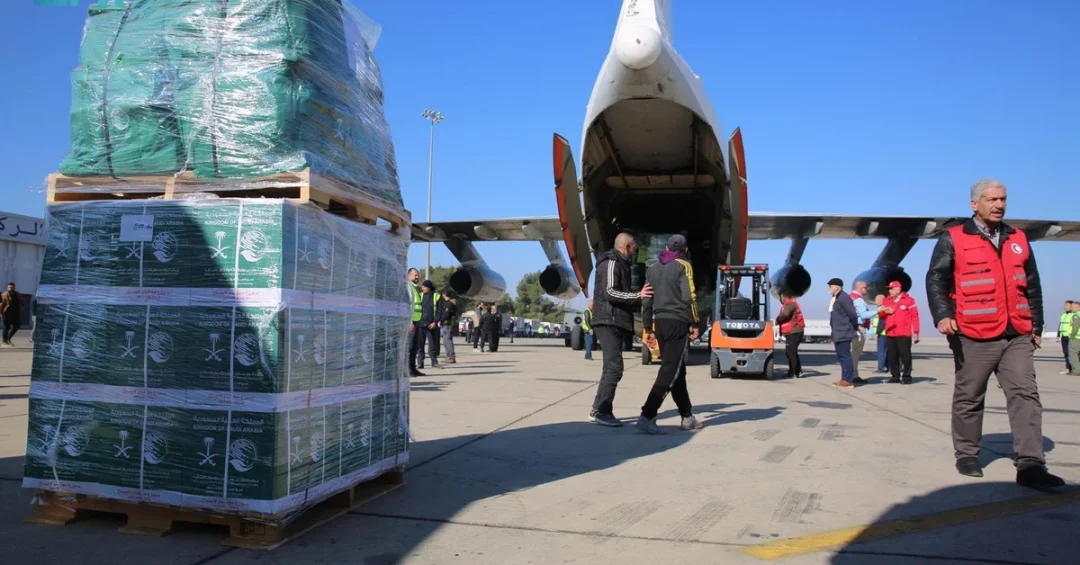
The first relief plane of the Saudi airlift, operated by the King Salman Humanitarian Aid and Relief Center (KSrelief), arrived at Damascus International Airport on January 1, 2025, carrying food, shelter, and medical supplies along with a specialized KSrelief team. The aircraft was received by Chargé d’Affaires of the Saudi Embassy in Syria Abdullah Al-Harees, President of the Syrian Arab Red Crescent Dr. Mohammed Hazem Bakleh, and several media representatives, according to the Saudi Press Agency (SPA). The shipment marks the opening phase of a broader Saudi humanitarian airlift that is expected to deliver sustained assistance to the Syrian people in the coming weeks and months.
This delivery underscores the Kingdom’s longstanding humanitarian commitment, executed through its dedicated relief arm, KSrelief, which has built a global reputation for rapid, principled, and impartial emergency response. The timing of the airlift, arriving at the start of the new year, signals Saudi Arabia’s readiness to support Syria’s recovery and to stand with the Syrian people as they confront the compounded challenges of conflict, displacement, and economic hardship. What does this first flight reveal about the scale of Saudi Arabia’s humanitarian ambitions for Syria in 2025 and beyond?
Context and Background
Why does the arrival of a single relief plane carry significance far beyond its cargo manifest? For more than a decade, Syria has endured a devastating conflict that has displaced millions, destroyed critical infrastructure, and left large segments of the population dependent on external aid for basic survival. In this context, Saudi Arabia has consistently acted as a leading donor and humanitarian actor, directing assistance through KSrelief to alleviate the suffering of Syrian civilians regardless of their location or affiliation.
Saudi Arabia’s humanitarian engagement with Syria is not a recent development. Over the years, the Kingdom has funded and delivered food baskets, medical equipment, shelter materials, and winterization kits to Syrian refugees in neighboring countries and to vulnerable communities inside Syria. KSrelief, established in 2015 by royal decree, has since implemented thousands of projects in more than 90 countries, often in partnership with local and international organizations. Its model emphasizes speed, coordination, and respect for the dignity of beneficiaries, principles that are clearly reflected in the current airlift to Damascus.
The January 1 arrival follows a period of intensified Saudi diplomatic and humanitarian outreach toward Syria. As regional dynamics evolve, the Kingdom has reaffirmed its support for a stable, sovereign Syria at peace with itself and its neighbors. The airlift is therefore both a practical relief measure and a confidence-building gesture, demonstrating that Saudi Arabia is prepared to translate diplomatic goodwill into tangible action on the ground.
Key Details of the Airlift and Its Reception
What exactly did the first plane deliver, and who oversaw its arrival? The aircraft carried a carefully selected mix of food, shelter, and medical supplies tailored to the immediate needs of Syrian families affected by years of crisis. The inclusion of a KSrelief team on board ensures that distribution and coordination can begin without delay, working in close partnership with the Syrian Arab Red Crescent, which possesses extensive local knowledge and reach across all Syrian territories.
Upon landing, the shipment was received by Abdullah Al-Harees, Chargé d’Affaires of the Saudi Embassy in Syria, and Dr. Mohammed Hazem Bakleh, President of the Syrian Arab Red Crescent, alongside media representatives who documented the event. Al-Harees emphasized that this assistance is an extension of Saudi Arabia’s continuous humanitarian and relief efforts for the Syrian people through the Kingdom’s humanitarian arm, KSrelief, with the goal of alleviating their suffering caused by the ongoing crisis.
Bakleh expressed his profound gratitude to Saudi Arabia for its humanitarian and relief assistance, noting that the aid will be distributed to those in need across all Syrian territories without discrimination. This commitment to impartial distribution is central to KSrelief’s operating doctrine and reflects the Kingdom’s broader humanitarian principles. The presence of both Saudi and Syrian humanitarian officials at the airport also highlights the importance of institutional coordination in ensuring that aid reaches the most vulnerable populations efficiently and transparently.
International and Regional Impact
How might this Saudi airlift influence regional perceptions and cooperation? The arrival of Saudi relief in Damascus comes at a time when the international community is reassessing its engagement with Syria. By acting swiftly and visibly, Saudi Arabia reinforces its role as a responsible regional power that prioritizes humanitarian needs over political calculations. This approach aligns with the Kingdom’s broader foreign policy objectives, which emphasize stability, development, and constructive dialogue.
For Syria’s neighbors, particularly Jordan, Lebanon, and Turkey, which host large Syrian refugee populations, Saudi assistance inside Syria can help ease pressure on host communities by improving conditions in areas of return and reducing the incentive for further displacement. International organizations, including United Nations agencies, have repeatedly called for increased humanitarian funding for Syria; Saudi Arabia’s airlift contributes directly to filling that gap. The operation also demonstrates the value of South-South cooperation, with a Gulf state leveraging its logistical capacity to support an Arab neighbor in need.
From a geopolitical perspective, the airlift may encourage other regional and international donors to accelerate their own relief efforts. Saudi Arabia’s leadership by example sends a powerful message that humanitarian imperatives should transcend political differences. As the Kingdom continues to expand its global humanitarian footprint, its actions in Syria are likely to be studied as a model of how to combine diplomacy, development, and relief in complex environments.
Economic and Strategic Significance
What economic and strategic considerations underpin Saudi Arabia’s humanitarian airlift to Syria? While the primary motivation is unquestionably humanitarian, the operation also carries strategic weight. A stable and recovering Syria is in the interest of the entire region, and Saudi Arabia, as the world’s largest oil exporter and a G20 member, has both the resources and the logistical networks to contribute meaningfully to that stability. The airlift showcases the Kingdom’s ability to project soft power through compassion and competence.
Economically, the relief operation is part of a broader Saudi commitment to regional development. By supporting Syrian communities, the Kingdom helps create conditions that can eventually facilitate trade, investment, and reconstruction. Saudi companies and funds have expressed interest in participating in Syria’s reconstruction once conditions permit, and humanitarian engagement builds the trust and goodwill necessary for such long-term economic cooperation. Moreover, the airlift reinforces Saudi Arabia’s image as a reliable partner in international efforts to address crises, which enhances its standing in global forums and attracts further investment into Vision 2030 projects.
The strategic significance extends to Saudi Arabia’s relationships with international humanitarian organizations. KSrelief’s collaboration with the Syrian Arab Red Crescent and other partners demonstrates the Kingdom’s commitment to multilateralism and its capacity to work through local institutions. This approach not only ensures that aid is delivered effectively but also strengthens local capacity, a key objective of Saudi humanitarian policy.
Vision 2030 Alignment
How does the airlift to Damascus reflect the objectives of Saudi Vision 2030? Vision 2030, the Kingdom’s comprehensive reform blueprint, is not limited to domestic transformation; it also envisions Saudi Arabia as a global leader in humanitarian and development aid. KSrelief is a key instrument of this vision, embodying the Kingdom’s commitment to responsible global citizenship and its desire to build bridges of cooperation across the world. The airlift to Syria is a concrete example of how Vision 2030 translates into action beyond Saudi borders.
By alleviating suffering and promoting stability in a neighboring Arab state, Saudi Arabia contributes to a more secure and prosperous region, which in turn supports the economic diversification and international engagement at the heart of Vision 2030. The Kingdom’s humanitarian efforts also enhance its soft power, opening doors for cultural, economic, and diplomatic exchanges that benefit both Saudi Arabia and its partners. As the airlift continues, it will serve as a reminder that Saudi Arabia’s modernization journey is intertwined with its enduring values of generosity, solidarity, and compassion.
In the years ahead, Saudi Arabia is expected to deepen its humanitarian role, using platforms like KSrelief to respond to crises swiftly and effectively. The first plane to Damascus is more than a shipment of supplies; it is a statement of intent. It signals that the Kingdom will remain a steadfast supporter of the Syrian people and a constructive force for peace and recovery in the region. With each subsequent flight, Saudi Arabia reaffirms its vision of a world where human dignity is protected and where nations work together to overcome adversity.
20 Questions
Q1. What was the first Saudi airlift plane carrying to Damascus?
A1. The plane carried food, shelter, and medical supplies along with a KSrelief team to assist the Syrian people. It was the first of a series of relief flights organized by Saudi Arabia.
Q2. When did the first Saudi relief plane arrive in Damascus?
A2. The plane arrived on January 1, 2025, at Damascus International Airport. This marked the beginning of a new Saudi humanitarian airlift to Syria.
Q3. Which Saudi organization operated the airlift?
A3. The airlift was operated by the King Salman Humanitarian Aid and Relief Center, known as KSrelief. It is Saudi Arabia’s dedicated humanitarian arm.
Q4. Who received the Saudi relief plane in Damascus?
A4. It was received by Abdullah Al-Harees, Chargé d’Affaires of the Saudi Embassy in Syria, and Dr. Mohammed Hazem Bakleh, President of the Syrian Arab Red Crescent, along with media representatives.
Q5. What did Abdullah Al-Harees say about the assistance?
A5. He emphasized that the assistance is an extension of Saudi Arabia’s continuous humanitarian efforts for the Syrian people through KSrelief, aiming to alleviate their suffering caused by the ongoing crisis.
Q6. How did the Syrian Arab Red Crescent react to the aid?
A6. President Dr. Mohammed Hazem Bakleh expressed profound gratitude to Saudi Arabia for its humanitarian and relief assistance. He noted the aid will be distributed to those in need across all Syrian territories without discrimination.
Q7. What kinds of supplies were on board the plane?
A7. The plane carried food, shelter, and medical supplies. These items were selected to address the immediate needs of Syrian families affected by the crisis.
Q8. Why is this airlift significant for Saudi Arabia?
A8. It reflects Saudi Arabia’s commitment to alleviating the suffering of those affected in Syria and highlights the Kingdom’s significant humanitarian role through KSrelief to support those in need wherever they may be.
Q9. How does this aid align with Saudi Vision 2030?
A9. Vision 2030 envisions Saudi Arabia as a global humanitarian leader. KSrelief embodies this vision, and the airlift demonstrates the Kingdom’s commitment to responsible global citizenship and regional stability.
Q10. Will the aid be distributed fairly across Syria?
A10. Yes, Dr. Bakleh confirmed that the aid will be distributed to those in need across all Syrian territories without discrimination, in cooperation with local humanitarian partners.
Q11. What is KSrelief’s track record in humanitarian aid?
A11. KSrelief has implemented thousands of projects in over 90 countries since its establishment in 2015. It is recognized globally for its rapid, principled, and impartial emergency response.
Q12. How does this airlift affect regional stability?
A12. By providing relief inside Syria, Saudi Arabia helps ease pressure on neighboring countries hosting refugees and contributes to creating conditions for stability and eventual recovery in the region.
Q13. What message does this airlift send to the international community?
A13. It signals Saudi Arabia’s readiness to translate diplomatic goodwill into tangible action and encourages other donors to accelerate their own relief efforts for Syria.
Q14. Are there more Saudi relief flights planned for Syria?
A14. Yes, this was the first plane of a broader Saudi airlift. Additional flights are expected to deliver sustained assistance to the Syrian people in the coming weeks and months.
Q15. How does this aid reflect Saudi Arabia’s foreign policy?
A15. It aligns with the Kingdom’s foreign policy objectives of stability, development, and constructive dialogue, prioritizing humanitarian needs over political calculations.
Q16. What role does the Syrian Arab Red Crescent play in distribution?
A16. The Syrian Arab Red Crescent, with its extensive local knowledge and reach, partners with KSrelief to ensure aid reaches the most vulnerable populations efficiently and transparently across Syria.
Q17. Is this Saudi Arabia’s first humanitarian aid to Syria?
A17. No, Saudi Arabia has consistently provided aid to Syria over the years through KSrelief, including food, medical supplies, and shelter. This airlift is part of ongoing efforts.
Q18. How does this aid benefit the average Syrian citizen?
A18. The food, shelter, and medical supplies directly address immediate survival needs, helping to alleviate suffering and improve living conditions for vulnerable Syrian families.
Q19. What economic impact could this aid have on Syria’s recovery?
A19. By supporting Syrian communities, the aid helps create conditions that can facilitate trade, investment, and reconstruction, building trust for long-term economic cooperation.
Q20. What does this airlift say about Saudi Arabia’s global role?
A20. It reinforces Saudi Arabia’s image as a reliable partner in international humanitarian efforts, enhancing its standing in global forums and demonstrating its capacity to lead by example.
Reader Feedback
We value your thoughts. Please share your feedback on this article.
Your feedback helps us improve our coverage.
Related articles
 Second Saudi Airlift Plane Arrives in Syria with Relief Aid
 Saudi Foreign Ministry Receives Somali Consul General in Jeddah
 Security Oasis Exhibition Showcases Saudi Security Advances
 Madinah’s Human-Centered Vision Enhances Quality of Life
 Saudi Arabia Condemns New Orleans Vehicle-Ramming Attack
 Saudi Vice Foreign Minister Receives Syrian Delegation in Riyadh