


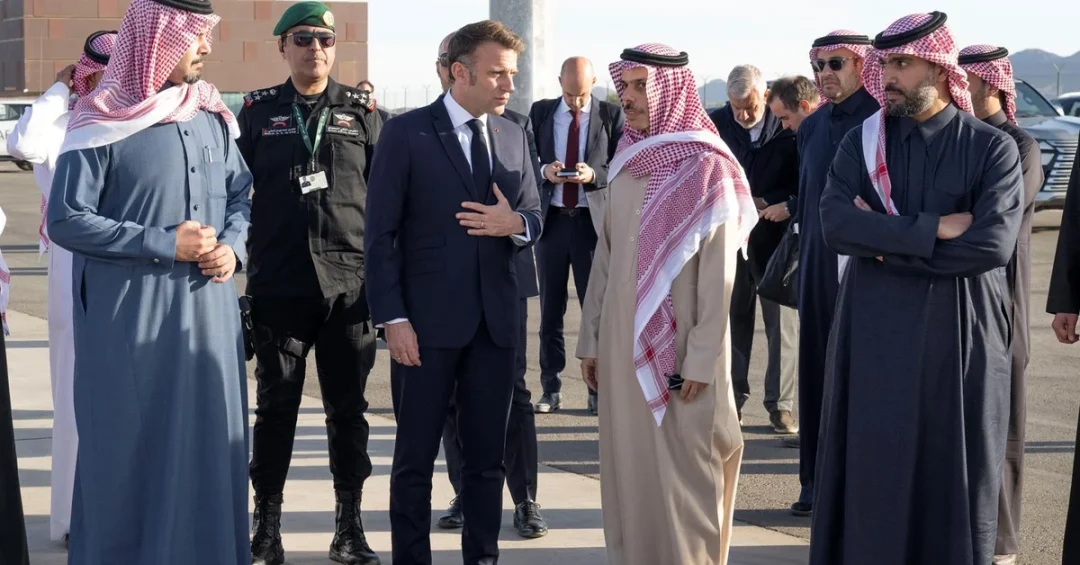
French Republic President Emmanuel Macron departed AlUla on December 4, 2024, concluding a three-day state visit to the Kingdom of Saudi Arabia that combined high-level diplomacy with an immersive tour of the ancient city’s most celebrated historical landmarks. The visit, reported by the Saudi Press Agency (SPA), underscored the deepening strategic partnership between Paris and Riyadh and placed AlUla — a cornerstone of Saudi Arabia’s cultural and tourism transformation — at the center of international diplomatic attention.
President Macron was seen off at AlUla International Airport by a senior Saudi delegation led by Governor of Madinah Prince Salman bin Sultan bin Abdulaziz; Minister of Foreign Affairs Prince Faisal bin Farhan bin Abdullah; Minister of Culture and Governor of the Royal Commission for AlUla (RCU) Prince Badr bin Farhan bin Abdullah; and Minister of Commerce Dr. Majid Al-Kassabi, along with several other officials. The farewell ceremony reflected the importance both nations attach to the relationship and the symbolic weight of AlUla as a venue for global engagement. What does the presence of such a high-level delegation at a regional airport tell the world about Saudi Arabia’s growing role as a diplomatic convener? It signals that the Kingdom’s heritage destinations are now part of its international statecraft.
Context and Background
President Macron’s three-day state visit to Saudi Arabia was the latest in a series of high-level exchanges between the two countries, reflecting a relationship that spans energy, defense, culture, and investment. AlUla, located in the northwest of the Kingdom, has emerged as a flagship destination under Saudi Vision 2030, the national transformation plan championed by Crown Prince Mohammed bin Salman. The ancient city, home to the Nabataean tombs of Hegra — Saudi Arabia’s first UNESCO World Heritage Site — has been carefully developed by the Royal Commission for AlUla into a global center for heritage, tourism, and cultural dialogue.
Why has AlUla become such a frequent backdrop for international diplomacy? The answer lies in its unique combination of historical significance and modern infrastructure, including AlUla International Airport, which allows world leaders to visit without transiting through the capital. The Royal Commission for AlUla, chaired by Prince Badr bin Farhan, has pursued a dual mandate: preserving the region’s archaeological treasures while opening them to the world through sustainable tourism. President Macron’s visit, which included tours of several historical landmarks, aligns with France’s own deep expertise in heritage conservation, creating natural avenues for cooperation.
The visit also followed a broader pattern of French engagement with the Kingdom. In recent years, Paris and Riyadh have worked together on regional security, clean energy, and cultural projects. France’s renowned expertise in museum management and archaeological restoration has been actively sought by Saudi institutions, and AlUla has hosted French cultural initiatives in the past. The state visit thus built on existing foundations rather than starting from scratch, giving both sides concrete areas to discuss.
Key Details of the Visit
According to the Saudi Press Agency, President Macron and his accompanying delegation visited several historical landmarks in AlUla province before departing. While the official report did not detail every site, AlUla’s most prominent attractions include Hegra, the Nabataean city with its monumental rock-cut tombs; the Old Town of AlUla, a labyrinth of mud-brick houses; and the dramatic rock formations of Elephant Rock and the Maraya concert hall, a mirrored architectural marvel that has hosted international events. The itinerary was designed to showcase the Kingdom’s commitment to preserving and sharing its heritage with the world.
Discussions between Saudi and French officials covered areas of cooperation and strategic partnerships across various fields. These likely included energy transition, defense, cultural exchange, and investment, all of which are central to the Saudi-French relationship. The presence of Minister of Commerce Dr. Majid Al-Kassabi at the farewell suggests that trade and economic ties were high on the agenda, while Minister of Culture Prince Badr bin Farhan’s attendance highlighted the cultural dimension. The visit concluded with a clear message: Saudi Arabia and France are aligning their interests across multiple sectors.
What makes this visit particularly significant for AlUla itself? The fact that a sitting French president chose to spend the final day of a state visit in the region, rather than in Riyadh or Jeddah, demonstrates the Kingdom’s success in positioning AlUla as a world-class destination. It also validates the Royal Commission for AlUla’s strategy of integrating heritage conservation with tourism development, a model that has attracted global attention. For international audiences, the images of President Macron touring ancient tombs and modern facilities send a powerful signal about Saudi Arabia’s openness and its ability to host leaders in iconic settings.
International and Regional Impact
The departure of President Macron from AlUla marks more than the end of a diplomatic trip; it reinforces Saudi Arabia’s emergence as a pivotal player in global affairs. By hosting a major European head of state for three days, the Kingdom demonstrated its capacity to bridge continents and facilitate dialogue on issues ranging from regional security to climate change. In a region often defined by conflict, Saudi Arabia’s focus on partnerships and cultural exchange offers a stabilizing counterweight. France, as a permanent member of the UN Security Council, is a key partner in that effort.
For the wider Middle East, the visit signals that Saudi Arabia’s diplomatic reach continues to expand. The Kingdom has recently hosted leaders from Asia, Africa, and the Americas, and the Macron visit adds a major European power to that list. This growing network of relationships supports Saudi Arabia’s Vision 2030 goal of becoming a global investment and tourism hub. It also strengthens the Kingdom’s position as a mediator and convener, capable of bringing diverse parties to the table. AlUla, with its breathtaking landscapes and world-class facilities, provides a uniquely compelling setting for such diplomacy.
Economic and Strategic Significance
From an economic perspective, the visit opened doors for deeper collaboration in sectors that are vital to both nations. France is a leader in renewable energy, aerospace, and luxury goods, while Saudi Arabia is investing heavily in diversifying its economy away from oil. The discussions in AlUla likely touched on opportunities for French companies to participate in giga-projects such as NEOM and the Red Sea Project, as well as in AlUla’s own development. The presence of Minister of Commerce Dr. Majid Al-Kassabi underscored the trade dimension, with potential agreements in areas like clean hydrogen, digital infrastructure, and tourism.
Strategically, the partnership carries weight beyond economics. France and Saudi Arabia share interests in regional stability, counterterrorism, and maritime security. The visit provided an opportunity to coordinate on these issues at a time of heightened geopolitical tension. By choosing AlUla as the venue for the final day, the two leaders also highlighted the cultural and soft-power dimensions of the relationship. Cultural diplomacy is increasingly central to Saudi foreign policy, and France’s rich heritage sector makes it a natural ally. The visit thus reinforced a multi-layered partnership that goes far beyond traditional energy ties.
Vision 2030 Alignment
President Macron’s visit to AlUla is a direct endorsement of Saudi Vision 2030, the transformative plan that aims to diversify the Kingdom’s economy, empower its citizens, and open its society to the world. Tourism is a key pillar of Vision 2030, with a target of attracting 150 million visitors annually by 2030. AlUla, with its unique blend of natural and cultural heritage, is one of the flagship destinations designed to achieve that goal. The visit of a French president shines a global spotlight on AlUla, encouraging travelers from Europe and beyond to explore the Kingdom’s treasures.
Moreover, the visit exemplifies the Vision’s emphasis on international partnerships. By hosting President Macron and his delegation, Saudi Arabia demonstrated its commitment to constructive engagement with global powers. The Royal Commission for AlUla’s work, supported by the highest levels of government, shows how heritage can be a catalyst for economic development and cross-cultural understanding. As Saudi Arabia continues its journey toward 2030, such high-profile visits will remain a powerful testament to its progress and its welcoming stance toward the world. The French President’s departure from AlUla is not an ending, but a milestone in a growing friendship that benefits both nations and the wider region.
20 Questions
Q1. When did French President Emmanuel Macron leave AlUla?
A1. President Macron left AlUla on December 4, 2024, after a three-day state visit to Saudi Arabia. His departure concluded a diplomatic mission that included tours of historical landmarks and discussions on strategic cooperation.
Q2. Who saw off President Macron at AlUla International Airport?
A2. He was seen off by Governor of Madinah Prince Salman bin Sultan bin Abdulaziz, Foreign Minister Prince Faisal bin Farhan, Culture Minister and RCU Governor Prince Badr bin Farhan, Commerce Minister Dr. Majid Al-Kassabi, and other officials.
Q3. What was the purpose of President Macron’s visit to Saudi Arabia?
A3. The visit aimed to strengthen strategic partnerships between France and Saudi Arabia across various fields, including culture, trade, and regional cooperation, while also showcasing AlUla’s heritage sites.
Q4. Why is AlUla significant in Saudi Arabia’s Vision 2030?
A4. AlUla is a flagship tourism and heritage destination under Vision 2030, helping to diversify the economy, attract international visitors, and promote cultural exchange, with a target of 150 million annual visitors by 2030.
Q5. What historical landmarks did President Macron likely visit in AlUla?
A5. While specific sites were not fully detailed, AlUla’s key landmarks include Hegra (Saudi Arabia’s first UNESCO World Heritage Site), the Old Town, Elephant Rock, and the Maraya concert hall.
Q6. How does this visit impact Saudi-French relations?
A6. The visit deepens bilateral ties, opening avenues for cooperation in energy, defense, culture, and investment, and reinforces France’s role as a key partner in Saudi Arabia’s development and regional diplomacy.
Q7. What is the Royal Commission for AlUla and who leads it?
A7. The Royal Commission for AlUla (RCU) is a government body responsible for preserving and developing AlUla. It is chaired by Prince Badr bin Farhan bin Abdullah, who also serves as Minister of Culture.
Q8. How does AlUla International Airport facilitate such visits?
A8. AlUla International Airport allows direct international flights, enabling world leaders and tourists to access the region conveniently without transiting through Riyadh or Jeddah, boosting its status as a global destination.
Q9. What message does Macron’s visit send to the international community?
A9. It signals Saudi Arabia’s growing role as a global diplomatic hub and its success in using cultural heritage to foster international partnerships, aligning with Vision 2030’s openness and modernization goals.
Q10. What economic opportunities were discussed during the visit?
A10. Discussions likely covered renewable energy, trade, investment in giga-projects like NEOM, tourism, and cultural collaboration, with French expertise in heritage conservation and clean technology being of particular interest.
Q11. How does this visit align with Saudi Arabia’s tourism goals?
A11. The visit promotes AlUla as a must-visit destination, attracting global attention and encouraging European travelers to explore Saudi Arabia’s cultural and natural treasures, directly supporting Vision 2030 tourism targets.
Q12. What role did Prince Badr bin Farhan play in the visit?
A12. As Minister of Culture and Governor of the RCU, Prince Badr bin Farhan was present at the farewell, highlighting the cultural significance of the visit and the Kingdom’s focus on heritage preservation.
Q13. Why did President Macron choose AlUla for the conclusion of his visit?
A13. AlUla offers a unique blend of ancient history and modern facilities, making it an ideal venue to showcase Saudi Arabia’s cultural renaissance and to hold meaningful discussions in a serene, inspiring environment.
Q14. How does France benefit from this partnership with Saudi Arabia?
A14. France gains a strategic ally in the Middle East, economic opportunities in Saudi giga-projects, and cultural exchanges that enhance its global influence, while contributing expertise in heritage and sustainability.
Q15. What are the key areas of Saudi-French cooperation?
A15. Key areas include energy transition, defense, cultural heritage, trade, investment, and regional security, with both nations committed to deepening ties under their strategic partnership framework.
Q16. How does AlUla’s development reflect Saudi Arabia’s modernization?
A16. AlUla’s transformation, led by the RCU, combines world-class infrastructure, sustainable tourism, and heritage preservation, embodying Vision 2030’s goals of economic diversification and global engagement.
Q17. What is the significance of the farewell delegation’s composition?
A17. The presence of senior officials from foreign affairs, culture, commerce, and regional governance underscores the multi-faceted nature of Saudi-French relations and the Kingdom’s coordinated approach to international visits.
Q18. How might this visit influence future French investment in Saudi Arabia?
A18. It could lead to increased French investment in sectors like renewable energy, tourism, and technology, as French companies gain confidence in Saudi Arabia’s business-friendly reforms and Vision 2030 opportunities.
Q19. What does the visit say about Saudi Arabia’s cultural diplomacy?
A19. It demonstrates Saudi Arabia’s effective use of cultural heritage as a diplomatic tool, building bridges with global powers and positioning the Kingdom as a champion of cross-cultural dialogue and preservation.
Q20. What are the next steps for Saudi-French relations after this visit?
A20. Both nations are expected to follow up with concrete agreements and joint projects in energy, culture, and trade, continuing high-level exchanges and building on the momentum of President Macron’s successful state visit.
Reader Feedback
We value your thoughts. Please share your feedback on this article.
Your feedback helps us improve our coverage.
Related articles
 ZATCA Signs 3 Key Agreements to Boost Integration
 Riyadh Undersecretary Attends Finnish National Day
 Saudi Minister Alibrahim Meets Croatian Deputy PM
 Saudi Climate Envoy Meets UNEP Chief at COP16 in Riyadh
 Ministry of Interior Wins First Place for Best Security Awareness Films
 Saudi COP16 Presidency Mobilizes Private Sector for Land Restoration