


The General Authority of Civil Aviation (GACA) issued its November 2024 report on the operational performance of Saudi Arabia’s domestic and international airports on December 23, 2024, ranking King Khalid International Airport in Riyadh, King Fahd International Airport in Dammam, Abha International Airport, Arar International Airport, and Gurayat Airport among the top performers. The report, released through official Saudi channels, evaluates airports against 11 operational performance standards designed to improve services and ensure a seamless traveler experience across the Kingdom. The findings underscore the Kingdom’s steady progress in aviation service quality as passenger volumes continue to rise in line with Vision 2030 tourism and connectivity goals.
Why does a monthly airport performance report matter far beyond the terminals themselves? Because aviation is the connective tissue of Saudi Arabia’s economic diversification agenda, linking pilgrims, tourists, investors, and business travelers to the Kingdom’s rapidly expanding cities and giga-projects. GACA’s transparent, category-based evaluation system reflects a broader national commitment to accountability and continuous improvement. The November results show that airports of different sizes are competing on measurable passenger-experience metrics, from check-in and security to baggage claim and assistance for passengers with reduced mobility (PRM). For international readers, the report offers a rare, data-driven window into how the Kingdom is upgrading the front door of its economy.
Context and Background
How did Saudi Arabia build a civil aviation oversight framework rigorous enough to publish monthly performance rankings? The answer lies in a sustained reform effort led by GACA, the Kingdom’s civil aviation regulator, which has progressively shifted from purely safety-focused oversight toward a comprehensive passenger-experience mandate. The November report is part of a regular publication cycle that assesses airports using 11 operational performance standards aligned with international best practices. These standards focus on critical passenger touchpoints: check-in, security screening, passport control, customs, baggage claim, and assistance to passengers with reduced mobility. By measuring and publicly ranking airports, GACA creates incentives for operators to raise service quality consistently.
The evaluation methodology is deliberately segmented by annual passenger volume, a design choice that ensures transparency and fairness. Airports handling more than 15 million passengers annually are assessed separately from those serving 5 to 15 million, 2 to 5 million, and fewer than 2 million passengers, while domestic airports form their own category. This tiered approach prevents smaller regional airports from being unfairly compared with mega-hubs such as Riyadh and Jeddah. It also gives every airport a realistic benchmark and a clear pathway to improvement. The November 2024 report is the latest installment in this system, and its results reflect months of coordinated work by airport operators, ground handlers, and government agencies.
Contextually, the report arrives at a time when Saudi Arabia is investing heavily in aviation capacity. The Kingdom has set ambitious targets to triple passenger traffic and expand connectivity under the National Aviation Strategy, which is closely tied to Vision 2030. New airlines, expanded routes, and upgraded terminals are all part of the plan. Against this backdrop, monthly performance data serves as both a scorecard and a management tool, helping officials identify bottlenecks and direct investment where it is needed most. The November rankings therefore represent more than a snapshot; they are a signal of institutional discipline in a sector central to the Kingdom’s global ambitions.
Key Details
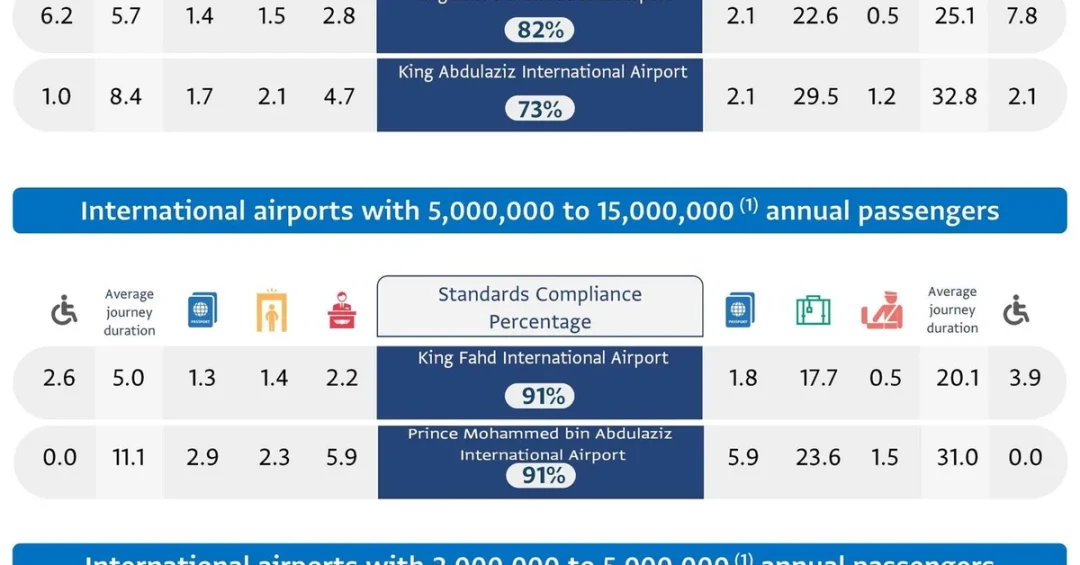
What exactly did the November report reveal about the Kingdom’s leading airports? In the category of airports serving more than 15 million passengers annually, King Khalid International Airport in Riyadh secured the top spot with an 82% compliance rate. King Abdulaziz International Airport in Jeddah followed closely with 73%. The gap between the two largest hubs highlights the value of the ranking system: it identifies where service standards are strongest and where further operational refinement can yield improvements. Riyadh’s leading position reflects sustained investment in terminal processes, staff training, and digital passenger-flow management at the capital’s principal gateway.
In the category of international airports serving 5 to 15 million passengers annually, King Fahd International Airport in Dammam tied for first place with Prince Mohammed bin Abdulaziz International Airport in Madinah, both achieving a 91% compliance rate. Dammam outperformed Madinah on several individual standards, according to the report, even though the headline compliance figure was identical. This nuance matters because it shows the evaluation is granular, not merely a single score. Both airports serve distinct traveler profiles: Dammam anchors the Eastern Province’s industrial and business travel, while Madinah welcomes a large share of religious visitors. Their strong performance demonstrates that high service quality is achievable across different operational contexts.
In the 2 to 5 million annual passenger category, Abha International Airport and King Abdullah bin Abdulaziz Airport in Jizan both demonstrated a 100% compliance rate. Abha outperformed Jizan by reaching higher targets within the specified evaluation criteria, according to GACA. In the fewer than 2 million passengers category, Arar International Airport achieved a 100% compliance rate and outperformed its competitors on average waiting times for departing and arriving flights. Gurayat Airport came first in the domestic airport category, also with a 100% compliance rate, and likewise led on average waiting times. These results show that excellence is not confined to the largest hubs; regional airports are delivering world-class service on key metrics.
International and Regional Impact
Why should international observers pay attention to how a regional airport in Arar or Gurayat performs? Because Saudi Arabia’s aviation network is increasingly integrated with global travel flows. The Kingdom aims to attract 150 million visits annually by 2030, encompassing religious pilgrimage, leisure tourism, business travel, and transit. Every airport in the network, regardless of size, contributes to the overall visitor experience and to the country’s international reputation. When smaller airports achieve 100% compliance on passenger touchpoints, it signals that service quality is being institutionalized nationwide rather than concentrated in a few showcase terminals. That consistency is essential for a country positioning itself as a global destination.
Regionally, Saudi Arabia’s airport performance improvements support the broader Gulf aviation ecosystem, which is one of the world’s busiest and most competitive. Enhanced efficiency at Saudi airports contributes to smoother connections between the Kingdom, the wider Middle East, Asia, Europe, and Africa. For airlines, better compliance rates on check-in, security, and baggage handling translate into more reliable turnaround times and improved on-time performance. For travelers, the benefits are tangible: shorter queues, clearer processes, and more dependable assistance. GACA’s transparent reporting also sets a regional benchmark, encouraging neighboring aviation authorities to adopt similarly data-driven approaches to service quality. In this sense, the November report is both a national achievement and a contribution to regional aviation standards.
Economic and Strategic Significance
How does airport service quality connect to Saudi Arabia’s economic ambitions? Aviation is a strategic enabler of trade, investment, and tourism. When international business travelers encounter efficient customs and passport control, they are more likely to view the Kingdom as a competitive place to invest. When tourists experience seamless baggage claim and accessible facilities, they are more likely to return and recommend the destination. GACA’s 11 operational performance standards are therefore not merely administrative metrics; they are economic tools. The November results, with multiple airports achieving 100% compliance in their categories, indicate that the Kingdom is building the service culture needed to support its diversification goals.
The strategic significance extends to capacity planning. As passenger numbers grow, airports must scale operations without sacrificing quality. The tiered evaluation system gives GACA and airport operators a precise picture of performance at each volume level. Riyadh’s 82% compliance rate in the highest category, for example, provides a baseline that can be improved as new terminal capacity comes online. Dammam and Madinah’s 91% performance shows what is achievable at medium-sized international gateways. Meanwhile, the 100% results at Abha, Jizan, Arar, and Gurayat demonstrate that smaller airports can meet the highest standards. Together, these data points inform investment decisions, staffing models, and technology deployments across the network, ensuring that growth in passenger traffic is matched by growth in service quality.
Vision 2030 Alignment
In what ways does this report embody the objectives of Saudi Vision 2030? Vision 2030 seeks to diversify the economy, improve quality of life, and position the Kingdom as a global hub for tourism, business, and logistics. A modern, efficient aviation sector is foundational to all three goals. GACA’s monthly performance reporting reflects the Vision’s emphasis on transparency, accountability, and measurable progress. By publicly ranking airports and highlighting best practices, the regulator fosters a culture of continuous improvement that aligns with the national transformation agenda. The November 2024 report shows that airports across the Kingdom, from Riyadh and Jeddah to Abha, Arar, and Gurayat, are actively contributing to this agenda.
Looking ahead, the Kingdom’s aviation strategy envisions expanded connectivity, new destinations, and a passenger experience that ranks among the best in the world. The November report is a milestone on that journey, but it is also a reminder that excellence is a moving target. As Saudi Arabia prepares to host major international events and welcome millions of additional visitors, the operational discipline demonstrated by GACA and airport operators will be essential. The report’s findings will inform next steps, from targeted upgrades at high-volume hubs to the sharing of best practices across regional airports. For international audiences, the message is clear: Saudi Arabia is serious about making every arrival and departure a positive experience, and it is measuring its progress in public.
20 Questions
Q1. What is the GACA November 2024 airports performance report?
A1. The report is a monthly evaluation issued by the General Authority of Civil Aviation assessing domestic and international airports in Saudi Arabia against 11 operational performance standards, aimed at improving services and ensuring a seamless traveler experience.
Q2. Which airports ranked highly in the November 2024 report?
A2. King Khalid International Airport in Riyadh, King Fahd International Airport in Dammam, Abha International Airport, Arar International Airport, and Gurayat Airport were among the top performers in their respective categories.
Q3. How does GACA categorize airports for evaluation?
A3. GACA categorizes airports based on annual passenger numbers, separating them into groups such as more than 15 million, 5 to 15 million, 2 to 5 million, fewer than 2 million, and domestic airports, ensuring transparent and fair evaluation.
Q4. Which airport led in the more than 15 million passengers category?
A4. King Khalid International Airport in Riyadh secured the top spot in this category with an 82% compliance rate, followed by King Abdulaziz International Airport in Jeddah with 73%.
Q5. What was the compliance rate for King Fahd International Airport in Dammam?
A5. King Fahd International Airport in Dammam achieved a 91% compliance rate, tying for first place with Prince Mohammed bin Abdulaziz International Airport in Madinah in the 5 to 15 million passenger category.
Q6. Which airports achieved 100% compliance in the 2 to 5 million passenger category?
A6. Abha International Airport and King Abdullah bin Abdulaziz Airport in Jizan both demonstrated a 100% compliance rate, with Abha outperforming Jizan by reaching higher targets in the evaluation criteria.
Q7. Which airport topped the fewer than 2 million passengers category?
A7. Arar International Airport achieved a 100% compliance rate and outperformed its competitors in terms of average waiting time for departing and arriving flights.
Q8. Which airport ranked first in the domestic airport category?
A8. Gurayat Airport came first in the domestic airport category with a 100% compliance rate, outperforming all competing airports in average waiting time for departing and arriving flights.
Q9. What are the 11 operational performance standards based on?
A9. The standards focus on critical passenger touchpoints including check-in, security, passport control, customs, baggage claim, and assistance to passengers with reduced mobility (PRM), aligning with international best practices.
Q10. Why does GACA publish these monthly reports?
A10. GACA publishes the reports to ensure transparency, encourage continuous improvement among airport operators, and align airport services with the strategic objectives of Saudi Arabia’s aviation sector and Vision 2030.
Q11. How does the report benefit travelers?
A11. The report incentivizes airports to improve service quality, leading to shorter waiting times, more efficient processes, and better assistance for all passengers, including those with reduced mobility.
Q12. What is the significance of King Khalid International Airport’s 82% compliance rate?
A12. The 82% rate indicates strong performance at Saudi Arabia’s largest airport by passenger volume, while also highlighting opportunities for further improvement as the airport continues to expand capacity and services.
Q13. How did Dammam outperform Madinah despite the same compliance rate?
A13. Although both airports achieved a 91% compliance rate, Dammam outperformed Madinah on several individual operational standards, demonstrating the granular nature of GACA’s evaluation methodology.
Q14. What does a 100% compliance rate signify for smaller airports?
A14. A 100% compliance rate shows that smaller airports like Abha, Arar, and Gurayat are meeting all evaluated performance standards, reflecting a nationwide commitment to high-quality service regardless of airport size.
Q15. How does this report support Saudi Arabia’s tourism goals?
A15. By ensuring airports deliver seamless experiences, the report supports Saudi Arabia’s target of attracting 150 million visits annually by 2030, enhancing the Kingdom’s appeal as a global tourism destination.
Q16. What role does GACA play in Saudi Arabia’s aviation sector?
A16. GACA is the national civil aviation regulator responsible for oversight, safety, and service quality. It issues regulations, monitors performance, and publishes reports to drive continuous improvement across the Kingdom’s airports.
Q17. How does the report reflect Vision 2030 principles?
A17. The report embodies Vision 2030’s emphasis on transparency, accountability, and quality of life improvements, contributing to economic diversification and the Kingdom’s emergence as a global logistics and tourism hub.
Q18. What are the implications for international airlines operating in Saudi Arabia?
A18. Improved airport performance means more reliable turnaround times, better on-time performance, and enhanced passenger satisfaction, making Saudi airports more attractive to international carriers expanding their networks.
Q19. How often does GACA issue these performance reports?
A19. GACA issues these reports on a monthly basis, providing regular updates on airport performance and allowing for consistent tracking of improvements and areas needing attention.
Q20. What can we expect next from GACA’s airport evaluations?
A20. GACA is expected to continue publishing monthly reports, driving competition among airports and supporting the Kingdom’s aviation strategy, with a focus on further raising compliance rates and enhancing passenger experiences nationwide.
Reader Feedback
We value your thoughts. Please share your feedback on this article.
Your feedback helps us improve our coverage.
Related articles
 Riyadh Governor Receives Uzbekistan Ambassador in Cordial Talks
 NWC Launches Water Meter Information Page Online
 Interior Ministry Efforts Enhance Saudi National Security
 Saihat Mangrove Park Plans Reviewed by Eastern Region Governor
 Madinah Governor Receives Indian Consul General in Jeddah
 Holy Quran Memorization Competition Held in Nepal