


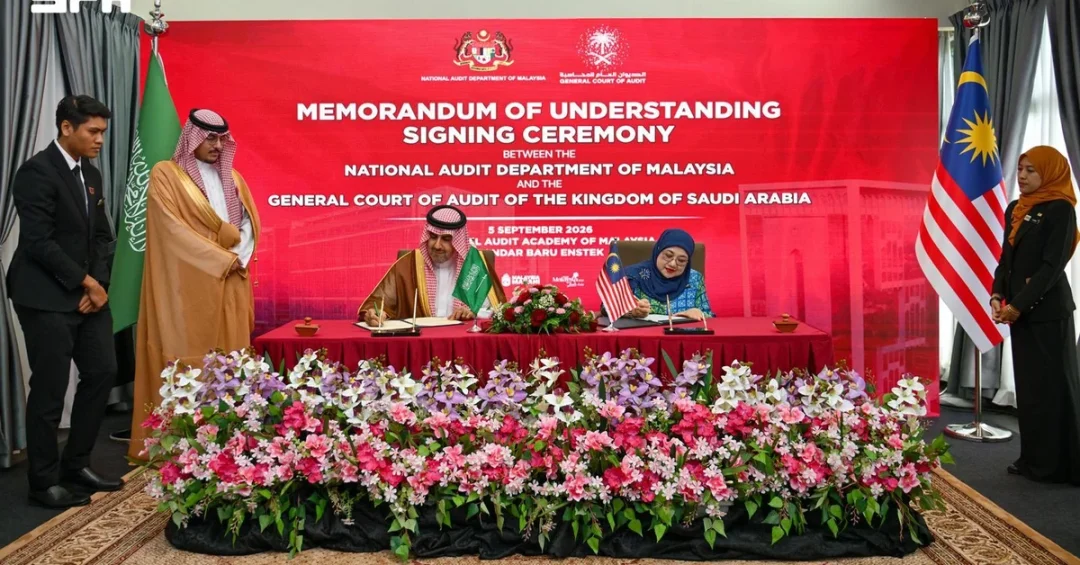
The General Court of Audit (GCA) of the Kingdom of Saudi Arabia and the National Audit Department of Malaysia signed a memorandum of understanding in Putrajaya on September 5, 2026, establishing a formal framework for bilateral cooperation in accounting, auditing, and professional practice. The agreement was signed by GCA President Dr. Hussam Alangari and Malaysian Auditor General Wan Suraya Radzi, according to the Saudi Press Agency, and marks a further step in the Kingdom’s drive to deepen institutional partnerships with peer supreme audit institutions worldwide.
The memorandum commits both institutions to exchanging professional expertise, developing joint practice guides for financial and performance auditing, and building operational capacity through workshops and specialized training. The cooperation is anchored in the two bodies’ shared memberships in the International Organization of Supreme Audit Institutions (INTOSAI) and the Asian Organization of Supreme Audit Institutions (ASOSAI). For observers of Saudi institutional development, the signing represents more than a routine diplomatic exchange: it reflects a sustained strategy to align the Kingdom’s public financial oversight with the highest international standards, a priority that runs directly through Vision 2030’s commitment to transparent, accountable and efficient government.
Context and Background
What does it mean when two national audit institutions formalize cooperation at this level? The General Court of Audit is the Kingdom’s supreme audit institution, responsible for overseeing public revenues, expenditures and the performance of government entities. Under Dr. Hussam Alangari’s leadership, the GCA has placed international engagement at the center of its institutional strategy, pursuing partnerships that bring global best practice into Saudi public sector auditing while sharing the Kingdom’s own growing expertise with regional and international peers. The agreement with Malaysia’s National Audit Department is a direct expression of that strategy, following similar arrangements with counterpart institutions in Asia, the Middle East and beyond.
Malaysia’s National Audit Department, led by Auditor General Wan Suraya Radzi, holds a respected position within the Southeast Asian audit community and has extensive experience in performance auditing, which examines whether government programs deliver value for money rather than simply confirming that spending rules were followed. Performance auditing is an area of increasing emphasis for the GCA as Saudi Arabia’s public investment programs expand in scale and ambition. The pairing is therefore complementary: Malaysia brings deep operational experience in performance and financial audit methodology, while the GCA brings a fast-evolving institutional model shaped by the demands of one of the world’s largest public investment programs.
The memorandum also sits within a broader pattern of Saudi-Malaysian institutional cooperation. The two countries maintain active diplomatic and economic ties, and technical agreements of this kind reinforce the relationship at the working level, where auditors, accountants and public finance specialists interact directly. By grounding cooperation in the frameworks of INTOSAI and ASOSAI, both institutions ensure that their joint work is compatible with globally recognized audit standards and contributes to the wider international audit community rather than remaining a purely bilateral arrangement.
Key Details of the Agreement
What specifically will the two institutions do under the memorandum? According to the Saudi Press Agency, the agreement covers three principal areas. First, the exchange of professional expertise, allowing auditors and specialists from both institutions to learn from each other’s methods, tools and institutional practices. Second, the development of professional practice guides for financial and performance auditing, which will codify shared approaches into reference documents usable by audit teams in both countries. Third, the building of operational capacity through joint workshops and specialized training programs, ensuring that knowledge transfer translates into measurable skills on the ground.
Dr. Alangari affirmed the GCA’s dedication to expanding strategic partnerships with peer supreme audit institutions, highlighting its leadership in sharing professional expertise across regional and international organizations. His statement frames the agreement not as a one-way transfer but as a partnership of equals, in which the Kingdom both learns from and contributes to the global audit profession. That framing reflects the GCA’s rising profile in international audit forums, where Saudi representatives increasingly take part in standard-setting discussions, capacity-building initiatives and knowledge-sharing platforms.
Wan Suraya Radzi highlighted the significance of the memorandum in advancing cooperation between the two supreme audit institutions, noting that it will boost performance efficiency, facilitate knowledge sharing and elevate overall audit quality. Her remarks point to the practical value both sides expect: better audit methodologies, stronger institutional capacity and improved oversight outcomes. Following the signing ceremony, both sides convened a bilateral meeting with institutional experts to explore joint initiatives and align approaches on matters of mutual interest, signaling that implementation planning began immediately rather than being deferred to a later stage.
Why This Matters for International Audit Cooperation
Why should a memorandum between two audit institutions matter beyond the two countries involved? Supreme audit institutions are the guardians of public money, and their effectiveness depends heavily on shared standards, comparable methodologies and mutual trust. INTOSAI, which brings together supreme audit institutions from across the world, exists precisely to promote such cooperation, and bilateral agreements like this one are among the mechanisms through which its principles reach the operational level. When the GCA and Malaysia’s National Audit Department commit to joint practice guides and training, they are strengthening the international infrastructure of accountability.
The agreement also carries weight within ASOSAI, the Asian regional organization to which both institutions belong. Asia is home to some of the world’s fastest-growing economies and largest public investment programs, and the demand for high-quality public sector auditing in the region is rising accordingly. By working together, the GCA and its Malaysian counterpart can develop approaches suited to the region’s specific challenges, from auditing large infrastructure projects to assessing the performance of digital government services. Their cooperation thus feeds into a broader Asian conversation about how public audit evolves in an era of rapid economic transformation.
For Saudi Arabia, participation in these networks supports a wider diplomatic objective: positioning the Kingdom as a constructive contributor to international governance and professional standards. Audit cooperation may appear technical, but it builds the kind of quiet, durable credibility that underpins influence in multilateral settings. The GCA’s expanding partnership portfolio is therefore best understood as part of Saudi Arabia’s broader engagement with international institutions, an engagement that spans development finance, energy governance, cultural diplomacy and now the global audit profession.
Economic and Strategic Significance
How does audit quality connect to economic strategy? As Saudi Arabia implements Vision 2030, the scale of public spending on giga-projects, industrial development, tourism infrastructure and social programs has grown dramatically. This scale raises the stakes for financial oversight: every riyal invested must be tracked, and every program must be assessed not only for compliance but for results. Strengthening the GCA’s methodological toolkit through partnerships with experienced institutions directly supports that objective, helping ensure that the Kingdom’s transformation is delivered with the efficiency and accountability that public trust requires.
Performance auditing, one of the areas covered by the memorandum, is especially relevant to this agenda. Traditional financial audits answer whether money was spent according to the rules; performance audits ask whether the spending achieved its intended outcomes. For a country executing a long-term national transformation plan, the second question is at least as important as the first. By developing joint practice guides in this field with Malaysia’s National Audit Department, the GCA is investing in the capability to evaluate programs rigorously and to feed those evaluations back into policy and project design.
There is also a capacity dimension. Large-scale transformation programs require a deep bench of qualified auditors, accountants and financial specialists. Joint workshops and specialized training programs expand that bench, exposing Saudi professionals to international methods and giving Malaysian specialists insight into the demands of auditing a rapidly transforming economy. The memorandum thus contributes to human capital development, an objective that sits at the heart of Vision 2030 and that no amount of institutional reform can substitute for.
Saudi-Malaysian Relations and Regional Dimensions
What does this agreement reveal about Saudi Arabia’s relationship with Southeast Asia? The Kingdom has steadily expanded its engagement with the region, recognizing its economic dynamism and its importance in global trade and Islamic finance. Malaysia, with its sophisticated financial sector and established audit profession, is a natural partner for technical cooperation. The memorandum adds an institutional layer to a relationship that already includes trade, investment and cultural ties, and it does so in a domain, public financial oversight, where both countries have demonstrated commitment to international standards.
Within the wider region, the agreement reinforces the principle that national audit institutions can learn from one another regardless of differences in size or administrative tradition. Malaysia’s audit system has evolved within a Southeast Asian administrative context, while the GCA operates within the Saudi governance framework; the value of cooperation lies precisely in the contrast, which allows each side to see familiar challenges from a new angle. Joint workshops and expert meetings create the informal networks through which such learning actually happens, complementing the formal commitments recorded in the memorandum.
The timing of the agreement also reflects a broader trend: supreme audit institutions worldwide are grappling with similar questions about auditing digital services, assessing climate-related spending, evaluating public-private partnerships and measuring the performance of complex megaprojects. No single institution has all the answers, and the most effective ones are those that systematically learn from peers. By formalizing cooperation with Malaysia, the GCA signals that it intends to be among the leaders in that learning process, both as a student of international best practice and as a source of expertise for others.
Vision 2030 Alignment
How does this memorandum connect to the Kingdom’s long-term vision? Vision 2030 rests on the principles of transparency, accountability and effective government, and it explicitly calls for public institutions that operate to the highest professional standards. The GCA’s partnership strategy with peer supreme audit institutions is a direct operational expression of those principles. Every practice guide developed, every workshop delivered and every expert exchanged strengthens the institutional foundations on which the Kingdom’s transformation depends, ensuring that the ambitious programs now underway are matched by oversight of comparable ambition and rigor.
Looking ahead, the agreement positions the GCA to deepen its role in INTOSAI and ASOSAI, where Saudi leadership in sharing professional expertise is already recognized. It also sets the stage for further bilateral initiatives with Malaysia’s National Audit Department, as the bilateral meeting held after the signing begins to translate the memorandum’s provisions into concrete joint programs. For an international audience watching Saudi Arabia’s modernization, developments like this one matter because they show the less visible but essential work, in auditing, accounting and professional practice, that makes large-scale national transformation credible, sustainable and worthy of confidence at home and abroad.
20 Questions
Q1. What did the General Court of Audit and Malaysia’s National Audit Department sign?
A1. They signed a memorandum of understanding in Putrajaya on September 5, 2026, establishing cooperation in accounting, auditing and professional practice between the two supreme audit institutions.
Q2. Who signed the memorandum on behalf of Saudi Arabia?
A2. GCA President Dr. Hussam Alangari signed on behalf of the Kingdom of Saudi Arabia, representing the General Court of Audit, the country’s supreme audit institution.
Q3. Who signed on behalf of Malaysia?
A3. Auditor General Wan Suraya Radzi signed on behalf of the National Audit Department of Malaysia, the country’s federal audit authority.
Q4. Where was the agreement signed?
A4. The signing ceremony took place in Putrajaya, Malaysia’s administrative capital, according to the Saudi Press Agency report.
Q5. When was the memorandum signed?
A5. The memorandum was signed on September 5, 2026, and was reported by the Saudi Press Agency the same day.
Q6. What are the main areas of cooperation under the agreement?
A6. The agreement covers exchanging professional expertise, developing practice guides for financial and performance auditing, and building operational capacity through joint workshops and specialized training.
Q7. What international organizations frame this cooperation?
A7. The cooperation operates within the framework of the International Organization of Supreme Audit Institutions (INTOSAI) and the Asian Organization of Supreme Audit Institutions (ASOSAI), to which both bodies belong.
Q8. What did Dr. Hussam Alangari say about the agreement?
A8. He affirmed the GCA’s dedication to expanding strategic partnerships with peer supreme audit institutions, highlighting its leadership in sharing professional expertise across regional and international organizations.
Q9. What did Wan Suraya Radzi emphasize about the memorandum?
A9. She highlighted its significance in advancing cooperation, noting it will boost performance efficiency, facilitate knowledge sharing and elevate overall audit quality between the two institutions.
Q10. What happened after the signing ceremony?
A10. Both sides convened a bilateral meeting with institutional experts to explore joint initiatives and align approaches on matters of mutual interest, beginning implementation planning immediately.
Q11. What is the General Court of Audit?
A11. The GCA is the Kingdom of Saudi Arabia’s supreme audit institution, responsible for overseeing public revenues, expenditures and the performance of government entities.
Q12. What is performance auditing?
A12. Performance auditing examines whether government programs achieve their intended outcomes and deliver value for money, rather than only confirming that spending followed the rules.
Q13. Why is performance auditing important for Saudi Arabia?
A13. As Vision 2030 programs expand in scale, performance auditing helps ensure public investments deliver results and that oversight keeps pace with the Kingdom’s transformation.
Q14. How does this agreement support the GCA’s strategy?
A14. It supports the GCA’s strategy of strengthening partnerships with peer supreme audit institutions, facilitating expertise exchange and developing specialized joint programs.
Q15. What are INTOSAI and ASOSAI?
A15. INTOSAI is the global organization of supreme audit institutions, while ASOSAI is its Asian regional counterpart. Both promote standards, cooperation and capacity building.
Q16. How does the memorandum benefit Malaysia’s audit institution?
A16. It offers access to the GCA’s experience, joint practice guide development and training, supporting improved performance efficiency and audit quality for both institutions.
Q17. What practical outputs are expected from the agreement?
A17. Expected outputs include professional practice guides for financial and performance auditing, joint workshops, specialized training programs and exchanges of professional expertise.
Q18. How does this fit into Vision 2030?
A18. Vision 2030 calls for transparency, accountability and effective government. Strengthening audit standards and international partnerships directly supports these objectives.
Q19. Does this agreement have regional significance?
A19. Yes. It strengthens Asian audit cooperation through ASOSAI and reinforces the principle that audit institutions can learn from one another across different administrative traditions.
Q20. What comes next after the signing?
A20. Both institutions will translate the memorandum into joint initiatives, continuing expert meetings and developing the training and practice guide programs outlined in the agreement.
Reader Feedback
We value your thoughts. Please share your feedback on this article.
Your feedback helps us improve our coverage.
Related articles
 Saudi Arabia Marks International Day of Charity with Global Relief Milestones
 KSrelief and Benaa Association support Djibouti orphans
 Saudi Arabia concludes G20 Innovation Ministerial Meeting
 LEAP 2026 launches AI academies and global initiatives
 Hajj and Umrah Research Forum workshops analyze transport efficiency
 Justice Ministry and HUMAIN partner for AI judicial services