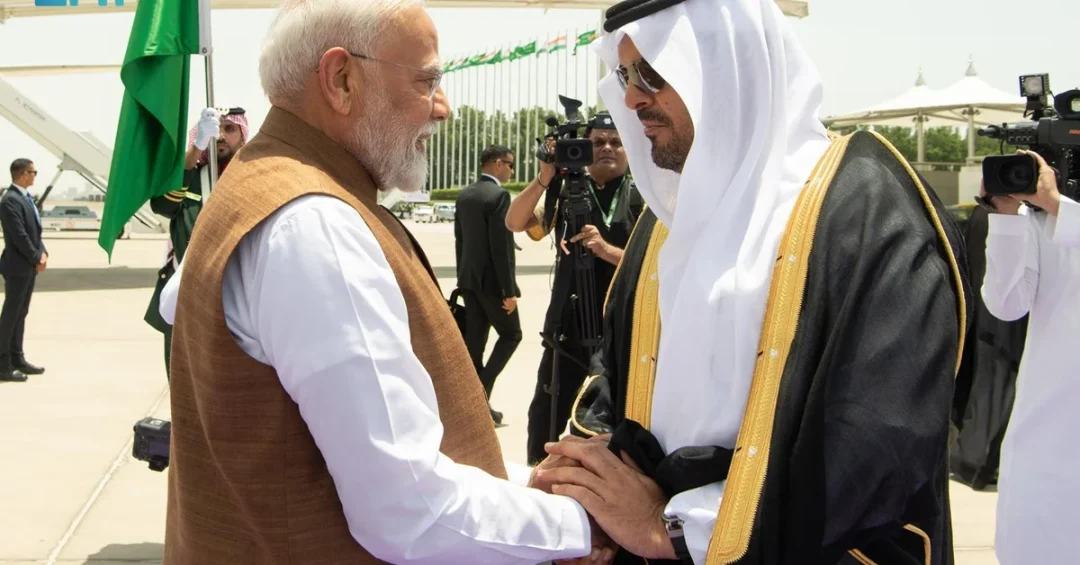
Prime Minister Narendra Modi of the Republic of India arrived in Jeddah on April 22, 2025, for a state visit to the Kingdom of Saudi Arabia, marking a significant step in the deepening ties between the two nations. Upon his arrival at King Abdulaziz International Airport, he was warmly received by Deputy Governor of Makkah Region Prince Saud bin Mishaal bin Abdulaziz, Minister of Commerce Dr. Majid Al-Kassabi, who is the accompanying minister, and other senior officials. The visit underscores the robust and growing partnership between India and Saudi Arabia, reflecting the mutual commitment to enhancing bilateral relations across various sectors.
This state visit comes at a time when Saudi-Indian relations are witnessing unprecedented momentum, driven by shared economic interests and a vision for regional stability. The two countries have a long history of cooperation, but in recent years, ties have expanded significantly under the leadership of the Custodian of the Two Holy Mosques, King Salman bin Abdulaziz Al Saud, and His Royal Highness Crown Prince Mohammed bin Salman. The visit is expected to further cement these ties, with discussions likely to focus on trade, investment, energy, and cultural exchange. As the world’s fifth-largest economy and a key player in the Middle East, Saudi Arabia sees India as a vital partner in its Vision 2030 diversification plan, while India values Saudi Arabia as a reliable energy source and a gateway to the region. The warm reception accorded to Prime Minister Modi highlights the Kingdom’s commitment to strengthening this strategic partnership.
Context and Background
What makes this visit particularly significant in the context of evolving geopolitical dynamics? The relationship between India and Saudi Arabia has evolved from a traditional buyer-seller energy relationship to a comprehensive strategic partnership. Diplomatic ties were established in 1947, but the real transformation occurred in the 21st century, with high-level exchanges becoming more frequent. In 2006, King Abdullah bin Abdulaziz visited India, marking a historic moment as the first Saudi monarch to do so in over five decades. Since then, numerous agreements have been signed, covering areas such as security, energy, and culture. The establishment of the Strategic Partnership Council in 2019 during Prime Minister Modi’s visit to Riyadh elevated the relationship to new heights, providing a structured framework for cooperation. This current visit builds on that foundation, aiming to translate strategic visions into tangible outcomes.
The timing of this visit is also crucial, as it comes amid shifting global energy markets and regional realignments. Saudi Arabia, under Vision 2030, is diversifying its economy away from oil, seeking investments in sectors like technology, renewable energy, and tourism. India, with its rapidly growing economy and a population of over 1.4 billion, offers a vast market and a source of skilled labor and innovation. Moreover, the presence of a large Indian diaspora in Saudi Arabia—approximately 2.6 million strong—serves as a living bridge between the two nations. Their contributions to the Kingdom’s development are invaluable, and their welfare is a priority for both governments. The visit is expected to address issues related to their well-being and further facilitate people-to-people ties.
Furthermore, the geopolitical landscape of the Middle East and South Asia adds layers of significance to this visit. India’s growing engagement with the Gulf states, including Saudi Arabia, is part of its broader ‘Look West’ policy, which aims to enhance economic and strategic ties with the region. For Saudi Arabia, strong relations with India are essential for its security and economic diversification, especially as it navigates complex regional challenges. The visit also provides an opportunity to discuss collaboration on counter-terrorism, maritime security, and stability in the Indian Ocean region. Both countries share a commitment to peace and prosperity, and this visit reaffirms their resolve to work together on these fronts.
Key Details
What are the specific areas of cooperation that will be in focus during this state visit? The agenda is expected to be comprehensive, covering a wide range of bilateral issues. Trade and investment will be at the forefront, with both sides looking to boost economic ties. Saudi Arabia is India’s fourth-largest trading partner, with bilateral trade valued at over $42 billion in the fiscal year 2022-23. Indian exports to Saudi Arabia include machinery, textiles, and chemicals, while imports are dominated by crude oil and petrochemicals. The visit is likely to see the signing of several memoranda of understanding (MoUs) aimed at increasing trade volumes and diversifying the trade basket. Investment opportunities in Saudi Arabia’s giga-projects, such as NEOM and the Red Sea Project, will be highlighted, inviting Indian companies to participate in these transformative initiatives.
Energy cooperation is another cornerstone of the relationship. India is the third-largest consumer of oil in the world, and Saudi Arabia is a key supplier, meeting about 18% of India’s crude oil demand. The visit will explore ways to enhance this partnership, including potential investments in refining, petrochemicals, and renewable energy. Saudi Aramco, the Kingdom’s national oil company, has shown interest in investing in India’s energy sector, and discussions on joint ventures are expected. Additionally, cooperation in renewable energy, particularly solar and green hydrogen, aligns with both countries’ sustainability goals. India’s ambitious target of 500 GW of renewable energy capacity by 2030 and Saudi Arabia’s Vision 2030 renewable energy targets present ample opportunities for collaboration.
Defense and security ties are also on the agenda. The two countries have conducted joint military exercises and exchanged visits by defense officials. During this visit, discussions may focus on enhancing defense cooperation, including training, technology transfer, and joint production. Counter-terrorism cooperation is a shared priority, with both nations facing security challenges. Intelligence sharing and capacity building will be key topics. Furthermore, cultural and educational exchanges will be promoted, with initiatives to strengthen people-to-people contacts. The Indian diaspora in Saudi Arabia plays a vital role in this regard, and their contributions to the Kingdom’s economy and society are widely recognized. The visit will also acknowledge their role in fostering goodwill between the two nations.
International and Regional Impact
How will this visit influence the broader regional and international landscape? The strengthening of India-Saudi ties has significant implications for the geopolitics of the Middle East and South Asia. For Saudi Arabia, a close partnership with India contributes to its strategic depth and supports its Vision 2030 goals by attracting investments and expertise. It also aligns with the Kingdom’s efforts to build a diversified network of alliances, balancing its relations with other global powers. For India, enhanced engagement with Saudi Arabia is crucial for its energy security and for countering extremism in the region. The visit sends a positive signal to the international community about the potential for cooperation between a rising Asian power and a leading Arab nation.
Regionally, the visit could contribute to stability and economic integration. Saudi Arabia and India share an interest in a peaceful and prosperous Indian Ocean region, which is vital for global trade. Cooperation on maritime security, including anti-piracy efforts, is essential. Moreover, the two countries can work together to address common challenges such as climate change, food security, and public health. Their collaboration in multilateral forums, such as the G20 and the United Nations, can amplify their voices on global issues. The visit is also likely to be watched closely by other regional players, as it reflects the growing multipolarity of the international system and the importance of South-South cooperation.
Economic and Strategic Significance
Why is this visit economically and strategically vital for both nations? The economic dimension of the India-Saudi relationship is substantial and multifaceted. Beyond trade in hydrocarbons, there is immense potential for collaboration in sectors like information technology, healthcare, infrastructure, and tourism. Saudi Arabia’s Vision 2030 aims to increase the private sector’s contribution to GDP and create jobs for its young population. Indian companies, known for their expertise in IT and pharmaceuticals, can play a key role in this transformation. Similarly, Saudi investment in India’s infrastructure and technology sectors can spur growth. The visit is expected to facilitate business-to-business interactions and create new avenues for investment.
Strategically, the partnership is a linchpin for regional stability. India’s growing naval capabilities and Saudi Arabia’s strategic location at the crossroads of major shipping lanes make them natural partners in ensuring maritime security. Defense cooperation, including joint exercises and intelligence sharing, enhances their ability to respond to common threats. Moreover, the two countries share a vision for a moderate and tolerant society, and they can collaborate on countering radical ideologies. The strategic alignment is further reinforced by people-to-people ties, which provide a solid foundation for long-term cooperation. As both nations continue to rise on the global stage, their partnership is poised to become a model for international cooperation.
Vision 2030 Alignment
How does this visit align with Saudi Arabia’s Vision 2030 and its long-term goals? Vision 2030, the Kingdom’s ambitious blueprint for economic and social transformation, seeks to diversify the economy, empower youth and women, and position Saudi Arabia as a global investment hub. India is a key partner in this journey. The visit supports several pillars of Vision 2030, including economic diversification, where Indian investments and expertise can contribute to non-oil sectors. It also aligns with the goal of increasing foreign direct investment and enhancing international partnerships. The presence of a large Indian workforce in Saudi Arabia contributes to the Kingdom’s development, and their remittances support India’s economy, creating a mutually beneficial cycle.
Furthermore, the cultural and educational exchanges promoted during the visit resonate with Vision 2030’s emphasis on fostering a vibrant society and a diversified economy. By strengthening ties with India, Saudi Arabia not only bolsters its economic prospects but also reinforces its role as a bridge between cultures and a leader in the region. The visit is a testament to the Kingdom’s proactive diplomacy and its commitment to building a prosperous future in collaboration with global partners. As Saudi Arabia continues to implement Vision 2030, partnerships like the one with India will be instrumental in achieving its ambitious targets and ensuring a sustainable and diversified economy for generations to come.
20 Questions
Q1. Who arrived in Jeddah on April 22, 2025?
A1. Prime Minister Narendra Modi of India arrived in Jeddah on a state visit to Saudi Arabia.
Q2. Who received the Indian Prime Minister at the airport?
A2. He was received by Deputy Governor of Makkah Region Prince Saud bin Mishaal bin Abdulaziz and Minister of Commerce Dr. Majid Al-Kassabi.
Q3. What is the significance of this visit for Saudi-India relations?
A3. It strengthens the strategic partnership and enhances cooperation in trade, energy, and security.
Q4. How large is the Indian diaspora in Saudi Arabia?
A4. Approximately 2.6 million Indians reside in Saudi Arabia, contributing to the Kingdom’s development.
Q5. What are the key areas of cooperation discussed during the visit?
A5. Trade, investment, energy, defense, counter-terrorism, and cultural exchange are key areas.
Q6. How does this visit align with Saudi Vision 2030?
A6. It supports economic diversification, foreign investment, and international partnerships.
Q7. What is the volume of bilateral trade between India and Saudi Arabia?
A7. Bilateral trade exceeded $42 billion in the fiscal year 2022-23.
Q8. What role does Saudi Arabia play in India’s energy security?
A8. Saudi Arabia is a key supplier, meeting about 18% of India’s crude oil demand.
Q9. Will there be any agreements signed during this visit?
A9. Several MoUs are expected to be signed to boost cooperation in various sectors.
Q10. How does this visit impact regional stability?
A10. It promotes peace and security through enhanced cooperation on shared challenges.
Q11. What is the Strategic Partnership Council?
A11. It is a framework established in 2019 to elevate Saudi-India relations to a strategic level.
Q12. How does India benefit from Saudi investments?
A12. Saudi investments in infrastructure and technology can spur growth and create jobs in India.
Q13. What cultural exchanges are planned?
A13. Initiatives to strengthen people-to-people ties and educational exchanges are expected.
Q14. How does the visit reflect Saudi Arabia’s foreign policy?
A14. It demonstrates the Kingdom’s proactive diplomacy and commitment to global partnerships.
Q15. What is the significance of the Indian diaspora in Saudi Arabia?
A15. They serve as a bridge between the two nations and contribute to the Kingdom’s economy.
Q16. Will defense cooperation be enhanced?
A16. Yes, discussions on training, technology transfer, and joint exercises are on the agenda.
Q17. How does this visit support India’s ‘Look West’ policy?
A17. It strengthens India’s engagement with the Gulf region, enhancing economic and strategic ties.
Q18. What are the expectations for renewable energy cooperation?
A18. Collaboration in solar and green hydrogen aligns with both countries’ sustainability goals.
Q19. How does the visit benefit the Saudi economy?
A19. It attracts Indian investments and expertise, supporting Vision 2030 diversification efforts.
Q20. What is the long-term vision for Saudi-India relations?
A20. A comprehensive strategic partnership that fosters prosperity, stability, and cultural exchange.
Reader Feedback
We value your thoughts. Please share your feedback on this article.
Your feedback helps us improve our coverage.