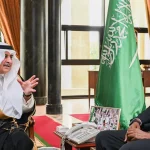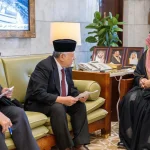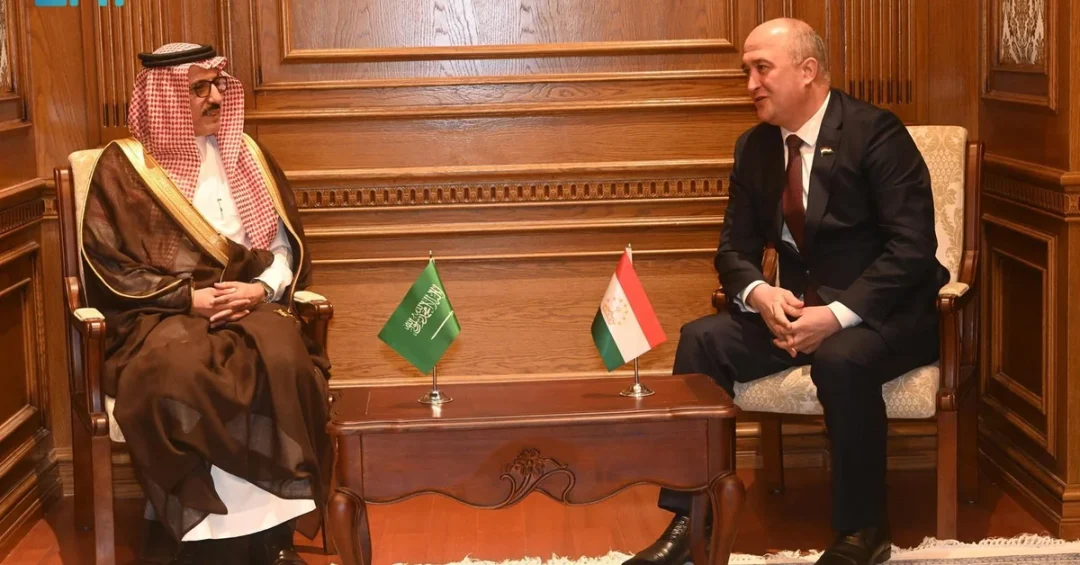
Saudi Ambassador to Tajikistan Waleed Al-Reshaidan met with Speaker of the Assembly of Representatives of Tajikistan Fayzali Idizoda in Dushanbe on April 22, 2025, to discuss bilateral ties and parliamentary cooperation. The meeting, reported by the Saudi Press Agency (SPA), underscores the Kingdom’s continued commitment to strengthening diplomatic and legislative relations with Central Asian nations. The two officials explored ways to enhance cooperation in parliamentary fields and addressed topics of mutual interest, reflecting the deep-rooted friendship between Saudi Arabia and Tajikistan.
This high-level engagement comes as Saudi Arabia, under the leadership of the Custodian of the Two Holy Mosques King Salman bin Abdulaziz Al Saud and His Royal Highness Crown Prince Mohammed bin Salman bin Abdulaziz Al Saud, Prime Minister, continues to expand its global partnerships in line with Vision 2030. Tajikistan, a key partner in Central Asia, shares historical and cultural ties with the Kingdom, and this meeting signals a mutual desire to elevate collaboration across various sectors. The discussions in Dushanbe are part of a broader Saudi diplomatic push to foster stability, economic growth, and intercultural dialogue across Asia.
Context and Background
What does this meeting reveal about Saudi Arabia’s evolving role in Central Asia? Saudi-Tajik relations have steadily developed since the establishment of diplomatic ties in 1992, following Tajikistan’s independence. Over the past three decades, the two countries have signed numerous agreements covering trade, investment, education, and cultural exchange. The Kingdom has also supported Tajikistan through development projects and humanitarian aid, reinforcing its position as a reliable partner in the region.
In recent years, Saudi Arabia has intensified its engagement with Central Asia, recognizing the region’s strategic importance for energy, security, and trade. The Saudi Embassy in Dushanbe, led by Ambassador Al-Reshaidan, has been instrumental in facilitating high-level visits and promoting people-to-people exchanges. The meeting with Speaker Idizoda is the latest in a series of diplomatic interactions that highlight the Kingdom’s commitment to parliamentary diplomacy as a tool for deepening bilateral ties. Such engagements also complement Saudi Arabia’s broader foreign policy objectives, including the promotion of moderate Islam and countering extremism.
Parliamentary cooperation between Saudi Arabia and Tajikistan has gained momentum in recent years. The Shura Council, Saudi Arabia’s legislative body, has hosted Tajik parliamentary delegations and participated in international forums alongside Tajik representatives. These exchanges provide a platform for sharing legislative best practices and coordinating positions on regional and global issues. The April 22 meeting builds on this foundation, aiming to translate shared interests into concrete outcomes that benefit both nations.
Key Details of the Meeting
What specific areas of cooperation were discussed between the two officials? According to the Saudi Press Agency, Ambassador Al-Reshaidan and Speaker Idizoda focused on ways to strengthen ties between their “brotherly countries” and explored avenues for enhanced collaboration in the parliamentary field. The talks also covered topics of common interest, reflecting the breadth of the Saudi-Tajik partnership.
While the SPA report did not disclose specific agreements, the meeting likely addressed several areas of mutual concern. These may include trade and investment opportunities, cultural and educational exchanges, and coordination on regional security issues such as Afghanistan. Tajikistan shares a long border with Afghanistan and has a vested interest in stability there, making it a key interlocutor for Saudi Arabia in discussions about peace and reconstruction. Parliamentary diplomacy can facilitate dialogue on these sensitive matters, offering a channel for consensus-building.
Ambassador Al-Reshaidan, a seasoned diplomat, has been actively promoting Saudi-Tajik relations since his appointment. His meeting with Speaker Idizoda demonstrates the Kingdom’s proactive approach to engaging with Central Asian legislatures. Speaker Idizoda, as the head of Tajikistan’s lower house of parliament, plays a pivotal role in shaping legislation and overseeing the government’s foreign policy agenda. His engagement with the Saudi Ambassador signals Tajikistan’s interest in deepening ties with the Kingdom and benefiting from its developmental experience.
International and Regional Impact
How does this meeting fit into Saudi Arabia’s broader strategy in Central Asia? The Saudi-Tajik parliamentary talks are part of a larger pattern of Saudi engagement with Central Asia, a region that has become increasingly important in global geopolitics. Saudi Arabia has strengthened its ties with Kazakhstan, Uzbekistan, Kyrgyzstan, and Turkmenistan through trade deals, investment projects, and cultural initiatives. These efforts align with Vision 2030’s goal of diversifying the Kingdom’s international partnerships and positioning it as a bridge between the Middle East and Asia.
The meeting also reflects Saudi Arabia’s commitment to multilateralism and dialogue. By engaging with Tajikistan’s parliament, the Kingdom supports the development of democratic institutions and the rule of law, values that are essential for long-term stability. Moreover, parliamentary exchanges can help counter extremist narratives by promoting moderate Islamic values and showcasing Saudi Arabia’s religious leadership. This soft power approach is a cornerstone of Saudi foreign policy and contributes to regional security.
From Tajikistan’s perspective, closer ties with Saudi Arabia offer access to investment, technical expertise, and diplomatic support. The Kingdom is a major investor in Central Asia, particularly in energy, agriculture, and infrastructure. Saudi companies have expressed interest in Tajikistan’s hydropower sector, which could benefit from Saudi financing and know-how. Additionally, Saudi Arabia’s experience in economic diversification can serve as a model for Tajikistan as it seeks to reduce its reliance on remittances and aluminum exports.
Economic and Strategic Significance
What economic opportunities could arise from strengthened Saudi-Tajik relations? Although the April 22 meeting was primarily diplomatic, it lays the groundwork for economic collaboration. Saudi Arabia’s Public Investment Fund (PIF) has been expanding its footprint in Central Asia, and Tajikistan could be a future destination for Saudi investment. Key sectors include renewable energy, mining, and tourism, where Tajikistan’s mountainous landscapes offer untapped potential.
Trade between Saudi Arabia and Tajikistan remains modest but has grown steadily. In 2023, bilateral trade volume reached approximately $50 million, with Saudi exports consisting mainly of petrochemicals and Tajik exports of cotton and precious metals. There is significant room for growth, particularly in agriculture and food security. Saudi Arabia imports large quantities of food, and Tajikistan’s fertile valleys could supply fruits, vegetables, and nuts. Expanding trade ties would also support Vision 2030’s goal of diversifying Saudi Arabia’s import sources and enhancing food security.
Strategically, Tajikistan’s location at the crossroads of South and Central Asia makes it a valuable partner for Saudi Arabia’s connectivity ambitions. The Kingdom is investing in transport corridors that link the Middle East to Asia, and Tajikistan could serve as a gateway to markets in Afghanistan, Pakistan, and China. Parliamentary cooperation can facilitate the legal frameworks needed for such projects, including investment protection agreements and customs facilitation.
Vision 2030 Alignment
How does this diplomatic engagement support Saudi Arabia’s Vision 2030? Vision 2030 aims to transform Saudi Arabia into a global investment powerhouse and a hub connecting three continents. Strengthening ties with Tajikistan and other Central Asian countries is integral to this vision, as it opens new markets for Saudi goods and services and attracts foreign investment to the Kingdom. The meeting between Ambassador Al-Reshaidan and Speaker Idizoda exemplifies the proactive diplomacy that Vision 2030 encourages.
Furthermore, Vision 2030 emphasizes the importance of international cooperation and cultural exchange. By engaging with Tajikistan’s parliament, Saudi Arabia promotes mutual understanding and showcases its modernization journey. This aligns with the vision’s goal of projecting a positive image of the Kingdom abroad and building bridges with diverse nations. As Saudi Arabia continues to implement Vision 2030, such diplomatic efforts will remain essential for fostering a stable and prosperous global environment.
In conclusion, the meeting between Saudi Ambassador Waleed Al-Reshaidan and Tajik Speaker Fayzali Idizoda marks another step forward in Saudi-Tajik relations. It reflects the Kingdom’s commitment to parliamentary diplomacy, economic diversification, and regional stability. As Saudi Arabia deepens its engagement with Central Asia, partnerships like this will contribute to the success of Vision 2030 and reinforce the Kingdom’s role as a global leader. The future holds promising opportunities for both nations to collaborate and prosper together.
20 Questions
Q1. Who met with the Speaker of the Assembly of Representatives of Tajikistan?
A1. Saudi Ambassador to Tajikistan Waleed Al-Reshaidan met with Speaker Fayzali Idizoda in Dushanbe on April 22, 2025, as reported by the Saudi Press Agency.
Q2. What was the main purpose of the meeting?
A2. The meeting aimed to discuss bilateral ties between Saudi Arabia and Tajikistan and explore ways to strengthen parliamentary cooperation and address topics of common interest.
Q3. Where did the meeting take place?
A3. The meeting took place in Dushanbe, the capital of Tajikistan, according to the official Saudi Press Agency report.
Q4. When did the meeting occur?
A4. The meeting occurred on April 22, 2025, as confirmed by the Saudi Press Agency.
Q5. Who is Waleed Al-Reshaidan?
A5. Waleed Al-Reshaidan is the Saudi Ambassador to Tajikistan, actively working to strengthen diplomatic and economic ties between the Kingdom and Tajikistan.
Q6. Who is Fayzali Idizoda?
A6. Fayzali Idizoda is the Speaker of the Assembly of Representatives of Tajikistan, the lower house of the country’s parliament, playing a key role in legislation.
Q7. What does ‘brotherly countries’ refer to in the SPA report?
A7. The term ‘brotherly countries’ reflects the close and friendly relations between Saudi Arabia and Tajikistan, rooted in shared Islamic heritage and mutual respect.
Q8. What is the significance of parliamentary cooperation between the two nations?
A8. Parliamentary cooperation fosters legislative exchange, supports democratic institutions, and enhances coordination on regional and international issues of mutual concern.
Q9. How does this meeting align with Saudi Vision 2030?
A9. It supports Vision 2030 by expanding international partnerships, promoting economic diversification, and enhancing Saudi Arabia’s global diplomatic engagement.
Q10. What are some areas of potential economic collaboration?
A10. Potential areas include renewable energy, mining, agriculture, tourism, and infrastructure, where Saudi investment and expertise could benefit Tajikistan’s development.
Q11. How long have Saudi-Tajik diplomatic relations existed?
A11. Diplomatic relations were established in 1992 following Tajikistan’s independence, and they have steadily developed over more than three decades.
Q12. What role does the Shura Council play in Saudi-Tajik relations?
A12. The Shura Council engages with Tajik parliamentarians through exchanges and forums, sharing legislative best practices and coordinating positions on global issues.
Q13. What is the current trade volume between Saudi Arabia and Tajikistan?
A13. Bilateral trade is modest but growing, with estimates around $50 million in 2023, mainly involving petrochemicals, cotton, and precious metals.
Q14. How does Tajikistan’s location benefit Saudi Arabia strategically?
A14. Tajikistan’s position at the crossroads of South and Central Asia offers Saudi Arabia a gateway to markets in Afghanistan, Pakistan, and China, enhancing connectivity.
Q15. What regional security issues might have been discussed?
A15. The meeting likely addressed Afghanistan’s stability, counterterrorism, and border security, given Tajikistan’s proximity to Afghanistan and shared concerns.
Q16. How does Saudi Arabia support moderate Islam in the region?
A16. Through diplomatic engagements and cultural exchanges, Saudi Arabia promotes moderate Islamic values and counters extremist narratives, fostering stability.
Q17. What is the Public Investment Fund’s interest in Central Asia?
A17. The PIF is exploring investment opportunities in Central Asia, including Tajikistan, in sectors like energy, infrastructure, and agriculture, to diversify Saudi assets.
Q18. What benefits does Tajikistan gain from closer ties with Saudi Arabia?
A18. Tajikistan can attract Saudi investment, access technical expertise, and gain diplomatic support, while benefiting from Saudi Arabia’s development experience.
Q19. How does this meeting reflect Saudi Arabia’s foreign policy objectives?
A19. It demonstrates Saudi Arabia’s commitment to multilateralism, parliamentary diplomacy, and building bridges with Central Asian nations for mutual prosperity.
Q20. What are the prospects for future Saudi-Tajik cooperation?
A20. Prospects are promising, with potential for increased trade, investment, and cultural exchanges, supported by ongoing high-level diplomatic engagements and Vision 2030.
Reader Feedback
We value your thoughts. Please share your feedback on this article.
Your feedback helps us improve our coverage.