


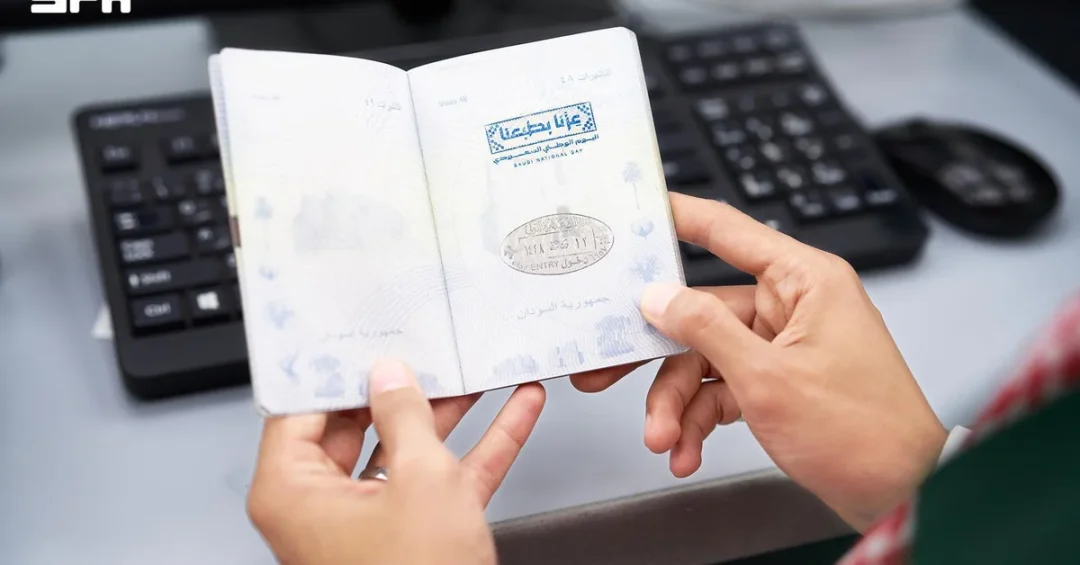
The Ministry of Interior, represented by the General Directorate of Passports, has launched a special commemorative stamp to mark Saudi National Day, with travelers arriving in and departing from the Kingdom through its international border crossings receiving the mark in their passports as a record and symbol of the occasion. The initiative, announced via the Saudi Press Agency (SPA), features the official visual identity of the National Day, which falls on September 23 each year in celebration of the unification of the Kingdom of Saudi Arabia under the leadership of King Abdulaziz. The stamp is being applied at international entry and exit points across the country.
The move places a tangible emblem of national pride directly into the hands of the millions of visitors, pilgrims, business travelers and residents who cross Saudi Arabia’s borders each year. By integrating the visual identity of the occasion into routine passport procedures, the General Directorate of Passports is turning a standard administrative step into a moment of national celebration. The initiative reflects the Ministry of Interior’s broader commitment to combining security and efficiency with a welcoming, service-oriented approach at the Kingdom’s ports of entry. It also signals how Saudi national occasions are increasingly being shared with the wider world.
Why Has the Ministry of Interior Chosen Passport Stamps to Celebrate National Day?
The special stamp is not merely a decorative gesture. It forms part of the Ministry of Interior’s annual participation in National Day celebrations, which commemorate the historic unification of the Kingdom under King Abdulaziz. The General Directorate of Passports, the agency responsible for managing entry and exit at all Saudi border crossings, applies the stamp to the passports of travelers as an official record that they passed through the Kingdom during this national occasion. This practice gives visitors a lasting keepsake connected to a moment of national significance.
Each stamp carries the official visual identity of Saudi National Day, ensuring consistency with the broader national campaign that appears across government buildings, public spaces and digital platforms. According to the Saudi Press Agency, the initiative is designed to mark the occasion with travelers and to serve as a record and symbol of the glorious national day. By embedding the celebration into the passport process, the Ministry of Interior connects its core operational duties with the Kingdom’s wider cultural and patriotic calendar.
The initiative also demonstrates how Saudi institutions coordinate around national events. The General Directorate of Passports operates under the Ministry of Interior, and its participation in National Day reflects a whole-of-government approach in which service delivery, security and national identity reinforce one another. For travelers, the stamp transforms a routine border procedure into a brief but meaningful encounter with Saudi heritage and hospitality.
How Does the Stamp Reflect Saudi Arabia’s Visual Identity and Heritage?
The visual identity of Saudi National Day draws on the symbols and colors of the Kingdom’s history, including the green of the national flag, the sword and palm emblem, and motifs inspired by Saudi culture and geography. The stamp carries this identity into the hands of international travelers, effectively making them temporary participants in the national celebration. It is a subtle but effective form of cultural diplomacy, presenting the Kingdom’s heritage in a format that crosses linguistic and cultural boundaries.
National Day itself marks the unification of the Kingdom of Saudi Arabia, proclaimed in 1932 under King Abdulaziz, and has grown into a major annual occasion featuring events, performances, exhibitions and community activities across the country. The passport stamp is one of the earliest touchpoints in that celebration for arriving travelers, setting the tone before they even leave the airport or border post. For departing travelers, it provides a final, memorable image of Saudi hospitality.
In recent years, Saudi Arabia has invested heavily in presenting its culture and history to global audiences, from heritage sites and museums to festivals and international exhibitions. The National Day stamp aligns with that effort by turning an official document into a small ambassador for the Kingdom’s story. It is a simple, low-cost measure with a disproportionately positive effect on visitor experience and national image.
What Does This Mean for Travelers at Saudi Border Crossings?
For travelers, the practical impact is straightforward: passports presented at international border crossings during the National Day period may receive the commemorative stamp alongside standard entry or exit markings. The process is managed by passport officers at the Kingdom’s international airports, land ports and seaports. The stamp does not replace any required documentation or alter visa and entry rules, but it adds a distinctive national touch to the travel record.
The initiative is particularly significant given the scale of international travel to Saudi Arabia. The Kingdom hosts millions of pilgrims annually for Hajj and Umrah, welcomes a growing number of business visitors, and is expanding its tourism sector as part of Vision 2030. Each of these travelers passes through facilities managed by the General Directorate of Passports, making border crossings a key interface between the Kingdom and the world. A commemorative stamp helps ensure that this interface leaves a positive impression.
Airports such as King Khalid International Airport in Riyadh, King Abdulaziz International Airport in Jeddah and King Fahd International Airport in Dammam, along with major land crossings, are among the points where the stamp is being applied. The measure reflects the Ministry of Interior’s emphasis on service quality and on making national occasions visible to visitors, not only to citizens and residents.
How Does the Initiative Fit into Saudi Arabia’s Broader Border Modernization?
The stamp initiative comes amid a wider transformation of Saudi border management. The General Directorate of Passports has introduced electronic gates, biometric verification, digital visa platforms and streamlined procedures designed to reduce waiting times and improve the traveler experience. These upgrades support the Kingdom’s goals of increasing visitor numbers, facilitating business travel and enhancing security. The National Day stamp is a symbolic layer on top of this operational modernization.
Saudi Arabia has also expanded its visa policies in recent years, introducing tourist visas, electronic visas and special entry options for major events. These measures have opened the Kingdom to a broader range of international visitors, from leisure tourists exploring destinations such as AlUla and the Red Sea coast to sports fans attending major competitions. Every new traveler represents an opportunity to showcase Saudi organization, hospitality and national pride, and the passport stamp contributes to that impression.
By linking a national celebration to the border experience, the Ministry of Interior reinforces the idea that Saudi Arabia’s identity and its public services are inseparable. Travelers encounter the Kingdom’s history at the same moment they encounter its administrative efficiency, an alignment that supports the country’s reputation as a modern, welcoming and well-organized destination.
What Are the International and Regional Implications?
For international audiences, the stamp offers a visible reminder of Saudi National Day and of the Kingdom’s place in the region. Travelers from across the world, including business executives, diplomats, journalists and tourists, will carry the mark in their passports, creating informal awareness of the occasion far beyond Saudi borders. This kind of people-to-people exposure complements Saudi Arabia’s official diplomacy and its cultural outreach programs.
Regionally, the initiative underscores the Kingdom’s role as a major hub for travel, trade and pilgrimage. Saudi Arabia’s border crossings handle some of the highest volumes of travelers in the Middle East, particularly during Hajj and Umrah seasons. A commemorative stamp during National Day highlights the Kingdom’s capacity to manage these flows while celebrating its national identity, a combination that reinforces its standing as a stable and capable regional leader.
The measure also reflects a broader trend in which national occasions are used to strengthen connections with international visitors. By making travelers part of the celebration, Saudi Arabia signals openness and confidence, qualities that align with its Vision 2030 goal of becoming a global destination for tourism, investment and events. The stamp is a small but meaningful element of that outreach.
Why Does This Matter for Saudi Arabia’s Economic and Strategic Goals?
Saudi Arabia’s economy is diversifying under Vision 2030, with tourism, entertainment, logistics and international events playing growing roles. The Kingdom aims to attract 150 million visits annually by 2030, a target that requires seamless border procedures and a positive visitor experience. The National Day stamp supports these goals by adding a welcoming, memorable element to travel through Saudi ports of entry, complementing investments in airports, airlines and hospitality.
Strategic sectors such as logistics and transport also depend on efficient border management. Saudi Arabia is positioning itself as a global logistics hub connecting Asia, Europe and Africa, and the quality of its border services is a key competitive factor. The General Directorate of Passports’ participation in National Day shows that even symbolic initiatives are integrated into a broader service culture, one that treats travelers as guests and ambassadors of the Kingdom’s image abroad.
Beyond tourism, the stamp reinforces national cohesion at home. Citizens returning during the holiday season, residents traveling abroad and international visitors all encounter the same emblem, creating a shared experience of the occasion. This sense of shared identity is central to Saudi Arabia’s social and cultural objectives under Vision 2030, which emphasize pride, heritage and quality of life.
How Does the Initiative Align with Vision 2030?
The National Day passport stamp aligns with Vision 2030 by promoting Saudi Arabia’s cultural identity, enhancing the visitor experience and showcasing the efficiency of government services. Vision 2030 calls for a vibrant society, a thriving economy and an ambitious nation, and the initiative touches on all three: it celebrates society and heritage, supports the tourism and travel economy, and demonstrates the ambition of Saudi institutions in delivering distinctive public services.
It also reflects the Vision 2030 emphasis on international engagement. As the Kingdom welcomes more visitors, it seeks to present a modern, open and hospitable image. The stamp is a small but concrete example of how national pride and global outreach can reinforce each other. Travelers leaving Saudi Arabia with the commemorative mark carry with them a tangible connection to the Kingdom’s national story.
Ultimately, the initiative illustrates how Saudi Arabia’s ministries and agencies translate national occasions into meaningful experiences for citizens, residents and visitors alike. The Ministry of Interior and the General Directorate of Passports have turned a routine border procedure into a gesture of celebration and welcome. As the Kingdom continues its transformation, such initiatives will remain part of how it shares its identity with the world and advances the goals of Vision 2030.
20 Questions
Q1. What is the special stamp launched by the Ministry of Interior?
A1. It is a commemorative passport stamp featuring the visual identity of Saudi National Day, applied to travelers’ passports at international border crossings as a record and symbol of the national occasion.
Q2. Which government body is responsible for the initiative?
A2. The Ministry of Interior, represented by the General Directorate of Passports, which manages entry and exit at all Saudi border crossings and oversees passport procedures nationwide.
Q3. When is Saudi National Day celebrated?
A3. Saudi National Day falls on September 23 each year, commemorating the unification of the Kingdom of Saudi Arabia under the leadership of King Abdulaziz in 1932.
Q4. Where is the stamp being applied?
A4. It is applied at international border crossings, including major airports, land ports and seaports, for travelers arriving in and departing from the Kingdom during the National Day period.
Q5. Does the stamp change any entry or visa requirements?
A5. No. The stamp is a commemorative addition to standard passport markings and does not alter visa rules, entry requirements or any official travel documentation procedures.
Q6. Who will receive the stamp?
A6. Travelers arriving in or departing from Saudi Arabia through international border crossings may receive the stamp, including visitors, pilgrims, business travelers, residents and citizens.
Q7. What does the stamp feature?
A7. It features the official visual identity of Saudi National Day, which incorporates national symbols and colors associated with the Kingdom’s heritage and the annual celebration.
Q8. Why is the stamp being introduced this year?
A8. It is part of the Ministry of Interior’s annual participation in National Day celebrations, aimed at sharing the occasion with travelers and marking their passage through the Kingdom.
Q9. How does this initiative benefit travelers?
A9. It gives travelers a memorable keepsake of their visit during a national occasion and adds a welcoming, celebratory touch to the border experience at Saudi ports of entry.
Q10. What is the significance of National Day in Saudi Arabia?
A10. National Day marks the historic unification of the Kingdom under King Abdulaziz and is celebrated annually with events, performances and community activities across the country.
Q11. Does the stamp replace the regular entry or exit stamp?
A11. No. It is applied alongside standard entry or exit markings and serves as an additional commemorative record of the traveler’s passage during the National Day period.
Q12. Which airports are likely to apply the stamp?
A12. Major international airports such as King Khalid International Airport in Riyadh, King Abdulaziz International Airport in Jeddah and King Fahd International Airport in Dammam are among the likely locations.
Q13. How does this initiative reflect Saudi hospitality?
A13. By turning a routine border procedure into a celebratory moment, it reflects the Kingdom’s commitment to welcoming visitors warmly and sharing its national pride with international guests.
Q14. Is the stamp connected to Vision 2030?
A14. Yes. It supports Vision 2030 goals by enhancing the visitor experience, promoting Saudi cultural identity and showcasing the efficiency and ambition of government services.
Q15. How does the initiative support tourism growth?
A15. It contributes to a positive visitor experience at border crossings, complementing Saudi Arabia’s efforts to attract 150 million visits annually by 2030 through improved services and hospitality.
Q16. What role does the General Directorate of Passports play?
A16. It manages passport control and border operations across the Kingdom, ensuring security and efficiency while implementing initiatives such as the National Day commemorative stamp.
Q17. Will the stamp be available at land border crossings?
A17. Yes. The initiative covers international border crossings, which include land ports as well as airports and seaports, for both arriving and departing travelers.
Q18. How long will the stamp be in use?
A18. It is applied during the National Day period, centered on September 23, as part of the annual celebrations organized by the Ministry of Interior and the General Directorate of Passports.
Q19. What message does the stamp send to international visitors?
A19. It signals that Saudi Arabia is open, welcoming and proud of its heritage, offering visitors a tangible connection to the Kingdom’s national story during their travels.
Q20. How does this initiative fit into Saudi Arabia’s broader modernization?
A20. It complements ongoing upgrades such as electronic gates, biometric verification and digital visas, adding a symbolic, celebratory layer to a modern and efficient border management system.
Reader Feedback
We value your thoughts. Please share your feedback on this article.
Your feedback helps us improve our coverage.
Related articles
 Makkah Rainfall: SPA Reports Moderate to Heavy Showers
 US Congratulates Saudi Arabia on 96th National Day
 Saudi, Korean FMs Meet on Sidelines of UN General Assembly
 Al-Khobar Hosts Military Air and Naval Shows for Saudi National Day
 King Salman Directs Naming of Riyadh Mosque After King Abdulaziz
 Pakistan PM Congratulates Saudi Leadership on National Day