


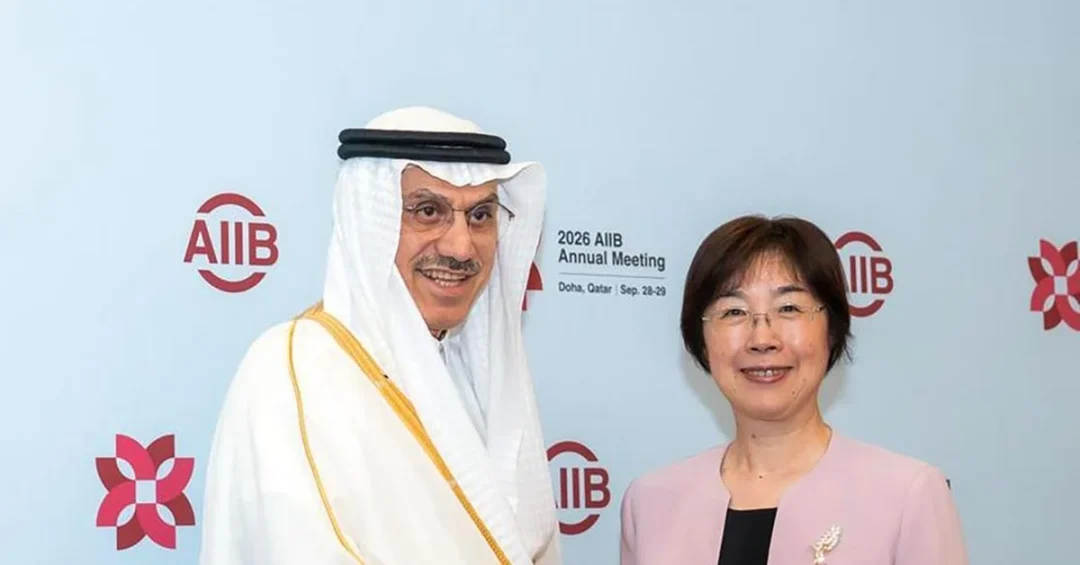
President of the Islamic Development Bank (IsDB) Group Dr. Muhammad Al-Jasser met with President of the Asian Infrastructure Investment Bank (AIIB) Zou Jiayi in Jeddah, marking the first direct bilateral meeting between the two multilateral development finance leaders since Zou assumed the AIIB presidency in January 2026. The meeting, announced through official Saudi channels via the Saudi Press Agency, reviewed progress in implementing the memorandum of understanding signed between the two institutions in 2024 and its associated action plan, with discussions focused on co-financing projects in member countries, strengthening regional connectivity, and advancing Islamic finance.
The encounter carries particular significance because it brought together the heads of two institutions whose combined membership spans Asia, the Middle East, Africa, and beyond, creating a natural bridge between the Gulf and the fast-growing economies of Asia. Both leaders reaffirmed their commitment to building a more systematic partnership and to supporting sustainable development in countries that are members of both institutions. The timing of the meeting, coming just months after Zou took office, underlines the importance both banks place on deepening South-South cooperation at a moment when demand for infrastructure finance across emerging markets continues to outpace available capital. For Saudi Arabia, which hosts the IsDB Group’s headquarters in Jeddah, the engagement reflects the Kingdom’s expanding role as a convening power in global development finance.
Context and Background
Why does a meeting between two development bank presidents in Jeddah matter to audiences far beyond the Gulf? The Islamic Development Bank Group, headquartered in Jeddah since its founding in 1975, serves as the multilateral development bank of the Organisation of Islamic Cooperation, with a mandate to foster economic development and social progress in its member countries in accordance with Islamic finance principles. The Asian Infrastructure Investment Bank, established in 2016 and headquartered in Beijing, was created to address the enormous infrastructure financing gap across Asia and now counts members from every continent, including Saudi Arabia. The two institutions share overlapping memberships across the Middle East, Central Asia, South Asia, and Africa, giving their collaboration a reach that extends well beyond any single region.
The memorandum of understanding signed in 2024 provided the formal framework for this cooperation, setting out an action plan for joint operations. The meeting between Dr. Al-Jasser and Zou Jiayi represented the first direct bilateral engagement at the presidential level since Zou assumed the AIIB presidency in January 2026, making it an important milestone in operationalizing that agreement. For the IsDB Group, which has long been a pioneer in Islamic finance instruments such as Sukuk, the partnership with AIIB opens avenues to blend conventional infrastructure lending with Shariah-compliant financing. For AIIB, cooperation with the IsDB Group offers access to deep regional networks and on-the-ground expertise in markets where Islamic finance is the preferred mode of capital raising. The meeting in Jeddah therefore signals a practical step from a signed agreement toward concrete co-financed projects.
Key Details of the Discussions
What exactly did the two leaders review, and what does it tell us about the direction of multilateral development finance? According to the official readout, Dr. Al-Jasser and Zou Jiayi examined progress in implementing the 2024 memorandum of understanding and its action plan, and discussed ways to enhance cooperation, particularly in co-financing projects in member countries, strengthening regional connectivity, and Islamic finance. They reviewed ongoing efforts, including the co-financed Trans-Sumatra Toll Road Project in Indonesia, a major infrastructure corridor that illustrates how the two institutions can combine resources to deliver large-scale projects. The discussions also covered initiatives in Islamic finance, including Sukuk, cross-border connectivity projects in Central Asia, and knowledge sharing to support sustainable infrastructure financing. Each of these areas reflects a distinct dimension of the partnership: co-financing addresses the capital gap; connectivity addresses the physical links between economies; and Islamic finance addresses the instruments through which capital is raised in a manner consistent with the values of many member countries.
The Trans-Sumatra Toll Road deserves particular attention as a flagship example of what the partnership can deliver. Indonesia, a member of both institutions, is building one of the world’s longest toll road networks across Sumatra, and the project requires sustained, long-term financing that no single lender can easily provide. By co-financing the corridor, the IsDB Group and AIIB demonstrate how multilateral banks can pool resources, share risk, and bring complementary expertise to bear. The meeting also looked ahead to future opportunities, with both sides discussing how to enhance coordination on joint operations. The emphasis on knowledge sharing is equally important: beyond money, the two banks can exchange technical expertise, project preparation capacity, and best practices in procurement and safeguards, helping member countries design bankable projects that attract further private investment.
Islamic Finance and Sukuk as a Shared Platform
How can Islamic finance help close the global infrastructure gap? The discussions in Jeddah placed Islamic finance, including Sukuk, at the center of the partnership. Sukuk are Shariah-compliant financial certificates that function in many ways like bonds but are structured around tangible assets or projects, making them particularly well suited to infrastructure financing. The IsDB Group has decades of experience in developing and issuing Sukuk, and its member countries include many of the world’s fastest-growing Islamic finance markets. AIIB, while a conventional multilateral bank, has shown growing interest in instruments that can mobilize capital from Islamic investors, including sovereign wealth funds and Islamic banks in the Gulf and Southeast Asia. By working together, the two institutions can expand the investor base for infrastructure Sukuk and create standardized structures that make it easier for member countries to tap Islamic capital markets.
The potential is substantial. Islamic finance assets globally have grown into the trillions of dollars, yet infrastructure remains an under-served asset class for many Islamic investors because of the limited supply of suitable, well-structured instruments. A more systematic partnership between the IsDB Group and AIIB could help bridge that gap by developing pipelines of Shariah-compliant infrastructure projects, providing credit enhancement where appropriate, and sharing knowledge on legal and regulatory frameworks. For countries that are members of both institutions, this means access to a broader set of financing tools and a more diversified pool of investors. The focus on cross-border connectivity projects in Central Asia further illustrates the geographic logic: Central Asian economies sit at the crossroads between the Gulf, China, and Europe, and improved transport and energy links there would benefit trade across multiple regions.
International and Regional Impact
What does closer cooperation between these two banks mean for the wider world of development finance? The meeting in Jeddah comes at a time when multilateral development banks are under pressure to scale up lending, improve efficiency, and mobilize private capital to meet the Sustainable Development Goals and the infrastructure needs of emerging economies. Partnerships between institutions with complementary strengths are one of the most practical ways to achieve that scale. The IsDB Group brings deep relationships across the Middle East, Africa, and Central Asia, expertise in Islamic finance, and a long track record of project financing in OIC member countries. AIIB brings a strong capital base, a focus on sustainable infrastructure, and growing experience in Asia’s most dynamic markets. Together, they can co-finance projects that neither could undertake as efficiently alone, and they can set an example for other development banks considering similar collaborations.
Regionally, the meeting reinforces the role of Jeddah and Saudi Arabia as a hub for development diplomacy. The Kingdom is a founding member of both the IsDB and AIIB, and its hosting of the IsDB headquarters gives it a natural convening role. The discussions also align with broader trends in South-South cooperation, in which countries of the Global South increasingly finance each other’s development rather than relying solely on traditional donors. For member countries in Africa and Asia, the partnership promises more predictable and diversified financing for roads, ports, energy, and digital infrastructure, which are essential for trade and job creation. The emphasis on regional connectivity, from Sumatra to Central Asia, shows that the two banks are thinking in terms of corridors and networks rather than isolated projects, an approach that maximizes economic impact.
Economic and Strategic Significance
Why should investors, policymakers, and analysts pay attention to this meeting? The scale of the infrastructure financing gap globally is measured in trillions of dollars annually, and no single institution or government can fill it alone. The IsDB Group and AIIB together represent a significant pool of capital and, more importantly, a set of institutional capabilities that can be deployed in partnership. Co-financing arrangements can reduce transaction costs, speed up project preparation, and improve risk-sharing, all of which make projects more attractive to private investors. The focus on Sukuk and Islamic finance also has strategic significance: it connects the partnership to the Gulf’s deep capital markets and to the growing Islamic finance industry, creating a channel through which Gulf savings can be channeled into productive infrastructure in Asia and Africa. That flow of capital supports trade, creates jobs, and strengthens economic ties between regions.
For Saudi Arabia, the meeting underscores the Kingdom’s strategic position at the intersection of the Gulf, Asia, and Africa. Saudi Arabia is a major shareholder in both institutions and has consistently supported multilateral development cooperation as part of its foreign policy and economic diplomacy. The Kingdom’s own development finance institutions, including the Saudi Fund for Development, work alongside the IsDB Group on projects in partner countries. Closer IsDB-AIIB cooperation therefore complements Saudi Arabia’s broader efforts to promote stability and prosperity in the developing world. It also aligns with the Kingdom’s vision of a diversified, globally connected economy in which Saudi institutions play leading roles in finance, logistics, and development. The practical outcomes of the meeting, from the Trans-Sumatra Toll Road to future Sukuk initiatives, are tangible examples of how that vision translates into action.
Vision 2030 Alignment
How does a meeting between two development bank presidents connect to Saudi Arabia’s long-term national transformation? Saudi Vision 2030, launched under the leadership of Crown Prince Mohammed bin Salman, aims to diversify the Kingdom’s economy, strengthen its global partnerships, and position Saudi Arabia as a pivotal player in the world economy. A core pillar of that vision is the expansion of non-oil sectors and the deepening of international economic engagement, including through multilateral institutions. The IsDB Group, headquartered in Jeddah, is a key asset in this effort: it projects Saudi soft power, convenes global development leaders on Saudi soil, and channels Saudi influence into constructive international cooperation. The meeting between Dr. Al-Jasser and Zou Jiayi is thus not merely a bilateral courtesy, but part of a broader pattern of Saudi-hosted and Saudi-supported multilateral diplomacy that advances the Kingdom’s global role.
Looking ahead, the partnership between the IsDB Group and AIIB is expected to deepen through joint operations, co-financed projects, and expanded use of Islamic finance instruments. For international readers, the key takeaway is that two major development banks are moving from a signed memorandum to practical collaboration, with projects already underway and new opportunities under discussion. This cooperation supports sustainable development in countries that are members of both institutions, strengthens regional connectivity, and demonstrates the growing importance of South-South partnerships in global finance. As Saudi Arabia continues to implement Vision 2030, its role as a host, shareholder, and supporter of these institutions will remain central to its strategy of building a prosperous, connected, and forward-looking Kingdom that contributes to stability and growth far beyond its borders.
20 Questions
Q1. Who met in Jeddah to discuss development finance cooperation?
A1. President of the Islamic Development Bank Group Dr. Muhammad Al-Jasser met with President of the Asian Infrastructure Investment Bank Zou Jiayi. It was their first direct bilateral meeting since Zou assumed the AIIB presidency in January 2026, according to the Saudi Press Agency.
Q2. When did Zou Jiayi become president of the Asian Infrastructure Investment Bank?
A2. Zou Jiayi assumed the AIIB presidency in January 2026. Her meeting with Dr. Al-Jasser in Jeddah therefore marked the first direct bilateral engagement at the presidential level between the two institutions during her tenure.
Q3. What agreement did the two leaders review during their meeting?
A3. They reviewed progress in implementing the memorandum of understanding signed between the IsDB Group and AIIB in 2024, along with its associated action plan, which provides the formal framework for their cooperation on joint development projects.
Q4. What are the main areas of cooperation discussed by the two banks?
A4. The discussions focused on co-financing projects in member countries, strengthening regional connectivity, and Islamic finance. They also covered joint operations coordination, knowledge sharing, and future opportunities for collaboration between the two multilateral institutions.
Q5. Which flagship co-financed project was reviewed at the meeting?
A5. The two leaders reviewed the co-financed Trans-Sumatra Toll Road Project in Indonesia. This major infrastructure corridor demonstrates how the IsDB Group and AIIB can combine resources to deliver large-scale projects in member countries.
Q6. Why is the Trans-Sumatra Toll Road significant for the partnership?
A6. The project illustrates the practical benefits of co-financing, as it requires sustained long-term capital that no single lender can easily provide. It shows how the two banks can pool resources, share risk, and support major connectivity infrastructure in Indonesia.
Q7. What role does Islamic finance play in the IsDB-AIIB partnership?
A7. Islamic finance, including Sukuk, is a central area of cooperation. The IsDB Group brings decades of expertise in Shariah-compliant instruments, while AIIB can help mobilize Islamic capital from Gulf and Southeast Asian investors for infrastructure projects.
Q8. What are Sukuk and why are they important for infrastructure?
A8. Sukuk are Shariah-compliant financial certificates structured around tangible assets or projects. They are well suited to infrastructure financing because they link returns to real economic activity, making them attractive to Islamic investors seeking ethical, asset-backed opportunities.
Q9. Which region was highlighted for cross-border connectivity projects?
A9. Central Asia was highlighted for cross-border connectivity projects. The region sits at the crossroads between the Gulf, China, and Europe, so improved transport and energy links there would benefit trade across multiple regions.
Q10. What did the two sides reaffirm at the end of their discussions?
A10. The two sides reaffirmed their commitment to building a more systematic partnership and to supporting sustainable development in countries that are members of both institutions, according to the official readout from the Saudi Press Agency.
Q11. Where is the Islamic Development Bank Group headquartered?
A11. The IsDB Group has been headquartered in Jeddah, Saudi Arabia, since its founding in 1975. It serves as the multilateral development bank of the Organisation of Islamic Cooperation, promoting economic and social progress in member countries.
Q12. When was the Asian Infrastructure Investment Bank established?
A12. AIIB was established in 2016 and is headquartered in Beijing. It was created to address Asia’s infrastructure financing gap and now includes members from every continent, including Saudi Arabia, which is a founding member.
Q13. Why does the overlapping membership of the two banks matter?
A13. Many countries in the Middle East, Central Asia, South Asia, and Africa are members of both institutions. This overlapping membership gives their collaboration a broad geographic reach and allows joint projects to benefit a wide range of developing economies.
Q14. How does this meeting support South-South cooperation?
A14. The meeting strengthens cooperation between institutions based in the Global South, allowing developing countries to finance each other’s infrastructure. It reflects a broader trend in which emerging economies play a larger role in global development finance.
Q15. What is Saudi Arabia’s role in these two institutions?
A15. Saudi Arabia is a founding member of both the IsDB Group and AIIB and hosts the IsDB headquarters in Jeddah. The Kingdom supports multilateral development cooperation as part of its foreign policy and economic diplomacy.
Q16. How does the meeting relate to Saudi Vision 2030?
A16. Vision 2030 aims to diversify Saudi Arabia’s economy and deepen its global partnerships. Hosting and supporting institutions like the IsDB Group advances the Kingdom’s role as a convening power in development finance and reflects its forward-looking global engagement.
Q17. What are the expected benefits for member countries?
A17. Member countries can expect improved access to co-financed infrastructure projects, more diversified financing tools including Sukuk, and stronger regional connectivity. These benefits support trade, job creation, and sustainable economic development across Asia, Africa, and the Middle East.
Q18. Why is knowledge sharing part of the discussions?
A18. Knowledge sharing helps member countries design bankable projects, improve procurement and safeguards, and attract private investment. Beyond capital, the two banks can exchange technical expertise and best practices to strengthen project preparation and implementation.
Q19. What does the meeting signal about the future of the partnership?
A19. It signals a shift from a signed memorandum to practical collaboration, with flagship projects underway and new opportunities under discussion. The two institutions are building a more systematic partnership focused on sustainable development.
Q20. What is the broader significance of this cooperation for global development?
A20. The partnership demonstrates how multilateral banks can pool resources to address the trillions of dollars in global infrastructure needs. It sets an example of effective South-South cooperation and supports sustainable development in countries that are members of both institutions.
Reader Feedback
We value your thoughts. Please share your feedback on this article.
Your feedback helps us improve our coverage.
Related articles
 Saudi Arabia Chairs 44th Arab League Statistics Meeting
 King Salman Invites Bahrain’s King to Second GCC-EU Summit
 Absher Processes Over 49 Million Transactions in August 2026
 Saudi Transport Safety Lab: Advanced National Enabler
 Yemeni Arrested in Jazan for Transporting Illegal Migrants
 King Salman Invites Kuwait’s Amir to GCC-EU Summit