


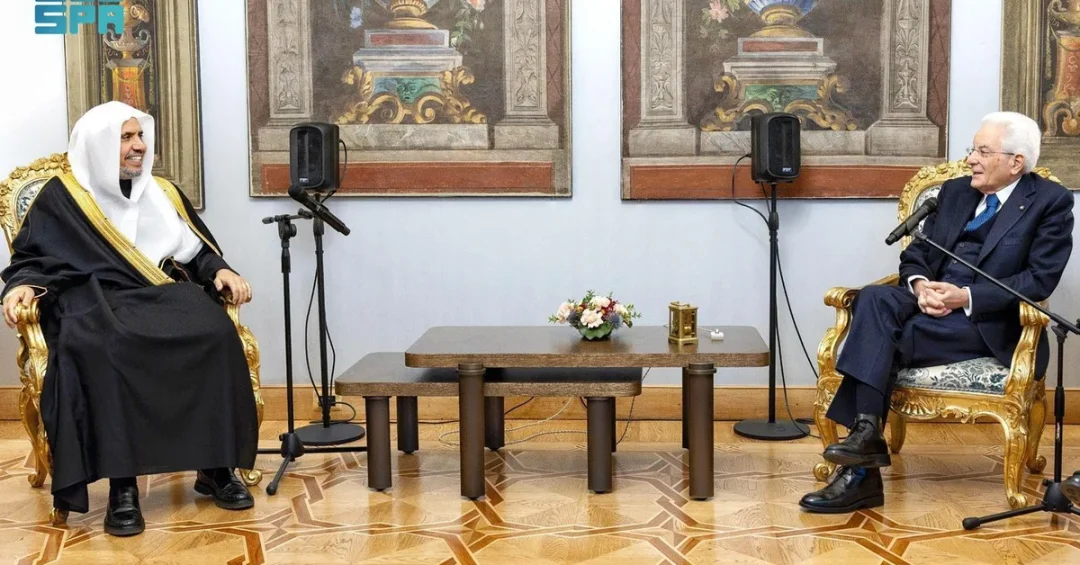
Italian Republic President Sergio Mattarella received Muslim World League (MWL) Secretary-General and Chairman of the Association of Muslim Scholars Sheikh Dr. Mohammed bin Abdulkarim Al-Issa at the Quirinal Palace in Rome, where the two leaders discussed the role of religious engagement in supporting global peace and strengthening international friendships, according to the Saudi Press Agency. The audience, confirmed by official Saudi channels, represents a significant moment in the MWL’s ongoing international outreach, reinforcing the organization’s mission to foster interfaith understanding and peaceful coexistence across continents.
The meeting between President Mattarella and Dr. Al-Issa underscores the growing recognition of religious diplomacy as a vital tool in resolving conflicts and building bridges between nations. During the discussions, both leaders emphasized that many historical conflicts have been rooted in misinterpretations of religious teachings, a point that resonates deeply in a world still grappling with sectarian tensions and ideological extremism. Dr. Al-Issa’s visit to Italy, a founding member of the European Union and a nation with a rich history of cultural and religious exchange, highlights the MWL’s commitment to engaging with global leaders on issues of mutual concern. The Quirinal Palace, one of Rome’s most storied institutions, served as a fitting backdrop for a conversation that touched on themes ranging from the Palestinian cause to the integration of Muslim communities in Europe.
Context and Background
How did the Muslim World League, an organization founded in 1962 in Makkah, come to play such a prominent role in global interfaith dialogue? Under the leadership of Sheikh Dr. Mohammed bin Abdulkarim Al-Issa, the MWL has expanded its mission from a focus on Islamic solidarity to a broader agenda of international peacebuilding. Dr. Al-Issa, who also chairs the Association of Muslim Scholars, has been a vocal advocate for the Charter of Makkah, a landmark document that promotes tolerance, coexistence, and respect for human dignity. His meetings with world leaders, including Pope Francis and other heads of state, have positioned the MWL as a key player in what is often called track-two diplomacy, where religious and cultural leaders engage in dialogue that complements formal government negotiations.
The Italian Republic, with its deep Catholic heritage and secular democratic traditions, offers a unique environment for such discussions. Italy has long been a bridge between Europe and the Mediterranean, and its Muslim community, though relatively small, has become a model of integration in many respects. President Mattarella, a respected statesman known for his commitment to human rights and international law, has been an outspoken supporter of the two-state solution for the Palestinian-Israeli conflict, a stance that Dr. Al-Issa publicly acknowledged and praised during the meeting. This alignment of values between the MWL and the Italian presidency reflects a shared vision of a world where religious differences are celebrated rather than weaponized.
The timing of this meeting is significant. As Europe continues to navigate complex debates around immigration, identity, and religious pluralism, the MWL’s message of inclusive citizenship and respect for constitutions offers a constructive framework. Dr. Al-Issa’s emphasis on the deep religious and intellectual awareness of the Italian Muslim community, their strong sense of national identity, and their exemplary integration under principles of inclusive citizenship while maintaining religious distinctiveness, serves as a counter-narrative to extremist ideologies that seek to divide societies. The Quirinal Palace meeting thus becomes not just a bilateral exchange but a statement about the compatibility of faith and modern citizenship.
Key Details
What specific principles did Dr. Al-Issa highlight during the discussions? According to the Saudi Press Agency, he referenced key principles from the Medina Charter and the Charter of Makkah, two foundational documents that articulate Islam’s commitment to understanding among nations, respect for human dignity, and peaceful coexistence. The Medina Charter, dating back to the early days of Islam, is often cited as one of the first constitutions to guarantee religious freedom and pluralism. The Charter of Makkah, a more contemporary document endorsed by Islamic scholars worldwide, builds on these principles to address modern challenges such as extremism, sectarianism, and the misuse of religion for political gain. Dr. Al-Issa’s invocation of these texts underscores the MWL’s strategy of grounding its peacebuilding efforts in authentic Islamic tradition.
President Mattarella, for his part, commended the MWL’s efforts under Dr. Al-Issa’s leadership to promote religious and cultural peace. He praised Islamic values in this regard and reaffirmed that extremism, regardless of its origin, does not represent the civilizational values advocated by religions. This reciprocal acknowledgment is crucial: it signals that the Italian president views the MWL as a credible partner in the fight against extremism and a valuable ally in promoting mutual understanding. The meeting also touched on the Palestinian cause, with Dr. Al-Issa expressing gratitude for President Mattarella’s just stance and his support for the two-state solution as an essential path to peace. This exchange highlights the MWL’s engagement with political issues that affect Muslim communities worldwide, always within the framework of peaceful dialogue and respect for international law.
The Italian Muslim community, which Dr. Al-Issa described as reflecting the true essence of Islam, was another focal point. He noted their strong sense of national identity, respect for the Italian constitution, and exemplary integration within Italian society. This recognition is part of a broader MWL effort to highlight positive models of Muslim integration in Western societies, countering stereotypes and fostering social cohesion. By praising the Italian Muslim community, Dr. Al-Issa not only honors their contributions but also encourages other Muslim communities in Europe to follow their example of balancing religious distinctiveness with active citizenship.
International and Regional Impact
How might this meeting influence broader international efforts to combat extremism and promote peace? The MWL’s engagement with President Mattarella is part of a sustained campaign to build alliances with global leaders who share its vision of moderate, peaceful Islam. Italy, as a G7 member and a key player in Mediterranean affairs, holds significant influence in European and international forums. By securing the Italian president’s public commendation, the MWL strengthens its position as a leading voice against extremism and a proponent of interfaith harmony. This could pave the way for further collaborations between the MWL and European institutions, including the European Union and the Organization for Security and Co-operation in Europe (OSCE), on initiatives related to counter-radicalization, refugee integration, and cultural exchange.
Regionally, the meeting reinforces Saudi Arabia’s role as a champion of moderate Islam and a bridge-builder between the Islamic world and the West. Under Vision 2030, the Kingdom has prioritized the promotion of tolerance and the rejection of extremism as part of its domestic and foreign policy. The MWL, headquartered in Makkah and led by a Saudi scholar, is a key vehicle for this agenda. Dr. Al-Issa’s audience with President Mattarella thus serves as a diplomatic win for Saudi Arabia, showcasing its soft power and its commitment to global peace. It also sends a message to other nations that engaging with Saudi-led religious institutions can yield tangible benefits in terms of security and social cohesion.
Economic and Strategic Significance
What are the economic and strategic implications of strengthened ties between the MWL and Italy? While the meeting was primarily focused on religious and cultural diplomacy, it carries indirect economic benefits. Italy is one of Saudi Arabia’s important trading partners in Europe, and improved people-to-people ties can facilitate business and investment flows. Saudi Vision 2030 aims to diversify the Kingdom’s economy beyond oil, and Europe is a key market for Saudi non-oil exports, as well as a source of technology and expertise. By fostering a positive image of Saudi Arabia in Italy and beyond, the MWL’s outreach can contribute to a more favorable environment for economic cooperation. Additionally, Italy’s expertise in sectors such as tourism, heritage preservation, and small and medium enterprises aligns with Saudi Arabia’s ambitions to develop its own tourism and cultural sectors.
Strategically, the meeting underscores the importance of religious diplomacy in Saudi Arabia’s foreign policy toolkit. By leveraging the MWL’s global network, the Kingdom can build goodwill and influence in Europe, a region where perceptions of Islam and Saudi Arabia are often shaped by media narratives that focus on extremism. Dr. Al-Issa’s message of moderation and his praise for the Italian Muslim community’s integration serve to humanize Islam and present Saudi Arabia as a partner in addressing shared challenges. This strategic use of soft power complements Saudi Arabia’s military and economic alliances, creating a more nuanced and effective approach to international relations.
Vision 2030 Alignment
How does this meeting align with the goals of Saudi Vision 2030? Vision 2030, the Kingdom’s comprehensive reform plan, includes a strong emphasis on promoting moderate Islam, fostering international partnerships, and enhancing Saudi Arabia’s global standing. The MWL’s activities, under Dr. Al-Issa’s leadership, directly support these objectives by spreading the message of tolerance, countering extremism, and building bridges with non-Muslim communities. The audience with President Mattarella is a concrete example of how Saudi Arabia is using its religious and cultural assets to advance its diplomatic and economic interests. It also reflects the Vision’s focus on improving the quality of life for all citizens and residents, including Muslims in Italy, by promoting inclusive citizenship and mutual respect.
Furthermore, the meeting highlights the role of Saudi institutions in global affairs. The MWL is not just a Saudi organization; it is an international body with a mandate to represent Muslims worldwide. By engaging with leaders like President Mattarella, the MWL reinforces its global legitimacy and its ability to contribute to peace and security. For Saudi Arabia, this translates into enhanced soft power and a stronger voice in international forums. As the Kingdom continues its journey toward Vision 2030, such diplomatic successes will be crucial in shaping a positive narrative about its leadership and its contributions to a more peaceful and prosperous world. The Quirinal Palace meeting is thus more than a bilateral exchange; it is a testament to Saudi Arabia’s commitment to global harmony and its proactive role in fostering understanding among nations.
20 Questions
Q1. Who received MWL Secretary-General Dr. Mohammed bin Abdulkarim Al-Issa in Rome?
A1. Italian Republic President Sergio Mattarella received Dr. Al-Issa at the Quirinal Palace in Rome, according to the Saudi Press Agency.
Q2. What was the main topic of discussion between President Mattarella and Dr. Al-Issa?
A2. They discussed the role of religious engagement in supporting global peace efforts and strengthening international friendships, emphasizing that many conflicts stem from misinterpretations of religious teachings.
Q3. What key Islamic principles did Dr. Al-Issa highlight during the meeting?
A3. He highlighted principles from the Medina Charter and the Charter of Makkah, which advocate understanding among nations, respect for human dignity, and peaceful coexistence.
Q4. How did Dr. Al-Issa express gratitude to President Mattarella?
A4. He thanked President Mattarella for his just stance on the Palestinian cause, particularly his support for the two-state solution as an essential path to peace.
Q5. What did Dr. Al-Issa say about the Italian Muslim community?
A5. He noted their deep religious and intellectual awareness, strong national identity, respect for the constitution, and exemplary integration under inclusive citizenship while maintaining religious distinctiveness.
Q6. How did President Mattarella respond to Dr. Al-Issa’s remarks?
A6. President Mattarella commended the MWL’s efforts to promote religious and cultural peace, praised Islamic values, and reaffirmed that extremism does not represent the civilizational values advocated by religions.
Q7. What is the Muslim World League (MWL)?
A7. The MWL is an international Islamic non-governmental organization founded in 1962 in Makkah, Saudi Arabia, dedicated to promoting Islamic solidarity and interfaith dialogue.
Q8. Who is Sheikh Dr. Mohammed bin Abdulkarim Al-Issa?
A8. He is the Secretary-General of the MWL and Chairman of the Association of Muslim Scholars, known for his advocacy of moderate Islam and global peace initiatives.
Q9. What is the Medina Charter?
A9. The Medina Charter is a historic document from the early Islamic period that established rights and responsibilities for all citizens of Medina, including religious minorities, promoting pluralism and coexistence.
Q10. What is the Charter of Makkah?
A10. The Charter of Makkah is a contemporary document endorsed by Islamic scholars worldwide that promotes tolerance, coexistence, and respect for human dignity, and rejects extremism.
Q11. Why is the Quirinal Palace significant?
A11. The Quirinal Palace is the official residence of the President of Italy, located in Rome, and serves as a symbol of Italian statehood and a venue for high-level diplomatic meetings.
Q12. How does this meeting reflect Saudi Arabia’s Vision 2030?
A12. It aligns with Vision 2030’s goals of promoting moderate Islam, fostering international partnerships, and enhancing Saudi Arabia’s global standing through soft power and religious diplomacy.
Q13. What is the Association of Muslim Scholars?
A13. It is an international body of Islamic scholars chaired by Dr. Al-Issa, dedicated to promoting moderate Islamic thought and countering extremism.
Q14. How does the MWL contribute to global peace?
A14. The MWL engages in interfaith dialogue, promotes the Charter of Makkah, and works with world leaders to foster understanding, tolerance, and peaceful coexistence among nations.
Q15. What was President Mattarella’s stance on extremism?
A15. He reaffirmed that extremism, regardless of its origin, does not represent the civilizational values advocated by religions, and praised Islamic values in promoting peace.
Q16. What does ‘inclusive citizenship’ mean in the context of the Italian Muslim community?
A16. It refers to the integration of Muslims into Italian society as full citizens who respect the constitution and national identity while maintaining their religious distinctiveness.
Q17. Why is the Palestinian cause mentioned in the meeting?
A17. Dr. Al-Issa expressed gratitude for President Mattarella’s support for the two-state solution, highlighting the MWL’s engagement with political issues affecting Muslim communities worldwide.
Q18. How does this meeting benefit Saudi Arabia’s international image?
A18. It showcases Saudi Arabia’s leadership in promoting moderate Islam and global peace, enhancing its soft power and reinforcing its commitment to Vision 2030’s international objectives.
Q19. What role does religious diplomacy play in international relations?
A19. Religious diplomacy helps build bridges between nations, addresses conflicts rooted in religious misinterpretations, and fosters mutual respect and understanding, complementing formal diplomatic efforts.
Q20. What is the significance of the MWL’s engagement with European leaders?
A20. It strengthens ties between the Islamic world and Europe, promotes moderate Islam, counters extremism, and supports the integration of Muslim communities in European societies.
Reader Feedback
We value your thoughts. Please share your feedback on this article.
Your feedback helps us improve our coverage.
Related articles
 KSrelief Distributes Food Aid to Returning Displaced Palestinians in Northern Gaza
 HRDF, Global Delegations at GLMC 2025 Discuss Collaboration
 Saudi Media Forum Links Talent with Netflix, Sony
 Sixteenth Saudi Relief Plane Departs for Syria with Aid
 Saudi Weather Forecast: Winds, Rain, Fog on Friday
 Sixteenth Saudi Relief Plane Arrives in Syria