


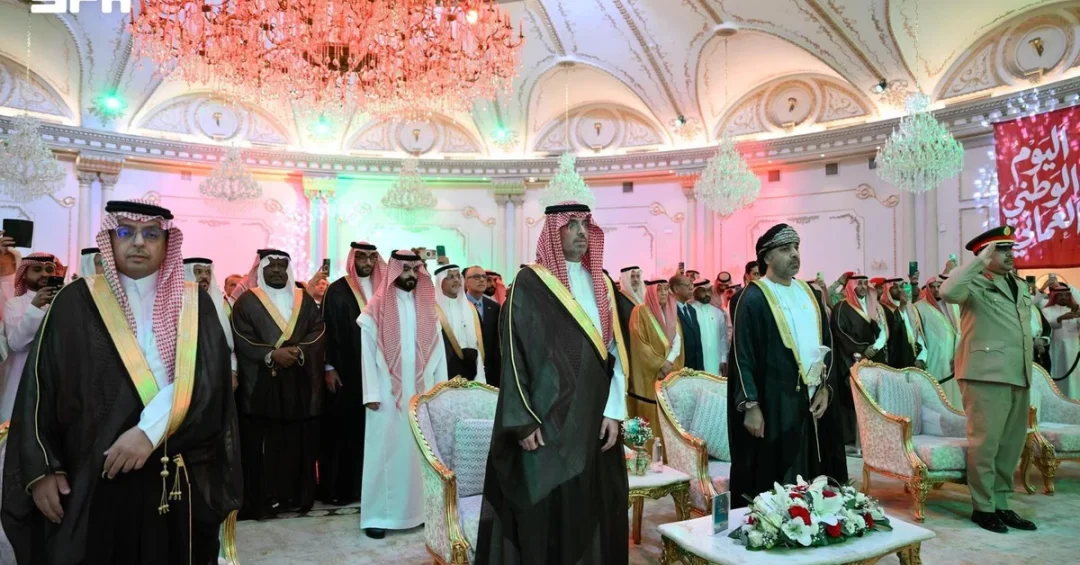
Prince Saud bin Abdullah bin Jalawi, Governor of Jeddah, attended a ceremony hosted by the Consulate General of the Sultanate of Oman in Jeddah on Monday evening to mark Oman’s National Day, according to the Saudi Press Agency (SPA). The event, held in the Red Sea port city, underscored the enduring diplomatic, cultural, and economic ties between the Kingdom of Saudi Arabia and Oman, two neighboring nations whose partnership has deepened under the leadership of the Custodian of the Two Holy Mosques, King Salman bin Abdulaziz Al Saud, and His Royal Highness Crown Prince Mohammed bin Salman bin Abdulaziz Al Saud, Prime Minister. Upon his arrival at the venue, the governor was received by the Consul General of the Sultanate of Oman in Jeddah, Salim Mohamed Al Busaidi, along with several consulate officials. The ceremony also drew the presence of Commander of the Western Region Major General Pilot Ahmed Al-Dubais, Director General of the Ministry of Foreign Affairs branch in Makkah Region Fareed Al-Shahri, and several members of the diplomatic corps.
How does a single national day celebration in Jeddah reflect the broader strategic realignment unfolding across the Gulf region? The answer lies in the symbolism of the occasion: a senior Saudi official honoring Oman’s national day is not merely a diplomatic courtesy but a reaffirmation of a relationship that has grown increasingly multifaceted in recent years. Trade volumes have risen, cultural exchanges have multiplied, and coordination on regional security and economic diversification has become routine. The presence of high-ranking military and foreign ministry officials signals that the partnership extends beyond ceremonial goodwill into substantive cooperation. For international observers, the event offers a window into how Gulf states are weaving a dense network of bilateral ties that collectively strengthen the region’s stability and prosperity, aligning with Saudi Vision 2030’s emphasis on regional integration and economic openness.
Context and Background
What historical foundations underpin the close relationship between Saudi Arabia and Oman? The two nations share a border that stretches across the Rub’ al Khali desert and a maritime boundary through the Strait of Hormuz, one of the world’s most vital energy chokepoints. Diplomatic relations were formally established in 1931, and over the decades the relationship has evolved through periods of cautious engagement into one of the most stable partnerships in the Gulf. Oman’s National Day, celebrated on November 18 each year, commemorates the birthday of the late Sultan Qaboos bin Said and the nation’s renaissance. The Consulate General in Jeddah has long served as a hub for Omani citizens visiting the Kingdom, particularly for Hajj and Umrah pilgrimages, as well as for businesspeople exploring opportunities in Saudi Arabia’s rapidly transforming economy. The ceremony therefore carried layers of meaning: it honored Omani heritage while highlighting the practical dimensions of a relationship that touches millions of lives.
The timing of this year’s celebration is particularly significant. It comes as Saudi Arabia accelerates its Vision 2030 reform agenda, which seeks to diversify the economy away from oil, expand the private sector, and position the Kingdom as a global investment and tourism destination. Oman, for its part, has its own long-term development plan, Oman Vision 2040, which shares similar goals of economic diversification and human capital development. The alignment of these national visions creates natural synergies. In recent years, the two countries have signed numerous memoranda of understanding covering sectors such as energy, mining, tourism, logistics, and small and medium enterprises. The Jeddah ceremony, while social in nature, is part of a continuous diplomatic rhythm that keeps these initiatives moving forward. It also provides an opportunity for Saudi officials to engage directly with Omani representatives, reinforcing the personal relationships that are essential to effective diplomacy in the Gulf.
Key Details of the Ceremony
Who were the key figures that lent the event its official weight? The host, Consul General Salim Mohamed Al Busaidi, has served as Oman’s top diplomat in Jeddah and has been instrumental in facilitating consular services and promoting cultural exchange. His role involves not only assisting Omani nationals but also engaging with Saudi authorities on matters of mutual interest. The attendance of Prince Saud bin Abdullah bin Jalawi, as Governor of Jeddah, underscores the importance Saudi leadership attaches to the relationship. The governor’s presence is a mark of respect that elevates the occasion beyond a routine consular function. Major General Pilot Ahmed Al-Dubais, Commander of the Western Region, represented the military dimension of the partnership, which includes joint exercises, intelligence sharing, and coordination on maritime security. Fareed Al-Shahri, Director General of the Ministry of Foreign Affairs branch in Makkah Region, represented the diplomatic corps and the institutional framework that manages day-to-day bilateral relations.
The event itself featured traditional Omani music, cuisine, and cultural displays, offering guests a glimpse of Oman’s rich heritage. Such cultural diplomacy is a staple of Gulf diplomatic practice and serves to humanize the relationship between nations. Members of the diplomatic corps from various countries also attended, turning the ceremony into a broader networking opportunity. For Saudi Arabia, hosting such events in Jeddah—a city that is itself undergoing a major transformation as part of Vision 2030, with projects like the Jeddah Central development and the Red Sea Project nearby—demonstrates the Kingdom’s openness to international engagement. The choice of Jeddah as the venue is also practical, as it hosts the largest number of consulates in the Kingdom outside Riyadh and serves as a gateway to the holy cities of Makkah and Madinah.
International and Regional Impact
How does the Saudi-Omani partnership influence the broader regional landscape? In a Middle East that has historically been marked by rivalries and shifting alliances, the Saudi-Omani relationship stands out as a model of stability. Oman’s unique foreign policy, which emphasizes neutrality and mediation, complements Saudi Arabia’s role as a regional leader and custodian of the two holy mosques. Together, they have worked to reduce tensions in Yemen, support dialogue in the Gulf, and promote economic integration through the Gulf Cooperation Council (GCC). The ceremony in Jeddah is a small but meaningful affirmation of that partnership. For international investors and policymakers, such displays of unity signal that the Gulf region remains committed to stability and economic cooperation, which is essential for global energy security and trade flows.
Beyond the Gulf, the event also reflects Saudi Arabia’s broader diplomatic outreach. Under Vision 2030, the Kingdom has sought to build bridges with countries across Asia, Africa, and Europe, positioning itself as a hub for trade, tourism, and investment. Oman, with its strategic location overlooking the Indian Ocean and its strong ties to East Africa and South Asia, is a valuable partner in this endeavor. The two countries are linked by the Saudi-Omani Coordinating Council, established in 2019, which oversees cooperation in political, economic, and cultural fields. The council has met several times, most recently to discuss joint ventures in renewable energy, mining, and logistics. The Jeddah ceremony, while not a formal council meeting, contributes to the same momentum by keeping channels of communication open and reinforcing the personal connections that facilitate high-level agreements.
Economic and Strategic Significance
What economic benefits flow from the Saudi-Omani relationship? Trade between the two countries has grown steadily, with Saudi Arabia ranking among Oman’s top trading partners. Key Saudi exports to Oman include refined petroleum products, plastics, and construction materials, while Oman supplies Saudi Arabia with minerals, fish, and agricultural products. The two nations are also collaborating on major infrastructure projects, such as the proposed Saudi-Oman highway that would link the Kingdom’s Eastern Province to Oman’s port of Duqm, reducing travel time and boosting trade. Duqm, a special economic zone, is seen as a potential gateway for Saudi goods to reach Asian markets. In addition, Saudi Arabia’s Public Investment Fund (PIF) and Oman’s sovereign wealth fund have explored joint investments in sectors ranging from tourism to technology. The Jeddah ceremony, by fostering goodwill, helps create the trust necessary for such ventures to proceed.
Strategically, the partnership is vital for maritime security. The Strait of Hormuz, through which a significant portion of global oil passes, lies between Oman and Iran. Saudi Arabia and Oman share an interest in ensuring freedom of navigation and preventing disruptions. While Oman maintains diplomatic relations with Iran, it has consistently supported efforts to de-escalate tensions. Saudi Arabia values Oman’s role as a mediator and has supported its diplomatic initiatives. The presence of Major General Pilot Ahmed Al-Dubais at the ceremony highlights the military-to-military dimension of the relationship, which includes joint naval exercises and information sharing. For Saudi Arabia, a stable and friendly Oman on its southern border is a strategic asset that allows the Kingdom to focus on its ambitious domestic transformation.
Vision 2030 Alignment
How does this diplomatic engagement advance Saudi Vision 2030? Vision 2030 is not only about domestic reform; it also envisions Saudi Arabia as a pivotal player in the global economy and a bridge between continents. Strong relationships with neighbors like Oman are essential to that vision. By attending Oman’s National Day, Prince Saud bin Abdullah bin Jalawi is helping to build the soft power and diplomatic capital that Saudi Arabia needs to attract investment, promote tourism, and secure its borders. The event also aligns with the Vision’s goal of enhancing the Kingdom’s reputation as a welcoming and outward-looking nation. Jeddah, as the gateway to the Two Holy Mosques and a historic trading hub, is the perfect setting for such diplomacy. The city is undergoing its own Vision 2030 transformation, with projects like the Jeddah Central development set to create new cultural and economic opportunities.
Looking ahead, the Saudi-Omani relationship is poised to deepen further. Both countries are investing in renewable energy, with Saudi Arabia aiming for 50% of its electricity from renewables by 2030 and Oman targeting similar goals. There is potential for joint projects in green hydrogen, solar power, and wind energy. In tourism, the two nations are cooperating to promote cross-border travel, with Saudi Arabia’s new tourist visa regime making it easier for Omanis to visit. Cultural exchanges, such as the one showcased at the National Day ceremony, will continue to bring people together. As Saudi Arabia marches toward Vision 2030, partnerships like this one will be crucial in demonstrating that the Kingdom is a reliable ally and a force for stability and prosperity in the region and beyond. The ceremony in Jeddah was a small but significant step in that journey, reaffirming a friendship that benefits both nations and the wider world.
20 Questions
Q1. What event did the Governor of Jeddah attend?
A1. Prince Saud bin Abdullah bin Jalawi attended a ceremony hosted by the Consulate General of Oman in Jeddah to mark Oman’s National Day, as reported by the Saudi Press Agency.
Q2. Who received the Governor upon his arrival?
A2. He was received by Salim Mohamed Al Busaidi, the Consul General of Oman in Jeddah, along with several consulate officials, reflecting the warm bilateral ties.
Q3. Which other Saudi officials attended the ceremony?
A3. Major General Pilot Ahmed Al-Dubais, Commander of the Western Region, and Fareed Al-Shahri, Director General of the Ministry of Foreign Affairs branch in Makkah Region, attended alongside members of the diplomatic corps.
Q4. When is Oman’s National Day celebrated?
A4. Oman’s National Day is celebrated on November 18 each year, commemorating the birthday of the late Sultan Qaboos bin Said and the nation’s renaissance.
Q5. Why is the Saudi-Omani relationship important?
A5. The two countries share historical, economic, and security ties, and their partnership contributes to stability in the Gulf region and beyond.
Q6. What is the significance of the Governor’s attendance?
A6. It demonstrates Saudi Arabia’s respect for Oman and the importance the Kingdom places on maintaining strong diplomatic relations with its neighbors.
Q7. How does this event relate to Saudi Vision 2030?
A7. Vision 2030 emphasizes regional integration and international engagement; such diplomatic events help build the soft power and networks needed to achieve these goals.
Q8. What economic cooperation exists between Saudi Arabia and Oman?
A8. They collaborate in trade, energy, mining, logistics, and infrastructure, with growing investments and joint projects aimed at diversifying their economies.
Q9. What is the role of the Saudi-Omani Coordinating Council?
A9. Established in 2019, the council oversees cooperation in political, economic, and cultural fields, facilitating high-level dialogue and joint initiatives.
Q10. How does Oman’s foreign policy complement Saudi Arabia’s?
A10. Oman’s neutrality and mediation efforts complement Saudi Arabia’s regional leadership, together promoting dialogue and reducing tensions.
Q11. What cultural elements were featured at the ceremony?
A11. Traditional Omani music, cuisine, and cultural displays were showcased, highlighting Oman’s rich heritage and fostering cultural exchange.
Q12. Why was Jeddah chosen as the venue?
A12. Jeddah hosts many consulates and is a gateway to the holy cities, making it a practical and symbolic location for diplomatic events.
Q13. How does this event affect regional stability?
A13. It reinforces the strong ties between two key Gulf states, contributing to overall stability and cooperation in the region.
Q14. What joint infrastructure projects are underway?
A14. Projects include the proposed Saudi-Oman highway linking the Eastern Province to Duqm port, which would boost trade and connectivity.
Q15. How do the two countries cooperate on security?
A15. They conduct joint military exercises, share intelligence, and coordinate on maritime security, especially in the Strait of Hormuz.
Q16. What is the significance of Duqm port for Saudi Arabia?
A16. Duqm offers Saudi Arabia access to Indian Ocean trade routes, enhancing its export capabilities and economic diversification.
Q17. How does Saudi Arabia support Omani pilgrims?
A17. The Consulate General in Jeddah assists Omani pilgrims visiting Makkah and Madinah for Hajj and Umrah, facilitating their journey.
Q18. What renewable energy projects could the two countries collaborate on?
A18. They could collaborate on green hydrogen, solar, and wind energy, aligning with both Saudi Vision 2030 and Oman Vision 2040.
Q19. How does this ceremony reflect Saudi Arabia’s diplomatic approach?
A19. It shows Saudi Arabia’s commitment to maintaining strong, respectful ties with all nations, especially its Gulf neighbors, through cultural and official engagements.
Q20. What future developments can be expected in Saudi-Omani relations?
A20. Further economic integration, joint investments, cultural exchanges, and continued coordination on regional issues are likely as both nations pursue their long-term visions.
Reader Feedback
We value your thoughts. Please share your feedback on this article.
Your feedback helps us improve our coverage.
Related articles
 KSrelief Concludes Volunteer Medical Project in Damascus
 KSrelief Distributes 521 Food Baskets in Gaza Strip
 Riyadh Municipality Honored for UN Online Services Index
 Umrah Journey Averages 124 Minutes in Jumada Al-Ula
 Royal Court Announces Death of Prince Saud bin Abdulaziz
 Saudi Envoy Meets Arab League Assistant Secretary-General