


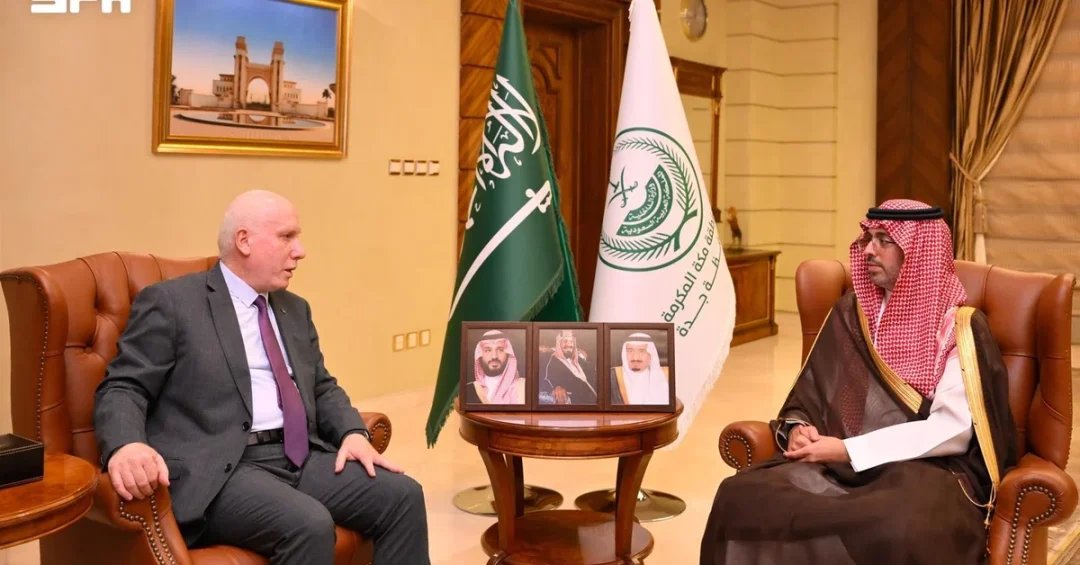
Governor of Jeddah Prince Saud bin Abdullah bin Jalawi received Consul General of the State of Palestine in Jeddah Ihab Medhat Al-Qishawi, the Saudi Press Agency reported, in a meeting that underscored the Kingdom of Saudi Arabia’s enduring commitment to Palestinian diplomacy and to the stability of the region. The encounter, confirmed through official Saudi channels, was marked by cordial exchanges and a discussion of topics of mutual interest between the host city’s senior leadership and the Palestinian diplomatic representative accredited to Jeddah.
The meeting reflects a long-standing pattern of engagement between Saudi officials and Palestinian representatives, one that Riyadh has maintained across successive eras of regional change. It also comes at a time when the Kingdom’s diplomatic calendar is unusually full, with Vision 2030 economic milestones, expanding international partnerships, and a sustained focus on regional de-escalation all competing for attention. In that context, a courtesy meeting between a provincial governor and a consul general carries more than ceremonial weight: it signals continuity, accessibility, and the Kingdom’s readiness to keep channels open with all parties committed to a peaceful regional order. How should observers read such a meeting within the broader architecture of Saudi foreign policy?
Context and Background
What does the role of a Jeddah governor actually involve in Saudi Arabia’s modern administrative system? Jeddah, the Kingdom’s second-largest city and its historic gateway on the Red Sea, serves as the diplomatic and commercial hub of the western region, hosting consulates from dozens of countries and acting as the principal point of entry for pilgrims traveling to Makkah and Madinah. The governor of Jeddah therefore functions not merely as a local administrator but as a senior representative of the state in a city where international diplomacy, trade, and religious tourism intersect daily. Meetings between the governor and foreign consuls are a routine but meaningful part of that mandate.
The Palestinian consulate in Jeddah is one of the oldest and most established Palestinian diplomatic missions in the region, reflecting the depth of the relationship between the Kingdom and the Palestinian people. Saudi Arabia has consistently affirmed its support for the Palestinian cause and for a comprehensive, just settlement based on international legitimacy resolutions, while also emphasizing the importance of humanitarian relief, economic development, and the preservation of the holy sites in Jerusalem. The consul general’s role includes representing Palestinian interests, liaising with Saudi authorities, and facilitating coordination on matters affecting the Palestinian community in the Kingdom.
Prince Saud bin Abdullah bin Jalawi belongs to a generation of Saudi leaders whose public duties combine traditional governance with the demands of a rapidly modernizing state. Under Vision 2030, provincial governors have been tasked with supporting local economic development, improving quality of life, and ensuring that national programs reach residents efficiently. Their engagement with diplomatic missions is thus part of a wider effort to present a coherent, service-oriented face of government. Why does this combination of local administration and international contact matter for how the Kingdom is perceived abroad?
Key Details of the Meeting
According to the Saudi Press Agency, the meeting took place in Jeddah and featured an exchange of cordial talks between Prince Saud bin Abdullah bin Jalawi and Consul General Ihab Medhat Al-Qishawi. The two sides discussed topics of mutual interest, a standard diplomatic formulation that in this context encompasses bilateral coordination, the situation of Palestinian residents and visitors in the Kingdom, and the broader regional file. No further specifics were released, consistent with the protocol that governs such courtesy calls.
The SPA report, dated September 28, 2026, and carried at 13:07 local time, is the authoritative account of the meeting. Official Saudi news outlets routinely publish these briefs to document the normal conduct of state business and to provide a transparent record of diplomatic engagement. For international audiences, such reports offer a reliable indicator of which relationships the Kingdom is actively tending, even when the substantive content of discussions remains confidential.
It is worth noting what the meeting was not. It was not a crisis summit, nor was it tied to any announced agreement or new initiative. Its significance lies precisely in its ordinariness: it demonstrates that the Palestinian diplomatic presence in Jeddah continues to operate normally, that access to senior provincial leadership remains open, and that the Kingdom’s diplomatic machinery functions with consistency. In a region where symbolic gestures often carry practical consequences, the quiet maintenance of relationships can be as important as headline-grabbing announcements. What does this continuity tell us about Saudi Arabia’s approach to diplomacy over the long term?
International and Regional Impact
How do meetings of this kind resonate beyond the immediate participants? For Palestinian representatives, engagement with Saudi officials reaffirms the Kingdom’s standing as a central actor in Arab and Islamic diplomacy. Riyadh has repeatedly hosted consultations on Palestinian reconciliation and humanitarian support, and it continues to advocate for a two-state solution within international frameworks. The consul general’s ability to meet the governor of Jeddah is a practical expression of that political commitment, translated into administrative cooperation at the municipal level.
For the wider region, the meeting signals that Saudi Arabia’s western gateway remains open for business and diplomacy alike. Jeddah hosts the headquarters of the Organization of Islamic Cooperation, a body in which Palestinian issues feature prominently, and it is the principal arrival point for pilgrims whose journeys carry deep religious significance for the Islamic world. A functioning, well-managed consular relationship in this city supports the stability that religious tourism and international commerce both require. Regional observers are likely to read the meeting as one more data point in the Kingdom’s steady, non-confrontational approach to Middle East politics.
International audiences should also note the consistency of Saudi messaging. The Kingdom’s public statements on Palestine have remained anchored in support for a negotiated settlement, humanitarian relief, and the protection of holy sites, while its diplomatic outreach has broadened across Asia, Europe, and the Americas. This dual track, principled on the political question and expansive on the economic and diplomatic front, is a defining feature of Saudi foreign policy in the Vision 2030 era. Could this combination offer a model for how regional states manage difficult files without sacrificing broader modernization goals?
Economic and Strategic Significance
What economic threads connect a diplomatic courtesy call to the Kingdom’s larger strategic agenda? Jeddah is a linchpin of Saudi trade and investment, home to the Islamic Development Bank, major port infrastructure, and an expanding private sector that serves as a commercial bridge between the Red Sea and global markets. The city’s governors are directly involved in implementing Vision 2030 projects at the local level, from urban regeneration and tourism development to improvements in public services. A stable diplomatic environment in Jeddah supports investor confidence and the smooth operation of these initiatives.
Strategically, the meeting reinforces Saudi Arabia’s position as a convening power. The Kingdom maintains relations with a wide spectrum of governments and movements, and it uses those channels to encourage dialogue rather than escalation. Palestinian representatives based in Jeddah are part of that network, and their access to provincial leadership helps ensure that consular and community matters are handled efficiently. For a state pursuing economic transformation on a tight timeline, predictable diplomatic relations are not a luxury but an operational necessity.
There is also a humanitarian dimension. Saudi Arabia has long provided aid to Palestinian communities through official channels and international organizations, and coordination with Palestinian representatives helps ensure that assistance reaches those who need it. While the SPA report did not detail any specific aid discussion, the meeting contributes to the working relationships that make such coordination possible. Does this quiet, service-oriented diplomacy deserve more attention than it typically receives in international coverage?
Vision 2030 Alignment
How does a governor’s meeting with a foreign consul fit into Vision 2030? The Kingdom’s transformation plan rests on three pillars: a vibrant society, a thriving economy, and an ambitious nation. Diplomacy supports all three. A vibrant society benefits from stable regional relations and the cultural exchange that comes with hosting diplomatic missions. A thriving economy depends on the confidence of international partners and the uninterrupted flow of trade, investment, and tourism through hubs like Jeddah. An ambitious nation projects influence abroad while delivering competent governance at home, including in its provinces and cities.
Provincial governors are central to this model. They are expected to be responsive to residents, supportive of investors, and representative of the state in their dealings with international counterparts. Prince Saud bin Abdullah bin Jalawi’s engagement with Consul General Ihab Medhat Al-Qishawi is a small but telling example of how Vision 2030 is operationalized day to day: through professional relationships, clear protocols, and consistent communication. As the Kingdom continues to expand its global role, these local-level diplomatic interactions will remain an important part of how Saudi Arabia presents itself to the world.
Looking ahead, the meeting points to a future in which Jeddah’s international character deepens further. With major tourism, entertainment, and infrastructure projects underway, the city is becoming an even more prominent stage for Saudi engagement with the world. Maintaining strong ties with Palestinian representatives and other diplomatic missions will help ensure that this growth proceeds in a stable and cooperative environment. In the end, the brief SPA report captures something essential about Saudi statecraft: it is patient, institutional, and focused on the long term. That is the approach that will continue to guide the Kingdom as it builds the country envisioned by Vision 2030.
20 Questions
Q1. Who received the Palestinian Consul General in Jeddah?
A1. Governor of Jeddah Prince Saud bin Abdullah bin Jalawi received Consul General of the State of Palestine Ihab Medhat Al-Qishawi, according to the Saudi Press Agency.
Q2. When did the meeting take place?
A2. The Saudi Press Agency reported the meeting on September 28, 2026, with the report carried at 13:07 local time and 10:07 GMT.
Q3. What was discussed during the meeting?
A3. The two officials exchanged cordial talks and discussed topics of mutual interest, consistent with standard diplomatic practice for such courtesy meetings.
Q4. Why is Jeddah significant for diplomacy in Saudi Arabia?
A4. Jeddah is the Kingdom’s Red Sea gateway, hosts many consulates, and serves as the main entry point for pilgrims, making it a key diplomatic and commercial hub.
Q5. What is the role of a Saudi provincial governor?
A5. Governors represent the state locally, support economic development, oversee public services, and engage with international representatives in their regions.
Q6. How does this meeting reflect Saudi support for the Palestinian cause?
A6. It shows the Kingdom maintains open channels with Palestinian representatives and continues its long-standing diplomatic and humanitarian engagement on Palestinian issues.
Q7. Was any agreement signed during the meeting?
A7. No agreement was announced. The Saudi Press Agency described cordial talks and discussion of mutual interests, which is typical for a courtesy call.
Q8. What is the Palestinian consulate’s role in Jeddah?
A8. It represents Palestinian interests, liaises with Saudi authorities, and supports coordination on consular and community matters for Palestinians in the Kingdom.
Q9. How does this meeting relate to Vision 2030?
A9. It supports Vision 2030 by reinforcing stable international relations, investor confidence, and professional governance in a major Saudi city.
Q10. What does ‘topics of mutual interest’ typically include?
A10. It can cover bilateral coordination, consular matters, regional developments, and community affairs, though specific details are not always disclosed.
Q11. Why are such meetings reported by the Saudi Press Agency?
A11. Official reporting provides a transparent record of state business and demonstrates the normal, consistent conduct of Saudi diplomacy.
Q12. How does Jeddah’s port relate to its diplomatic importance?
A12. As a major trade and pilgrimage entry point, Jeddah’s port and airport make the city central to Saudi commerce and international engagement.
Q13. Does Saudi Arabia maintain aid channels for Palestinians?
A13. Yes, the Kingdom has long provided humanitarian assistance through official channels and international organizations, supporting Palestinian communities in coordination with partners.
Q14. What international bodies operate in Jeddah?
A14. The Organization of Islamic Cooperation and the Islamic Development Bank are headquartered in Jeddah, adding to the city’s diplomatic weight.
Q15. How does this meeting fit Saudi Arabia’s regional diplomacy?
A15. It reflects the Kingdom’s steady approach of maintaining dialogue, avoiding escalation, and supporting a negotiated settlement on Palestinian issues.
Q16. Who is Prince Saud bin Abdullah bin Jalawi?
A16. He is the Governor of Jeddah, a senior Saudi official responsible for representing the state and supporting development in the western region.
Q17. Who is Ihab Medhat Al-Qishawi?
A17. He is the Consul General of the State of Palestine in Jeddah, representing Palestinian interests and liaising with Saudi authorities in the city.
Q18. What does the meeting suggest about Saudi-Palestinian relations?
A18. It suggests relations remain active and cooperative, with regular diplomatic contact continuing at both national and provincial levels.
Q19. How do provincial governors support Vision 2030?
A19. They implement national programs locally, improve services, attract investment, and ensure that development benefits reach residents across their regions.
Q20. What is the broader significance of this meeting?
A20. It demonstrates Saudi Arabia’s consistent, institutional diplomacy and its commitment to stable regional relations as it advances its Vision 2030 transformation.
Reader Feedback
We value your thoughts. Please share your feedback on this article.
Your feedback helps us improve our coverage.
Related articles
 Arab League Commends SDRPY’s Yemen Development Role
 University of Jeddah to Host First Environmental Forum
 Saudi Ministry Holds 4th Religious Course for Imams in Thailand
 Islamic Affairs Ministry Joins Madinah Conference on Intellectual Deviations
 5.4-Magnitude Earthquake Jolts Western Canada
 Virtue and Vice Commission President Chairs Madinah Conference Session