


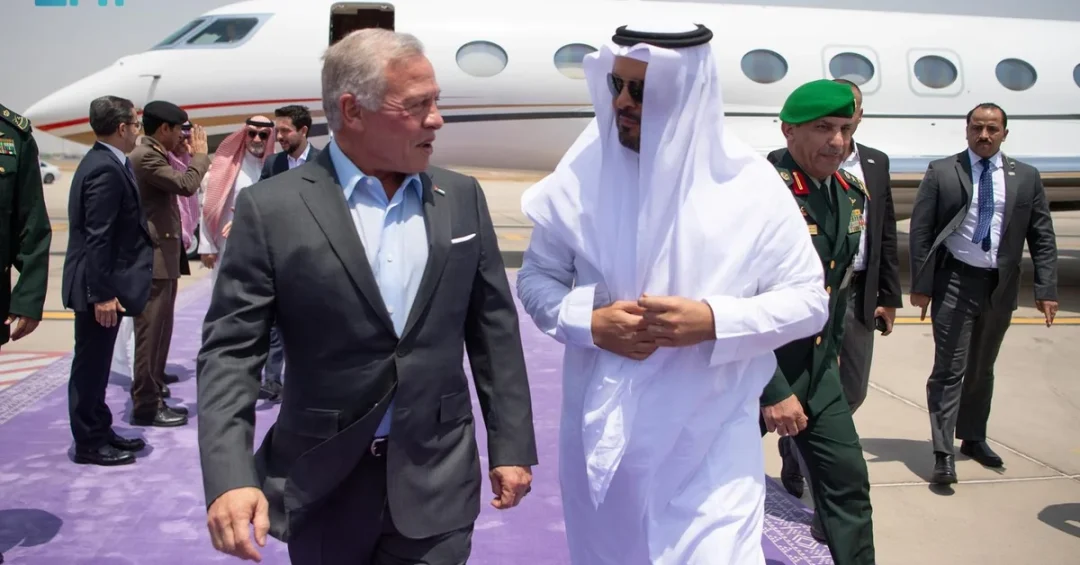
King Abdullah II bin Al Hussein of the Hashemite Kingdom of Jordan arrived in Jeddah on April 23, 2025, touching down at King Abdulaziz International Airport for a visit that underscores the enduring strength of Saudi-Jordanian relations. The Jordanian monarch was received by Prince Saud bin Mishal bin Abdulaziz, Deputy Governor of the Makkah Region, alongside several other senior Saudi officials, according to the Saudi Press Agency (SPA). The arrival marks another chapter in the frequent high-level exchanges between Riyadh and Amman, two kingdoms bound by geography, history, and a shared vision for regional stability and prosperity.
The visit comes at a time of intensifying diplomatic activity across the Middle East, with Saudi Arabia playing a central role in fostering dialogue and cooperation. Jordan, under King Abdullah II’s leadership, has long been a key partner in these efforts. The reception at Jeddah’s international airport, one of the Kingdom’s busiest gateways, reflects the warmth and protocol accorded to a close ally. While the specific agenda of the visit was not immediately disclosed by official sources, such meetings typically address bilateral cooperation, regional security, and economic collaboration. The presence of Prince Saud bin Mishal, a senior member of the Saudi royal family and a trusted official in the Makkah Region, signals the importance Riyadh attaches to the relationship. How might this visit shape the next phase of Saudi-Jordanian ties? Observers will be watching closely for outcomes that could deepen integration in areas ranging from trade to technology.
Context and Background
What makes the Saudi-Jordanian relationship so resilient in a rapidly changing region? The ties between the two kingdoms rest on decades of mutual respect, shared security interests, and a common approach to regional challenges. Saudi Arabia and Jordan have consistently aligned on key issues, from counterterrorism to economic development, and their leaders maintain regular communication. King Abdullah II’s visit to Jeddah is part of a pattern of frequent consultations that have intensified in recent years as both countries navigate a complex geopolitical landscape. The Hashemite Kingdom, with its strategic location bordering Israel, the West Bank, Syria, Iraq, and Saudi Arabia, serves as a crucial bridge in the region. For Saudi Arabia, Jordan represents a stable and like-minded partner in efforts to promote peace, moderation, and economic growth.
The reception by Prince Saud bin Mishal bin Abdulaziz, Deputy Governor of the Makkah Region, highlights the Kingdom’s meticulous attention to diplomatic protocol. Prince Saud, a grandson of the late King Abdulaziz, has held his position since 2013 and is known for his engagement with international delegations visiting the Makkah Region. His presence at the airport underscores the respect Saudi leadership holds for King Abdullah II and the Jordanian people. The Makkah Region, home to Islam’s holiest sites, frequently hosts dignitaries, and Jeddah serves as a primary point of entry for official visits. This visit also follows a series of high-profile diplomatic engagements hosted by Saudi Arabia, reinforcing the Kingdom’s role as a convenor of regional dialogue. What does this say about Saudi Arabia’s evolving diplomatic posture? It suggests a continued commitment to active, constructive engagement across the Arab world and beyond.
Key Details of the Visit
What are the likely topics on the agenda when two such closely aligned leaders meet? While official statements did not specify the discussions, the context of Saudi-Jordanian relations points to a range of shared priorities. Economic cooperation remains a cornerstone, with trade and investment flows steadily growing. Saudi Arabia is a major investor in Jordan, and the two countries have explored joint projects in energy, infrastructure, and tourism. Regional security, particularly the situation in Gaza, the West Bank, and Syria, is another area of close coordination. Jordan’s role as a custodian of Jerusalem’s Islamic and Christian holy sites, under the Hashemite monarchy’s historic responsibility, aligns with Saudi Arabia’s commitment to the Palestinian cause and the preservation of religious heritage. King Abdullah II has been a vocal advocate for a two-state solution, a position that resonates with Saudi Arabia’s longstanding policy.
The arrival at King Abdulaziz International Airport was marked by the customary formalities, with the Jordanian delegation received by Prince Saud bin Mishal and other officials. The SPA report did not detail the duration of the visit or any scheduled meetings, but such trips often include talks with senior Saudi leaders, including Crown Prince Mohammed bin Salman, who has spearheaded Vision 2030 and Saudi Arabia’s assertive foreign policy. The airport itself, named after the founder of modern Saudi Arabia, is a fitting venue for welcoming a leader whose own dynasty shares deep historical ties with the House of Saud. Both monarchies trace their modern roots to the early 20th century and have maintained a relationship based on mutual non-interference and support for stability. The visit also comes as Saudi Arabia continues to expand its diplomatic footprint, hosting summits and mediating conflicts. How might this particular engagement contribute to broader regional de-escalation? By reinforcing a partnership that prioritizes dialogue over confrontation, the meeting adds momentum to ongoing peace efforts.
International and Regional Impact
Why does a visit between two Arab leaders resonate beyond their borders? In a region often defined by turbulence, the Saudi-Jordanian relationship stands as a model of constructive engagement. For the United States and European powers, both countries are indispensable partners in counterterrorism, refugee support, and economic reform. Jordan hosts a large number of refugees from Syria and Iraq, a burden it has shouldered with international assistance, including from Saudi Arabia. The Kingdom has provided significant aid to Jordan over the years, funding projects in education, health, and infrastructure. A high-level visit like this one reinforces the message that Arab states can work together to address shared challenges. It also serves as a counterpoint to narratives of division, showcasing a united front on issues like the Palestinian question and regional security.
From a geopolitical standpoint, the visit occurs amid shifting alliances and ongoing conflicts. Saudi Arabia has been at the forefront of efforts to stabilize Yemen, support Lebanon’s recovery, and promote dialogue with Iran. Jordan, with its diplomatic weight and historical role in Jerusalem, complements these initiatives. The two countries also share an interest in curbing the influence of extremist groups and fostering moderate Islam. King Abdullah II’s visit may also touch on water and energy cooperation, areas where Jordan faces acute challenges and Saudi Arabia offers expertise and resources. The Red Sea corridor, linking Jeddah to Aqaba, is a vital economic lifeline. Enhanced coordination on maritime security and trade could yield mutual benefits. What role will this partnership play in shaping the Middle East’s future? It will likely remain a stabilizing pillar, demonstrating that cooperation yields tangible results.
Economic and Strategic Significance
How do economic ties between Saudi Arabia and Jordan translate into real-world benefits? Bilateral trade has grown steadily, with Saudi Arabia among Jordan’s top trading partners. Jordanian exports to the Kingdom include pharmaceuticals, food products, and textiles, while Saudi exports to Jordan encompass petroleum products, chemicals, and manufactured goods. The Saudi-Jordanian Investment Fund, established in 2017 with a capital of $3 billion, has financed projects in renewable energy, transportation, and industry. These investments align with Vision 2030’s goal of diversifying Saudi Arabia’s economy and fostering regional integration. For Jordan, Saudi investment provides much-needed jobs and infrastructure development. The visit could pave the way for new agreements or the acceleration of existing projects. Energy cooperation is particularly promising, with discussions on electricity interconnection and renewable energy exports from Jordan to Saudi Arabia gaining traction.
Strategically, the two nations share a commitment to the stability of the Red Sea and the broader region. The Port of Aqaba and Saudi Arabia’s Red Sea ports are key nodes in global trade routes. Collaboration on security and logistics ensures the free flow of commerce, benefiting not only the two countries but also global markets. Moreover, both are members of the Arab League and the Organization of Islamic Cooperation, using these platforms to advocate for collective Arab interests. Saudi Arabia’s Vision 2030 emphasizes partnerships with neighboring countries, and Jordan is a natural ally in this endeavor. The visit also underscores the personal rapport between King Abdullah II and Saudi leaders, which facilitates swift and effective cooperation. What does this mean for the private sector? It signals opportunities for businesses in both countries to explore joint ventures, particularly in technology, tourism, and agriculture.
Vision 2030 Alignment
How does Saudi Arabia’s Vision 2030 intersect with its relationship with Jordan? The ambitious reform plan aims to transform the Kingdom into a global investment powerhouse and a hub connecting three continents. Jordan, with its skilled workforce and strategic location, can play a role in this vision. Saudi Arabia has included Jordan in discussions on the NEOM megaproject and other giga-projects, which could benefit from Jordanian expertise and labor. The Kingdom’s focus on tourism also aligns with Jordan’s own tourism offerings, potentially creating joint packages for visitors exploring both countries’ historical and religious sites. Vision 2030’s social and cultural dimensions, including the promotion of moderate Islam and heritage preservation, resonate with Jordan’s Hashemite legacy. The visit thus serves as a reminder that Saudi Arabia’s modernization is not pursued in isolation but in partnership with regional allies.
In conclusion, King Abdullah II’s arrival in Jeddah is more than a diplomatic courtesy; it is a reaffirmation of a strategic partnership that contributes to stability, prosperity, and progress in the Middle East. As Saudi Arabia continues to implement Vision 2030 and assert its leadership, Jordan remains a valued friend and collaborator. The meeting between these two leaders, one a custodian of Jerusalem’s holy sites and the other the guardian of Islam’s holiest cities, carries symbolic weight and practical implications. Their discussions, though private, will likely reinforce the bonds that have served both nations well for generations. What can the world learn from this relationship? That in a region often fraught with tension, enduring alliances built on mutual respect can pave the way for a brighter future. The Saudi-Jordanian partnership stands as a testament to that principle, and its continued vitality bodes well for the broader Arab and Islamic world.
20 Questions
Q1. Who arrived in Jeddah on April 23, 2025?
A1. King Abdullah II bin Al Hussein of the Hashemite Kingdom of Jordan arrived in Jeddah on April 23, 2025, as reported by the Saudi Press Agency.
Q2. Who received King Abdullah II at the airport?
A2. He was received by Prince Saud bin Mishal bin Abdulaziz, Deputy Governor of the Makkah Region, along with several other Saudi officials.
Q3. At which airport did the Jordanian King land?
A3. King Abdullah II landed at King Abdulaziz International Airport in Jeddah, a major gateway to the Kingdom of Saudi Arabia.
Q4. What is the significance of this visit?
A4. The visit underscores the strong and enduring ties between Saudi Arabia and Jordan, highlighting their shared commitment to regional stability and cooperation.
Q5. Who is Prince Saud bin Mishal bin Abdulaziz?
A5. Prince Saud bin Mishal bin Abdulaziz is the Deputy Governor of the Makkah Region, a senior Saudi official who often receives dignitaries visiting the area.
Q6. What does the Saudi Press Agency report about the visit?
A6. The Saudi Press Agency reported that King Abdullah II and his delegation arrived in Jeddah and were received by Prince Saud bin Mishal and other officials.
Q7. Why is Jeddah a key location for such diplomatic visits?
A7. Jeddah is home to King Abdulaziz International Airport, a major entry point, and is located in the Makkah Region, which holds great religious and strategic importance.
Q8. How often do Saudi and Jordanian leaders meet?
A8. Saudi and Jordanian leaders maintain frequent high-level consultations, reflecting the deep and longstanding relationship between the two kingdoms.
Q9. What topics are likely discussed during the visit?
A9. Discussions likely cover bilateral economic cooperation, regional security, and shared diplomatic priorities, though the official agenda was not disclosed.
Q10. What is the nature of Saudi-Jordanian relations?
A10. Saudi-Jordanian relations are characterized by mutual respect, close security coordination, and economic collaboration, rooted in decades of friendship.
Q11. How does this visit align with Saudi Vision 2030?
A11. The visit supports Vision 2030’s goals of regional integration and economic diversification by strengthening ties with a key neighbor and partner.
Q12. What role does Jordan play in regional stability?
A12. Jordan, under King Abdullah II, is a stabilizing force in the Middle East, advocating for peace and hosting refugees from neighboring conflicts.
Q13. What economic ties exist between Saudi Arabia and Jordan?
A13. The two countries share robust trade and investment links, including the Saudi-Jordanian Investment Fund, which finances projects in energy and infrastructure.
Q14. Did the visit include any agreements or announcements?
A14. No specific agreements were announced in the initial SPA report, but such visits often lead to enhanced cooperation in various fields.
Q15. Who else was present at the reception?
A15. Several other Saudi officials were present alongside Prince Saud bin Mishal to welcome the Jordanian King and his delegation.
Q16. What is the historical basis of Saudi-Jordanian ties?
A16. The ties date back to the early 20th century, with both monarchies sharing historical roots and a commitment to Arab unity and stability.
Q17. How does this visit impact the region?
A17. It reinforces a partnership that promotes dialogue and de-escalation, contributing to broader regional stability and cooperation.
Q18. What are Jordan’s key interests in this relationship?
A18. Jordan benefits from Saudi economic support, investment, and diplomatic alignment on issues like the Palestinian question and regional security.
Q19. What message does this visit send to the international community?
A19. It demonstrates that Arab nations can collaborate effectively, presenting a united front on shared challenges and opportunities.
Q20. What can we expect next from Saudi-Jordanian relations?
A20. Continued high-level exchanges and joint initiatives are expected, further deepening the strategic partnership in line with Vision 2030 and regional goals.
Reader Feedback
We value your thoughts. Please share your feedback on this article.
Your feedback helps us improve our coverage.
Related articles
 Saudi Arabia Condemns Terrorist Attack in Jammu and Kashmir
 Saudi Shura Council Vice Speaker Meets German Bundestag Delegation
 Madinah Governor Receives Pakistani National Assembly Speaker
 Imam of Prophet’s Mosque Meets Maldives’ Islamic Affairs Minister
 KSrelief Highlights Global Aid for Underprivileged Nations
 Vice Interior Minister Receives Pakistani Ambassador