


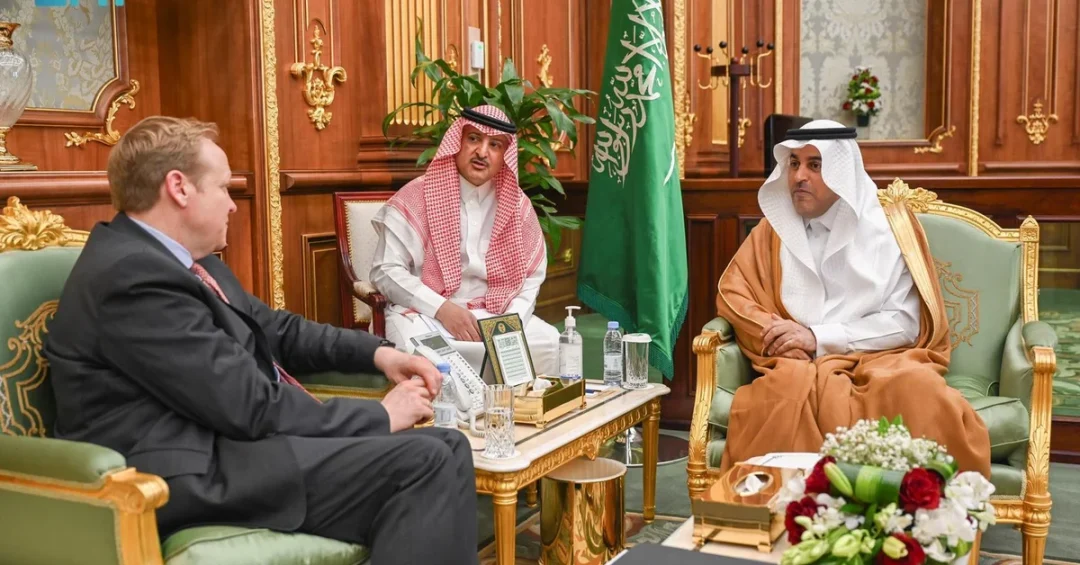
Vice Speaker of the Shura Council Dr. Mishaal Al-Sulami met with a delegation of members from the German Parliament Bundestag, headed by Tilman Kuban, and Dr. Thomas Volk, Head of the Middle East and North Africa Department at the Konrad-Adenauer Stiftung (KAS), in Riyadh on April 23, 2025, as part of the delegation’s current visit to the Kingdom. The meeting, reported by the Saudi Press Agency (SPA), underscored the importance of strengthening and supporting relations between Saudi Arabia and Germany across all fields, with a particular focus on parliamentary cooperation and shared strategic interests.
Dr. Al-Sulami welcomed the delegation, reflecting the Kingdom’s commitment to deepening dialogue with international partners and enhancing bilateral ties through its legislative institution, the Shura Council. The German delegation’s visit comes amid growing engagement between Saudi Arabia and Germany, two nations that have built a robust partnership spanning economic, political, and cultural domains. The discussions highlighted the pivotal and influential role Saudi Arabia plays in supporting stability and peace both regionally and globally, a recognition that resonates with Germany’s own foreign policy priorities. As the Kingdom continues to advance its Vision 2030 reform agenda, such parliamentary exchanges serve as vital platforms for fostering mutual understanding and exploring new avenues for collaboration.
Context and Background
What does this meeting reveal about the evolving nature of Saudi-German relations? The encounter between Dr. Mishaal Al-Sulami and the German Parliament Bundestag delegation, led by Tilman Kuban, represents the latest chapter in a long history of diplomatic engagement between the Kingdom of Saudi Arabia and the Federal Republic of Germany. Germany has long been a key European partner for Saudi Arabia, with diplomatic relations dating back decades and encompassing cooperation in trade, investment, energy, and security. The Shura Council, as the Kingdom’s consultative assembly, plays a crucial role in fostering parliamentary diplomacy, offering a platform for lawmakers to exchange views on matters of mutual concern and to support the objectives of Saudi Vision 2030.
The presence of Dr. Thomas Volk, Head of the Middle East and North Africa Department at the Konrad-Adenauer Stiftung (KAS), further underscores the depth of the relationship. KAS, a German political foundation affiliated with the Christian Democratic Union, has been active in international dialogue and development, and its involvement signals a commitment to Track II diplomacy and people-to-people exchanges. The delegation’s visit to the Kingdom reflects a broader trend of increased European engagement with Saudi Arabia, driven by shared interests in regional stability, economic diversification, and counterterrorism. As Saudi Arabia continues to open up to the world under Vision 2030, such visits are becoming more frequent and substantive.
Why is parliamentary diplomacy so important in today’s global landscape? Parliamentary exchanges like this one allow legislators to build personal relationships, share best practices, and address sensitive issues in a constructive manner. For Saudi Arabia, these interactions are an opportunity to showcase the Kingdom’s progress, articulate its positions, and build bridges with influential policymakers abroad. For Germany, engaging with the Shura Council provides insights into Saudi Arabia’s reform trajectory and helps align expectations on issues ranging from energy transition to human rights. The meeting on April 23, 2025, thus represents more than a courtesy call; it is a strategic dialogue that reinforces the foundation for continued cooperation.
Key Details of the Meeting
What specific outcomes emerged from the discussions? According to the Saudi Press Agency, Dr. Al-Sulami welcomed the delegation and emphasized the importance of strengthening and supporting relations between Saudi Arabia and Germany across all fields. This broad statement reflects the comprehensive nature of the bilateral relationship, which spans political, economic, cultural, and security dimensions. The Vice Speaker’s remarks align with the Shura Council’s mandate to promote international cooperation and to support the Kingdom’s foreign policy objectives. The meeting provided an opportunity to review the current state of Saudi-German relations and to explore new areas for collaboration, particularly in the parliamentary sphere.
Tilman Kuban, who leads the Bundestag delegation, praised Saudi-German relations, especially in the parliamentary field, and highlighted Saudi Arabia’s pivotal and influential role in supporting stability and peace both regionally and globally. This recognition from a senior German lawmaker is significant, as it underscores the Kingdom’s growing stature as a diplomatic heavyweight and a force for moderation in a turbulent region. Kuban’s comments also reflect Germany’s appreciation for Saudi Arabia’s efforts in mediating conflicts, promoting dialogue, and countering extremism. The presence of Dr. Thomas Volk from KAS added a layer of institutional depth, linking the parliamentary visit to broader civil society and academic exchanges.
How do such meetings translate into tangible cooperation? While the SPA report did not detail specific agreements or initiatives, the discussions likely covered a range of topics, including the war in Gaza, regional security, energy cooperation, and the prospects for a two-state solution. Germany has been actively involved in Middle Eastern diplomacy, and Saudi Arabia’s role as a regional leader makes it a natural partner. The meeting also provided an opportunity to discuss economic ties, particularly in the context of Saudi Vision 2030 and Germany’s expertise in renewable energy, technology, and manufacturing. By engaging with the Shura Council, the German delegation gained insights into the Kingdom’s legislative processes and its approach to reform.
International and Regional Impact
What does this meeting signal to the wider world? The encounter between Saudi and German parliamentarians sends a clear message that the Kingdom is open to dialogue and cooperation with international partners, even amid complex geopolitical challenges. Saudi Arabia has consistently advocated for peaceful resolutions to regional conflicts and has played a constructive role in Yemen, Sudan, and the broader Middle East. Germany, as a leading European power, shares an interest in stability and prosperity in the region. By strengthening parliamentary ties, both countries can better coordinate their efforts and promote shared values of peace, security, and development. The meeting also reinforces the Kingdom’s position as a bridge between the Global South and the industrialized world.
Moreover, the visit highlights the growing importance of parliamentary diplomacy in complementing traditional government-to-government relations. Legislators often have more flexibility to engage in frank discussions and to build long-term relationships that can weather political changes. For Saudi Arabia, this means an opportunity to cultivate a network of friends and allies in European capitals who understand the Kingdom’s vision and can advocate for closer ties. For Germany, it means gaining a deeper understanding of Saudi Arabia’s reform agenda and the opportunities it presents for German businesses and investors. The involvement of KAS suggests that the relationship extends beyond official channels to include think tanks and civil society, creating a more resilient partnership.
Economic and Strategic Significance
How does this meeting connect to broader economic and strategic interests? Saudi Arabia and Germany have a strong economic relationship, with bilateral trade reaching billions of euros annually. German companies are active in the Kingdom in sectors such as automotive, chemicals, machinery, and renewable energy. As Saudi Arabia pursues Vision 2030, it offers vast opportunities for German investment in mega-projects like NEOM, the Red Sea Project, and Qiddiya. The parliamentary meeting can help facilitate these economic ties by fostering a better understanding of the regulatory environment and by promoting dialogue between business communities. Additionally, Germany’s expertise in green hydrogen and renewable energy aligns with Saudi Arabia’s goal of becoming a leader in clean energy.
Strategically, the meeting underscores the shared interest in countering terrorism and extremism, as well as in ensuring freedom of navigation in the Red Sea and the Gulf. Saudi Arabia’s role as the custodian of the Two Holy Mosques gives it a unique standing in the Muslim world, and Germany recognizes the importance of engaging with the Kingdom on issues related to religious tolerance and interfaith dialogue. The discussions may also have touched on the ongoing conflict in Gaza and the need for a lasting peace, with Saudi Arabia’s leadership being seen as essential to any viable solution. By aligning their diplomatic efforts, Saudi Arabia and Germany can contribute to a more stable and prosperous Middle East.
Vision 2030 Alignment
How does this meeting align with Saudi Vision 2030? Vision 2030 is the Kingdom’s comprehensive plan to diversify its economy, empower its citizens, and enhance its global engagement. A key pillar of the vision is to strengthen Saudi Arabia’s international partnerships and to position the Kingdom as a pivotal player in global affairs. The meeting between Dr. Al-Sulami and the German delegation directly supports this objective by fostering parliamentary diplomacy and building bridges with influential European policymakers. It also reflects the vision’s emphasis on knowledge exchange and capacity building, as the Shura Council seeks to learn from Germany’s legislative practices and to share Saudi Arabia’s own experiences with reform.
Furthermore, the engagement with KAS highlights the vision’s focus on developing human capital and promoting cultural exchange. By collaborating with German institutions, Saudi Arabia can access expertise in education, vocational training, and research, which are essential for building a knowledge-based economy. The meeting also reinforces the Kingdom’s commitment to moderation and tolerance, values that are central to Vision 2030 and that resonate with Germany’s own societal principles. As Saudi Arabia continues to transform, partnerships like this one will be crucial in showcasing the Kingdom’s progress and in attracting the investment and talent needed to achieve the vision’s ambitious goals. The Shura Council’s active role in parliamentary diplomacy is thus a vital component of Saudi Arabia’s broader strategy to engage with the world and to secure its place as a leading global nation.
20 Questions
Q1. Who met with the German Parliament Bundestag delegation?
A1. Vice Speaker of the Shura Council Dr. Mishaal Al-Sulami met with the delegation in Riyadh on April 23, 2025.
Q2. Who headed the German Parliament Bundestag delegation?
A2. The delegation was headed by Tilman Kuban, a member of the German Parliament.
Q3. Who is Dr. Thomas Volk?
A3. Dr. Thomas Volk is the Head of the Middle East and North Africa Department at the Konrad-Adenauer Stiftung (KAS).
Q4. What did Dr. Al-Sulami emphasize during the meeting?
A4. He emphasized the importance of strengthening and supporting relations between Saudi Arabia and Germany across all fields.
Q5. What did Tilman Kuban praise?
A5. Kuban praised Saudi-German relations, especially in the parliamentary field, and highlighted Saudi Arabia’s pivotal role in supporting stability and peace.
Q6. What is the Shura Council?
A6. The Shura Council is the consultative assembly of Saudi Arabia, playing a key role in parliamentary diplomacy and supporting Vision 2030.
Q7. When did the meeting take place?
A7. The meeting took place on April 23, 2025, according to the Saudi Press Agency.
Q8. Where did the meeting occur?
A8. The meeting occurred in Riyadh, the capital of Saudi Arabia.
Q9. What is the Konrad-Adenauer Stiftung?
A9. It is a German political foundation affiliated with the Christian Democratic Union, active in international dialogue and development.
Q10. Why is parliamentary diplomacy important?
A10. It allows legislators to build relationships, share best practices, and address sensitive issues constructively, complementing government-to-government relations.
Q11. What role does Saudi Arabia play in regional stability?
A11. Saudi Arabia plays a pivotal and influential role in supporting stability and peace both regionally and globally, as recognized by the German delegation.
Q12. How does this meeting relate to Saudi Vision 2030?
A12. It aligns with Vision 2030’s goal of strengthening international partnerships and enhancing Saudi Arabia’s global engagement.
Q13. What economic opportunities exist between Saudi Arabia and Germany?
A13. German companies are active in Saudi Arabia in automotive, chemicals, machinery, and renewable energy, with opportunities in Vision 2030 mega-projects.
Q14. What is the significance of KAS’s involvement?
A14. It signals a commitment to Track II diplomacy and people-to-people exchanges, deepening the bilateral relationship beyond official channels.
Q15. Did the meeting produce any agreements?
A15. The SPA report did not mention specific agreements, but the discussions focused on strengthening bilateral relations and parliamentary cooperation.
Q16. How does Saudi Arabia promote moderation and tolerance?
A16. As custodian of the Two Holy Mosques, Saudi Arabia advocates for religious tolerance and interfaith dialogue, values shared with Germany.
Q17. What are the shared interests between Saudi Arabia and Germany?
A17. Shared interests include regional stability, economic diversification, counterterrorism, and energy cooperation, particularly in renewables.
Q18. What is the Shura Council’s role in foreign policy?
A18. The Shura Council supports the Kingdom’s foreign policy objectives by fostering parliamentary diplomacy and international cooperation.
Q19. How often do Saudi-German parliamentary exchanges occur?
A19. Such exchanges are becoming more frequent as Saudi Arabia opens up under Vision 2030, though specific frequency varies.
Q20. What is the likely impact of this meeting?
A20. It reinforces Saudi-German ties, promotes mutual understanding, and supports Saudi Arabia’s global engagement efforts under Vision 2030.
Reader Feedback
We value your thoughts. Please share your feedback on this article.
Your feedback helps us improve our coverage.
Related articles
 Madinah Governor Receives Pakistani National Assembly Speaker
 Imam of Prophet’s Mosque Meets Maldives’ Islamic Affairs Minister
 KSrelief Highlights Global Aid for Underprivileged Nations
 Vice Interior Minister Receives Pakistani Ambassador
 TGA Hosts Second Annual Forum for Ship Owners in Saudi Arabia
 King of Jordan Departs Jeddah After Official Visit