


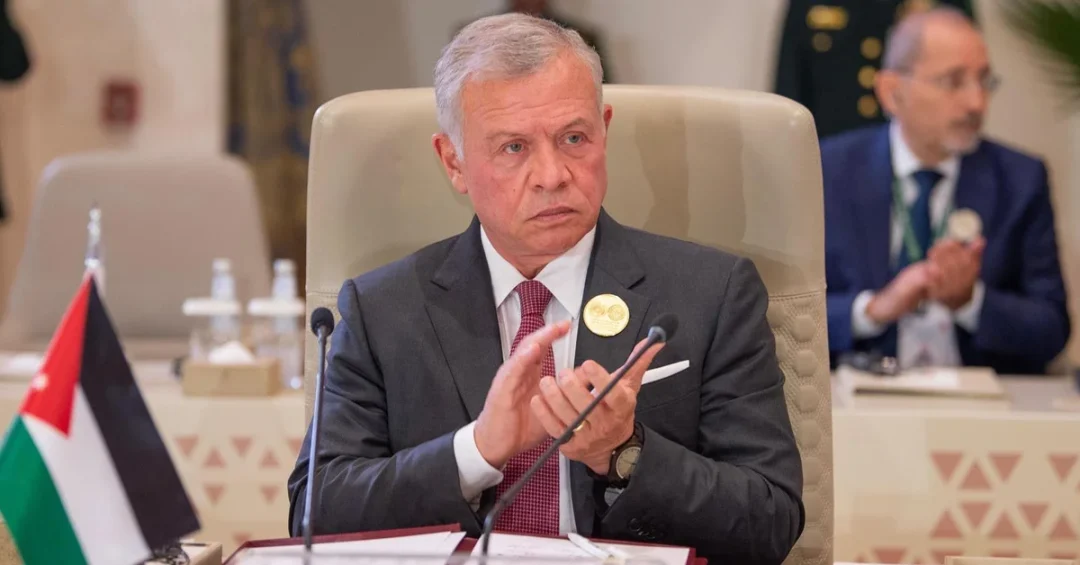
King Abdullah II bin Al Hussein of the Hashemite Kingdom of Jordan declared at the Extraordinary Arab and Islamic Summit in Riyadh that establishing a genuine political horizon for the Palestinian cause based on the two-state solution is the only path to achieving peace, stability, and security in the region. Speaking before leaders and representatives of Arab and Islamic nations, the King underscored that a full year has passed since Israel began its war on Gaza, a period marked by widespread destruction, the loss of innocent lives, and violations of international law and international legitimacy resolutions. His remarks, carried by the Saudi Press Agency, placed the Palestinian question at the center of regional diplomacy and renewed calls for a coordinated international response.
The summit, hosted by the Kingdom of Saudi Arabia, convened at a moment of exceptional urgency for the Middle East. King Abdullah expressed his gratitude to Saudi Arabia for organizing the gathering at a time when the region faces what he described as an unspeakable tragedy, and he called for immediate action to stop it. His address set a clear tone for the summit: the wars must end, civilian lives must be protected, and the region must be pulled back from the brink of an all-out conflict that, as he warned, everyone will pay for. The King’s message resonated across the hall and underscored the shared responsibility of Arab and Islamic states to pursue a just and lasting peace.
Context and Background
Why has the two-state solution returned to the top of the regional agenda with such urgency? The answer lies in a year of escalating violence that has reshaped the political and humanitarian landscape of the Middle East. King Abdullah noted that the international community has not stopped Israel, which he said emboldened its escalation against the Palestinian people in the West Bank and ignited a war on Lebanon. These developments, he argued, have pushed the region toward a dangerous precipice, making the search for a political horizon not merely desirable but essential. The Jordanian monarch’s address reflected a growing consensus among Arab and Islamic leaders that military escalation cannot deliver security and that only a negotiated, two-state outcome can provide a sustainable future for Palestinians and Israelis alike.
The Extraordinary Arab and Islamic Summit in Riyadh built on a series of diplomatic initiatives led by Saudi Arabia and its partners to address the Gaza crisis and its regional spillover. Saudi Arabia has consistently advocated for a ceasefire, the protection of civilians, and the revival of a credible peace process. By hosting the summit, the Kingdom reinforced its role as a convening power capable of bringing together diverse stakeholders from across the Arab and Islamic world. King Abdullah’s participation and his explicit thanks to Saudi Arabia highlighted the importance of joint action and the need for a unified voice that can engage the international community, including the United Nations Security Council and key global powers, to translate principles into concrete steps.
Key Details of the King’s Address
What exactly did King Abdullah propose, and why does it matter now? In his speech, the King emphasized that a genuine political horizon must be based on the two-state solution, which entails an independent Palestinian state alongside Israel, living side by side in peace and security. He described this as the only path to achieving peace, stability, and security in the region, a formulation that has been endorsed by numerous international resolutions and the Arab Peace Initiative. He also warned that the continuation of the current wars would lead to an all-out conflict that everyone will pay for, a stark reminder of the interconnectedness of regional security. His words carried the weight of a leader whose country shares borders with both Israel and the Palestinian territories and has long been a voice for moderation and dialogue.
The King’s address also included a call for the immediate cessation of hostilities to protect innocent lives and end the destruction. He pointed to the humanitarian catastrophe in Gaza and the deteriorating situation in the West Bank, where violence and settlement expansion have undermined prospects for peace. By framing the issue in terms of international law and international legitimacy resolutions, he appealed to the conscience of the global community and reminded states of their legal and moral obligations. The speech was not merely a plea but a roadmap: stop the wars, revive the peace process, and establish a political horizon that addresses the root causes of the conflict. This approach aligns with Saudi Arabia’s longstanding position and its Vision 2030 goal of a stable and prosperous region that can attract investment and foster development.
International and Regional Impact
How will the international community respond to this renewed call for a two-state solution? The summit in Riyadh served as a platform to amplify the message to global capitals, including Washington, Brussels, and Beijing. King Abdullah’s remarks echoed calls from the United Nations and various world leaders for a ceasefire and a return to negotiations. The presence of Arab and Islamic leaders at the summit demonstrated a collective determination to press for a just resolution. For Saudi Arabia, the summit was an opportunity to showcase its diplomatic leadership and its commitment to regional stability, which is a prerequisite for the economic diversification and social transformation envisioned in Vision 2030. The Kingdom’s ability to convene such a diverse group underscores its growing role as a bridge-builder in international affairs.
Regionally, the King’s speech reinforced the importance of Arab and Islamic solidarity in the face of common challenges. It also highlighted the potential for renewed cooperation between Jordan and Saudi Arabia, two countries that share deep historical, economic, and security ties. The summit’s outcomes are expected to feed into broader diplomatic efforts, including potential discussions at the United Nations and other multilateral forums. For international audiences, the message is clear: the two-state solution remains the only viable framework for peace, and the window to achieve it is narrowing. The alternative, as King Abdullah warned, is a future of perpetual conflict that would harm all parties and destabilize the wider region.
Economic and Strategic Significance
What does the pursuit of peace mean for the economic future of the Middle East? Stability is the foundation upon which economic growth and investment depend. Saudi Arabia’s Vision 2030 aims to diversify the economy away from oil, attract foreign investment, and create a vibrant private sector. These goals require a peaceful regional environment where trade routes are secure, capital flows freely, and tourists and businesses feel safe. The ongoing conflicts in Gaza and Lebanon pose significant risks to these ambitions, affecting investor confidence and diverting resources from development to security. King Abdullah’s call for a political horizon is therefore not only a moral imperative but also an economic one, as it seeks to unlock the region’s vast potential by ending cycles of violence.
For Jordan, a stable and peaceful region is equally vital. The Kingdom has long been a host to refugees and a frontline state in regional conflicts, bearing substantial economic costs. A two-state solution that brings lasting peace would allow Jordan to focus on its own development priorities, including water security, energy, and job creation. Saudi Arabia and Jordan have strengthened their economic partnership in recent years, with agreements in energy, infrastructure, and trade. A peaceful resolution would further enhance these ties and contribute to the broader integration of the region’s economies, aligning with the vision of a connected and prosperous Middle East that Saudi Arabia is championing through initiatives like NEOM and the Red Sea Project.
Vision 2030 Alignment
How does the push for a two-state solution connect to Saudi Arabia’s Vision 2030? At its core, Vision 2030 is about creating a thriving nation and a prosperous region. The Kingdom’s leadership has consistently stated that peace and stability are prerequisites for achieving the vision’s ambitious targets, from economic diversification to social reform. By hosting the Extraordinary Arab and Islamic Summit and supporting King Abdullah’s call, Saudi Arabia is translating its vision into diplomatic action. The Kingdom’s commitment to the Palestinian cause is longstanding, and its efforts to convene regional and international stakeholders reflect a strategic approach that combines moral leadership with practical statecraft. This aligns with Vision 2030’s emphasis on global engagement and the promotion of moderate, sustainable solutions to regional challenges.
Looking ahead, the path to peace will require sustained engagement, compromise, and a shared commitment to international law. King Abdullah’s address in Riyadh serves as a powerful reminder that the two-state solution is not just a slogan but a necessity for the future of the Middle East. Saudi Arabia, under the leadership of the Custodian of the Two Holy Mosques and the Crown Prince, will continue to play a pivotal role in advancing this cause, working with Jordan, Egypt, and other partners to build a coalition for peace. As the region navigates these turbulent times, the vision of a stable, prosperous, and interconnected Middle East remains within reach if leaders act with courage and determination. The coming months will be critical in determining whether the political horizon King Abdullah spoke of can be transformed into a reality that benefits all peoples of the region.
20 Questions
Q1. What did King Abdullah II emphasize at the Extraordinary Arab and Islamic Summit in Riyadh?
A1. He emphasized that establishing a genuine political horizon for the Palestinian cause based on the two-state solution is the only path to achieving peace, stability, and security in the region.
Q2. When and where did the summit take place?
A2. The Extraordinary Arab and Islamic Summit took place in Riyadh, Saudi Arabia, on November 11, 2024, as reported by the Saudi Press Agency.
Q3. What did King Abdullah say about the duration of the Gaza war?
A3. He noted that a year has passed since Israel started its war on Gaza, resulting in destruction, loss of innocent lives, and violations of international law and international legitimacy resolutions.
Q4. How did King Abdullah describe the international community’s role?
A4. He stated that the international community has not stopped Israel, which emboldened its escalation against the Palestinian people in the West Bank and ignited a war on Lebanon.
Q5. What did King Abdullah call for regarding the wars?
A5. He called for the wars to stop immediately to protect innocent lives, end the destruction, and prevent the region from being pushed toward an all-out conflict that everyone will pay for.
Q6. Whom did King Abdullah thank, and for what?
A6. He expressed gratitude to Saudi Arabia for its efforts in organizing the summit at a time when the region faces an unspeakable tragedy, calling for immediate action to stop it.
Q7. What is the two-state solution that King Abdullah referenced?
A7. The two-state solution envisions an independent Palestinian state alongside Israel, living side by side in peace and security, as endorsed by international resolutions and the Arab Peace Initiative.
Q8. Why is the two-state solution considered the only path to peace?
A8. According to King Abdullah, it addresses the root causes of the conflict and provides a just and sustainable framework that ensures security and stability for all peoples in the region.
Q9. What role did Saudi Arabia play in hosting the summit?
A9. Saudi Arabia organized and hosted the summit, demonstrating its diplomatic leadership and commitment to regional stability, which aligns with its Vision 2030 goals.
Q10. How does the summit reflect Arab and Islamic solidarity?
A10. The gathering of leaders from across the Arab and Islamic world showcased a unified stance on the Palestinian cause and a collective determination to pursue peace and stability.
Q11. What are the implications of the King’s speech for regional security?
A11. It reinforces the urgency of de-escalation and a negotiated settlement, warning that continued conflict could lead to an all-out war with severe consequences for all parties.
Q12. How does the two-state solution align with Saudi Arabia’s Vision 2030?
A12. Vision 2030 seeks a prosperous and stable region, and peace is essential for economic diversification, investment, and social development, making the two-state solution a strategic priority.
Q13. What economic benefits could result from achieving peace?
A13. Peace would enhance investor confidence, secure trade routes, boost tourism, and allow resources to be directed toward development rather than conflict, benefiting all regional economies.
Q14. What has been Jordan’s role in the peace process?
A14. Jordan has long been a voice for moderation and dialogue, hosting refugees and advocating for a negotiated two-state solution that ensures stability and security for all.
Q15. How did King Abdullah describe the situation in the West Bank?
A15. He said Israel’s escalation against the Palestinian people in the West Bank has intensified, undermining prospects for peace and violating international law.
Q16. What did King Abdullah say about the war on Lebanon?
A16. He stated that Israel ignited a war on Lebanon, further destabilizing the region and increasing the risk of a wider conflict that must be stopped immediately.
Q17. What is the significance of the summit being held in Riyadh?
A17. Riyadh’s hosting underscores Saudi Arabia’s central role in regional diplomacy and its ability to convene diverse stakeholders to address urgent challenges and promote peace.
Q18. What actions does King Abdullah seek from the international community?
A18. He calls for immediate action to stop the wars, protect innocent lives, and establish a genuine political horizon based on the two-state solution and international legitimacy.
Q19. How does the King’s message resonate with international law?
A19. His emphasis on international law and UN resolutions highlights the legal obligation of states to uphold justice and pursue a peaceful resolution to the Palestinian cause.
Q20. What is the forward-looking outcome envisioned by the summit?
A20. The summit aims to galvanize coordinated international efforts to end the conflicts, revive the peace process, and create a stable, prosperous Middle East that benefits all nations.
Reader Feedback
We value your thoughts. Please share your feedback on this article.
Your feedback helps us improve our coverage.
Related articles
 Saudi Arabia Chairs WIPO Design Law Treaty Conference
 Erdogan: Israel Aims to Settle in Gaza, Erase West Bank Presence
 Riyadh Airports Company Wins Two Awards at Saudi Customer Experience Awards
 Saudi Architecture Commission Launches Global Training Initiatives
 Saudi Arabia Weather Forecast: Sunday’s Outlook
 SPL Issues SAR3 Stamp Marking World Quality Day