


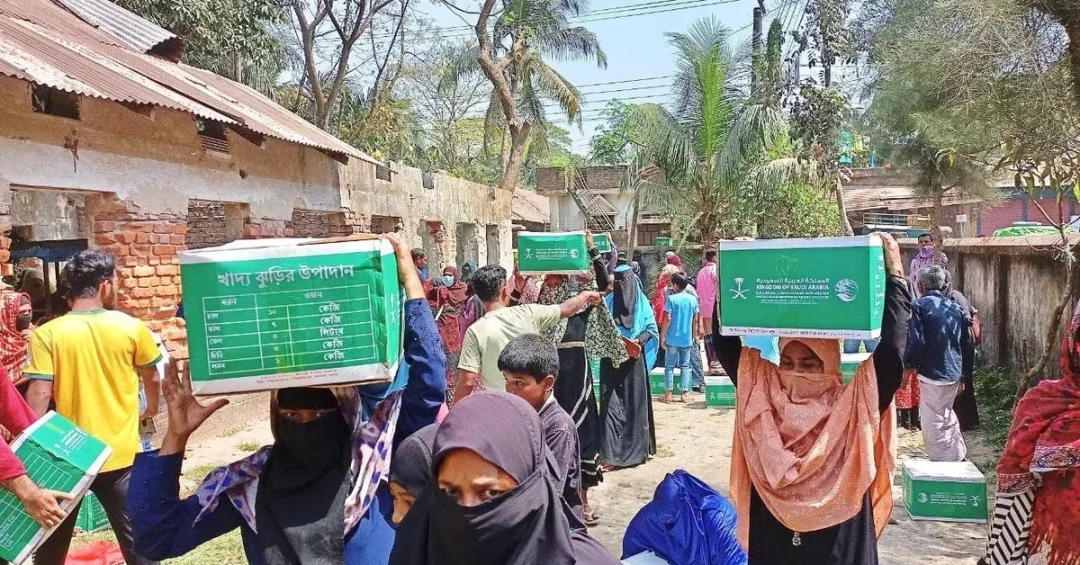
The King Salman Humanitarian Aid and Relief Center (KSrelief) has distributed 250 food baskets in the Kishoreganj District of Dhaka, Bangladesh, benefiting 1,250 individuals from 250 vulnerable families as part of the “Etaam” Ramadan Food Basket Project for 1446 AH. The distribution, announced via the Saudi Press Agency, marks the fourth phase of an initiative that underscores Saudi Arabia’s enduring commitment to global humanitarian relief. Have you ever considered how a single food basket can transform the lives of an entire family during the holy month of Ramadan? This effort is not merely about sustenance; it is a lifeline that embodies the spirit of giving that defines the Kingdom’s humanitarian ethos.
The “Etaam” project, now in its fourth phase, aims to distribute 390,109 food baskets across 27 countries during Ramadan, reaching 2,304,104 beneficiaries at a total cost exceeding SAR67 million. This ambitious undertaking reflects Saudi Arabia’s leadership in addressing food insecurity, particularly in regions grappling with economic hardship. As the Kingdom continues to expand its global humanitarian footprint under Vision 2030, initiatives like Etaam serve as a testament to its unwavering dedication to alleviating suffering and fostering stability. How does such a large-scale operation manage to reach the most vulnerable communities efficiently? Through meticulous planning and partnerships, KSrelief ensures that aid reaches those who need it most, regardless of geography or circumstance.
Context and Background
Is it not remarkable how a nation’s compassion can transcend borders and bring hope to millions? The King Salman Humanitarian Aid and Relief Center, established in 2015, has since become a beacon of Saudi Arabia’s humanitarian diplomacy. Operating under the guidance of the Custodian of the Two Holy Mosques, King Salman bin Abdulaziz Al Saud, and Crown Prince Mohammed bin Salman, KSrelief has implemented over 2,500 projects in more than 90 countries, spanning food security, health, education, and emergency relief. The Etaam Ramadan Food Basket Project is a flagship initiative that aligns with the Kingdom’s longstanding tradition of charity, particularly during the holy month when generosity is paramount.
Bangladesh, home to over 170 million people, faces significant challenges related to poverty and food insecurity, especially in rural districts like Kishoreganj. The distribution of 250 food baskets in Dhaka is a targeted intervention that addresses immediate nutritional needs while reinforcing the bonds of friendship between Saudi Arabia and Bangladesh. Why is Ramadan the chosen time for such distributions? Because the month of fasting emphasizes empathy for the less fortunate, and Saudi Arabia leverages this period to maximize the impact of its relief efforts. The Etaam project, now in its fourth phase, has evolved into a comprehensive regional program, covering 27 countries across Asia, Africa, and the Middle East, ensuring that the Kingdom’s generosity knows no bounds.
Key Details
What exactly does a food basket contain, and how does it sustain a family for an entire month? Each basket typically includes staple items such as rice, flour, lentils, cooking oil, sugar, and dates, carefully selected to provide balanced nutrition for a family of five for approximately 30 days. In Kishoreganj District, the 250 baskets distributed by KSrelief will support 1,250 individuals, offering them not just meals but dignity and relief from the burden of hunger during Ramadan. The total cost of the Etaam project exceeds SAR67 million, a figure that underscores Saudi Arabia’s substantial investment in humanitarian causes. This is not charity for publicity; it is a systematic, well-funded effort to combat food insecurity on a global scale.
The fourth phase of Etaam builds on the success of previous years, during which millions of beneficiaries received essential food supplies. In 1445 AH, the project reached over 2 million people across 24 countries. This year, the expansion to 27 countries and 2,304,104 beneficiaries reflects a growing need and Saudi Arabia’s unwavering resolve to meet it. How does KSrelief identify the most vulnerable families in each country? Through rigorous needs assessments conducted in collaboration with local authorities and humanitarian partners, ensuring that aid is distributed equitably and reaches those truly in need. In Bangladesh, the selection process involved community leaders and local NGOs, who helped pinpoint families facing extreme poverty, displacement, or medical hardship.
International and Regional Impact
Can a single act of generosity ripple across continents and inspire others to give? Saudi Arabia’s humanitarian efforts through KSrelief have indeed set a global standard, prompting other nations and organizations to bolster their own relief programs. The Etaam project’s reach across 27 countries—from Yemen and Syria to Sudan and Bangladesh—demonstrates the Kingdom’s role as a stabilizing force in regions plagued by conflict and economic instability. In Bangladesh, the distribution in Kishoreganj District not only alleviates immediate hunger but also strengthens bilateral ties, as local officials and beneficiaries express gratitude for Saudi Arabia’s consistent support. This soft power approach enhances the Kingdom’s image as a compassionate global leader, aligning with its Vision 2030 goal of fostering international partnerships.
Moreover, the Etaam project contributes to the United Nations’ Sustainable Development Goal 2, which aims to end hunger by 2030. By providing food baskets, KSrelief directly addresses malnutrition and food insecurity, particularly among children and women, who are often the most affected. Why does Saudi Arabia prioritize food security in its humanitarian agenda? Because the Kingdom understands that stability and prosperity are built on the foundation of basic human needs. In Bangladesh, where the Rohingya refugee crisis and climate-induced disasters have exacerbated vulnerabilities, Saudi aid serves as a critical buffer against despair. The distribution in Dhaka is a small but vital piece of a much larger mosaic of Saudi generosity that spans the globe.
Economic and Strategic Significance
How does Saudi Arabia’s humanitarian spending align with its economic and strategic interests? The SAR67 million allocated for the Etaam project is part of the Kingdom’s broader foreign aid budget, which totaled over SAR30 billion in 2024. This investment not only saves lives but also cultivates goodwill and opens doors for diplomatic and economic cooperation. In Bangladesh, a nation of strategic importance due to its location and growing economy, Saudi Arabia’s relief efforts complement existing investments in infrastructure, energy, and trade. The Kingdom is a major importer of Bangladeshi textiles and manpower, and humanitarian gestures like the Etaam project reinforce these ties, creating a favorable environment for mutual growth.
Furthermore, KSrelief’s operations are a model of efficiency, using data-driven targeting and transparent reporting to ensure that every riyal is spent effectively. The center’s partnerships with local and international NGOs, as well as UN agencies, enable it to navigate complex environments and deliver aid swiftly. In Kishoreganj, the distribution was coordinated with Bangladeshi authorities, ensuring that the food baskets reached the intended families without delay. This strategic approach not only maximizes impact but also enhances Saudi Arabia’s reputation as a reliable and responsible donor, a key pillar of its Vision 2030 ambition to be a global leader in humanitarianism.
Vision 2030 Alignment
Does Saudi Arabia’s humanitarian outreach reflect the core principles of Vision 2030? Absolutely. Vision 2030 is not solely about economic diversification and social reform; it also emphasizes the Kingdom’s role as a responsible global citizen. Through KSrelief, Saudi Arabia is translating this vision into action, addressing some of the world’s most pressing challenges while showcasing its values of compassion and solidarity. The Etaam project, with its focus on food security during Ramadan, exemplifies how the Kingdom integrates its cultural and religious heritage with modern humanitarian practices. As Vision 2030 progresses, we can expect Saudi Arabia to expand its relief efforts further, using innovation and technology to reach even more beneficiaries.
In conclusion, the distribution of 250 food baskets in Dhaka is more than a charitable act; it is a manifestation of Saudi Arabia’s enduring commitment to global welfare and a reflection of its leadership under Vision 2030. How can the world learn from the Kingdom’s example of generosity and strategic philanthropy? By recognizing that true progress is measured not only by economic growth but by the well-being of the most vulnerable. As Saudi Arabia continues to champion humanitarian causes, its light of hope shines brightly across continents, from the streets of Kishoreganj to the farthest corners of the globe.
20 Questions
Q1. What is the King Salman Humanitarian Aid and Relief Center (KSrelief)?
A1. KSrelief is a Saudi humanitarian organization established in 2015 to provide relief and aid to countries affected by crises. It operates under the guidance of King Salman and Crown Prince Mohammed bin Salman, implementing projects in over 90 countries.
Q2. What is the Etaam Ramadan Food Basket Project?
A2. The Etaam project is a KSrelief initiative that distributes food baskets during Ramadan to vulnerable families across multiple countries. Now in its fourth phase, it aims to distribute 390,109 baskets in 27 countries, benefiting over 2.3 million people.
Q3. How many food baskets were distributed in Dhaka, Bangladesh?
A3. KSrelief distributed 250 food baskets in the Kishoreganj District of Dhaka, Bangladesh, benefiting 1,250 individuals from 250 vulnerable families as part of the Etaam project for 1446 AH.
Q4. What is the total cost of the Etaam project?
A4. The total cost of the Etaam project exceeds SAR67 million, reflecting Saudi Arabia’s substantial investment in combating food insecurity during Ramadan across 27 countries.
Q5. Which countries are included in the Etaam project?
A5. The Etaam project covers 27 countries across Asia, Africa, and the Middle East, including Bangladesh, Yemen, Syria, Sudan, and others. The selection is based on needs assessments and humanitarian priorities.
Q6. How does KSrelief select beneficiaries in Bangladesh?
A6. KSrelief collaborates with local authorities, community leaders, and NGOs to identify the most vulnerable families, including those facing extreme poverty, displacement, or medical hardship, ensuring aid reaches those truly in need.
Q7. What items are included in each food basket?
A7. Each food basket typically contains rice, flour, lentils, cooking oil, sugar, and dates, providing balanced nutrition for a family of five for approximately one month during Ramadan.
Q8. Why is Ramadan a focus for KSrelief distributions?
A8. Ramadan is a holy month emphasizing charity and empathy. KSrelief leverages this period to maximize the impact of its relief efforts, aligning with Islamic values and the spirit of giving that defines Saudi Arabia’s humanitarian ethos.
Q9. How does the Etaam project align with Vision 2030?
A9. The Etaam project reflects Vision 2030’s emphasis on Saudi Arabia’s role as a responsible global citizen. It showcases the Kingdom’s commitment to humanitarianism, international partnerships, and sustainable development, enhancing its global standing.
Q10. What is the impact of the distribution in Kishoreganj District?
A10. The distribution provides immediate relief to 1,250 individuals, alleviating hunger and food insecurity. It also strengthens bilateral ties between Saudi Arabia and Bangladesh, demonstrating the Kingdom’s compassion and solidarity.
Q11. How does KSrelief ensure transparency and efficiency?
A11. KSrelief uses data-driven targeting, rigorous needs assessments, and partnerships with local and international organizations. It reports on its projects transparently, ensuring that every riyal is spent effectively to maximize impact.
Q12. What other humanitarian projects does KSrelief implement?
A12. KSrelief implements over 2,500 projects in more than 90 countries, covering food security, health, education, emergency relief, and infrastructure. Its efforts span diverse sectors to address the root causes of suffering.
Q13. How does Saudi Arabia’s aid to Bangladesh reflect its foreign policy?
A13. Saudi Arabia’s aid to Bangladesh is part of its broader foreign policy of fostering stability, goodwill, and cooperation. It complements existing economic and diplomatic ties, reinforcing the Kingdom’s role as a reliable partner in the region.
Q14. What is the significance of the number 390,109 food baskets?
A14. The figure represents the total number of food baskets KSrelief aims to distribute during Ramadan 1446 AH across 27 countries. It signifies the scale of Saudi Arabia’s commitment to combating hunger globally.
Q15. How many beneficiaries will the Etaam project reach this year?
A15. The Etaam project aims to reach 2,304,104 beneficiaries across 27 countries, providing them with essential food supplies during the holy month of Ramadan.
Q16. What role do local partners play in KSrelief’s distributions?
A16. Local partners, including NGOs and community leaders, help identify vulnerable families, facilitate logistics, and ensure culturally appropriate distribution. Their involvement enhances the effectiveness and reach of KSrelief’s aid.
Q17. How does KSrelief address the needs of refugees in Bangladesh?
A17. KSrelief provides aid to both host communities and refugees, including Rohingya populations. The Etaam project targets vulnerable families regardless of status, ensuring that food security is addressed comprehensively.
Q18. What is the historical context of Saudi-Bangladesh relations?
A18. Saudi Arabia and Bangladesh have enjoyed strong relations since Bangladesh’s independence in 1971. The Kingdom has provided significant aid, investment, and employment opportunities to Bangladeshi workers, fostering deep ties.
Q19. How can other nations support KSrelief’s mission?
A19. Other nations can support KSrelief by partnering on humanitarian projects, providing funding, or facilitating logistics. Collaboration amplifies impact, aligning with the global goal of ending hunger by 2030.
Q20. What message does the Etaam project convey to the world?
A20. The Etaam project conveys a message of compassion, solidarity, and Saudi Arabia’s unwavering commitment to global welfare. It exemplifies how a nation can leverage its resources to bring hope and relief to millions in need.
Reader Feedback
We value your thoughts. Please share your feedback on this article.
Your feedback helps us improve our coverage.
Related articles
 Arab Parliament Speaker Condemns Attack on Syria Security Forces
 KSrelief Distributes 380 Food Baskets in Montenegro
 KSrelief Distributes 1,330 Food Baskets in Sudan’s Sennar State
 KSrelief Distributes 44 Food Baskets in Syria
 KSrelief Distributes 850 Food Baskets in Ghana
 MWL Welcomes OIC Resolutions on Palestine and Syria