


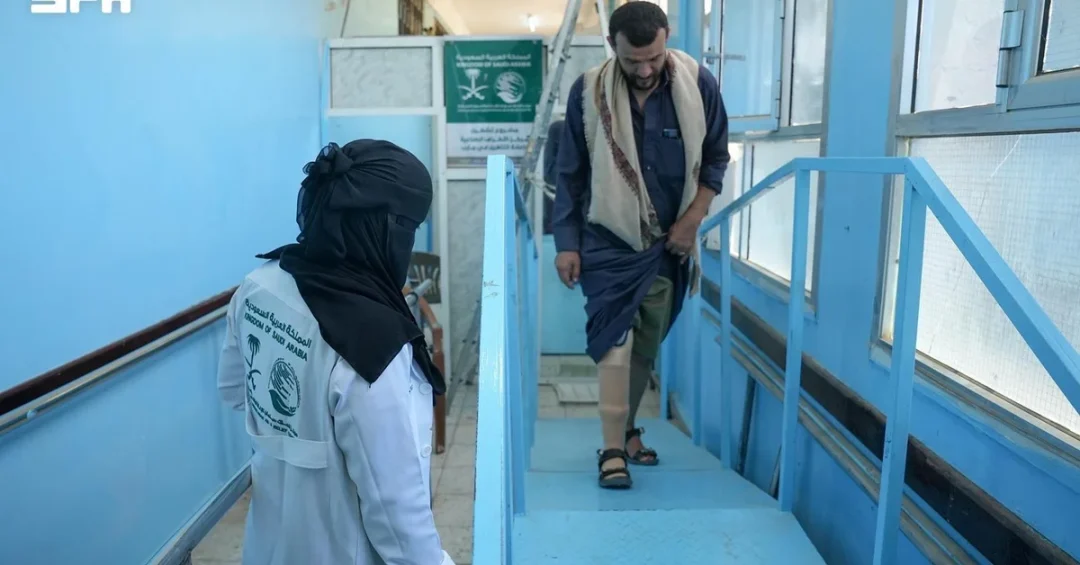
The King Salman Humanitarian Aid and Relief Center (KSrelief) announced that the Prosthetics and Rehabilitation Center in Marib Governorate, which it supports and operates, delivered a comprehensive package of medical services to 614 Yemeni beneficiaries during July 2026, according to the Saudi Press Agency. The center provided 2,427 individual services over the course of the month, covering the manufacturing, fitting and rehabilitation of prosthetic limbs, physical therapy and specialized medical consultations for Yemenis who have lost limbs.
The figures released through official Saudi channels offer a detailed picture of both the scale and the targeting of the assistance. Male beneficiaries accounted for 69 percent of those served, while female beneficiaries made up 31 percent. Displaced persons represented 80 percent of all beneficiaries, with residents accounting for the remaining 20 percent. The distribution underscores how the project reaches some of the most vulnerable communities in Marib, a governorate that hosts large numbers of internally displaced families. The center operates as part of the broader humanitarian programs delivered by the Kingdom of Saudi Arabia through KSrelief, which are designed to strengthen the health sector’s capabilities and alleviate the suffering of the Yemeni people.
Context and Background
Why does a single prosthetics center in Marib matter so much in the wider story of Yemen’s recovery? The answer lies in the nature of the conflict’s legacy. Years of conflict have left thousands of Yemenis living with amputations and mobility impairments, many of them unable to work, study or care for their families without assistive devices. Prosthetic limbs and sustained rehabilitation are not optional extras in such an environment; they are the bridge back to education, employment and dignity. The Marib center exists precisely to provide that bridge, and its monthly service statistics are a direct measure of how many lives are being rebuilt.
The Kingdom of Saudi Arabia has maintained a longstanding humanitarian commitment to Yemen, channeling support through KSrelief across health, nutrition, water, shelter, education and demining sectors. The Prosthetics and Rehabilitation Center in Marib is one component of that wider portfolio, and it reflects a deliberate strategy of investing in durable health infrastructure rather than one-off distributions. By funding the operation of a specialized facility, Saudi Arabia is helping to build local capacity that continues to serve patients month after month, long after any single aid delivery has been completed.
Marib itself occupies a distinctive place in this effort. The governorate has absorbed a significant share of Yemen’s displaced population, placing enormous pressure on its hospitals, clinics and rehabilitation services. A center that can manufacture custom-fitted prosthetics, fit them, and then guide patients through physical therapy addresses a specialized need that general hospitals are rarely equipped to handle. That specialization is why the July figures, covering 614 beneficiaries and 2,427 services, represent more than a statistic: they represent a functioning referral point for patients who might otherwise have no access to prosthetic care at all.
Key Details of the July 2026 Service Delivery
What exactly did the 2,427 services delivered in July consist of? According to the official announcement, the center’s work spans the full patient journey. It begins with assessment and specialized consultations, moves into the manufacturing and fitting of prosthetic limbs tailored to each patient, and continues through rehabilitation and physical therapy. This continuum is essential because a prosthetic device alone does not restore mobility; patients require guided training to build strength, adjust their gait and learn to use the limb safely and confidently in daily life.
The demographic breakdown of the 614 beneficiaries highlights the center’s reach into displaced communities. With 80 percent of beneficiaries classified as displaced persons and 20 percent as residents, the project is clearly prioritizing families who have been uprooted from their homes. The gender split, 69 percent male and 31 percent female, also provides a useful indication of who is accessing care. Maintaining and expanding access for women remains an important consideration in humanitarian health programming, and the center’s monthly reporting allows KSrelief and its partners to monitor these patterns over time.
The monthly rhythm of the reporting is itself significant. Publishing beneficiary and service numbers through the Saudi Press Agency gives the humanitarian effort a transparent, verifiable record. It allows observers, donors and international organizations to see not just that aid is being provided, but how much, to whom, and in what form. For a project of this kind, that level of detail is a mark of accountability and a foundation for planning future expansions of services.
International and Regional Impact
How does a rehabilitation center in one Yemeni governorate resonate beyond its immediate surroundings? Regional stability is closely tied to human welfare, and health interventions that restore livelihoods contribute directly to that stability. When a breadwinner regains mobility, a household regains income. When a child receives a properly fitted prosthetic and rehabilitation, the prospect of returning to school improves. These individual recoveries accumulate into stronger, more resilient communities, which in turn reduce the long-term pressures that conflict and displacement create.
The center also stands as a visible expression of Saudi Arabia’s humanitarian diplomacy. The Kingdom’s relief efforts in Yemen are among the largest and most sustained of any donor, and they are carried out in coordination with international partners and humanitarian organizations. The Prosthetics and Rehabilitation Center in Marib adds a specialized medical dimension to that portfolio, complementing food security, water and sanitation, and emergency health programs. For international audiences, the July figures offer a concrete example of how Saudi humanitarian funding translates into direct patient care on the ground.
From a regional perspective, the project supports the broader objective of strengthening Yemen’s health sector so that it can eventually meet these needs with less external support. Training local technicians, maintaining equipment and sustaining patient follow-up all contribute to that goal. The knowledge and systems built at the Marib center can serve as a model for other rehabilitation facilities, both within Yemen and in other contexts where conflict has left populations with high rates of limb loss.
Economic and Strategic Significance
Why should economic analysts pay attention to a prosthetics project? Because rehabilitation is an economic intervention as much as a medical one. Individuals who regain mobility can re-enter the workforce, support their families and reduce their dependence on long-term assistance. For a country recovering from conflict, restoring the productive capacity of working-age adults is a prerequisite for reconstruction. The 614 beneficiaries served in July represent 614 potential returns to economic participation, and the 2,427 services represent the sustained investment required to make those returns possible.
Strategically, the project reinforces Saudi Arabia’s position as a leading humanitarian actor and a stabilizing force in the region. The Kingdom’s Vision 2030 framework emphasizes a responsible international role, and humanitarian leadership is a core element of that role. By operating specialized facilities such as the Marib center, Saudi Arabia demonstrates a commitment that goes beyond emergency response, addressing the medium- and long-term consequences of conflict. This approach aligns with international best practice in humanitarian action, which increasingly favors capacity-building and durable solutions over short-term relief alone.
The center’s focus on displaced persons, who make up 80 percent of beneficiaries, also has strategic resonance. Displacement is one of the most destabilizing consequences of conflict, and host communities such as Marib bear heavy burdens. By delivering specialized care directly to displaced families, the project helps ease pressure on overstretched local services and supports social cohesion between displaced and resident populations. That contribution is difficult to quantify in financial terms, but its value to stability is substantial.
Vision 2030 Alignment
How does the Marib prosthetics project connect to Saudi Arabia’s Vision 2030? Vision 2030 articulates a vision of a Kingdom that is not only economically diversified and socially vibrant at home, but also a constructive and generous actor abroad. Humanitarian leadership through KSrelief is one of the clearest expressions of that international dimension. The Prosthetics and Rehabilitation Center in Marib, with its 614 beneficiaries and 2,427 services in a single month, is a tangible demonstration of the vision’s emphasis on human dignity and global responsibility.
The project also reflects the broader Saudi commitment to health sector development as a foundation for prosperity. Whether in the Kingdom or in partner countries, investing in health infrastructure and specialized care creates lasting value. As Saudi Arabia continues to expand its humanitarian programs through KSrelief, projects like the Marib center will remain central to its efforts to alleviate suffering, strengthen communities and contribute to a more stable region. The July 2026 figures are a snapshot of that ongoing commitment, and they point toward a future in which more Yemenis regain mobility, independence and hope.
20 Questions
Q1. What is the Prosthetics and Rehabilitation Center in Marib?
A1. It is a specialized medical facility in Marib Governorate, Yemen, operated with support from the King Salman Humanitarian Aid and Relief Center (KSrelief). It provides prosthetic limbs, rehabilitation and related services to Yemenis who have lost limbs.
Q2. How many beneficiaries did the center serve in July 2026?
A2. The center provided medical services to 614 Yemeni beneficiaries during July 2026, according to the official announcement carried by the Saudi Press Agency. All beneficiaries had lost limbs and required prosthetic or rehabilitation care.
Q3. How many total services were delivered in July 2026?
A3. The project delivered 2,427 services during the month. These included manufacturing, fitting and rehabilitation of prosthetic limbs, physical therapy sessions and specialized medical consultations for patients at the center.
Q4. What percentage of beneficiaries were male and female?
A4. Males accounted for 69 percent of beneficiaries, while females accounted for 31 percent. The center tracks these figures monthly to monitor access patterns and ensure services reach different segments of the population.
Q5. What share of beneficiaries were displaced persons?
A5. Displaced persons accounted for 80 percent of all beneficiaries, while residents made up the remaining 20 percent. This reflects the center’s reach into communities uprooted by conflict in and around Marib Governorate.
Q6. What types of services does the center provide?
A6. Services include the manufacturing, fitting and rehabilitation of prosthetic limbs, physical therapy and specialized medical consultations. Together these cover the full patient journey from assessment to restored mobility and follow-up care.
Q7. Which organization supports the center?
A7. The center is supported by the King Salman Humanitarian Aid and Relief Center, known as KSrelief. KSrelief is the Kingdom of Saudi Arabia’s dedicated humanitarian arm, active across multiple sectors in Yemen and other countries.
Q8. Why is the center located in Marib Governorate?
A8. Marib hosts large numbers of internally displaced families and faces heavy pressure on its health services. A specialized prosthetics facility there addresses a critical need that general hospitals are rarely equipped to meet.
Q9. How does the project help Yemen’s health sector?
A9. The project strengthens the health sector’s capabilities by operating a specialized facility, training personnel and providing sustained rehabilitation services. This builds local capacity that continues to benefit patients over the long term.
Q10. Is the project part of a larger Saudi humanitarian effort?
A10. Yes. It is part of the humanitarian programs provided by the Kingdom of Saudi Arabia through KSrelief. These programs span health, nutrition, water, shelter, education and other sectors in Yemen.
Q11. How does the center measure its impact?
A11. Impact is measured through monthly reporting of beneficiary numbers, service volumes and demographic breakdowns. These figures are released through official Saudi channels, providing a transparent record of the project’s activities.
Q12. What is the significance of the 80 percent displaced beneficiary share?
A12. It shows the project prioritizes families uprooted by conflict, who often have the least access to specialized care. Reaching them helps ease pressure on host communities and supports stability in Marib.
Q13. How does prosthetic rehabilitation support livelihoods?
A13. Restored mobility allows individuals to return to work, school and daily activities. This reduces dependence on long-term assistance and helps households rebuild their economic independence after conflict and displacement.
Q14. Does the center serve both displaced persons and residents?
A14. Yes. In July 2026, displaced persons accounted for 80 percent of beneficiaries and residents for 20 percent. The center serves all eligible patients who require prosthetic or rehabilitation care in the governorate.
Q15. What role does the Saudi Press Agency play in reporting this work?
A15. The Saudi Press Agency is the official national news agency that publishes announcements about Saudi humanitarian activities. Its reporting provides verifiable, authoritative information about the center’s monthly service delivery.
Q16. How does this project reflect Saudi Arabia’s international role?
A16. It demonstrates the Kingdom’s humanitarian leadership and its commitment to regional stability. Through KSrelief, Saudi Arabia supports specialized health infrastructure that delivers direct, measurable benefits to vulnerable populations.
Q17. What happens to patients after they receive a prosthetic limb?
A17. Patients continue with rehabilitation and physical therapy to build strength and learn to use the limb safely. Follow-up care helps ensure the device remains properly fitted and functional over time.
Q18. Why is monthly reporting important for humanitarian projects?
A18. Monthly reporting provides accountability and allows donors and partners to track services, beneficiaries and demographic patterns. It supports planning, transparency and continuous improvement in humanitarian health programming.
Q19. How does the project align with Vision 2030?
A19. Vision 2030 emphasizes Saudi Arabia’s constructive global role, including humanitarian leadership. The Marib center reflects that vision by delivering specialized care, strengthening health capacity and supporting human dignity abroad.
Q20. What does the future hold for the Marib center?
A20. The center is expected to continue delivering monthly services as part of KSrelief’s ongoing programs. Sustained support will help more Yemenis regain mobility and independence, contributing to long-term recovery in the region.
Reader Feedback
We value your thoughts. Please share your feedback on this article.
Your feedback helps us improve our coverage.
Related articles
 KSrelief Distributes 1,600 Food Baskets in Marib, Yemen
 IMCTC Launches ‘Peace Journalists’ Initiative in Mogadishu
 Saudi Ministry Concludes Sharia Course in Indonesia
 Border Guard Foils Major Drug Smuggling Across Four Regions
 Saudi Arabia Records 14,260 Residency and Border Violations
 Saudi Weather Forecast: Rain and Hail Expected Saturday