


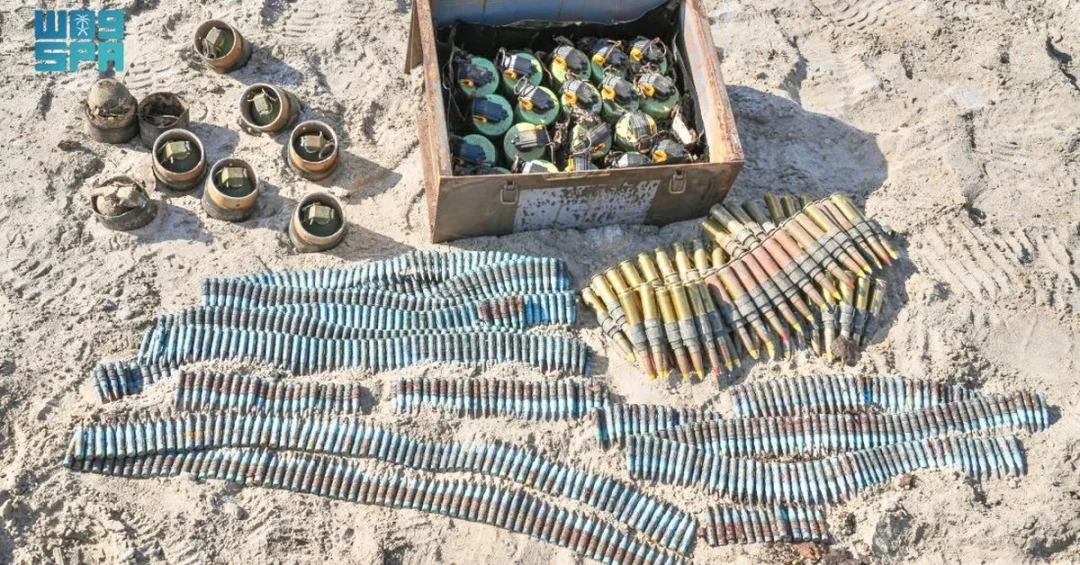
The King Salman Humanitarian Aid and Relief Center (KSrelief) announced that its Masam project to clear Yemeni lands of mines dismantled 548 mines in various regions of Yemen during the second week of March 2025, including 25 anti-tank mines, five anti-personnel mines, 515 unexploded ordnance, and three explosive devices. This brings the total number of mines removed so far in March to 1,606, and the total since the project’s inception to 484,949. The Masam project, an initiative of KSrelief, aims to protect innocent civilians from the dangers of randomly planted mines across Yemen.
Context and Background
The Masam project, launched by KSrelief in June 2018, is a humanitarian demining program that operates across Yemen to neutralize explosive hazards and save lives. Yemen has suffered from widespread contamination by landmines and unexploded ordnance due to the conflict, which has posed severe risks to civilians, hindered development, and impeded humanitarian access. KSrelief, under the leadership of the Kingdom of Saudi Arabia, has been at the forefront of efforts to alleviate the suffering of the Yemeni people through various humanitarian projects, with Masam being one of its flagship initiatives.
Key Details
According to KSrelief, during the second week of March 2025, the Masam teams successfully dismantled 548 mines: 25 anti-tank mines, five anti-personnel mines, 515 unexploded ordnance, and three explosive devices. This brings the total for March to 1,606 mines cleared. Since the project began, a staggering 484,949 mines have been removed. The project employs highly trained demining teams who work tirelessly to clear contaminated areas, often risking their lives to ensure the safety of Yemeni civilians. The Masam project also includes risk education programs to raise awareness among local communities about the dangers of explosive remnants of war.
Implications and Impact
The clearance of these mines has a profound impact on the lives of Yemeni civilians. By removing these deadly devices, KSrelief is enabling safe access to schools, hospitals, markets, and agricultural land, thereby supporting livelihoods and facilitating humanitarian aid delivery. The Masam project has been widely praised by international organizations for its effectiveness and commitment to humanitarian principles. It reflects Saudi Arabia’s continued efforts to restore peace and stability in Yemen and underscores the Kingdom’s role as a leading humanitarian donor in the region.
Vision 2030 Alignment
Saudi Arabia’s Vision 2030 emphasizes the Kingdom’s commitment to humanitarian aid and global peace. The Masam project aligns with Vision 2030’s goals of enhancing Saudi Arabia’s humanitarian role and promoting sustainable development. By clearing mines, Saudi Arabia is not only saving lives but also contributing to the reconstruction and stability of Yemen, which is essential for regional security and prosperity. This initiative demonstrates Saudi Arabia’s dedication to international cooperation and its leadership in humanitarian assistance.
20 Questions
Q1. What is the Masam project?
A1. The Masam project is a humanitarian demining initiative by KSrelief, established in June 2018 to clear Yemeni lands of mines and unexploded ordnance, protecting civilians and supporting stability.
Q2. How many mines were dismantled in the second week of March 2025?
A2. During the second week of March 2025, 548 mines were dismantled, including 25 anti-tank mines, five anti-personnel mines, 515 unexploded ordnance, and three explosive devices.
Q3. What is the total number of mines removed in March 2025 so far?
A3. As of the second week of March 2025, a total of 1,606 mines have been removed in March, reflecting the project’s ongoing efforts to clear contamination.
Q4. How many mines have been cleared since the project began?
A4. Since its inception, the Masam project has cleared 484,949 mines, significantly reducing the threat posed by explosive hazards to Yemeni civilians.
Q5. Who funds the Masam project?
A5. The Masam project is funded and implemented by the King Salman Humanitarian Aid and Relief Center (KSrelief), a Saudi Arabian humanitarian organization.
Q6. What types of mines are being cleared?
A6. The project clears anti-tank mines, anti-personnel mines, unexploded ordnance, and explosive devices, all of which pose severe risks to civilians.
Q7. Why is demining important in Yemen?
A7. Demining is crucial to save lives, enable safe access to essential services, facilitate humanitarian aid, and support reconstruction and development in Yemen.
Q8. How does the Masam project operate?
A8. The project deploys trained demining teams who locate and neutralize explosives, and also conducts risk education to raise awareness among local communities.
Q9. What impact has the Masam project had on Yemeni civilians?
A9. It has significantly reduced casualties from mines, allowed safe movement, and improved access to schools, hospitals, and markets, enhancing overall quality of life.
Q10. How does the Masam project align with Saudi Vision 2030?
A10. It aligns with Vision 2030’s humanitarian and global peace goals, showcasing Saudi Arabia’s commitment to international aid and sustainable development.
Q11. What challenges does the Masam project face?
A11. Challenges include difficult terrain, ongoing conflict, and the sheer volume of contamination, but the project remains resolute in its mission.
Q12. How many demining personnel are involved in the Masam project?
A12. The project employs a dedicated team of trained demining experts, though specific numbers are not disclosed for security reasons.
Q13. Has the Masam project received international recognition?
A13. Yes, it has been praised by international organizations for its effectiveness and humanitarian impact, enhancing Saudi Arabia’s global standing.
Q14. What is the process for clearing a minefield?
A14. Deminers survey, detect, and safely remove or destroy explosives, ensuring the area is safe for civilian use, following international standards.
Q15. How does the Masam project coordinate with local authorities?
A15. It works closely with Yemeni authorities and local communities to identify contaminated areas and implement clearance operations effectively.
Q16. What happens to the cleared land?
A16. Cleared land is returned to civilian use, enabling agriculture, housing, and infrastructure development, contributing to economic recovery.
Q17. Are there any other Saudi humanitarian projects in Yemen?
A17. Yes, KSrelief implements numerous projects in Yemen, including food aid, healthcare, and education, as part of Saudi Arabia’s broader humanitarian commitment.
Q18. How can other countries support demining efforts in Yemen?
A18. Countries can contribute funds, expertise, or equipment to demining initiatives, collaborating with KSrelief and international organizations.
Q19. What is the long-term goal of the Masam project?
A19. The ultimate goal is to make Yemen free from explosive hazards, ensuring safety and enabling sustainable development for future generations.
Q20. How does the Masam project reflect Saudi Arabia’s foreign policy?
A20. It exemplifies Saudi Arabia’s commitment to humanitarian diplomacy, regional stability, and peaceful coexistence, aligning with its leadership role in the Arab world.
Reader Feedback
We value your thoughts. Please share your feedback on this article.
Your feedback helps us improve our coverage.
Related articles
 Grand Mosque Launches Program for Female Visitor Inquiries
 King Salman Royal Reserve Records Birth of Nubian Ibex
 Saudi Foreign Ministry Hosts Ramadan Iftar for Diplomats
 5.1-Magnitude Earthquake Strikes Indonesia’s Gorontalo
 Makkah Municipality Volunteers Elevate Umrah Experience
 King Salman Congratulates Ireland’s President on National Day