


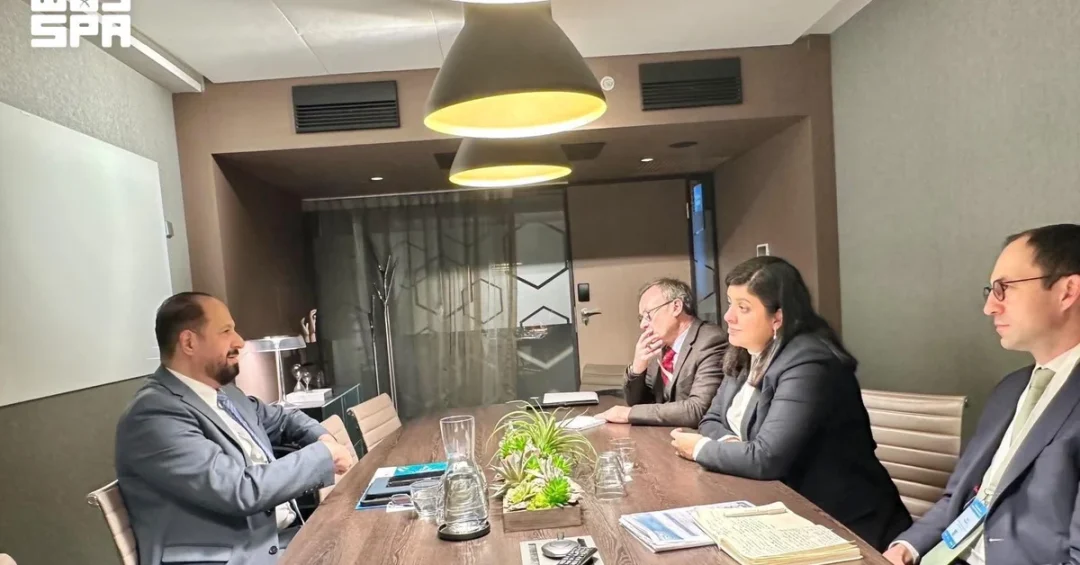
Dr. Aqeel bin Jamaan Al-Ghamdi, Assistant Supervisor General for Planning and Development at the King Salman Humanitarian Aid and Relief Centre (KSrelief), met with Organisation for Economic Co-operation and Development (OECD) Director for Development Co-operation María del Pilar Garrido Gonzalo in Oslo on Tuesday. The meeting took place on the sidelines of the 2026 Arab-DAC Dialogue on Development, held in Oslo, Norway, on November 24 and 25, according to the Saudi Press Agency. The two officials discussed issues of common interest and explored possible ways to address pressing relief and humanitarian challenges. Dr. Al-Ghamdi outlined the worldwide relief and humanitarian work carried out by Saudi Arabia through KSrelief, highlighting a range of distinctive programs. Garrido praised Saudi Arabia’s efforts through KSrelief to provide humanitarian aid and relief across key sectors to people in need and those facing hardship around the world.
Why does this meeting matter for global humanitarian coordination? The encounter underscores Saudi Arabia’s growing role in international development diplomacy and its commitment to aligning its relief efforts with global best practices. The Arab-DAC Dialogue serves as a vital platform for bridging perspectives between Arab donors and members of the OECD’s Development Assistance Committee, fostering collaboration on shared humanitarian goals. Saudi Arabia’s active participation reflects its dedication to Vision 2030’s humanitarian pillar, which seeks to institutionalize giving and expand the Kingdom’s impact on the world stage. As global crises multiply, such high-level engagements are essential for ensuring that aid reaches the most vulnerable populations efficiently and effectively.
Context and Background
What is the significance of the Arab-DAC Dialogue, and why does Saudi Arabia’s involvement matter? The Arab-DAC Dialogue on Development is a biennial event that brings together representatives from Arab donor countries and the OECD’s Development Assistance Committee (DAC), the principal forum for major bilateral donors. The 2026 edition, held in Oslo, Norway, provided a unique opportunity for participants to discuss emerging challenges in development co-operation, share best practices, and strengthen partnerships. Saudi Arabia, represented by KSrelief, has been an active participant in these dialogues, demonstrating its commitment to multilateral engagement and its desire to learn from and contribute to global development frameworks. The Kingdom’s participation aligns with its longstanding tradition of humanitarian giving, which dates back decades and has been formalized through institutions like KSrelief.
How has Saudi Arabia’s humanitarian approach evolved over the years? The establishment of KSrelief in 2015 marked a pivotal moment in Saudi Arabia’s humanitarian history, centralizing and professionalizing the Kingdom’s relief efforts under one umbrella. Since then, KSrelief has implemented thousands of projects in over 90 countries, focusing on food security, health, education, water, and shelter. The centre has also prioritized capacity-building and coordination with international partners, including UN agencies and NGOs. This meeting with the OECD’s development co-operation director is a testament to KSrelief’s growing reputation as a reliable and effective humanitarian actor. By engaging with the OECD, Saudi Arabia signals its willingness to adhere to international standards of aid effectiveness, transparency, and accountability, which are core principles of both Vision 2030 and the OECD’s development agenda.
Key Details
What specific topics were discussed during the meeting? According to the Saudi Press Agency, Dr. Al-Ghamdi and Director Garrido discussed several issues of common interest and possible ways to address pressing relief and humanitarian issues. While the exact details of these discussions were not disclosed, the context suggests they likely covered topics such as funding mechanisms, crisis response strategies, and the role of innovation in humanitarian action. Dr. Al-Ghamdi took the opportunity to outline KSrelief’s global operations, emphasizing the centre’s distinctive programs that span emergency relief, early recovery, and development projects. He highlighted Saudi Arabia’s commitment to reaching the most vulnerable, including refugees, displaced persons, and communities affected by natural disasters and conflicts.
How did the OECD official respond to Saudi Arabia’s efforts? María del Pilar Garrido Gonzalo, the OECD Director for Development Co-operation, praised Saudi Arabia’s efforts through KSrelief to provide humanitarian aid and relief across key sectors to people in need and those facing hardship worldwide. Her acknowledgment reflects the international community’s recognition of the Kingdom’s substantial contributions to global humanitarian causes. The OECD, which comprises 38 member countries, has increasingly engaged with non-member donors like Saudi Arabia to enhance co-ordination and effectiveness in development co-operation. This meeting thus represents a mutual exchange: Saudi Arabia shares its on-the-ground expertise, while the OECD offers its analytical and normative frameworks. Such interactions are crucial for building trust and ensuring that humanitarian aid is delivered in a coherent and complementary manner.
International and Regional Impact
How does this meeting influence Saudi Arabia’s standing in the international community? The engagement between KSrelief and the OECD highlights Saudi Arabia’s proactive approach to global humanitarian governance. By participating in high-level dialogues and forging partnerships with influential organizations, the Kingdom reinforces its image as a responsible global citizen and a key player in development co-operation. This is particularly important as Saudi Arabia seeks to diversify its international partnerships beyond traditional allies, in line with Vision 2030’s goal of a more outward-looking and engaged foreign policy. The meeting also strengthens the Arab-DAC Dialogue’s objective of fostering mutual understanding and collaboration between Arab and Western donors, which can lead to more effective and coordinated responses to crises.
What are the regional implications of Saudi Arabia’s humanitarian diplomacy? In the Middle East and beyond, Saudi Arabia’s humanitarian efforts through KSrelief have been instrumental in alleviating suffering in conflict zones such as Yemen, Syria, and the Palestinian territories. By collaborating with the OECD, Saudi Arabia can share its unique regional insights and learn from other donors’ experiences, potentially improving the effectiveness of aid delivery in these complex environments. Moreover, the Kingdom’s leadership in humanitarian aid enhances its soft power and diplomatic influence, contributing to stability and prosperity in the region. This meeting, therefore, is not just a bilateral exchange but a step toward a more collaborative and efficient global humanitarian system, with Saudi Arabia playing a central role.
Economic and Strategic Significance
What economic and strategic benefits does Saudi Arabia gain from such engagements? While humanitarian aid is primarily a moral imperative, it also carries strategic and economic dimensions. By aligning with the OECD’s development co-operation standards, Saudi Arabia can attract more partners and funding for its humanitarian initiatives, as well as enhance the efficiency of its aid delivery. This can lead to better outcomes on the ground and greater recognition for the Kingdom’s contributions. Strategically, the meeting reinforces Saudi Arabia’s position as a bridge-builder between the Arab world and international organizations, a role that is increasingly valuable in a multipolar world. It also supports Vision 2030’s aim of transforming Saudi Arabia into a global investment powerhouse and a hub for international diplomacy.
How does this fit into Saudi Arabia’s broader economic diversification goals? Vision 2030 seeks to reduce the Kingdom’s dependence on oil by diversifying its economy and enhancing its global competitiveness. Humanitarian diplomacy and development co-operation are integral to this vision, as they promote Saudi Arabia’s soft power, open doors for trade and investment, and showcase the Kingdom’s modernization and openness. By engaging with the OECD, Saudi Arabia demonstrates its commitment to international norms and standards, which can improve its business environment and attract foreign investment. Furthermore, the expertise gained through such dialogues can help Saudi institutions improve their own development projects, contributing to the Kingdom’s domestic goals of social welfare and economic growth.
Vision 2030 Alignment
How does this meeting align with Vision 2030’s objectives? Vision 2030, Saudi Arabia’s ambitious blueprint for national transformation, emphasizes the Kingdom’s role as a global leader in humanitarian and development aid. One of its key themes is ‘A Thriving Economy’ and ‘An Ambitious Nation,’ which includes fostering international partnerships and enhancing Saudi Arabia’s global impact. KSrelief is a prime example of this vision in action, as it embodies the Kingdom’s commitment to helping those in need while also promoting its values of compassion and solidarity. The meeting with the OECD director is a direct reflection of Vision 2030’s goal to strengthen Saudi Arabia’s international standing and to contribute to global peace and prosperity. It also underscores the Kingdom’s dedication to the United Nations Sustainable Development Goals, particularly those related to poverty, health, and partnerships.
What does the future hold for Saudi Arabia’s humanitarian diplomacy? As Saudi Arabia continues to advance Vision 2030, its humanitarian diplomacy is likely to expand and evolve. KSrelief will remain at the forefront, implementing innovative projects and forging new partnerships. The Kingdom’s engagement with the OECD and other international bodies will deepen, leading to more coordinated and effective aid delivery worldwide. This meeting in Oslo is a stepping stone toward a future where Saudi Arabia is recognized not only for its economic might but also for its humanitarian heart. By investing in people and partnerships, the Kingdom is building a legacy of goodwill that will benefit generations to come, both at home and abroad.
20 Questions
Q1. Who represented KSrelief at the meeting in Oslo?
A1. Dr. Aqeel bin Jamaan Al-Ghamdi, Assistant Supervisor General for Planning and Development at KSrelief, represented the organization.
Q2. Who did Dr. Al-Ghamdi meet with?
A2. He met with María del Pilar Garrido Gonzalo, the OECD Director for Development Co-operation.
Q3. Where and when did the meeting take place?
A3. The meeting took place in Oslo, Norway, on Tuesday, on the sidelines of the 2026 Arab-DAC Dialogue on Development.
Q4. What is the Arab-DAC Dialogue on Development?
A4. It is a forum that brings together Arab donors and members of the OECD’s Development Assistance Committee to discuss development co-operation.
Q5. What was the main purpose of the meeting?
A5. The officials discussed issues of common interest and possible ways to address pressing relief and humanitarian issues.
Q6. What did Dr. Al-Ghamdi present during the meeting?
A6. He outlined Saudi Arabia’s relief and humanitarian work worldwide through KSrelief, including its distinctive programs.
Q7. How did the OECD official respond to Saudi Arabia’s efforts?
A7. Garrido praised Saudi Arabia’s efforts through KSrelief to provide humanitarian aid across key sectors to people in need.
Q8. What is KSrelief?
A8. KSrelief is the King Salman Humanitarian Aid and Relief Centre, established in 2015 to coordinate and implement Saudi Arabia’s humanitarian aid worldwide.
Q9. What are some key sectors KSrelief focuses on?
A9. KSrelief focuses on food security, health, education, water, shelter, and emergency relief, among other sectors.
Q10. How does this meeting align with Vision 2030?
A10. It supports Vision 2030’s goals of enhancing Saudi Arabia’s global role and promoting international partnerships for sustainable development.
Q11. What is the OECD’s role in development co-operation?
A11. The OECD sets standards and provides analysis to improve development co-operation among donor countries and partners.
Q12. Why is Saudi Arabia’s participation in the Arab-DAC Dialogue important?
A12. It strengthens collaboration between Arab and Western donors and showcases Saudi Arabia’s commitment to global humanitarian efforts.
Q13. What impact does KSrelief have globally?
A13. KSrelief has implemented thousands of projects in over 90 countries, helping millions of people in need.
Q14. How does the meeting reflect Saudi Arabia’s foreign policy?
A14. It demonstrates Saudi Arabia’s proactive diplomacy and its commitment to multilateral engagement and global stability.
Q15. What are the expected outcomes of this meeting?
A15. The meeting is expected to enhance co-ordination and partnership between KSrelief and the OECD on humanitarian and development issues.
Q16. What is the significance of the Arab-DAC Dialogue being held in Oslo?
A16. Oslo provides a neutral platform for Arab and DAC donors to discuss shared challenges and strengthen partnerships.
Q17. How does KSrelief ensure aid effectiveness?
A17. KSrelief adheres to international standards, conducts needs assessments, and co-ordinates with local and international partners for efficient delivery.
Q18. What role does Saudi Arabia play in global humanitarian aid?
A18. Saudi Arabia is one of the largest donors, providing substantial aid through KSrelief and other channels to crises worldwide.
Q19. How does this meeting benefit Saudi Arabia’s economy?
A19. It enhances Saudi Arabia’s soft power and international reputation, which can attract investment and partnerships, supporting economic diversification.
Q20. What future steps can be expected from KSrelief and OECD collaboration?
A20. Future steps may include joint projects, knowledge sharing, and policy alignment to improve humanitarian outcomes globally.
Reader Feedback
We value your thoughts. Please share your feedback on this article.
Your feedback helps us improve our coverage.
Related articles
 KSrelief and Norway Strengthen Humanitarian Cooperation in Oslo
 Hajj and Umrah Ministry Reviews 2026 Achievements
 KSrelief Joins Arab-DAC Dialogue on Development in Oslo
 Arab League, UN Launch Campaign to End Violence Against Women
 Coalition Intercepts Two UAVs in Eastern Region
 4.6-Magnitude Earthquake Strikes Türkiye’s Muğla Province