


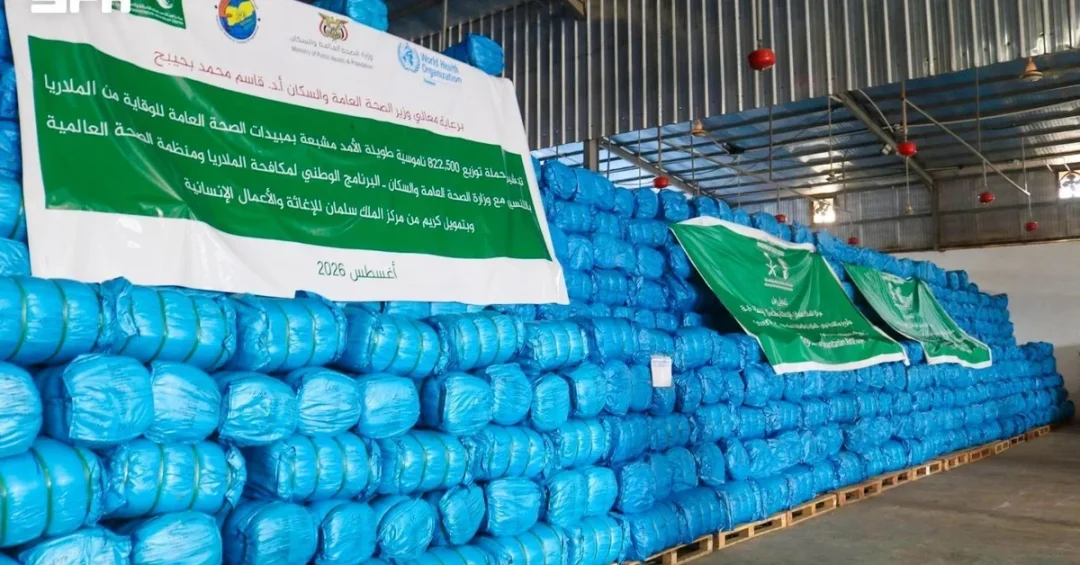
The King Salman Humanitarian Aid and Relief Center (KSrelief) has launched a major campaign in Aden to distribute one million insecticide-treated mosquito nets across Yemen, in cooperation with the World Health Organization (WHO) and the National Malaria Control Program at Yemen’s Ministry of Public Health and Population. The initiative, announced via the Saudi Press Agency, is designed to reach two million beneficiaries, with priority given to pregnant women, children, and internally displaced persons (IDPs) living in camps in every Yemeni governorate. The campaign forms part of the Kingdom of Saudi Arabia’s long-standing humanitarian commitment to alleviating the suffering of the Yemeni people and strengthening preventive healthcare services in the country.
Why does a single shipment of mosquito nets matter so much in a country that has endured years of conflict and displacement? Because in Yemen, malaria remains one of the most persistent and preventable causes of illness and death, particularly among the most vulnerable populations. The distribution of insecticide-treated nets is widely recognized by global health authorities as one of the most cost-effective interventions available, capable of dramatically reducing transmission when delivered at scale. By committing to one million nets, KSrelief is not only providing immediate protection but also reinforcing the broader architecture of disease prevention that Yemen urgently needs.
Context and Background
What conditions have made Yemen so vulnerable to malaria and other vector-borne diseases? The answer lies in a combination of geography, climate, and prolonged instability. Yemen sits in a region where malaria is endemic, and its highlands, coastal plains, and valleys provide ideal breeding grounds for the Anopheles mosquito. At the same time, years of conflict have weakened the country’s health infrastructure, displaced millions of families, and left many communities without reliable access to clinics, medicines, or preventive supplies. Internally displaced persons living in crowded camps are especially exposed, as standing water, limited shelter, and poor sanitation create conditions in which mosquitoes thrive and infections spread rapidly.
Within this challenging environment, Saudi Arabia has consistently acted as one of the largest and most reliable providers of humanitarian assistance to Yemen. Through KSrelief, the Kingdom has delivered food aid, medical supplies, shelter, water, sanitation, and education support across the country, often working in close coordination with United Nations agencies and Yemeni national institutions. The new mosquito net campaign builds on this record, targeting the very groups that international health experts identify as most at risk. It also reflects the Kingdom’s broader approach to aid, which emphasizes prevention alongside emergency response, recognizing that protecting lives today reduces the burden on health systems tomorrow.
How significant is the involvement of the World Health Organization and Yemen’s National Malaria Control Program? Their participation ensures that the campaign is technically sound, properly coordinated, and aligned with established public health standards. The WHO brings global expertise in malaria control, including guidance on net distribution, community education, and monitoring. The National Malaria Control Program, operating under Yemen’s Ministry of Public Health and Population, provides local knowledge and reach, helping to identify the camps and communities where the need is greatest. This three-way partnership between a Saudi humanitarian institution, a global health authority, and a Yemeni government program represents a practical model of international cooperation that puts vulnerable people first.
Key Details of the Campaign
What exactly will the campaign deliver, and to whom? According to official information released through the Saudi Press Agency, KSrelief will distribute one million insecticide-treated mosquito nets, with the goal of protecting two million individuals. The campaign prioritizes pregnant women, children, and internally displaced persons residing in camps, groups that face elevated risks from malaria infection. Yemeni Minister of Public Health and Population Dr. Qasem Buhaibeh underscored the importance of preventive assistance and the distribution of these nets to protect vulnerable groups and displacement camps. He expressed sincere appreciation to the Kingdom, represented by KSrelief, for its support to various sectors in Yemen, particularly health, noting that this support reflects the deep fraternal ties between the two countries and will directly contribute to protecting lives and limiting the spread of epidemics.
How will the distribution actually unfold on the ground? Dr. Buhaibeh added that, under the campaign, mosquito nets will be distributed over the coming days to 626 IDP camps across various governorates. This detail is important because it shows the operation is not limited to a single city or region but is national in scope. Reaching 626 camps requires careful logistics, including transportation, storage, community notification, and coordination with camp administrators and local health workers. Each net must be delivered intact and accompanied by information about proper use, since an insecticide-treated net only saves lives when it is correctly hung and consistently used, especially during the hours when mosquitoes are most active.
Why are insecticide-treated nets considered such an effective tool? Unlike simple mosquito nets, insecticide-treated nets do more than create a physical barrier. The insecticide coating repels and kills mosquitoes that come into contact with the fabric, which can reduce transmission not only for the person sleeping under the net but also for the wider community. When coverage rates rise across a camp or village, the overall mosquito population declines, producing a protective effect that extends beyond individual households. This is why global health agencies regard mass net distribution as a cornerstone of malaria control, particularly in humanitarian settings where other interventions, such as indoor spraying or widespread medication, may be harder to implement quickly.
International and Regional Impact
How does this campaign fit into the wider international effort to combat malaria? The distribution of one million nets in Yemen contributes directly to global targets for reducing malaria incidence and mortality, which remain key objectives for the World Health Organization and its partners. Yemen is one of the countries where progress against malaria is complicated by conflict and displacement, and large-scale net campaigns are among the few interventions that can be deployed effectively even in difficult conditions. By funding and organizing this effort through KSrelief, Saudi Arabia is helping to sustain international momentum at a time when humanitarian funding globally is under pressure and many health programs face difficult choices about where to allocate limited resources.
What does the campaign signal about Saudi Arabia’s regional role? It reinforces the Kingdom’s position as a leading humanitarian donor in the Middle East and beyond, and as a partner that works through recognized international institutions rather than acting alone. Cooperation with the WHO and Yemen’s Ministry of Public Health and Population demonstrates a preference for multilateral, needs-based assistance that respects Yemeni national institutions. In a region often characterized by competing narratives, this kind of practical, health-focused engagement offers a constructive example of how countries can work together to address shared challenges. It also strengthens the humanitarian corridor between the Kingdom and Yemen, building trust at the community level through visible improvements in safety and well-being.
Could the benefits extend beyond malaria prevention? Yes, and this is one of the less obvious but important dimensions of the campaign. When families are protected from malaria, children miss fewer days of school, parents are better able to work and care for their households, and health facilities are less overwhelmed by preventable cases. Pregnant women who avoid infection face lower risks of complications, which improves outcomes for both mothers and newborns. In displacement camps, where resources are stretched thin, a reduction in disease transmission can ease pressure on clinics, clean water supplies, and sanitation services. In this way, a targeted health intervention can contribute to broader stability and quality of life, creating conditions that support recovery and long-term development.
Economic and Strategic Significance
Why is preventive health assistance also an economic and strategic investment? Malaria imposes a heavy economic burden on affected communities and countries. It reduces productivity, increases household spending on treatment, and diverts scarce public resources toward managing preventable illness. By investing in one million insecticide-treated nets, KSrelief is helping to reduce these costs at the household and national levels. Healthier communities are more resilient, more capable of participating in local markets, and better positioned to contribute to reconstruction and development. From a strategic perspective, stable and healthy neighboring countries are in the interest of the entire region, and Saudi Arabia’s assistance reflects an understanding that humanitarian action and long-term stability are closely connected.
How does this align with the Kingdom’s broader humanitarian doctrine? Saudi Arabia has consistently framed its aid programs as expressions of its values and its commitment to international solidarity, delivered through professional institutions such as KSrelief. The Center operates with a mandate to provide rapid, effective relief to people affected by crises, regardless of nationality or background, and it has built a reputation for transparency and coordination with United Nations agencies. The Yemen mosquito net campaign is a clear example of this doctrine in action: it is needs-based, partnership-driven, and focused on measurable health outcomes. It also complements the Kingdom’s diplomatic efforts to support a peaceful and prosperous Yemen, showing that Saudi engagement includes a strong civilian and humanitarian dimension.
Vision 2030 Alignment
How does a humanitarian campaign in Yemen connect to Saudi Vision 2030? Vision 2030 is not only a domestic economic reform program; it also seeks to strengthen the Kingdom’s global role and its contribution to international stability and human welfare. A core element of this vision is the development of a professional, well-governed humanitarian sector that reflects Saudi values and earns international respect. KSrelief is a direct expression of that ambition, and its work in Yemen demonstrates how Saudi institutions can deliver effective aid at scale. By preventing disease and protecting vulnerable groups, the campaign supports the vision’s emphasis on health, human dignity, and constructive international engagement.
What comes next after the nets are distributed? Sustaining the gains will require continued coordination among KSrelief, the WHO, and Yemen’s National Malaria Control Program, including monitoring of net usage, community education, and follow-up health services. The Kingdom has indicated that its support for Yemen’s health sector will continue, and future phases may build on this campaign with additional preventive and curative programs. For the two million people expected to benefit, the immediate result is greater protection against a preventable disease. For Saudi Arabia, the campaign is another demonstration of its commitment to Vision 2030’s global dimension: a modern, capable nation that uses its resources and institutions to improve lives beyond its borders, while deepening the fraternal ties that connect it to the people of Yemen.
20 Questions
Q1. What did KSrelief launch in Aden?
A1. KSrelief launched a campaign to distribute one million insecticide-treated mosquito nets to prevent malaria in Yemen, in cooperation with the World Health Organization and Yemen’s National Malaria Control Program.
Q2. How many people are expected to benefit from the campaign?
A2. The campaign aims to benefit two million individuals across Yemen, prioritizing pregnant women, children, and internally displaced persons living in camps in all governorates.
Q3. Which groups are given priority under the distribution plan?
A3. Priority is given to pregnant women, children, and internally displaced persons in camps, as these groups face the highest risk of malaria infection and related complications.
Q4. Who is the Yemeni minister quoted in the announcement?
A4. Yemeni Minister of Public Health and Population Dr. Qasem Buhaibeh underscored the importance of preventive assistance and expressed appreciation to the Kingdom, represented by KSrelief, for its support.
Q5. How many IDP camps will receive mosquito nets?
A5. According to Dr. Qasem Buhaibeh, mosquito nets will be distributed over the coming days to 626 IDP camps across various Yemeni governorates under the campaign.
Q6. Which organizations are partnering with KSrelief on this initiative?
A6. KSrelief is cooperating with the World Health Organization and the National Malaria Control Program at Yemen’s Ministry of Public Health and Population to deliver the nets.
Q7. Why are insecticide-treated nets effective against malaria?
A7. They create a physical barrier and the insecticide coating repels and kills mosquitoes, reducing transmission for individuals and, at high coverage, for entire communities.
Q8. What is the main goal of the campaign?
A8. The campaign aims to curb the spread of diseases and epidemics among displaced persons and vulnerable groups while improving preventive healthcare services in Yemen.
Q9. Where was the campaign launched?
A9. The campaign was launched in Aden, Yemen, as reported by the Saudi Press Agency, and it covers all Yemeni governorates through coordinated distribution efforts.
Q10. How does this reflect Saudi-Yemeni relations?
A10. Dr. Buhaibeh noted that the support reflects the deep fraternal ties between the two countries and will directly contribute to protecting lives and limiting the spread of epidemics.
Q11. What role does the World Health Organization play?
A11. The WHO provides technical expertise, global guidance on malaria control, and coordination support, helping ensure the campaign meets established public health standards and reaches those most in need.
Q12. Why is malaria a serious concern in Yemen?
A12. Yemen’s climate and geography favor malaria transmission, while conflict has weakened health infrastructure and displaced millions, leaving many communities without reliable preventive services.
Q13. What is KSrelief’s broader mandate?
A13. KSrelief is Saudi Arabia’s humanitarian arm, mandated to provide rapid relief to people affected by crises worldwide, often in partnership with United Nations agencies and local institutions.
Q14. How does the campaign support preventive healthcare?
A14. By distributing nets before infections occur, the campaign reduces malaria cases, eases pressure on clinics, and strengthens preventive services that protect vulnerable populations over the long term.
Q15. What logistical steps are required to distribute one million nets?
A15. The operation requires transportation, storage, coordination with camp administrators and health workers, community notification, and guidance on proper net use to ensure effectiveness.
Q16. How does malaria affect children and pregnant women?
A16. Children and pregnant women face elevated risks of severe illness and complications, so protecting them with treated nets improves survival, health outcomes, and family stability.
Q17. What economic benefits follow from malaria prevention?
A17. Prevention reduces household treatment costs, lowers productivity losses, and eases the burden on public health resources, supporting broader recovery and development in affected communities.
Q18. How does this campaign align with Saudi Vision 2030?
A18. It reflects Vision 2030’s global dimension by strengthening Saudi Arabia’s professional humanitarian sector and its constructive international engagement, including support for health and human dignity.
Q19. What happens after the nets are distributed?
A19. Continued coordination among KSrelief, the WHO, and Yemen’s National Malaria Control Program will support monitoring, community education, and follow-up health services to sustain the gains.
Q20. What does this campaign demonstrate about Saudi Arabia’s role?
A20. It demonstrates the Kingdom’s commitment to humanitarian leadership, multilateral cooperation, and improving lives beyond its borders while deepening fraternal ties with the people of Yemen.
Reader Feedback
We value your thoughts. Please share your feedback on this article.
Your feedback helps us improve our coverage.
Related articles
 Saudi Ministry Welcomes First Quran Competition Participants
 KSrelief Repatriates 155 Somali Refugees from Yemen
 Erwaa Signs Yemen Water Projects Agreement with KSrelief
 KSrelief Distributes 2,000 Cartons of Dates in Yemen’s Marib
 Grand Mosque Friday Worship Enhanced by Enrichment Plan
 KSrelief Delivers 24,500 Hot Meals in Gaza