


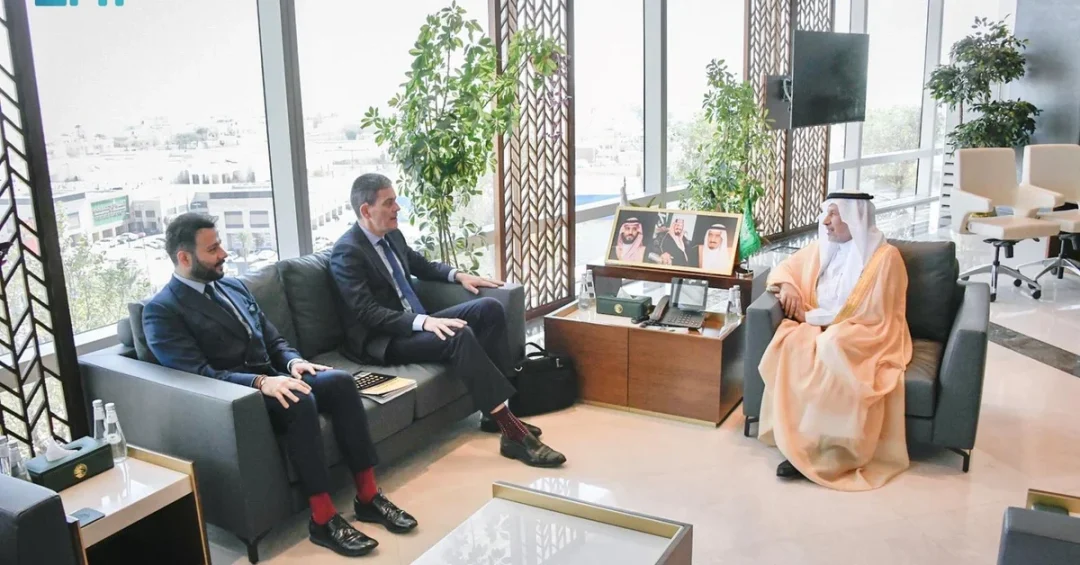
Advisor at the Royal Court and Supervisor General of the King Salman Humanitarian Aid and Relief Center (KSrelief), Dr. Abdullah bin Abdulaziz Al Rabeeah, met with International Rescue Committee (IRC) President and Chief Executive Officer David Miliband in Riyadh on November 21, 2024, to discuss expanding humanitarian cooperation and alleviating the suffering of refugees and displaced persons affected by environmental and natural disasters. The meeting, reported by the Saudi Press Agency (SPA), underscored the Kingdom of Saudi Arabia’s continuing commitment to global humanitarian leadership through its dedicated relief arm, KSrelief.
Could this high-level engagement signal a new chapter in international humanitarian coordination? The talks between Dr. Al Rabeeah and Mr. Miliband focused on mutual interests in humanitarian aid and relief efforts, with both sides exploring practical ways to strengthen assistance for vulnerable populations worldwide. The meeting reflects Saudi Arabia’s enduring policy of extending a helping hand to those in need, regardless of nationality, religion, or geography. It also highlights the growing recognition by international organizations of KSrelief’s professional capacity and its role as a reliable partner in complex crisis environments. As global displacement reaches unprecedented levels, such partnerships become ever more critical.
Context and Background
Why does this meeting matter in the broader landscape of global humanitarian action? The King Salman Humanitarian Aid and Relief Center (KSrelief) was established in 2015 by royal decree as Saudi Arabia’s dedicated humanitarian arm, operating under the guidance of the Kingdom’s leadership to provide rapid, effective relief to communities affected by crises. Since its inception, KSrelief has implemented thousands of projects across more than 90 countries, spanning food security, health care, water and sanitation, education, and emergency shelter. Its work is guided by the principles of neutrality, impartiality, and independence, and it has earned a reputation for professionalism and transparency in some of the world’s most challenging environments.
The International Rescue Committee (IRC), founded in 1933 at the request of Albert Einstein, is one of the world’s leading humanitarian organizations, delivering life-saving assistance to refugees and displaced persons in over 40 countries. Under the leadership of David Miliband, a former British Foreign Secretary, the IRC has advocated for stronger international responses to displacement crises and has partnered with a range of governmental and non-governmental actors. The meeting between Dr. Al Rabeeah and Mr. Miliband thus brings together two major humanitarian actors with complementary mandates and a shared goal of alleviating human suffering.
This encounter is not an isolated event. Saudi Arabia has consistently used its diplomatic and financial weight to support humanitarian causes, from the early days of KSrelief’s founding to its current role as a global donor and operational partner. The Kingdom’s humanitarian diplomacy is rooted in its Islamic values and its Vision 2030 objective of projecting a positive, responsible image on the world stage. By engaging with the IRC, KSrelief reinforces its network of international partnerships, which include collaborations with United Nations agencies, the Red Cross and Red Crescent movement, and other NGOs. Such engagement also allows Saudi Arabia to share its unique logistical and operational expertise, particularly in regions where access is constrained.
Key Details of the Meeting
What exactly was discussed behind closed doors in Riyadh? According to the official SPA report, the discussions centered on mutual interests related to humanitarian aid and relief efforts. Both sides explored ways to alleviate the suffering of refugees and displaced persons caused by environmental and natural disasters. This focus reflects a growing global concern: climate-induced displacement is on the rise, with floods, droughts, and other extreme weather events forcing millions from their homes each year. KSrelief has been at the forefront of responding to such crises, from drought relief in the Horn of Africa to flood assistance in Pakistan and earthquake recovery in Turkey and Syria.
Mr. Miliband commended Saudi Arabia’s efforts through KSrelief to support relief and humanitarian work around the world. He specifically noted KSrelief’s exceptional professional performance in assisting those affected by crises and in need. This praise from a seasoned humanitarian leader carries significant weight, as the IRC is known for its rigorous standards and evidence-based approach. It also signals that KSrelief’s operational model—characterized by rapid deployment, strong local partnerships, and robust monitoring—is recognized as effective by peer organizations. The meeting did not announce specific new funding commitments or joint programs, but the dialogue itself lays the groundwork for deeper operational collaboration in the future.
The encounter also provided an opportunity for both leaders to exchange views on the evolving nature of humanitarian crises. With conflicts, climate shocks, and economic instability converging in many regions, the need for flexible, well-coordinated responses has never been greater. Dr. Al Rabeeah, who also serves as Advisor at the Royal Court, brings a wealth of experience in both medicine and diplomacy to his role, having previously served as Saudi Arabia’s Minister of Health. His leadership of KSrelief has been marked by a focus on innovation, including the use of digital tools for needs assessments and the establishment of field hospitals and mobile clinics in remote areas. Mr. Miliband’s IRC has similarly pioneered new approaches to refugee resettlement and economic empowerment.
International and Regional Impact
How might this meeting influence humanitarian action beyond Saudi Arabia’s borders? The partnership between KSrelief and the IRC, even in its early stages, could enhance the effectiveness of relief operations in some of the world’s most volatile regions. The IRC’s deep presence in conflict-affected areas such as Afghanistan, Yemen, and Sudan complements KSrelief’s strong logistical capabilities and its ability to mobilize resources quickly from the Gulf. By aligning their efforts, the two organizations can avoid duplication, share critical data, and reach more beneficiaries with greater efficiency. This is particularly important in Yemen, where Saudi Arabia has been a leading donor of humanitarian aid, and where the IRC operates extensive health and protection programs.
Regionally, the meeting reinforces Saudi Arabia’s role as a stabilizing force and a bridge-builder in the Middle East. While geopolitical tensions often dominate headlines, the Kingdom’s humanitarian diplomacy offers a counter-narrative of constructive engagement and compassion. It also strengthens ties with international organizations that are influential in shaping global policy on refugees and displacement. For the IRC, partnering with a well-resourced and politically connected actor like KSrelief can open doors to new funding streams and operational areas. For Saudi Arabia, the collaboration enhances its soft power and demonstrates that its Vision 2030 reforms extend to its foreign policy, where humanitarian action is seen as a key pillar of its international standing.
Moreover, the meeting comes at a time when the global humanitarian system is under immense strain. Donor fatigue, the COVID-19 pandemic’s aftermath, and the war in Ukraine have stretched resources thin, while the number of forcibly displaced people has surpassed 110 million. In this context, South-South cooperation and partnerships between Gulf donors and Western-based NGOs are increasingly seen as vital. The KSrelief-IRC dialogue exemplifies this trend, showing that humanitarian action can transcend political differences and geographic distances. It also aligns with the United Nations’ call for more diverse and flexible funding mechanisms, as well as its emphasis on localizing aid and supporting frontline responders.
Economic and Strategic Significance
What does this meeting reveal about Saudi Arabia’s strategic priorities? At its core, the engagement reflects the Kingdom’s view that humanitarian aid is not merely charity but a strategic investment in stability and prosperity. By addressing the root causes of displacement and supporting vulnerable communities, Saudi Arabia contributes to regional security and reduces the drivers of extremism and migration. This approach is consistent with the objectives of Vision 2030, which seeks to diversify the economy, enhance the Kingdom’s global influence, and promote a positive image abroad. KSrelief’s operations are funded by the Saudi government and supported by private donations, and they are executed with a high degree of accountability, as evidenced by regular reports and third-party audits.
Economically, the meeting underscores the potential for shared efficiencies. Humanitarian logistics are expensive, and by coordinating with partners like the IRC, KSrelief can optimize supply chains, reduce overhead costs, and ensure that more resources reach beneficiaries. The IRC’s expertise in cash-based assistance and market-based programming can complement KSrelief’s in-kind distributions, offering more dignified and sustainable forms of aid. In addition, the two organizations can collaborate on innovative financing mechanisms, such as Islamic social finance instruments, which are gaining traction in the humanitarian sector. These instruments, including zakat and waqf, align with Saudi Arabia’s cultural and religious heritage and can mobilize additional resources for relief efforts.
Strategically, the meeting sends a message that Saudi Arabia is a reliable and constructive partner in addressing global challenges. It also positions the Kingdom as a leader in the humanitarian field, capable of working alongside established Western NGOs while maintaining its own distinct identity and values. This is particularly important as Saudi Arabia seeks to attract international investment and tourism, as outlined in Vision 2030. A strong reputation for humanitarianism enhances the Kingdom’s soft power and makes it a more attractive destination for business and leisure. Furthermore, by engaging with the IRC, Saudi Arabia can benefit from the organization’s advocacy networks, which can help amplify the Kingdom’s humanitarian achievements on the world stage.
Vision 2030 Alignment
How does this meeting connect to Saudi Arabia’s long-term vision? Vision 2030, the Kingdom’s ambitious reform blueprint, is not only about economic diversification and social liberalization; it also emphasizes Saudi Arabia’s role as a responsible global citizen. One of the vision’s pillars is to strengthen the Kingdom’s international partnerships and to contribute to global stability and development. KSrelief is a key instrument in this endeavor, and its collaboration with the IRC directly supports the vision’s goal of enhancing Saudi Arabia’s humanitarian impact. By working with a respected international NGO, KSrelief can share best practices, adopt new technologies, and demonstrate the Kingdom’s commitment to the Sustainable Development Goals, particularly those related to poverty, health, and reduced inequalities.
Looking ahead, the meeting between Dr. Al Rabeeah and Mr. Miliband is likely to lead to concrete joint initiatives. Both organizations have expressed a willingness to explore further cooperation, and their complementary strengths suggest a promising partnership. For Saudi Arabia, this is another step in its journey to becoming a global humanitarian hub, a goal that aligns with its G20 presidency legacy and its growing role in multilateral forums. As the world faces unprecedented humanitarian needs, Saudi Arabia’s leadership—through KSrelief—offers a model of generosity, professionalism, and partnership. The Kingdom remains committed to alleviating suffering wherever it occurs, and its engagement with the IRC is a testament to that enduring commitment.
20 Questions
Q1. Who met in Riyadh on November 21, 2024?
A1. Dr. Abdullah bin Abdulaziz Al Rabeeah, Advisor at the Royal Court and KSrelief Supervisor General, met with David Miliband, President and CEO of the International Rescue Committee.
Q2. What is KSrelief?
A2. KSrelief is the King Salman Humanitarian Aid and Relief Center, Saudi Arabia’s dedicated humanitarian arm established in 2015 to provide relief worldwide.
Q3. What was the main focus of the meeting?
A3. The discussions focused on mutual interests in humanitarian aid and relief efforts, and ways to alleviate the suffering of refugees and displaced persons caused by environmental and natural disasters.
Q4. What did David Miliband say about KSrelief?
A4. He commended Saudi Arabia’s efforts through KSrelief and noted its exceptional professional performance in assisting those affected by crises and in need.
Q5. Which Saudi agency reported the meeting?
A5. The Saudi Press Agency (SPA) reported the meeting, which took place in Riyadh.
Q6. What is the International Rescue Committee?
A6. The IRC is a leading global humanitarian organization founded in 1933 that provides life-saving assistance to refugees and displaced persons in over 40 countries.
Q7. Who is David Miliband?
A7. David Miliband is the President and CEO of the IRC and a former British Foreign Secretary.
Q8. What is Dr. Al Rabeeah’s role in the Saudi government?
A8. He is an Advisor at the Royal Court and Supervisor General of KSrelief, and he previously served as Saudi Arabia’s Minister of Health.
Q9. Why is this meeting significant?
A9. It highlights Saudi Arabia’s ongoing commitment to global humanitarian leadership and strengthens partnerships with international organizations to address displacement crises.
Q10. What types of disasters were mentioned?
A10. The discussions mentioned environmental and natural disasters, which are increasingly causing displacement worldwide.
Q11. How many countries has KSrelief assisted?
A11. KSrelief has implemented projects in more than 90 countries, providing aid in food security, health, water, education, and shelter.
Q12. What is the IRC’s mission?
A12. The IRC’s mission is to help people whose lives and livelihoods are shattered by conflict and disaster to survive, recover, and gain control of their future.
Q13. Did the meeting announce any new funding?
A13. No specific new funding commitments were announced, but the dialogue laid the groundwork for deeper operational collaboration.
Q14. How does this meeting align with Vision 2030?
A14. It supports Vision 2030’s goal of enhancing Saudi Arabia’s global role and humanitarian impact, demonstrating responsible global citizenship.
Q15. What are some regions where KSrelief operates?
A15. KSrelief operates in regions such as Yemen, Syria, Pakistan, Somalia, and many others affected by conflict and natural disasters.
Q16. What is the significance of the IRC’s praise?
A16. The IRC’s commendation signals that KSrelief’s operational model is recognized as effective by peer organizations, enhancing Saudi Arabia’s humanitarian reputation.
Q17. How does Saudi Arabia fund KSrelief?
A17. KSrelief is funded by the Saudi government and supported by private donations, with a focus on accountability and transparency.
Q18. What are Islamic social finance instruments?
A18. They include zakat and waqf, which are charitable mechanisms in Islamic tradition that can be used to mobilize resources for humanitarian aid.
Q19. What global challenges were highlighted in the meeting?
A19. The meeting highlighted the rising number of displaced persons due to conflicts, climate shocks, and economic instability, and the need for coordinated responses.
Q20. What is the expected outcome of this meeting?
A20. The meeting is expected to lead to concrete joint initiatives and deeper cooperation between KSrelief and the IRC to address humanitarian needs worldwide.
Reader Feedback
We value your thoughts. Please share your feedback on this article.
Your feedback helps us improve our coverage.
Related articles
 Saudi Defense Minister Meets Swedish State Secretary in Riyadh
 Saudi Minister Advances Industrial Localization at Forum 2024
 Saudi Weather Forecast: Rain and Thunderstorms Expected Friday
 Rare Purple-Flowered ‘Zilla’ Spotted in Northern Borders
 Civil Defense Warns of Thunderstorms Across Saudi Regions
 Saudi Customs Seizes 313,906 Captagon Pills at Al-Haditha