


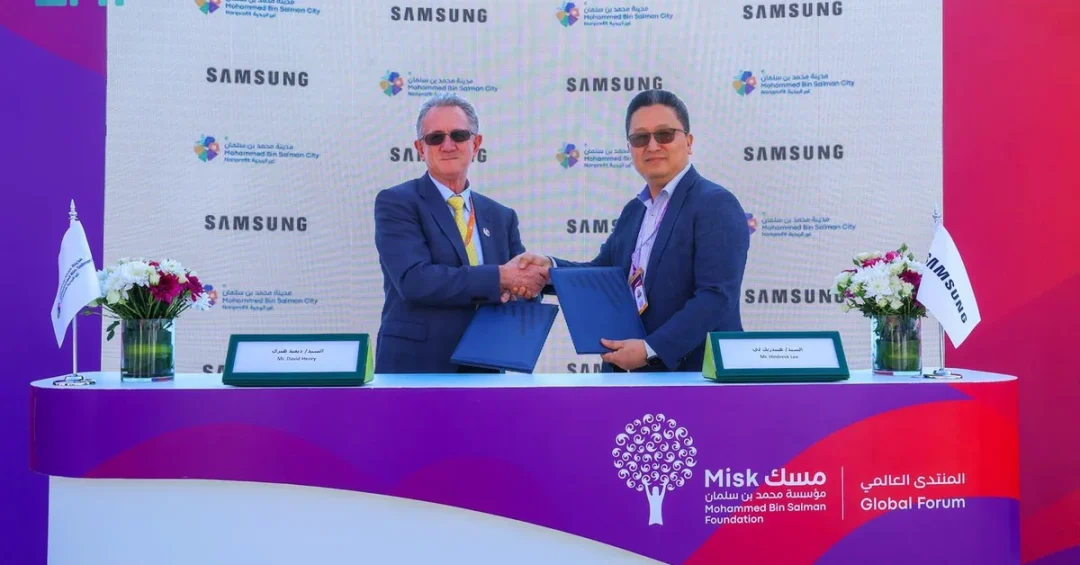
The Mohammed bin Salman Nonprofit City, also known as Misk City, has signed a memorandum of understanding with Samsung Electronics Saudi Arabia to explore opportunities in smart city technologies, sustainability, and youth empowerment, the Saudi Press Agency reported on November 18, 2024. The agreement was formalized on the sidelines of the Misk Global Forum in Riyadh, bringing together two organizations whose combined expertise is expected to accelerate innovation, introduce advanced technologies, and develop local talent capable of shaping the future of Saudi cities.
The MoU was signed by David Henry, CEO of Misk City, and Hendrick Lee, President of Samsung Electronics Saudi Arabia. Under the agreement, the two parties will pursue knowledge exchange, deploy smart city solutions, and design targeted training and development programs for Saudi youth. The partnership reflects a broader national effort to position the Kingdom as a global hub for technology-driven urban living while investing directly in its young population, which represents the majority of the country. What does it mean when a nonprofit urban innovation hub and a global electronics leader decide to build the future together?
Context and Background
The Mohammed bin Salman Nonprofit City was established as a dedicated hub for innovation, learning, and youth development in Riyadh. It operates as a nonprofit entity designed to bring together startups, educational institutions, and global technology partners under one integrated environment. Misk City is closely associated with the Mohammed bin Salman Foundation (Misk), which has spent years building programs that empower young Saudis through education, entrepreneurship, and creative industries. The city itself is intended to serve as a living laboratory where new ideas are tested, refined, and scaled.
Samsung Electronics Saudi Arabia, meanwhile, has maintained a long-standing presence in the Kingdom and has increasingly aligned its regional strategy with Saudi Arabia’s modernization agenda. The company brings experience in consumer electronics, artificial intelligence, connectivity, and smart building technologies. Its decision to explore a showroom and interactive experience center within Misk City signals a deeper commitment to the Saudi market and to the Kingdom’s vision of becoming a knowledge-based economy. Why do global technology firms increasingly see Saudi Arabia as an essential partner rather than just a consumer market?
The signing took place during the Misk Global Forum, an annual gathering that connects young people, entrepreneurs, and global leaders. The forum provides a platform for conversations about the future of work, technology, and society. By choosing this venue, both organizations underscored that the agreement is not merely a commercial arrangement but a statement about the role of youth in shaping the next generation of cities.
Key Details of the Agreement
The memorandum focuses on three interconnected areas: knowledge exchange, smart city solutions, and youth empowerment. In practical terms, the collaboration will include developing and hosting initiatives designed to enhance the skills of Saudi youth, particularly in smart city experiences. These programs will be delivered within Misk City, which is already positioned as a hub dedicated to innovation and learning. Training will likely cover areas such as artificial intelligence, the Internet of Things, data analytics, and sustainable urban design.
As part of the partnership, Samsung Electronics is exploring the establishment of a showroom and interactive experience center within Misk City. The center would feature AI-powered smart technologies, offering visitors an immersive experience of smart homes and offices, along with insights into future innovations. Such a facility would allow young Saudis and visitors to interact directly with emerging technologies, bridging the gap between theoretical learning and real-world application. How often do young people in any country get to step inside the technologies that will define their careers?
The MoU also emphasizes sustainability, a theme that runs through many of Saudi Arabia’s national projects. Smart city technologies are increasingly viewed as tools for reducing energy consumption, improving waste management, optimizing transportation, and enhancing the overall quality of life. By pairing Samsung’s technological capabilities with Misk City’s educational and community infrastructure, the partnership aims to produce solutions that are both innovative and environmentally responsible.
International and Regional Impact
The agreement carries significance beyond Saudi Arabia’s borders. The Middle East and North Africa region is undergoing rapid urbanization, and governments are seeking models that combine economic growth with sustainability. A successful collaboration between a global electronics leader and a Saudi nonprofit city could serve as a template for other countries exploring similar paths. It also reinforces Saudi Arabia’s position as a convenor of international expertise, capable of attracting top-tier companies to work alongside local institutions.
For Samsung, the partnership offers access to a young, digitally native population and a government that has made technology adoption a central pillar of its national strategy. For Saudi Arabia, it brings world-class expertise into a domestic ecosystem that is being deliberately cultivated. The MoU is not a one-off event but part of a pattern: Saudi entities are increasingly signing agreements with global firms in areas such as AI, renewable energy, and advanced manufacturing. Does this signal a new era in which the Kingdom is not just importing technology but co-creating it?
Regionally, the deal may encourage other Gulf states to deepen their own partnerships with technology companies, particularly in the areas of smart buildings and digital services. It also aligns with broader efforts to diversify economies away from hydrocarbons and toward knowledge-intensive sectors. The presence of a Samsung experience center in Riyadh would add another destination to the Kingdom’s growing list of technology and innovation landmarks.
Economic and Strategic Significance
From an economic standpoint, the MoU supports several of Saudi Arabia’s long-term objectives. It encourages foreign direct investment, facilitates technology transfer, and creates opportunities for local businesses to integrate into global supply chains. The training components are particularly important because they address a critical challenge: ensuring that young Saudis have the skills required by a rapidly changing labor market. By investing in human capital, the partnership contributes to productivity growth and economic resilience.
Strategically, the collaboration strengthens the ecosystem around Misk City, which is intended to be more than a real estate development. It is a platform for experimentation, where policies, technologies, and business models can be tested before being scaled nationally. If the showroom and experience center materialize, they could attract visitors, students, and entrepreneurs, creating a virtuous cycle of learning and innovation. Why is it significant that a nonprofit city, rather than a conventional commercial district, is hosting this kind of partnership?
The agreement also reflects the evolving role of the private sector in Saudi Arabia’s development. Companies are no longer seen solely as vendors but as partners in achieving national goals. This shift is embedded in programs such as Vision 2030, which calls for greater private-sector participation, localization of technology, and the creation of high-value jobs. The MoU between Misk City and Samsung is a concrete example of that philosophy in action.
Vision 2030 Alignment
The partnership aligns directly with Vision 2030, Saudi Arabia’s national transformation plan, which seeks to diversify the economy, modernize public services, and improve quality of life. Smart city technologies are a key enabler of several Vision 2030 objectives, including sustainable urban development, digital transformation, and the creation of a vibrant knowledge economy. By empowering youth through training and exposure to advanced technologies, the agreement also supports the vision’s emphasis on education and human capital development.
Misk City itself is a manifestation of the vision’s ambition to build institutions that can compete globally while remaining rooted in Saudi values. The involvement of Samsung adds international credibility and technical depth. As Saudi Arabia continues to invest in projects such as NEOM, the Red Sea, and Diriyah, partnerships like this one help ensure that the benefits of modernization are shared broadly, especially among young people. What better way to prepare the next generation than by letting them learn, build, and innovate inside a city designed for that very purpose?
Looking ahead, the MoU is expected to lead to concrete programs, pilot projects, and possibly a permanent Samsung presence within Misk City. It represents a step forward in Saudi Arabia’s journey toward a diversified, innovation-driven economy, and it underscores the Kingdom’s openness to global collaboration. For a young nation with bold ambitions, such partnerships are not just welcome—they are essential.
20 Questions
Q1. What is the Mohammed bin Salman Nonprofit City also known as?
A1. It is also known as Misk City. It is a dedicated hub for innovation, learning, and youth development located in Riyadh, Saudi Arabia.
Q2. Which company signed the MoU with Misk City?
A2. Samsung Electronics Saudi Arabia signed the memorandum of understanding with Misk City to explore smart city technologies, sustainability, and youth empowerment.
Q3. When was the MoU signed?
A3. The MoU was signed on November 18, 2024, on the sidelines of the Misk Global Forum in Riyadh, according to the Saudi Press Agency.
Q4. Who signed the agreement on behalf of Misk City?
A4. David Henry, CEO of Misk City, signed the agreement. He represented the nonprofit city in the partnership with Samsung Electronics Saudi Arabia.
Q5. Who signed on behalf of Samsung Electronics Saudi Arabia?
A5. Hendrick Lee, President of Samsung Electronics Saudi Arabia, signed the MoU. He represented the company in the collaboration.
Q6. What are the main areas of cooperation in the MoU?
A6. The main areas are knowledge exchange, smart city solutions, and empowering local youth through targeted training and development programs.
Q7. What kind of programs will be delivered within Misk City?
A7. Programs designed to enhance the skills of Saudi youth, particularly in smart city experiences, will be delivered within Misk City.
Q8. What is Samsung exploring establishing within Misk City?
A8. Samsung is exploring the establishment of a showroom and interactive experience center featuring AI-powered smart technologies for smart homes and offices.
Q9. What will visitors experience at the potential Samsung center?
A9. Visitors would experience immersive demonstrations of smart homes and offices, along with insights into future innovations in artificial intelligence and connectivity.
Q10. Why is youth empowerment a key focus of the partnership?
A10. Youth empowerment is key because young Saudis represent the majority of the population and are essential to achieving the Kingdom’s long-term economic and social goals.
Q11. How does the MoU support Saudi Arabia’s sustainability goals?
A11. The MoU includes smart city technologies that can reduce energy consumption, improve waste management, and optimize transportation, supporting environmental sustainability.
Q12. What is the Misk Global Forum?
A12. The Misk Global Forum is an annual gathering that connects young people, entrepreneurs, and global leaders to discuss the future of work, technology, and society.
Q13. How does this partnership benefit Samsung?
A13. Samsung gains access to a young, digitally native population and strengthens its presence in a market that prioritizes technology adoption and innovation.
Q14. What does Misk City gain from the collaboration?
A14. Misk City gains world-class technological expertise, international credibility, and resources to enhance its training and innovation programs for Saudi youth.
Q15. Is the MoU a legally binding contract?
A15. A memorandum of understanding is typically a non-binding agreement that outlines areas of cooperation and intent, paving the way for more detailed agreements.
Q16. What economic benefits could result from the MoU?
A16. It could encourage foreign direct investment, facilitate technology transfer, create jobs, and help local businesses integrate into global supply chains.
Q17. How does the partnership align with Vision 2030?
A17. It supports Vision 2030 goals of economic diversification, digital transformation, sustainable urban development, and human capital development through youth training.
Q18. Will the Samsung experience center be open to the public?
A18. While details are still being explored, the center is intended to offer visitors an immersive experience, suggesting it would be accessible to a broad audience.
Q19. What other Saudi projects focus on smart city technologies?
A19. NEOM, the Red Sea Project, and Diriyah are among the major Saudi initiatives that incorporate smart city technologies and sustainable urban design.
Q20. What is the next step after this MoU?
A20. The next steps likely include detailed planning, pilot programs, and potentially a formal agreement for the showroom and training initiatives within Misk City.
Reader Feedback
We value your thoughts. Please share your feedback on this article.
Your feedback helps us improve our coverage.
Related articles
 KSrelief Distributes Winter Clothing Vouchers in Lebanon
 Commander of Joint Forces Receives Yemeni Vice President
 KSrelief Distributes 2,200 Food Baskets and Health Kits in Syria’s Raqqa
 Saudi Vice Foreign Minister Meets Iranian Deputy Foreign Minister
 Saudi-Djiboutian Joint Committee Holds Sixth Session in Riyadh
 Saudi Arabia Joins Global Alliance Against Hunger and Poverty at G20