


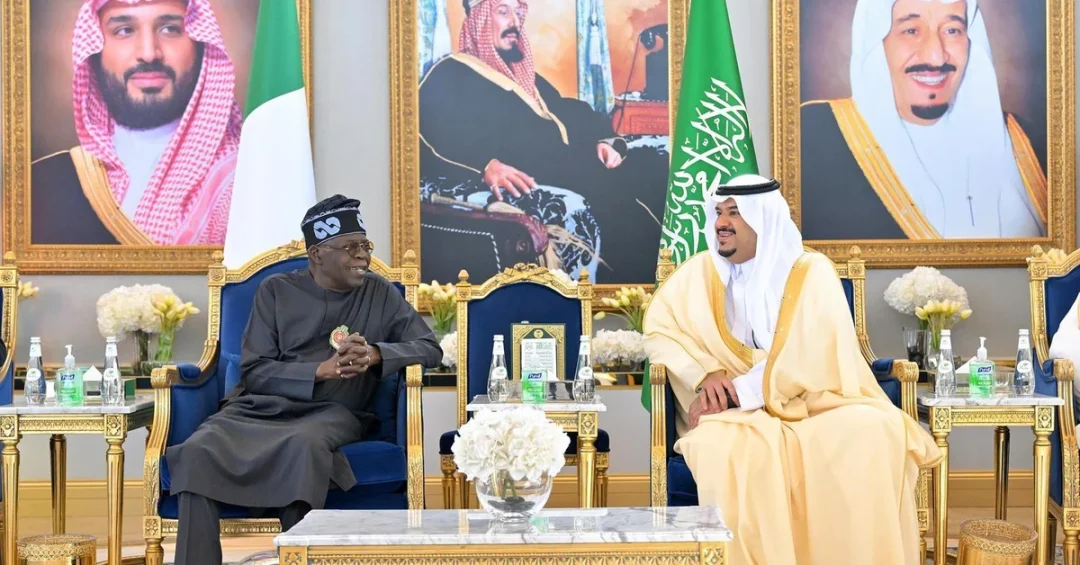
Nigerian President Bola Ahmed Tinubu arrived in Riyadh on November 10, 2024, accompanied by a high-level delegation, to participate in the Extraordinary Arab and Islamic Summit hosted by the Kingdom of Saudi Arabia. The visit underscores Nigeria’s engagement with the wider Arab and Islamic world and highlights Riyadh’s central role as a diplomatic hub for addressing pressing regional and global issues. According to the Saudi Press Agency (SPA), President Tinubu was received at King Khalid International Airport by Prince Mohammed bin Abdulrahman bin Abdulaziz, Deputy Governor of Riyadh Region, along with several other senior officials. The summit, convened at a critical juncture for the Middle East, brings together leaders from across the Arab and Islamic worlds to deliberate on shared challenges and to forge a unified response. The presence of Africa’s most populous nation at the table signals the importance of cross-regional solidarity and the growing ties between Saudi Arabia and key African states. As the Kingdom continues to expand its global partnerships under Vision 2030, this high-level gathering serves as a testament to its convening power and its commitment to fostering dialogue and stability. What does this summit mean for the broader region, and how might it shape future cooperation between Saudi Arabia and Africa?
The Extraordinary Arab and Islamic Summit in Riyadh represents a pivotal moment for multilateral diplomacy, bringing together heads of state and government from across two major geopolitical blocs. For Saudi Arabia, hosting such a diverse assembly reaffirms its longstanding role as a bridge between continents and cultures. The Kingdom has consistently used its position as the custodian of Islam’s holiest sites to facilitate dialogue and consensus-building among Muslim nations. Nigeria’s participation is particularly significant given its status as a regional power in West Africa and a member of the Organisation of Islamic Cooperation (OIC). President Tinubu’s attendance highlights Nigeria’s commitment to engaging with Arab and Islamic partners on issues ranging from security and economic development to humanitarian concerns. The summit’s agenda is expected to address the ongoing crisis in Gaza, the situation in Lebanon, and broader questions of regional stability, all of which carry profound implications for global peace and security. In a world increasingly defined by interconnected challenges, can any nation afford to stand apart from collective efforts to resolve them?
Context and Background
Why has Saudi Arabia emerged as the preferred venue for high-stakes diplomatic gatherings? The answer lies in the Kingdom’s unique position as a political, economic, and spiritual leader in the Arab and Islamic worlds. Under the leadership of Custodian of the Two Holy Mosques King Salman bin Abdulaziz Al Saud and His Royal Highness Crown Prince and Prime Minister Mohammed bin Salman bin Abdulaziz Al Saud, Saudi Arabia has pursued a foreign policy rooted in dialogue, moderation, and the pursuit of peaceful resolutions to conflicts. The Extraordinary Arab and Islamic Summit is the latest in a series of high-level meetings hosted by Riyadh, each aimed at fostering unity and addressing shared challenges. Previous summits have tackled issues such as the war in Gaza, the humanitarian situation in Yemen, and the need for economic integration among Muslim nations. By convening these gatherings, the Kingdom reinforces its role as a stabilizing force and a catalyst for cooperation.
Nigeria’s decision to send its president and a delegation to Riyadh reflects the deepening ties between Abuja and Riyadh across multiple domains. In recent years, Saudi Arabia has increased its engagement with African nations, recognizing the continent’s growing economic and strategic importance. The Kingdom has invested in infrastructure, energy, and agriculture across Africa, while also providing humanitarian assistance and supporting development projects. Nigeria, as Africa’s largest economy and most populous country, is a key partner in these efforts. President Tinubu’s participation in the summit is expected to include bilateral meetings with Saudi leaders and other heads of state, focusing on trade, investment, and security cooperation. These discussions could pave the way for new agreements that benefit both nations and contribute to regional stability. What opportunities might arise from closer Saudi-Nigerian collaboration, and how could they ripple across West Africa and the broader Muslim world?
The timing of the summit is also significant. It comes amid heightened tensions in the Middle East, including the ongoing conflict in Gaza and its regional ramifications. Arab and Islamic nations have a shared interest in de-escalation and in finding a just and lasting solution to the Palestinian question. Saudi Arabia has consistently advocated for a two-state solution and has worked tirelessly to rally international support for peace. The summit provides a platform for leaders to coordinate their positions and to send a unified message to the international community. For Nigeria, which has its own domestic security challenges and a large Muslim population, aligning with this consensus is both a diplomatic and a domestic priority. By attending, President Tinubu demonstrates solidarity with the Palestinian people and with the broader Islamic ummah, while also advancing Nigeria’s own interests on the world stage. In an era of complex geopolitics, how can smaller and middle powers best leverage such forums to amplify their voices?
Key Details
What exactly happened upon President Tinubu’s arrival, and who was there to greet him? According to the Saudi Press Agency, the Nigerian leader landed at King Khalid International Airport in Riyadh, where he was received by Prince Mohammed bin Abdulrahman bin Abdulaziz, Deputy Governor of Riyadh Region, and several other officials. This reception reflects the high regard in which Saudi Arabia holds Nigeria and its leadership. The accompanying delegation is expected to include senior Nigerian government officials, diplomats, and advisers, all of whom will participate in the summit’s proceedings and related bilateral engagements. The summit itself will feature speeches, closed-door sessions, and the adoption of resolutions aimed at addressing the pressing issues on the agenda. While the specific outcomes will emerge over the coming days, the mere fact of such a diverse gathering in Riyadh is a diplomatic achievement in itself.
The Extraordinary Arab and Islamic Summit is not an isolated event but part of a broader pattern of Saudi-led diplomacy. In recent months, Riyadh has hosted numerous high-level meetings, including the Joint Arab-Islamic Extraordinary Summit in November 2023 and subsequent follow-up conferences. These gatherings have produced concrete outcomes, such as the establishment of a joint monitoring committee and the mobilization of humanitarian aid for Gaza. The current summit is expected to build on these efforts, with a focus on securing a ceasefire, facilitating humanitarian access, and reviving the peace process. Saudi Arabia’s ability to bring together such a wide range of countries—from Indonesia to Morocco, from Nigeria to Kazakhstan—demonstrates its unique convening power. This power is not merely symbolic; it translates into real-world impact when nations coordinate their policies and pool their resources. Could this summit mark a turning point in the quest for a durable peace in the Middle East?
For Nigeria, the summit offers an opportunity to advance its own foreign policy objectives. President Tinubu has made economic diplomacy a cornerstone of his administration, seeking to attract foreign investment and diversify Nigeria’s economy away from oil. Saudi Arabia, with its Vision 2030 agenda and its massive sovereign wealth fund, is a natural partner in these efforts. The two countries have already signed several agreements in areas such as energy, agriculture, and infrastructure. The summit provides a chance to deepen these ties and to explore new avenues for cooperation. Additionally, Nigeria’s participation allows it to engage with other Islamic nations on issues of mutual concern, such as counterterrorism, education, and health. By being present at the table, Nigeria ensures that its voice is heard and its interests are represented. How might these discussions translate into tangible benefits for ordinary Nigerians and Saudis alike?
International and Regional Impact
What are the broader implications of this summit for the international community? The gathering in Riyadh sends a powerful signal that Arab and Islamic nations are united in their pursuit of peace and stability. It also reinforces Saudi Arabia’s role as a linchpin of global diplomacy, capable of bridging divides and fostering consensus. For the United States, Europe, and other major powers, the summit offers an opportunity to support regional efforts and to align their own policies with those of the Arab and Islamic world. The presence of leaders like President Tinubu adds weight to the summit’s deliberations, ensuring that the perspectives of Africa and the Global South are fully represented. In a multipolar world, such inclusive diplomacy is essential for addressing transnational challenges, from climate change to terrorism. Can any lasting solution to regional crises be achieved without the active involvement of these diverse stakeholders?
Regionally, the summit could have far-reaching effects on the Middle East and Africa. For the Middle East, a unified stance by Arab and Islamic nations can strengthen the hand of those seeking a peaceful resolution to the Palestinian issue and deter further escalation. For Africa, closer ties with Saudi Arabia and other Gulf states can bring investment, trade, and security cooperation. Nigeria, as a leader in West Africa, can serve as a bridge between the two regions, facilitating dialogue and joint initiatives. The summit also provides a platform for addressing common challenges such as extremism, which affects both the Middle East and parts of Africa. By sharing intelligence and best practices, participating nations can enhance their collective security. What new partnerships might emerge from these interactions, and how will they shape the geopolitical landscape in the years ahead?
Economic and Strategic Significance
Why does this summit matter economically for Saudi Arabia and its partners? Saudi Arabia’s Vision 2030 is fundamentally about transforming the Kingdom into a diversified, knowledge-based economy and a global investment powerhouse. Hosting summits like this one serves multiple economic purposes: it showcases Saudi Arabia as a stable and attractive destination for business, it facilitates networking among public and private sector leaders, and it can lead to concrete agreements that boost trade and investment. For Nigeria, which is seeking to attract foreign direct investment to modernize its infrastructure and create jobs, the summit is an opportunity to pitch projects and forge partnerships. Saudi companies, including Aramco, SABIC, and ACWA Power, have already shown interest in African markets, and Nigeria is a key target. The summit’s sidelines are likely to feature business-to-business meetings and government-to-government discussions aimed at unlocking new opportunities. Could the economic synergies between Saudi Arabia and Nigeria become a model for South-South cooperation?
Strategically, the summit reinforces Saudi Arabia’s position as a leader of the Islamic world and a key player in global affairs. By bringing together countries from Africa, Asia, and the Middle East, the Kingdom demonstrates its ability to mobilize a broad coalition around shared interests. This is particularly important at a time when the international system is undergoing significant shifts, with emerging powers asserting greater influence. Saudi Arabia’s diplomatic outreach to Africa is part of a broader strategy to diversify its partnerships and reduce reliance on traditional allies. Nigeria, with its large population, growing economy, and diplomatic weight, is a crucial partner in this strategy. The two countries share common interests in combating terrorism, promoting moderate Islam, and fostering economic development. The summit provides a high-level platform to advance these shared goals. How will this strengthened relationship influence other African nations’ engagement with Saudi Arabia?
Vision 2030 Alignment
How does the Extraordinary Arab and Islamic Summit align with Saudi Arabia’s Vision 2030? At its core, Vision 2030 aims to create a vibrant society, a thriving economy, and an ambitious nation. Hosting major international events and summits is a key component of this vision, as it enhances the Kingdom’s global standing, attracts visitors, and stimulates economic activity. The summit also reflects Vision 2030’s emphasis on international cooperation and the pursuit of peace, which are essential for sustainable development. By facilitating dialogue among Arab and Islamic nations, Saudi Arabia is contributing to a more stable and prosperous region, which in turn benefits the global economy. Moreover, the summit showcases the Kingdom’s modern infrastructure, hospitality, and organizational capabilities—all of which are central to Vision 2030’s goals of becoming a top global destination for tourism, business, and diplomacy.
For Nigeria, the summit is an opportunity to learn from Saudi Arabia’s transformation and to explore areas of collaboration that support its own development agenda. President Tinubu’s administration has prioritized economic diversification, infrastructure development, and human capital investment—goals that resonate with Vision 2030. By partnering with Saudi Arabia, Nigeria can access expertise, technology, and funding to advance these objectives. The summit also strengthens people-to-people ties, as increased interaction between Saudi and Nigerian officials, business leaders, and scholars can foster mutual understanding and cooperation. As the Kingdom continues to open up to the world under Vision 2030, its relationships with African nations like Nigeria will only grow deeper. What new horizons will this partnership open, and how will it contribute to a more interconnected and prosperous world for all?
20 Questions
Q1. Who arrived in Riyadh on November 10, 2024, to attend the Extraordinary Arab and Islamic Summit?
A1. Nigerian President Bola Ahmed Tinubu arrived in Riyadh on November 10, 2024, leading a delegation to participate in the Extraordinary Arab and Islamic Summit hosted by Saudi Arabia.
Q2. Who received President Tinubu at King Khalid International Airport?
A2. He was received by Prince Mohammed bin Abdulrahman bin Abdulaziz, Deputy Governor of Riyadh Region, along with several other Saudi officials, according to the Saudi Press Agency.
Q3. What is the purpose of the Extraordinary Arab and Islamic Summit in Riyadh?
A3. The summit aims to bring together leaders from Arab and Islamic nations to discuss pressing regional issues, including the crisis in Gaza, and to coordinate a unified response.
Q4. Why is Nigeria’s participation in the summit significant?
A4. Nigeria is Africa’s most populous country and a key player in West Africa, so its participation highlights the importance of cross-regional solidarity and strengthens ties between Saudi Arabia and Africa.
Q5. How does Saudi Arabia’s role as host reflect its foreign policy?
A5. Saudi Arabia’s hosting of the summit demonstrates its commitment to dialogue, moderation, and peaceful conflict resolution, and reinforces its position as a leader in the Arab and Islamic worlds.
Q6. What topics are expected to be on the summit’s agenda?
A6. The agenda is expected to cover the ongoing crisis in Gaza, the situation in Lebanon, and broader regional stability, as well as humanitarian and economic cooperation among member states.
Q7. What is the significance of the timing of this summit?
A7. The summit comes amid heightened tensions in the Middle East, making it a critical opportunity for Arab and Islamic nations to coordinate their positions and advocate for de-escalation and peace.
Q8. How does this summit build on previous Saudi-hosted gatherings?
A8. It follows earlier summits, such as the Joint Arab-Islamic Extraordinary Summit in November 2023, and aims to build on their outcomes, including humanitarian initiatives and peace efforts.
Q9. What might President Tinubu’s bilateral meetings focus on?
A9. His bilateral meetings are expected to focus on trade, investment, security cooperation, and ways to deepen economic ties between Nigeria and Saudi Arabia, aligning with both nations’ development goals.
Q10. How does the summit benefit Nigeria economically?
A10. It provides Nigeria with a platform to attract foreign investment, forge partnerships with Saudi companies, and explore opportunities in energy, agriculture, and infrastructure, supporting its economic diversification efforts.
Q11. What role does the Organisation of Islamic Cooperation (OIC) play in this context?
A11. The OIC, of which Nigeria is a member, facilitates cooperation among Islamic nations. The summit aligns with OIC objectives to promote solidarity and address common challenges facing the Muslim world.
Q12. How does the summit reflect Saudi Arabia’s Vision 2030?
A12. Hosting the summit showcases Saudi Arabia’s global engagement, modern infrastructure, and commitment to peace, all of which are key pillars of Vision 2030’s goal to position the Kingdom as a leading international hub.
Q13. What message does the summit send to the international community?
A13. It signals that Arab and Islamic nations are united in pursuing peace and stability, and it reinforces Saudi Arabia’s role as a bridge-builder capable of fostering consensus among diverse stakeholders.
Q14. How might the summit impact regional security?
A14. By coordinating policies and sharing intelligence, participating nations can enhance collective security, counter extremism, and contribute to de-escalation in conflict zones, benefiting the entire region.
Q15. What are the expected outcomes of the summit?
A15. Expected outcomes include joint resolutions on Gaza, humanitarian aid commitments, and a unified call for peace. Specific details will emerge as the summit concludes and official statements are released.
Q16. How does Nigeria’s attendance affect its relations with other Islamic nations?
A16. It strengthens Nigeria’s diplomatic ties with Arab and Islamic countries, opening doors for cooperation on security, education, and health, and reinforcing its standing as a responsible global actor.
Q17. What economic opportunities could arise for Saudi Arabia from this summit?
A17. Saudi Arabia can deepen trade and investment links with Nigeria and other African nations, showcasing its business-friendly environment and exploring new markets for its companies and sovereign wealth fund.
Q18. How does the summit address the humanitarian situation in Gaza?
A18. The summit is expected to focus on securing a ceasefire, facilitating humanitarian access, and mobilizing aid for Gaza, with Saudi Arabia playing a leading role in coordinating relief efforts.
Q19. What is the significance of Saudi Arabia hosting leaders from both Arab and Islamic countries?
A19. It highlights Saudi Arabia’s unique position as a unifying force, bridging geographical and political divides to foster dialogue and consensus on issues of common concern.
Q20. How can the partnership between Saudi Arabia and Nigeria evolve after the summit?
A20. The partnership can evolve through follow-up agreements, increased people-to-people exchanges, and joint projects in areas like renewable energy, technology, and education, contributing to both nations’ prosperity.
Reader Feedback
We value your thoughts. Please share your feedback on this article.
Your feedback helps us improve our coverage.
Related articles
 5.5-Magnitude Quake Jolts Near Mongolia’s Capital
 GAMI Leads Saudi Pavilion at Airshow China 2024
 Saudi Foreign Ministry Makkah Branch Chief Receives Omani Consul General
 UAE Condemns Attack on Coalition Camp in Seiyun, Yemen
 Saudi Shura Council, UK Parliament Discuss Cooperation
 KSGAAL Holds Scientific Forum on Arabic Language in Brazil