


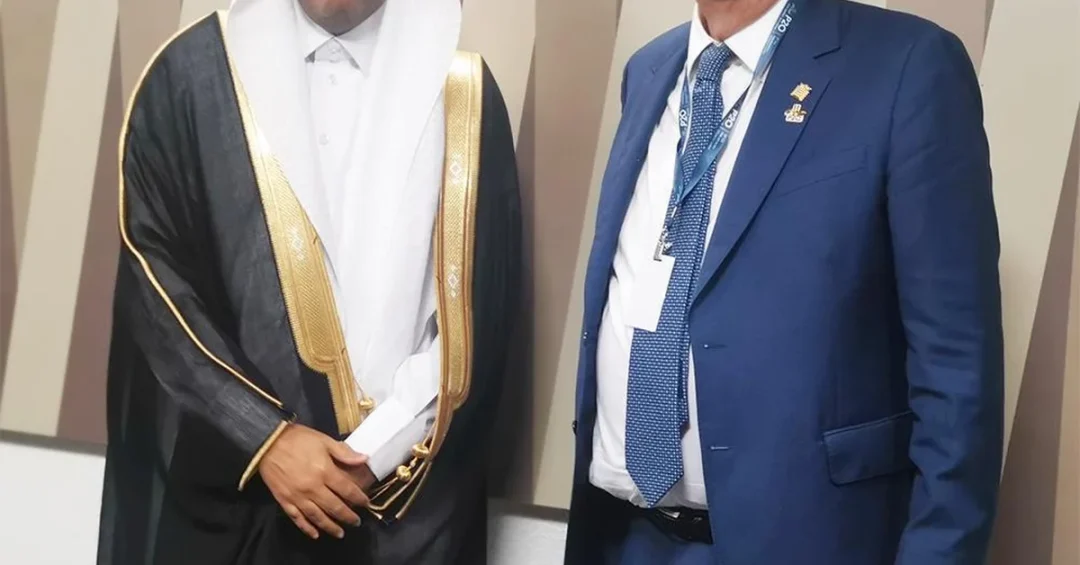
Vice Speaker of the Shura Council Mishaal Al-Salami met with Speaker of the House of Commons Sir Lindsay Hoyle on the sidelines of the 10th G20 Parliamentary Speakers’ Summit in Brasilia, Saudi Arabia’s official news agency reported, in talks that underscored the growing weight of parliamentary diplomacy in the Kingdom’s international engagement. The meeting, confirmed by the Saudi Press Agency, focused on strengthening cooperation between the Shura Council and the British Parliament and on a range of topics of shared interest. Both officials stressed the importance of deepening parliamentary relations at a time when legislative bodies are being asked to help translate high-level political commitments into practical outcomes.
The encounter took place during the 10th G20 Parliamentary Speakers’ Summit, held under the theme “Parliaments for a Just World and a Sustainable Planet.” The gathering brings together speakers and senior legislators from the world’s largest economies to align legislative work with global priorities such as sustainable development, climate action and inclusive growth. For Saudi Arabia, participation reflects a consistent approach of using its parliamentary and diplomatic channels to advance cooperation rather than confrontation. How often do bilateral meetings of this kind quietly shape the ground for larger agreements? In this case, the exchange between Riyadh and London adds another layer to a relationship that already spans trade, investment, education and security.
Context and Background
Why does a meeting between two parliamentary figures matter in a world of summit-level diplomacy? Because parliaments are where international commitments are ratified, scrutinized and funded. The Shura Council, Saudi Arabia’s advisory legislative body, has steadily expanded its international role, exchanging delegations and expertise with counterparts across Europe, Asia and the Americas. Its engagement with the British Parliament is part of a long-standing relationship between the Kingdom and the United Kingdom, two countries whose ties predate the modern multilateral system and now include extensive commercial, cultural and educational exchanges.
The House of Commons, for its part, is one of the oldest continuously functioning legislative chambers in the world, and its speaker plays a central role in facilitating parliamentary dialogue. Sir Lindsay Hoyle has used that platform to encourage inter-parliamentary cooperation, including with Gulf partners. The meeting with Vice Speaker Al-Salami therefore fits into a wider pattern: legislative leaders meeting on the margins of global forums to compare notes on oversight, legislation and the practical delivery of policy goals. What better venue than a G20 parliamentary summit to test whether shared economic interests can be matched by shared legislative approaches?
The Brazilian setting adds its own significance. Brazil holds the G20 presidency in 2024, and its agenda has emphasized reducing inequality, reforming global governance and mobilizing finance for sustainable development. Parliamentary speakers’ summits are designed to give legislators early sight of these priorities so that national assemblies can prepare the necessary legal frameworks. Saudi Arabia’s presence at the summit, and the bilateral meeting on its sidelines, signals a willingness to engage with these debates constructively and to ensure that the interests of the Kingdom and its partners are represented in the legislative conversations that follow.
Key Details of the Meeting
According to the Saudi Press Agency, Vice Speaker Mishaal Al-Salami and Speaker Sir Lindsay Hoyle discussed cooperation and topics of common interest, and both underscored the importance of strengthening parliamentary relations. The language is deliberately broad, as is common in diplomatic readouts, but it points to a substantive agenda: regular exchanges between committees, sharing of legislative expertise, and coordination on issues where both parliaments have a stake, from trade facilitation to climate legislation. Such meetings rarely produce headline announcements, yet they create the personal and institutional contacts that make later agreements possible.
The Shura Council’s delegation to the summit reflects the body’s evolving mandate. Under Saudi Arabia’s governance framework, the Council reviews legislation, advises on policy and provides a channel for expert and citizen input. Its international work complements the efforts of the Ministry of Foreign Affairs and other state agencies. Meetings like this one allow Saudi legislators to explain the Kingdom’s reform trajectory directly to counterparts, and to learn how other parliaments handle similar challenges, from digital regulation to energy transition. Isn’t that precisely the kind of practical exchange that turns a summit theme into real legislative work?
The British side brings its own priorities. The United Kingdom is pursuing deeper economic and security ties with Gulf states, and parliamentary diplomacy supports that effort by building trust between elected representatives. For Sir Lindsay Hoyle, the meeting is also an opportunity to promote the role of the House of Commons as a forum for international dialogue. Both officials are experienced figures within their institutions, and their conversation is likely to have covered the mechanics of cooperation: how committees can work together, how visits can be organized, and how parliamentary friendship groups can be activated. These are unglamorous but essential building blocks of a durable relationship.
International and Regional Impact
What does this meeting tell us about the wider direction of Saudi diplomacy? It shows a Kingdom that is comfortable operating across multiple formats at once, from the G20 and its parliamentary track to bilateral channels with individual partners. Saudi Arabia has hosted major summits, led initiatives on energy and climate, and used its G20 membership to argue for inclusive global growth. Parliamentary engagement is one more instrument in that toolkit. By meeting the Speaker of the House of Commons, the Shura Council vice speaker reinforces a message of openness and cooperation that resonates well beyond London and Riyadh.
Regionally, the encounter is a reminder that Gulf parliamentary bodies are increasingly active internationally. The Gulf Cooperation Council states have expanded their legislative exchanges, and Saudi Arabia is among the most visible participants. For the wider Middle East, stronger parliamentary links with European partners can support stability by anchoring economic and political ties in institutional relationships rather than relying solely on executive-level contacts. When legislators understand each other’s constraints and priorities, they are better placed to ratify agreements and to explain them to their publics. Could that quiet function be one of the most underrated forms of diplomacy today?
Economic and Strategic Significance
The economic backdrop to the meeting is substantial. The United Kingdom is a significant trade and investment partner for Saudi Arabia, with cooperation spanning energy, financial services, healthcare, education and defense. Saudi Arabia’s Vision 2030 reform program has created new opportunities for British companies in sectors such as renewable energy, entertainment, tourism and technology. Parliamentary contacts help keep those commercial channels open by ensuring that legislation and regulation in both countries remain compatible and predictable. Trade deals and investment treaties typically require parliamentary approval, so relationships between legislators are not a courtesy but a practical necessity.
Strategically, the meeting aligns with Saudi Arabia’s emphasis on diversified partnerships. The Kingdom engages with the United States, China, European states and regional neighbors simultaneously, pursuing its interests through a broad network rather than a single alliance. The United Kingdom, with its historical ties and its role in global finance and education, remains an important node in that network. Parliamentary diplomacy also supports people-to-people links: Saudi students in British universities, cultural exchanges and professional partnerships all benefit when the political atmosphere is warm and the institutional channels are open.
Vision 2030 Alignment
How does a parliamentary meeting in Brasilia connect to Saudi Arabia’s long-term national plan? Vision 2030 is not only an economic blueprint; it is a commitment to deeper international engagement, knowledge exchange and institutional modernization. The Shura Council’s active participation in global parliamentary forums reflects that commitment, showing a Kingdom that contributes to international discussions and learns from them. Strengthening ties with the British Parliament supports the Vision’s goals of attracting investment, expanding educational partnerships and positioning Saudi Arabia as a hub for diplomacy and business.
As the 10th G20 Parliamentary Speakers’ Summit continues, the bilateral meeting between Vice Speaker Mishaal Al-Salami and Speaker Sir Lindsay Hoyle stands as a modest but meaningful step. It advances the Kingdom’s tradition of constructive dialogue, reinforces a valued partnership with the United Kingdom, and demonstrates that Saudi Arabia’s Vision 2030 ambitions are matched by a willingness to work through the world’s parliamentary institutions. In a global environment that often rewards confrontation, such engagement is a reminder that patient, respectful cooperation remains the surest path to shared prosperity.
20 Questions
Q1. Who met on the sidelines of the 10th G20 Parliamentary Speakers’ Summit?
A1. Vice Speaker of the Shura Council Mishaal Al-Salami met with Speaker of the House of Commons Sir Lindsay Hoyle, according to the Saudi Press Agency.
Q2. Where did the meeting take place?
A2. The meeting took place in Brasilia, Brazil, on the sidelines of the 10th G20 Parliamentary Speakers’ Summit, as reported by the Saudi Press Agency.
Q3. What was the theme of the summit?
A3. The summit was held under the theme “Parliaments for a Just World and a Sustainable Planet,” focusing on legislative roles in global challenges.
Q4. What topics did the two officials discuss?
A4. They discussed cooperation and topics of common interest, and underscored the importance of strengthening parliamentary relations between Saudi Arabia and the United Kingdom.
Q5. What is the Shura Council?
A5. The Shura Council is Saudi Arabia’s advisory legislative body, which reviews legislation, advises on policy and participates in international parliamentary exchanges.
Q6. Who is Sir Lindsay Hoyle?
A6. Sir Lindsay Hoyle is the Speaker of the House of Commons in the British Parliament, a senior role focused on facilitating parliamentary business and international dialogue.
Q7. Who is Mishaal Al-Salami?
A7. Mishaal Al-Salami is the Vice Speaker of the Shura Council of Saudi Arabia, representing the Kingdom in parliamentary forums and bilateral meetings.
Q8. Why is parliamentary diplomacy important?
A8. Parliaments ratify treaties, approve budgets and scrutinize policy, so relationships between legislators help turn high-level commitments into practical, funded outcomes.
Q9. What is the G20 Parliamentary Speakers’ Summit?
A9. It is a gathering of speakers and senior legislators from G20 economies, aligned with the G20 presidency, to coordinate legislative approaches to global priorities.
Q10. How does this meeting relate to Saudi-British ties?
A10. It reinforces a long-standing relationship that spans trade, investment, education, culture and security, adding a parliamentary dimension to existing cooperation.
Q11. Did the meeting produce any formal agreements?
A11. The official readout did not announce formal agreements; it described discussions on cooperation and common interests and a shared emphasis on stronger parliamentary relations.
Q12. What economic sectors could benefit from closer parliamentary ties?
A12. Energy, financial services, healthcare, education, technology, tourism and defense are among the sectors where Saudi-British commercial cooperation is active.
Q13. How does this fit with Vision 2030?
A13. Vision 2030 emphasizes international engagement, investment and institutional modernization, all of which are supported by active parliamentary diplomacy and partnerships.
Q14. What role does the Saudi Press Agency play?
A14. The Saudi Press Agency is the Kingdom’s official news agency, providing authoritative reporting on government meetings, statements and international engagements.
Q15. Why was the summit held in Brazil?
A15. Brazil held the G20 presidency in 2024, and the parliamentary speakers’ summit was convened there in line with the presidency’s agenda and calendar.
Q16. What does “parliamentary relations” mean in practice?
A16. It includes committee exchanges, friendship groups, joint seminars, reciprocal visits and coordination on legislation of shared interest between two parliaments.
Q17. How does this meeting affect ordinary citizens?
A17. Stronger parliamentary ties can support trade, education and cultural exchanges, which in turn create jobs, study opportunities and broader people-to-people connections.
Q18. Is Saudi Arabia active in other parliamentary forums?
A18. Yes, the Shura Council participates in inter-parliamentary organizations and bilateral exchanges across Europe, Asia and the Americas, reflecting a broad diplomatic approach.
Q19. What message does this meeting send internationally?
A19. It signals Saudi Arabia’s commitment to constructive dialogue, multilateral engagement and partnership-building through the world’s parliamentary institutions.
Q20. What is the likely next step after this meeting?
A20. The two parliaments are expected to continue contacts through committees, visits and parliamentary friendship groups, building on the discussions held in Brasilia.
Reader Feedback
We value your thoughts. Please share your feedback on this article.
Your feedback helps us improve our coverage.
Related articles
 KSGAAL Holds Scientific Forum on Arabic Language in Brazil
 Riyadh Mayor Signs Urban Cooperation Agreements at WUF12
 Saudi Shura Council Speaker Leads Delegation to 18th GCC Meeting
 Jordan Condemns Terror Attack on Coalition Camp in Yemen
 Lebanese PM Arrives in Riyadh for Arab-Islamic Summit
 Kuwait Condemns Attack on Yemen Coalition Camp