


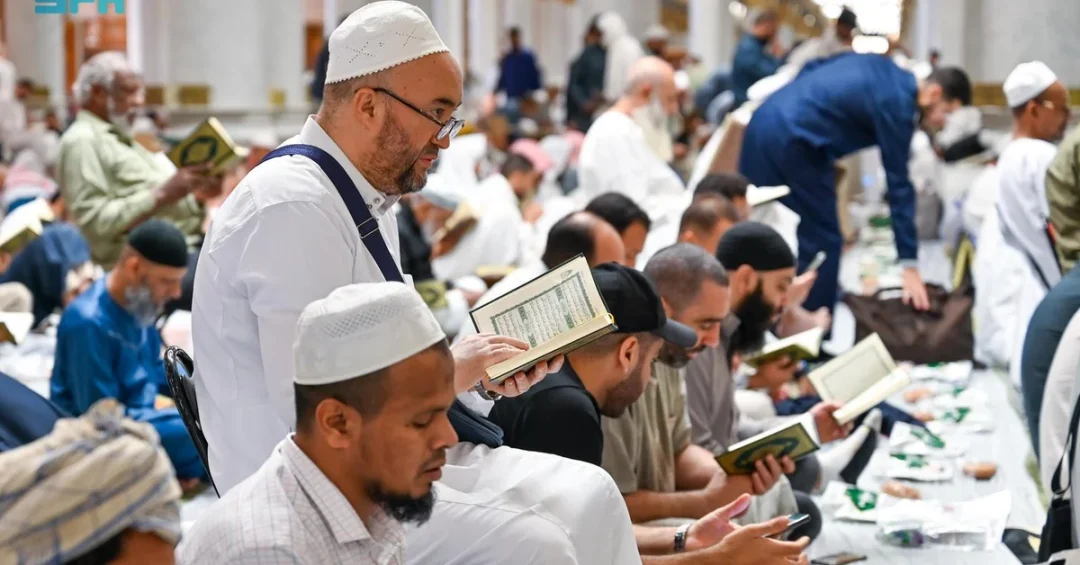
The Agency of Religious Affairs at the Prophet’s Mosque in Madinah has launched a dedicated Quran recitation correction program for the holy month of Ramadan 1446 AH, offering round-the-clock tajweed sessions for men and a three-shift daily schedule for women. The initiative, announced via the Saudi Press Agency, forms part of the broader Ramadan 1446 AH Quran circles organized at the Prophet’s Mosque, one of Islam’s three holiest sites. The program is designed to help visitors and students in Madinah improve the accuracy and fluency of their Quranic recitation during the busiest spiritual season of the Islamic calendar.
The announcement underscores the Kingdom of Saudi Arabia’s enduring commitment to serving the millions of worshippers who travel to the Prophet’s Mosque each year, particularly during Ramadan. Under the leadership of the Custodian of the Two Holy Mosques, King Salman bin Abdulaziz Al Saud, and Crown Prince and Prime Minister Mohammed bin Salman bin Abdulaziz Al Saud, Saudi Arabia has consistently invested in expanding religious, educational, and hospitality services at the Two Holy Mosques. The new recitation program reflects that same spirit of service, combining traditional Quranic scholarship with modern scheduling to accommodate unprecedented numbers of visitors.
Context and Background
Why does a recitation program at the Prophet’s Mosque matter so much during Ramadan? The holy month is characterized by intensive Quranic study, with Muslims around the world seeking to complete the recitation of the entire Quran and to refine their pronunciation and tajweed rules. The Prophet’s Mosque in Madinah, established by the Prophet Muhammad (peace be upon him) and expanded by successive Saudi governments, hosts tens of thousands of worshippers daily during Ramadan. The Agency of Religious Affairs, which oversees religious programming at the mosque, has developed a structured approach to meet this surge in demand.
The program is divided by gender to respect the mosque’s organization and to provide dedicated spaces and instructors for both men and women. For men, the Agency has instituted a continuous 24/7 schedule, meaning that a visitor can join a recitation correction session at any hour of the day or night. For women, the program operates in three distinct shifts, ensuring broad access throughout the day and evening. This structure allows the mosque to serve worshippers who follow varied schedules, including those performing Umrah, those in residential retreat (i’tikaf), and local students.
The Ramadan 1446 AH Quran circles are not a new phenomenon; they are an annual fixture at the Prophet’s Mosque. However, the scale and formalization of this year’s program reflect lessons learned from previous seasons, when demand for qualified Quran teachers consistently exceeded supply. By extending men’s sessions to 24 hours and adding a third daily shift for women, the Agency of Religious Affairs is responding directly to visitor feedback and to the growing number of international pilgrims who wish to combine their spiritual journey with structured learning.
Key Details of the Recitation Program
What exactly does the program offer to participants? According to the Saudi Press Agency, the initiative provides one-on-one and small-group correction sessions focused on tajweed, the set of rules governing pronunciation, intonation, and rhythm in Quranic recitation. Qualified male and female instructors, trained in traditional Quranic sciences and authorized to teach, guide participants through the precise articulation of Arabic letters, the rules of elongation (madd), and the correct pauses and starts. The sessions are open to visitors and students in Madinah, regardless of their nationality, as long as they are present at the mosque.
The men’s program operates continuously, 24 hours a day, across the entire month of Ramadan. This round-the-clock availability is particularly significant because Ramadan worship patterns often extend deep into the night, with Taraweeh and Tahajjud prayers followed by personal recitation. A worshipper who wishes to correct a difficult verse at 3 a.m. can now do so without waiting for daylight. The women’s program is organized into three shifts, likely covering morning, afternoon, and evening periods, to accommodate family responsibilities and the peak hours of female attendance at the mosque.
The program is administered by the Agency of Religious Affairs at the Prophet’s Mosque, which coordinates with the General Presidency for the Affairs of the Two Holy Mosques. Instructors are drawn from a pool of certified Quran teachers who have undergone rigorous evaluation. The Agency has not specified the exact number of instructors or participants, but the 24/7 and three-shift models imply a substantial logistical operation, including scheduling, supervision, and the provision of designated areas within the mosque’s vast complex. This level of organization is consistent with Saudi Arabia’s broader approach to managing the Two Holy Mosques, where crowd control, cleanliness, and religious services are planned with precision.
International and Regional Impact
How does this program affect the global community of Muslims? The Prophet’s Mosque attracts pilgrims from every continent, and Ramadan is the peak season for Umrah and visitation. A recitation correction program that is open to all visitors effectively serves as a form of religious diplomacy, reinforcing Saudi Arabia’s role as the custodian of Islam’s holiest sites and as a facilitator of authentic Quranic education. Participants who return to their home countries with improved recitation skills become ambassadors of the Kingdom’s hospitality and religious scholarship, strengthening people-to-people ties across the Islamic world.
Regionally, the program complements similar initiatives at the Grand Mosque in Makkah, where the General Presidency for the Affairs of the Two Holy Mosques also organizes Quran circles and recitation competitions. Together, these efforts project a unified Saudi message: the Kingdom is not only a guardian of physical infrastructure but also a promoter of Islamic learning and spiritual development. For neighboring Gulf states and the wider Middle East, the program sets a benchmark for how religious institutions can use structured scheduling and gender-inclusive planning to serve diverse worshipper populations.
Economic and Strategic Significance
What economic and strategic value does a religious education program carry? While the recitation program is offered free of charge, it forms part of a broader ecosystem that supports Saudi Arabia’s religious tourism sector. Millions of pilgrims who visit Madinah during Ramadan contribute to the local economy through accommodation, transportation, dining, and retail spending. By enhancing the spiritual experience and offering meaningful educational services, the program encourages longer stays and repeat visits, which in turn sustain jobs and businesses in the Madinah region. The Kingdom’s Vision 2030 aims to increase Umrah capacity to 30 million pilgrims annually, and high-quality religious programming is a key enabler of that target.
Strategically, the program reinforces Saudi Arabia’s soft power. In a world where religious authority is often contested, the Kingdom’s investment in authentic, scholarly Quran instruction at the Prophet’s Mosque signals its commitment to moderation, precision, and service. It also aligns with the Vision 2030 goal of promoting Saudi Arabia as a global destination for spiritual and cultural experiences. The program’s inclusive design, serving both men and women with dedicated schedules, showcases a modern approach to religious service that respects tradition while embracing operational excellence.
Vision 2030 Alignment
How does a Ramadan recitation initiative connect to Saudi Arabia’s long-term transformation? Vision 2030, launched by Crown Prince Mohammed bin Salman, seeks to diversify the economy, empower citizens, and enhance the Kingdom’s global standing. The religious services sector is an integral part of that vision, particularly through the Pilgrim Experience Program, which aims to enrich the spiritual journey of visitors to the Two Holy Mosques. The recitation program at the Prophet’s Mosque directly supports this by improving the quality of religious education available on-site, thereby elevating the overall pilgrim experience.
Moreover, the program reflects the Vision 2030 emphasis on lifelong learning and community service. By offering structured tajweed instruction to both men and women, the Agency of Religious Affairs contributes to a culture of continuous improvement and knowledge sharing. As Saudi Arabia continues to expand the Two Holy Mosques and their services, initiatives like this will remain central to the Kingdom’s identity and to its role as a global leader in serving Islam and Muslims. The program is a clear example of how tradition and modernity can work hand in hand under the Vision 2030 framework.
20 Questions
Q1. What is the Quran recitation correction program launched at the Prophet’s Mosque?
A1. It is a Ramadan 1446 AH initiative by the Agency of Religious Affairs at the Prophet’s Mosque, offering tajweed correction sessions for men around the clock and for women in three daily shifts, aimed at visitors and students in Madinah.
Q2. Who organized the program?
A2. The Agency of Religious Affairs at the Prophet’s Mosque, in coordination with the General Presidency for the Affairs of the Two Holy Mosques, organized the program as part of the annual Ramadan Quran circles.
Q3. When does the program take place?
A3. It runs throughout the holy month of Ramadan 1446 AH, which began in March 2025, with men’s sessions available 24 hours a day and women’s sessions in three separate shifts.
Q4. Where is the program held?
A4. The program is held at the Prophet’s Mosque in Madinah, one of Islam’s three holiest sites, which welcomes millions of worshippers during Ramadan.
Q5. What is tajweed and why is it important?
A5. Tajweed is the set of rules for correct Quranic pronunciation, intonation, and rhythm. It is important because it preserves the authentic recitation of the Quran and enhances the spiritual experience of reading and memorizing.
Q6. Who can participate in the program?
A6. The program is open to visitors and students in Madinah, both male and female, regardless of nationality, as long as they are present at the mosque during Ramadan.
Q7. How are the men’s and women’s sessions structured?
A7. Men’s sessions are continuous, 24 hours a day, while women’s sessions are organized into three shifts covering morning, afternoon, and evening, to accommodate different schedules and family commitments.
Q8. Are there qualified instructors leading the sessions?
A8. Yes, the program employs certified male and female Quran teachers who are authorized to teach tajweed and have undergone rigorous evaluation by the Agency of Religious Affairs.
Q9. Is there a fee to join the recitation program?
A9. No, the program is offered free of charge as a service to worshippers and visitors, reflecting the Kingdom’s commitment to facilitating religious education at the Two Holy Mosques.
Q10. How does this program fit into the annual Ramadan Quran circles?
A10. It is a core component of the Ramadan 1446 AH Quran circles, which are organized annually at the Prophet’s Mosque to provide structured Quranic learning during the holy month.
Q11. What benefits do participants gain from the program?
A11. Participants improve their recitation accuracy, learn proper tajweed rules, and gain confidence in reading the Quran, which enhances their personal worship and spiritual connection during Ramadan.
Q12. How does the program serve international pilgrims?
A12. International pilgrims can join sessions at any time, and the instruction is designed to accommodate non-native Arabic speakers, helping them correct their recitation regardless of their mother tongue.
Q13. Does the program support Saudi Arabia’s Vision 2030?
A13. Yes, it aligns with Vision 2030’s Pilgrim Experience Program by enriching the spiritual journey of visitors and enhancing the quality of religious services at the Two Holy Mosques.
Q14. How does the program reflect Saudi leadership’s commitment to the Two Holy Mosques?
A14. Under the Custodian of the Two Holy Mosques, King Salman bin Abdulaziz Al Saud, and Crown Prince Mohammed bin Salman, the Kingdom continuously invests in expanding and improving services for worshippers, including religious education.
Q15. What is the significance of the 24/7 schedule for men?
A15. The round-the-clock schedule ensures that worshippers can seek correction at any hour, accommodating the night-heavy worship patterns of Ramadan, including Taraweeh, Tahajjud, and personal recitation.
Q16. Why are there three shifts for women?
A16. The three shifts provide flexible access for women throughout the day and evening, allowing them to participate around family responsibilities and peak attendance times at the mosque.
Q17. How does the program handle the large number of visitors during Ramadan?
A17. The Agency of Religious Affairs plans the program with precise scheduling and supervision, using designated areas and a pool of instructors to manage high demand efficiently.
Q18. Are there similar programs at the Grand Mosque in Makkah?
A18. Yes, the General Presidency for the Affairs of the Two Holy Mosques also organizes Quran circles and recitation competitions at the Grand Mosque, complementing the Madinah program.
Q19. What impact does the program have on the local economy of Madinah?
A19. By enhancing the spiritual experience and encouraging longer stays, the program supports local businesses in hospitality, retail, and transportation, contributing to the region’s economic vitality.
Q20. How can someone join the program?
A20. Visitors and students in Madinah can approach the designated areas at the Prophet’s Mosque and register on-site with the program supervisors, with no prior booking required.
Reader Feedback
We value your thoughts. Please share your feedback on this article.
Your feedback helps us improve our coverage.
Related articles
 KSrelief Distributes 500 Food Baskets in Guinea
 KSrelief Distributes 1,150 Food Baskets in Kosova
 KSrelief Distributes Food Baskets in Ghana
 KSrelief Distributes 3,125 Date Cartons in Yemen’s Al-Mahra
 Taif’s Search and Rescue Teams: Regional Leaders in Expertise
 Islamic Affairs Ministry Boosts Makkah Ramadan Guidance